Rotors Over a Trap-Lined Valley
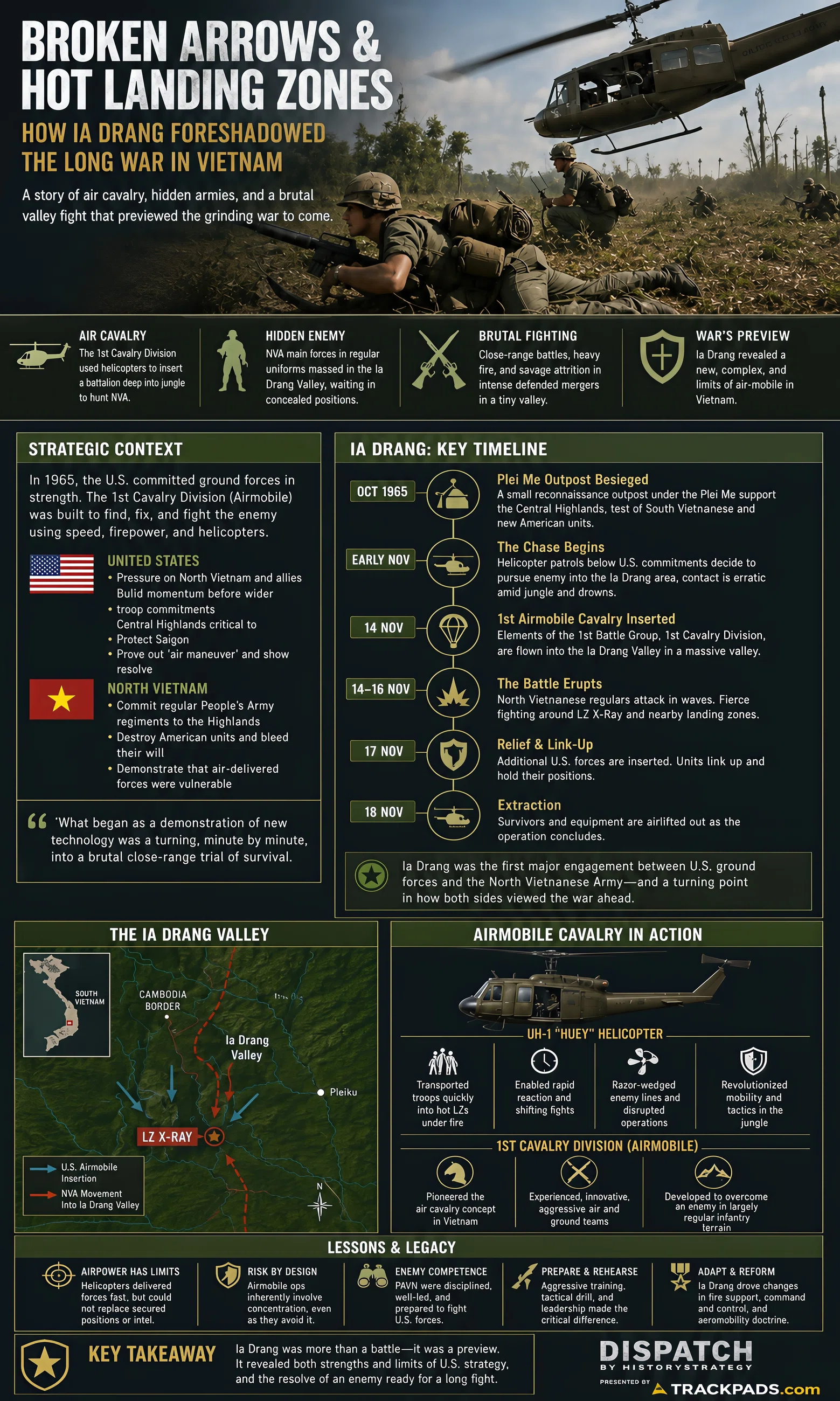
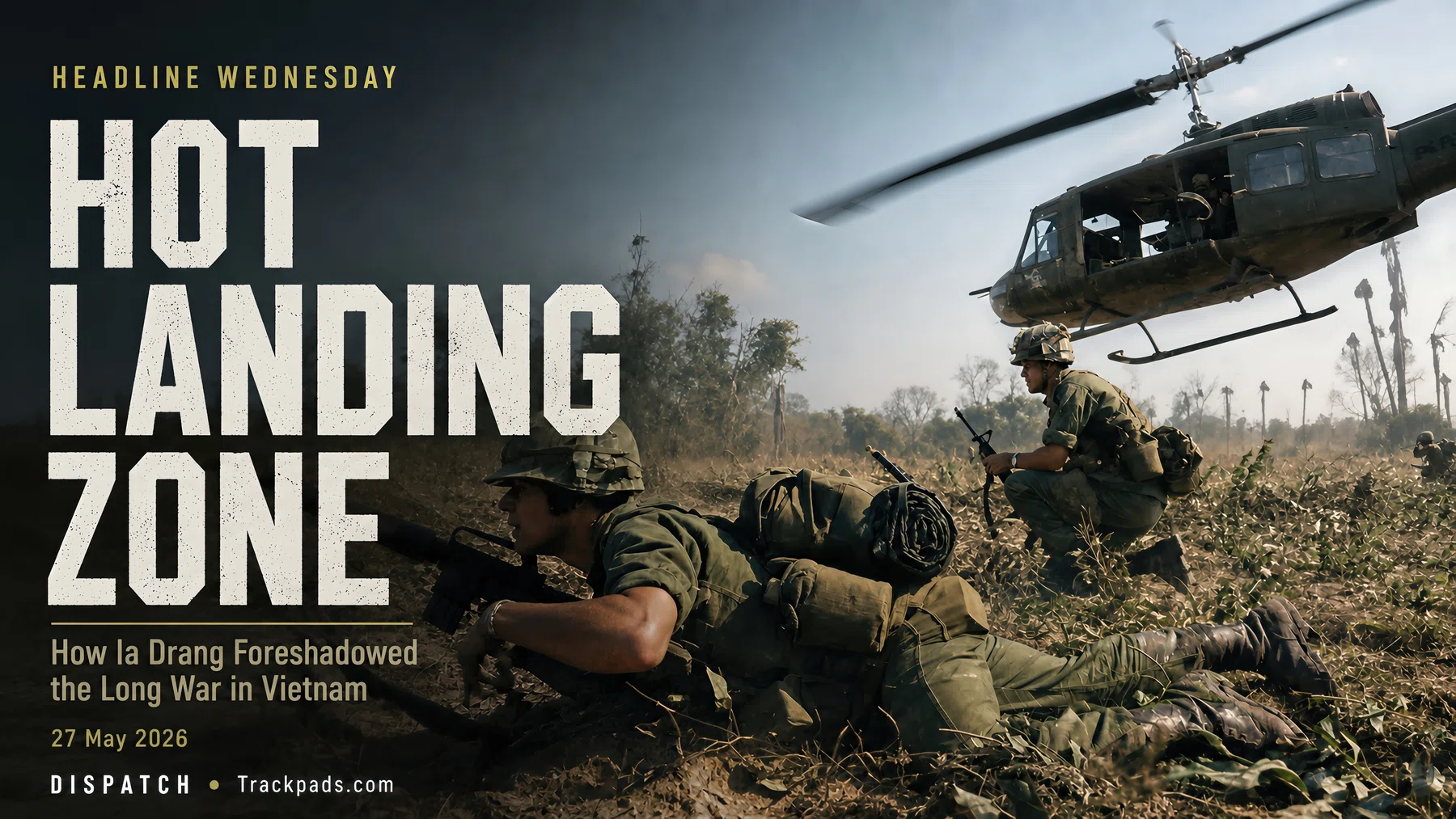
The first thing many soldiers remembered was the sound. Huey rotors beat the humid air into a constant thunder, echoing off the low ridgelines of the Ia Drang Valley in November 1965. Below, a small clearing called Landing Zone X-Ray waited like a bull’s-eye stamped into the elephant grass, ringed by scrub trees and shadowed hills. In the open doors of the helicopters, troopers of the 1st Cavalry Division gripped rifles and machine guns, boots resting on skids, eyes scanning the treeline for muzzle flashes they could not yet see.
As the first helicopters flared and dropped in, red dust and grass fragments whipped through the clearing. Men spilled out, crouching low, trying to form security around the sparse ant hills and broken tree stumps that would have to count as cover. Officers shouted over the rotor wash, fighting to be heard as each aircraft leapt back into the air to fetch more men from rear bases. It felt like the concept of “air mobility” made real: an American battalion delivered straight to the enemy’s doorstep in minutes instead of days.
But beneath the tree canopy surrounding X-Ray, another army was already in motion. North Vietnamese regulars, well-armed and drilled, shifted along spiderweb paths and dry creek beds, closing in on the clearing. They had studied the Americans’ reliance on helicopters and knew that if they could catch a battalion strung out, arriving in waves, they might smother it before the sky cavalry could fully assemble. At the edges of the clearing, scouts glimpsed movement that did not belong to the wind.
The first cracks of rifle and machine gun fire snapped through the valley, and the idea of a clean, controlled insertion dissolved in an instant. Men dropped where they had been standing seconds earlier, and officers realized they were not facing a scattered guerrilla band but a hidden, organized force intent on destroying them. What began as a demonstration of new technology was turning, minute by minute, into a brutal close-range trial of survival. And the fight now building around X-Ray was only the opening act of a longer, bloodier lesson.
A New Kind of War on Trial
The Ia Drang Valley battle unfolded at a moment when the Vietnam War’s shape was still, in many American minds, unsettled. Washington had recently committed ground forces in strength, and the 1st Cavalry Division (Airmobile) was meant to be the sharp edge of a new approach: use helicopters to find, fix, and finish an elusive enemy in the broken terrain of the Central Highlands. Commanders believed that mobility and firepower could offset jungle, distance, and an enemy comfortable with disappearing into the trees. If the concept worked at Ia Drang, it would become a blueprint.
For Hanoi and its field commanders, the stakes ran just as high. Up to this point, much of the fighting against American advisers and South Vietnamese forces had been a mix of guerrilla actions and limited engagements by regular units. In the Central Highlands, North Vietnamese commanders chose to commit full regiments of the People’s Army, moving them down the Ho Chi Minh Trail into South Vietnam. Their goal was to hit the new American units hard, prove that even air-delivered battalions could be bled white, and test how far the United States was really willing to go.
On the ground, those strategic calculations translated into immediate, deadly risks for the troopers churning into Landing Zone X-Ray. If the air cavalry battalion was overrun, it would not only mean hundreds of lives lost but also a propaganda victory for North Vietnam and a shudder through American public opinion. If the battalion held, but only by calling in massive artillery and air power, that too would send a signal about how this war would be fought: at high cost, with heavy fire, and often at very close range.
At division and corps headquarters, officers watched the unfolding reports as more companies were ordered into the valley, and relief plans were drawn up for any unit that became isolated. The Ia Drang fight would influence decisions on how to deploy air cavalry, how far commanders would push small units into remote terrain, and how willing both sides would be to accept heavy casualties for controlling a patch of jungle. In that narrow valley, over a few savage days, the United States and North Vietnamese forces were not just fighting for ground. They were testing the future of the war itself.
Choppers, Trail Traffic, and a Choice
The road to Ia Drang began weeks earlier at an outpost called Plei Me. North Vietnamese regulars had surrounded the camp in October 1965, testing both South Vietnamese defenders and the newly arriving American formations. When the siege was broken, American commanders knew enemy regiments were still in the Central Highlands, slipping back toward the Cambodian border along routes they had spent years building. The question was whether to let those units fade away or chase them into the broken country west of Pleiku. With the 1st Cavalry Division now in theater, the temptation to use airmobile power to hunt them down proved too strong to ignore.
The 1st Cavalry’s structure lent itself to bold moves. Helicopter companies were paired with infantry battalions, creating a force that could leap over poor roads and dense jungle. Leaders believed they could insert troops on the enemy’s flank, apply artillery and airpower, and then extract before the enemy could mass. To make that concept work, they needed a major engagement that showed air mobility was more than a flashy idea. Pursuing the regiments that had hit Plei Me into the Ia Drang Valley offered that chance, even though maps of the area were thin and the terrain favored whoever knew the ground first.
On the other side, North Vietnamese planners had moved substantial forces down the Ho Chi Minh Trail for a reason. They wanted to threaten the Central Highlands, pull South Vietnamese and American units away from coastal cities, and prove that their regulars could stand up to American firepower. Regiments dug in on the slopes of the Chu Pong Massif and in the folds of the valley, using spider holes, bunkers, and covered approach routes. They understood that helicopters would bring Americans in by the company and that if they could crush one or two battalions, it would echo far beyond the jungle.
Into this mix walked Lieutenant Colonel Hal Moore and his 1st Battalion, 7th Cavalry. Their orders were to find the enemy regiments believed to be in the area and fix them in place so that artillery and air could finish the job. The chosen touchpoint, Landing Zone X-Ray, was a modest clearing near the base of Chu Pong, close enough to sniff the enemy but just large enough to fit a helicopter at a time. It was, in effect, a bet that the air cavalry could land faster and fight harder than the enemy could react. When the first slicks lifted into the morning sky on 14 November, that bet was about to be tested in the most unforgiving way.
Assaults Against a Ring of Foxholes
As the first companies of 1st Battalion, 7th Cavalry began to fan out from Landing Zone X-Ray, the valley already felt too small. One platoon pushed out toward the trees and quickly discovered just how close the enemy was. Contact came suddenly, with automatic fire slashing through the grass and cutting men down before they could find solid cover. Attempts to reach isolated elements turned into firefights of their own, and in the chaos, one platoon became effectively cut off and encircled. The effort to reach and recover those soldiers pulled Moore’s attention and manpower at the very moment he was trying to build a perimeter around the landing zone.
Meanwhile, helicopters continued to shuttle more troopers into X-Ray, each bird bringing in a fresh stick of men who stepped out of the dust into a battlefield that was already roaring. Officers and NCOs dragged newcomers into hastily scraped foxholes, lining them along ant hills, tree stumps, and the slight rises that passed for high ground. The landing zone itself became both lifeline and bullseye, a place where ammunition and wounded flowed in opposite directions under fire. Every time a Huey came in low, enemy gunners tried to time bursts into the approach, seeking to knock down the birds that were keeping the Americans alive.
The North Vietnamese fed companies and then larger elements into the fight, probing for weak spots in the American ring. Attacks came from multiple directions, often delivered by small groups that slipped close under cover of brush before erupting into charges at a sprint. For the troopers in the line, the battle collapsed into cycles of incoming fire, shouted orders, and desperate counterfire at silhouettes that seemed to appear from the very earth. At times the distance between foxholes and attacking troops could be measured in feet, not yards, and grenade blasts tore branches from trees as often as they stopped an assault.
Supporting fires became the thin margin between survival and collapse. Artillery batteries miles away threw shells onto marked targets called in by forward observers who were sometimes only meters from the impact zones. Overhead, fighter-bombers and attack aircraft rolled in with bombs, rockets, and napalm, guided by pilots and ground controllers who tried to thread their attacks between the perimeter and the advancing enemy. On at least one occasion, the situation became so dire that a “broken arrow” call went out, signaling that an American unit was at risk of being overrun and pulling nearly every available aircraft into the valley.
As day turned toward evening, the fight did not slacken so much as change character. The heat and glare gave way to lengthening shadows, and both sides prepared for a night they knew would be even more brutal. Americans tightened their foxholes, redistributed ammunition, and tried to mark sectors of fire in the growing darkness. North Vietnamese troops used the dusk to shift units, dig closer approach trenches, and prepare new assaults aimed at breaching the ring around X-Ray. The initial hours had shown that neither side would break easily. The next rounds of the fight would test just how much punishment a helicopter-borne battalion could absorb while holding a clearing that, on the map, looked far too small to matter.
Firepower, Leadership, and a Thin Line
What kept Landing Zone X-Ray from being wiped off the map was not a single miracle but a stack of thin advantages, held together by leadership and discipline. Through the long night, North Vietnamese units hurled repeated assaults at the American perimeter, sometimes getting so close that men in foxholes could hear whispered commands and the clink of gear in the dark. Each time, officers and NCOs along the line tightened their sectors, shifted men to threatened points, and called for artillery that walked in perilously close to their own positions. It was a brutal kind of geometry: if the shells were too far out, the enemy would break through; if they were too close, the defenders would suffer their own steel.
In those hours, the air cavalry concept stripped down to its core. The helicopters could not fly easily in the dark, and the clearing itself was no longer a highway in the sky but a small, contested patch of earth. What did work was the combination of radios, artillery, and the stubbornness of companies that refused to pull back. Moore and his commanders moved along the line, sometimes under direct fire, checking positions, reshaping the perimeter, and making sure shaken soldiers did not slip away into the grass. Medics crawled to the wounded, sometimes dragging them only a few yards back to a slightly deeper fold in the ground that passed for a casualty collection point.
As the night wore on, North Vietnamese commanders faced their own hard decisions. Every renewed attack cost men, and the American artillery reached out not just to the immediate front lines but to assembly areas and suspected approach routes. By dawn, it was clear that the battalion at X-Ray was bloodied but not broken. Reinforcements from the 2nd Battalion, 7th Cavalry and other units began to arrive, thickening the perimeter and allowing Moore’s exhausted companies to contract their lines slightly without creating gaps. At the same time, higher headquarters started to bring heavier air strikes and even long-range bombers to bear on the broader Chu Pong area.
The turning point of Ia Drang, then, was not a dramatic charge or a single decisive maneuver. It was the moment when the North Vietnamese could no longer see a path to crushing the battalion at X-Ray before more Americans arrived, and when American commanders realized they could hold a tiny clearing deep in hostile territory with enough fire and grit. Survival at X-Ray came at a terrible cost in casualties and shattered platoons, but it denied the enemy the clean, annihilating victory they had hoped for. The fight was far from over, yet the immediate question—whether an air cavalry battalion could be landed, surrounded, and still hold—had been answered in the narrowest possible way.
One Valley’s Lessons for a Long War
The Ia Drang campaign did not end when helicopters finally began lifting companies out of X-Ray. As elements of the 7th Cavalry moved toward another clearing, Landing Zone Albany, they marched straight into a devastating North Vietnamese ambush that produced some of the heaviest American casualties of the war to that point. In the jungle and elephant grass, formations became tangled, and companies were shredded at close range before they could form proper defensive positions. Where X-Ray had shown how firepower and perimeter defense could save a surrounded battalion, Albany showed how quickly that same battalion structure could be torn apart when caught strung out on the move.
By the time the fighting in the valley and its approaches ebbed, both sides had paid dearly. The United States counted the campaign as a tactical victory, citing the number of North Vietnamese dead and the fact that the Central Highlands did not fall. But North Vietnamese commanders looked at the same valley and drew a different conclusion. They had seen that by closing to very short range, they could blunt American artillery and air power, and that small units could inflict heavy losses on battalions that relied on helicopters and radios to pull them out of trouble. For them, Ia Drang confirmed that a long war of attrition was not only possible but workable.
In American headquarters, the lessons were also mixed. On paper, the air cavalry had proven it could move quickly, hit hard, and survive even under pressure from multiple enemy regiments. In practice, the price in casualties was already raising questions about how many such fights the United States could sustain, and whether “search and destroy” operations deep in enemy territory truly shifted the strategic balance. The images and stories that eventually reached families at home—bodies brought back from a valley few could find on a map—added another layer to the growing unease about what victory in Vietnam would actually require.
Today, staff rides and unit studies still return to Ia Drang as a kind of early blueprint for the Vietnam War’s central contradictions. The battle showcased modern mobility and firepower while also revealing the enduring power of terrain, close combat, and the will of small units under crushing stress. It stands as a reminder that technology can deliver soldiers to the fight but cannot guarantee what happens after the skids touch the ground. For anyone trying to understand how a seemingly short intervention stretched into a long, grinding war, the lessons written in the grass and anthills of the Ia Drang Valley remain a stark place to start.