Grey Hulls on an Invisible Line
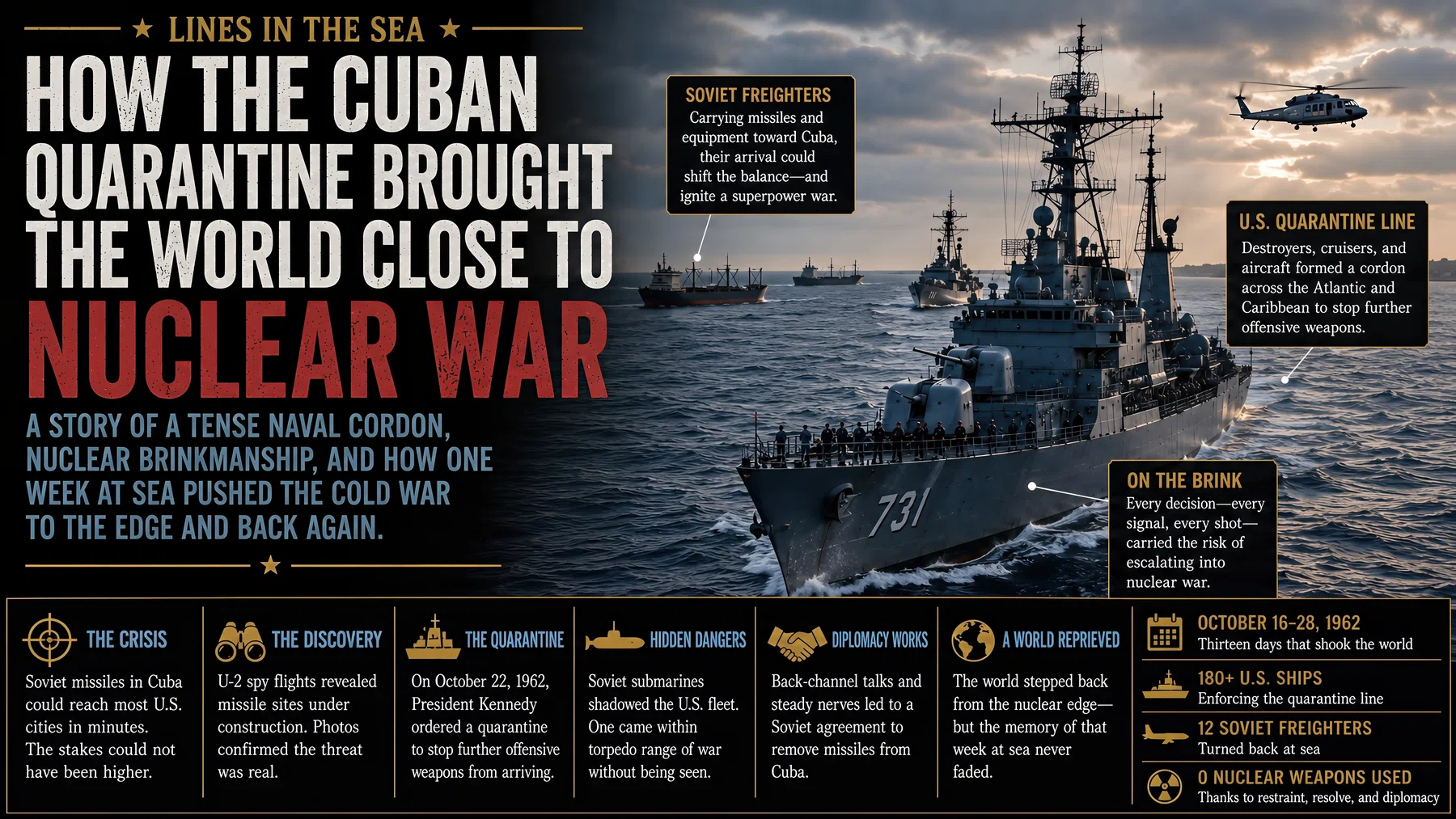
Just before dawn in late October 1962, United States destroyers and cruisers rode the swell of the Atlantic and Caribbean, steel silhouettes against a dark horizon. On radar scopes and plotting tables, the ocean did not look empty. Thin lines and faint blips marked Soviet merchant ships driving steadily toward Cuba, each one a potential carrier of missiles and warheads that could reach American cities in minutes. On the signal bridges, sailors waited beside hoists and flashing lights, ready to challenge freighters that might refuse to turn aside. In sonar rooms and combat information centers, crews watched for submarines that could be trailing the screen, unseen predators in deep water.
These ships formed a ring that did not exist on any chart, a “quarantine line” drawn by political decision and enforced by men who slept in their boots. They drilled through boarding procedures and rehearsed the steps from warning shot to firing for effect, aware that every order carried consequences far beyond a single hull. Above them, patrol aircraft swept back and forth, photographing decks and superstructures, counting crates and missiles, feeding the nervous map in Washington. On mess decks, the president’s recently broadcast address replayed in low, crackling audio, the words about “offensive weapons in Cuba” echoing beneath steel beams and hanging pipes.
For the crews, the scene felt both routine and utterly different from any previous cruise. Ships still followed standard formations, still checked bearings and fuel states, still worried about weather and mechanical problems. Yet every watch turnover came with the reminder that a misread signal or an overzealous shot could set off a chain no one could stop. The grey hulls sat between Soviet freighters and Cuban ports, but in a larger sense they sat between uneasy peace and a war their generation had been raised to fear more than any other. This was only one moment along the line, but as the week unfolded, the ocean would carry the weight of decisions made far above the waterline.
What Happens If the Line Breaks
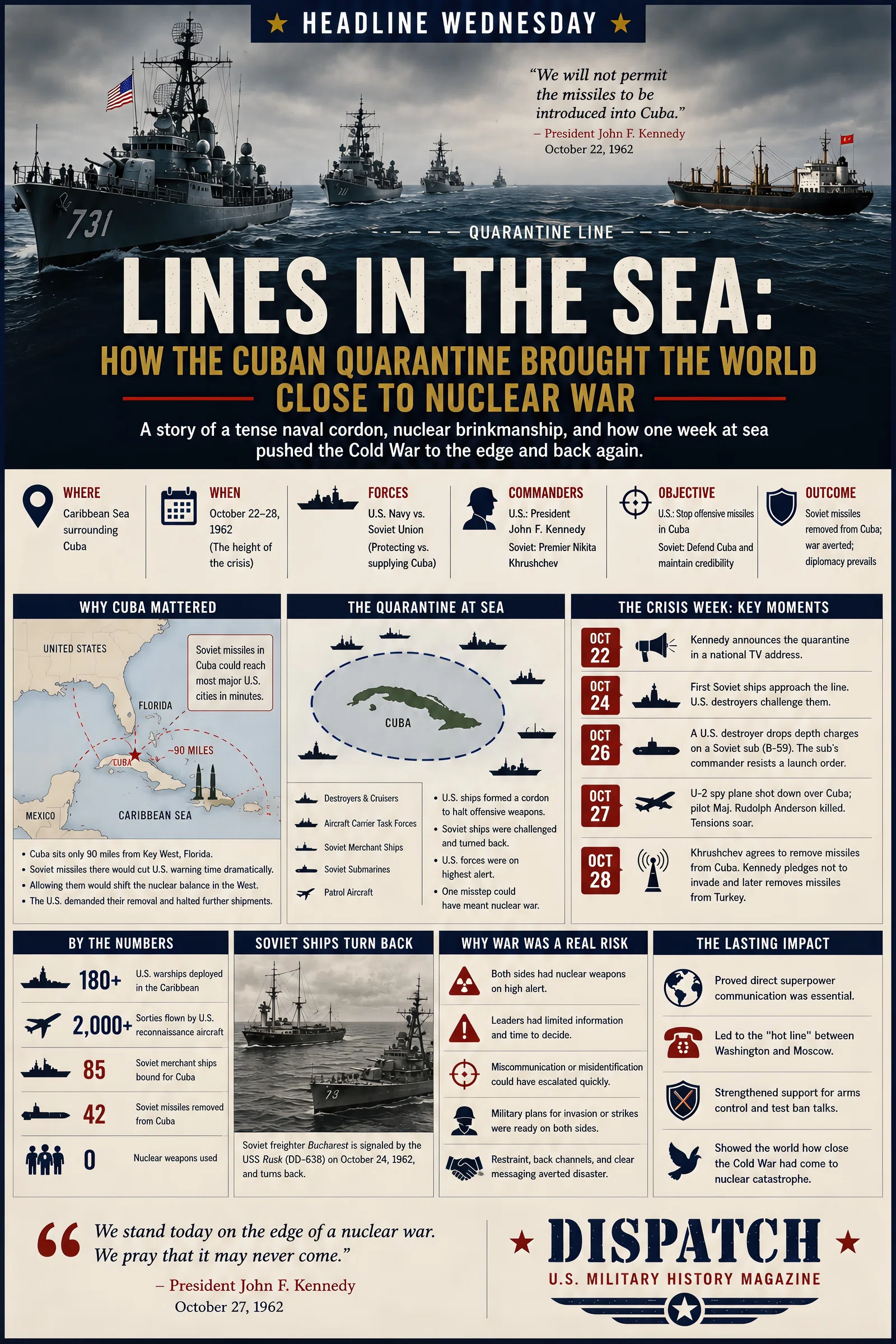
To understand why those ships mattered so much, you have to pull back from that narrow horizon to the wider map of the Cold War in 1962. The Soviet Union had begun moving medium- and intermediate-range missiles into Cuba, a revolutionary state only ninety miles from Florida. If those missiles became operational, they would slash American warning times and place much of the continental United States, along with key bases and cities, under direct and immediate threat. For President John F. Kennedy and his advisers, allowing that to stand meant accepting a new strategic disadvantage at a moment when Berlin, NATO cohesion, and domestic politics were already under strain.
Inside the administration, options ranged from doing nothing to launching air strikes and a full invasion of Cuba. Senior military leaders argued for decisive attacks to remove the missiles before they could be used, calculating risk in terms of targets, sorties, and damage estimates. Civilian advisers pressed the political dimensions, knowing that a surprise attack could shatter U.S. claims to moral high ground and trigger a Soviet response in Europe. The chosen course, a naval “quarantine” rather than a formal blockade, aimed to stop further offensive weapons without immediately triggering a direct clash of bombers and missiles.
Out at sea, the stakes translated into direct orders for the captains and crews enforcing that quarantine line. If they turned back Soviet ships without shots being fired, the United States could claim resolve without escalation. If a freighter refused to comply and a destroyer had to fire across its bow, the echo could carry all the way to Moscow and back, amplified in every command bunker and war room. Misidentifying cargo, misreading a maneuver, or overreacting to a submarine contact could transform a tense standoff into a shooting war that neither side truly wanted. The line drawn across the ocean was more than a military measure; it was a pressure point where strategy, fear, and human judgment met in real time, under the eyes of the world.
From Bay of Pigs to a Blue Line
The quarantine line did not appear overnight. It grew out of eighteen months of bruising encounters between Washington, Moscow, and Havana. In 1961, the failed Bay of Pigs invasion left Fidel Castro convinced that the United States would try again, this time with open force. For Nikita Khrushchev, the Soviet leader, backing Cuba offered both a chance to protect a revolutionary ally in the Western Hemisphere and to answer American missiles already planted close to Soviet borders in Turkey and Italy. Placing medium- and intermediate-range missiles in Cuba seemed a way to change the global balance and show that the Soviet Union could threaten American territory as directly as the West threatened his.
In mid-October 1962, high-flying United States reconnaissance aircraft photographed launch sites under construction in Cuban fields and groves. The images showed missiles, support equipment, and crews bringing the sites toward operational status. Inside the White House, an emergency committee of senior advisers gathered, weighing military and diplomatic responses day after day around a long conference table. Air strikes and invasion plans sat on the shelf, detailed down to target lists and amphibious landing schedules. Many uniformed leaders saw these as the most decisive options, believing that delay would only harden the sites and put American cities under the gun.
President Kennedy and several key civilian advisers worried that a surprise attack on Cuba could trigger Soviet moves against Berlin or unleash a chain of escalation neither side controlled. They searched for a step that would clearly oppose the missile deployment while still leaving room for negotiation. The idea of a “blockade” raised legal issues, so they adopted the term “quarantine” and sought backing from hemispheric partners to frame it as a collective response to offensive weapons. While diplomats gathered votes and ambassadors carried urgent messages, planners at the Pentagon began drawing arcs on maps, assigning carriers, cruisers, and destroyers to stations along that invisible curve. The decision to send ships, rather than bombers, toward Cuba set the stage for a confrontation measured in closing bearings and signal flags instead of immediate fire and smoke, but the weapons in the background were nuclear all the same.
Steel, Sonar, and Slow Approaches
Once the quarantine order took effect, the ocean became a board for a high-stakes game played in real time. United States task groups took up positions along the announced line, with carriers and cruisers farther out and lean, fast destroyers pushed forward as the hands and eyes of the screen. Lookouts scanned the horizon for masts and stacks that might match known Soviet merchant silhouettes. In the combat information centers, radar operators tracked contacts by number and course, building a moving picture of the sea lanes leading toward Cuba. Each plotted line was cross-checked against intelligence reports listing which Soviet ships were believed to be carrying missile components or other offensive cargo.
For the captains pacing their bridges, the rules of engagement were as important as any navigation chart. They were authorized to hail and inspect vessels believed to be carrying prohibited equipment, but only through a ladder of escalating steps: challenge by radio and signal light, orders to stop, warning shots, and only as a last resort, disabling fire. Any boarding would be carried out by armed but carefully briefed teams, whose actions could be interpreted in Moscow and Havana as restraint or as provocation. Meanwhile, Soviet diesel submarines, already deployed into the area, tried to shadow the cordon. Their commanders knew they might be ordered to defend Soviet shipping, but they also knew that surfacing at the wrong moment could expose them to overwhelming force from the surface ships above.
On several days, the world watched through news reports as named Soviet freighters steamed toward the announced line. In some cases, ships believed to be carrying the most sensitive cargo slowed, changed course, or turned back before reaching the cordon, signaling that pressure at sea and messages passed through diplomatic channels were having an effect. In other cases, neutral or allied vessels continued on, obliging United States crews to execute the full script of challenge and approach. The boarding of a non-Soviet ship suspected of carrying general cargo became an early test case, performed with deliberate calm to show that the quarantine could be firm without being reckless. Photographs of the encounter and the cargo holds eased some immediate fears but did not remove the deeper tension.
Below the surface, the encounters were far more nerve-racking and far less visible. Destroyers used sonar to fix submarine positions and then employed small practice charges and signaling devices to urge them to surface. For the crews inside those cramped Soviet boats, the muffled thuds and creaks of nearby explosions sounded close enough to be life-threatening. At least one submarine commander, struggling with heat, low battery power, and limited communication, weighed the use of a nuclear-armed torpedo carried aboard as a defensive measure. On the American side, officers on bridge wings and in operations rooms understood that a misjudged depth charge pattern, or a submarine misreading the intent of those signals, could turn a tense standoff into an underwater battle.
Day by day, as ships maintained their stations and tracked contacts, the pressure climbed onshore in Washington and Moscow. Each freighter that slowed or turned away without incident gave hope that the crisis might ease. Each new submarine contact, each report of missile site progress on the island, pushed nerves closer to the breaking point. The naval quarantine was not a single clash but a rolling sequence of controlled confrontations, and by the time the most dangerous weekend of the crisis arrived, both crews at sea and leaders ashore were exhausted, wary, and aware that the next decision might be the one that tipped the balance toward peace or catastrophe.
Turning Back From the Brink
The crisis began to turn in small, easily missed movements on the chart room tables. As the quarantine tightened, some Soviet ships carrying the most sensitive cargo slowed and then reversed course before reaching the line. These changes did not come with fanfare. They appeared as gentle bends in grease pencil tracks, a freighter’s steady bearing drifting just enough to show that orders had changed somewhere far away. For the officers at sea, those bends were proof that pressure without gunfire could still move steel hulls and the decisions behind them. Each ship that turned back reduced the immediate danger that more missiles or warheads would reach Cuban ports under the cover of the stand-off.
At the same time, the most dangerous moments were unfolding underwater and in the airwaves between capitals. One Soviet submarine, hounded by practice depth charges, heat, and fatigue, edged close to decisions that could have turned a local encounter into a nuclear incident. That weapon was not used, but the fact that it was even considered shows how narrow the path truly was. On the surface ships enforcing the quarantine, captains stuck rigidly to measured warning procedures, choosing signal shots and persistent hails over anything that could be mistaken for an attack. Their restraint gave political leaders room to maneuver and kept any single sailor’s action from becoming the match.
In Moscow and Washington, letters and public statements began to cross, carrying offers and demands that mirrored the slow adjustments at sea. One Soviet message suggested removing the missiles in exchange for a public pledge not to invade Cuba. Another added the demand that American missiles in Turkey be withdrawn. The Kennedy administration chose to answer the first message publicly and address the second point quietly, through back channels. While diplomats and brothers of presidents drafted replies, the quarantine line stayed in place, buying time and signaling that the United States would hold firm without racing to the trigger. That combination of visible naval pressure and carefully calibrated political signals became the true turning point: not a single dramatic shot, but a sustained decision to lean on warships and words rather than bombers and invasion plans.
Missiles Removed, Lessons Carried Forward
Within days, the outlines of a settlement emerged, and the ocean slowly began to relax. The Soviet Union agreed to remove its offensive missiles and bombers from Cuba under international observation. United States reconnaissance flights confirmed that launchers were dismantled, missiles were crated, and ships carrying them away left Cuban waters. In return, the United States publicly pledged not to invade Cuba and, in a separate and quiet understanding, later removed certain aging missiles from Turkey. The quarantine line remained up long enough to verify that the most dangerous weapons were truly departing, then stood down as warships peeled away toward other assignments. The steel ring that had once stood as a barrier between Soviet freighters and Cuban ports became just another set of coordinates in naval logs.
The immediate result was clear: no missiles in Cuba, no invasion, no war. Yet the deeper effects reached far beyond that one week in October. Both superpowers came out of the crisis with a new appreciation for how quickly misread signals and rigid war plans could lead to catastrophe. A direct communications link between Washington and Moscow was established to reduce the risk of delay or misunderstanding in future crises. Arms control talks, including efforts to limit nuclear testing, gained momentum from leaders who had seen how close they had come to disaster. Within navies and air forces, planners studied the crisis as a case study in controlled escalation, communication of intent, and the limits of pressure at sea when nuclear weapons are in the background.
For students of military history and for professionals who think about deterrence today, the naval quarantine around Cuba remains a rare example of warships used to push back without firing for effect. It highlights the importance of clear rules of engagement, disciplined restraint, and a constant awareness of the human beings making decisions on tired bridges and cramped submarine control rooms. It also serves as a reminder that even well-managed confrontations sit on fault lines of uncertainty, where a single shell, torpedo, or misinterpreted message can change everything. When visitors read about the Cuban Missile Crisis in museums or walk the decks of preserved destroyers and cruisers, they are looking at the steel that underpinned some of the most important choices of the Cold War, and at the ships that helped carry the world through its closest brush with nuclear war without crossing the final line.