Overview
Beyond the Call: Medal of Honor Stories — Dispatch: U.S. Military History Magazine, developed by Trackpads dot com
Lead Scout on the Road to Dagami
The sun had barely burned through the morning haze over the Philippine town of Dagami when the scouts from Company F stepped off the road and into the bamboo. It was 28 October 1944 on the island of Leyte, and the 7th Infantry Division was pushing inland from the beaches, trying to pry the Japanese Army out of a network of fortified villages and roadblocks.
At the very front of one assault platoon moved a quiet twenty-four-year-old rifleman from Idaho: Private First Class Leonard Carl Brostrom. In an infantry company on the attack, the lead scout is the first man in the file, the one who draws fire, spots ambushes, and feels the terrain before anyone else. It is a job that combines courage with patience—eyes scanning for trip wires and movement, feet learning to read the ground.
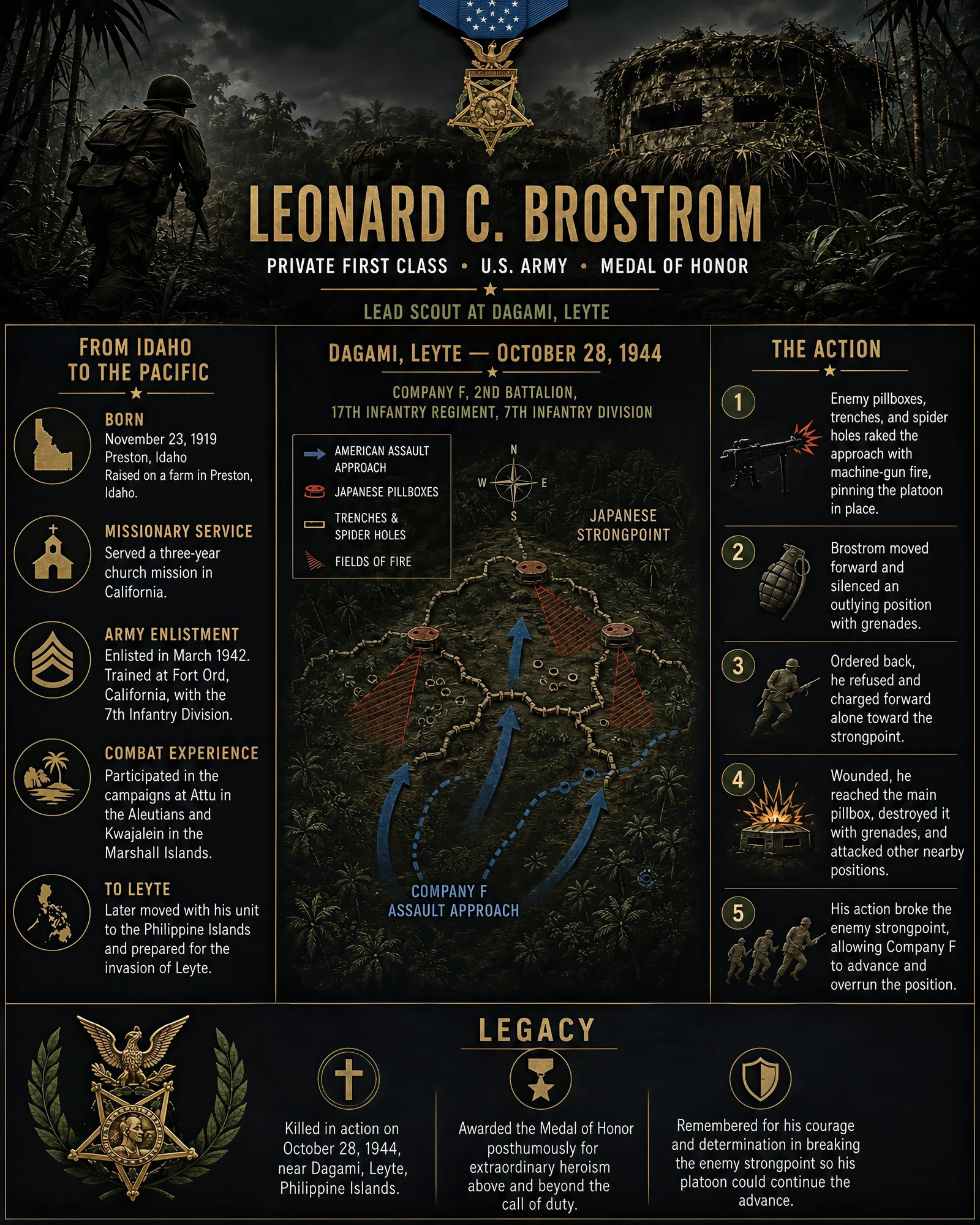
That morning, the ground ahead of Company F hid a carefully prepared killing zone. Camouflaged pillboxes—small, hardened bunkers built of logs, earth, and concrete—were dug into the tree line, backed by trenches and “spider holes,” one-man fighting pits covered with foliage. The Japanese defenders had overlapping machine-gun fields of fire that swept the open approaches to Dagami. As the Americans advanced, those guns opened up, cutting into the platoon and pinning men in place.
In the chaos, Brostrom saw that one key pillbox in the center of the position controlled everything. If it stayed in action, the company would not move another yard. Before the fight was over, he would make a decision that no one ordered and no one expected—a one-man assault that would cost him his life and earn him the Medal of Honor. But to understand why Leonard Brostrom ran toward that bunker instead of away from it, you have to go back to the farm fields of southeastern Idaho and a boyhood shaped by work, faith, and the long shadow of the Great Depression.
From Idaho Fields to the Call of War
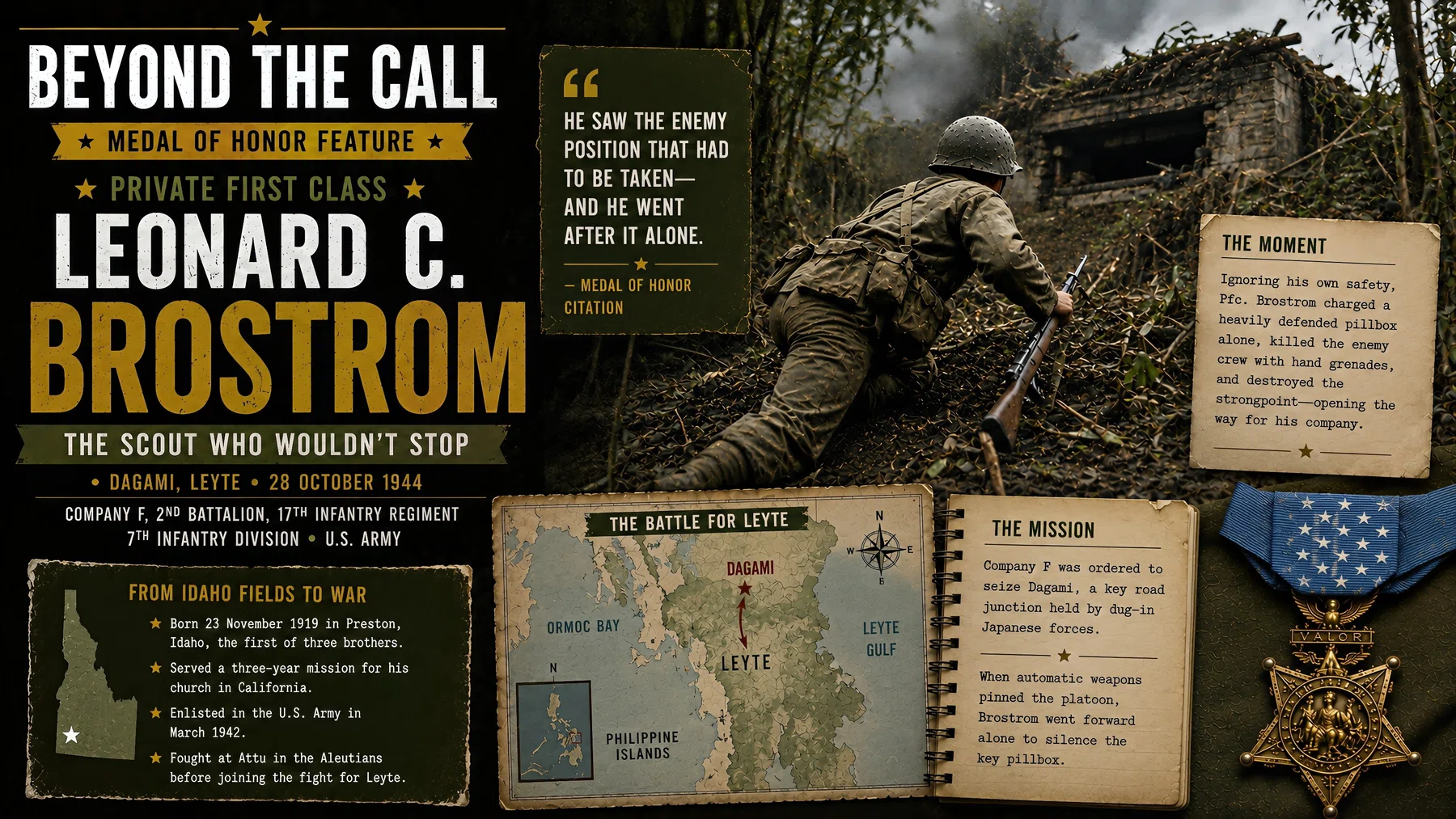
Leonard Carl Brostrom was born on 23 November 1919 in Preston, a small farming community tucked into Idaho’s Cache Valley near the Utah border. He was the first child of Carl and Louise Brostrom, who made their living from the land at a time when every harvest mattered. Leonard grew up alongside two younger brothers, Dean and Dale, in a world of chores before school, long days in the fields, and winters that could shut down the valley in snow.
He attended classes at the old Oneida Stake Academy, a school built by local members of the Church of Jesus Christ of Latter-day Saints. The building doubled as an academic and spiritual center for the community, and for Leonard it became a place where hard study mixed with church activities, ball games, and small-town friendships. Money was scarce in the Depression years, so he picked up odd jobs, hunted and fished to put food on the table, and learned early that quiet determination mattered more than talk.
Faith was not just a family habit—it was central to his identity. As a young man, Leonard accepted a three-year mission call for his church and was sent to California. Missionaries lived simply, walked their routes, and spent their days talking with strangers about what they believed. The work demanded discipline, humility, and a willingness to be turned away again and again. Those years also took him far from Idaho for the first time, broadening his sense of the world beyond the valley where he’d been born.
While he was still on that mission, events far across the Pacific reshaped his future. On 7 December 1941, Japan attacked Pearl Harbor. Like so many other young Americans, Leonard now faced a different kind of calling. He finished the service he had promised to his church, then returned home and enlisted in the U.S. Army in March 1942.
The Army sent him to Fort Ord, California, for basic training—a crash course in turning farm boys and factory workers into soldiers. Leonard learned to handle the M1 rifle, march in formation, dig foxholes, and navigate with map and compass. From there he joined the 7th Motorized Division, soon reorganized as the 7th Infantry Division, at Camp San Luis Obispo. The division initially trained in the Mojave Desert, preparing for a possible deployment to North Africa. Days were filled with maneuvering trucks and tanks over scorching sand, living on dust and discipline.
Then the plan changed. The division was retasked for the Pacific, and what had been a motorized outfit became a light infantry division specializing in amphibious assaults. Under Marine instructors from the Fleet Marine Force, the soldiers drilled on how to hit beaches from landing craft, fan out under fire, and fight from one palm grove or ridgeline to the next. General Holland Smith, a pioneer of amphibious warfare, oversaw their training.
By the time the division finished its workup, Leonard Brostrom had become a seasoned rifleman in Company F, 2nd Battalion, 17th Infantry Regiment. He had gone from irrigating fields in Preston to learning how to storm fortified shores. His first real test in combat would come on a place few Americans had ever heard of: a remote, storm-lashed island called Attu, at the far end of the Aleutian chain—thousands of miles from both Idaho and the Philippine town of Dagami where his story would reach its climax.
Forged in Fog and Tundra
Before Leonard Brostrom ever saw the jungles of the Philippines, war took him to a place that felt like the end of the earth. In May 1943, his regiment landed on Attu in the Aleutian chain, a treeless island of wind-carved ridges, muskeg bogs, and freezing fog. The division had trained for desert warfare, not arctic combat, and the soldiers stepped off their landing craft in standard field gear that soaked through quickly in the sleet and snow. Instead of palm trees and sand, they fought over tundra slopes, through icy ravines, and up toward nameless heights where visibility could vanish in seconds.
Company F went ashore on what the operation planners called Red Beach, pushing inland against Japanese positions dug into the hills. The fighting there was intimate and exhausting: short rushes between tufts of cover, rifles icing up, hands numbed around cold steel. Brostrom’s company helped drive enemy troops out of a series of trenches near a feature known as Cold Mountain, using rifles, bayonets, and hand grenades to clear one position at a time. The battle ended with a ferocious banzai charge near Chichagof Harbor, when Japanese soldiers hurled themselves in a final attack and were destroyed at close range by the 7th Infantry Division. Those days on Attu taught Brostrom what it meant to keep moving under terrible conditions, and what it looked like when an enemy chose death over surrender.
After Attu, the regiment returned briefly to Hawaii, trading snow and rock for palm trees and coral sand. There, the division trained for a new kind of mission: a series of carefully planned amphibious assaults across the central Pacific. In early 1944 they hit Kwajalein Atoll, a ring of small islands and reefs bristling with bunkers and gun positions. Under a new division commander, the attack unfolded with precision, each island assaulted in turn, the infantry following heavy naval and air bombardment. Brostrom, now a combat veteran, moved with the assault waves from beach to beach as the atoll was secured. Those operations sharpened his instincts as a rifleman and scout, reinforcing the lesson that success in an assault often depended on a few key strongpoints being silenced at exactly the right moment.
The Road Inland on Leyte
By October 1944, the war brought Brostrom and the 7th Infantry Division to Leyte, a large island in the central Philippines. The division landed on Leyte’s east coast on 20 October, part of a broad Allied operation to return to the islands and cut Japan’s supply lines. Company F came ashore with the main body, pushing inland along roads and trails that quickly turned to mud in the tropical rain. Within two days, the regiment helped seize key objectives including the Bayug airfield and nearby towns, giving Allied aircraft new bases and denying the enemy crucial terrain.
Once the beaches and initial airfields were secure, the division drove toward Dagami, a town that controlled approaches across the island’s interior. The Japanese Army responded by building a belt of strongpoints south and west of the town, using pillboxes, trenches, and hidden firing pits covered with foliage. These positions were arranged so that machine-gun fire from one bunker overlapped with fire from its neighbors, turning any open ground into a killing zone. On 27 October, the regiment spent a hard day taking several of these strongpoints; by nightfall, enemy resistance around Dagami had been pushed back but not broken.
At first light on 28 October, Company F moved out again, ordered to envelop Dagami from the left. Brostrom, now serving as lead scout for the assault platoon, stepped into his usual place at the front of the file. His job was to feel out the unseen edge of the enemy line—testing each patch of ground, reading the tree line, and catching any hint of movement before it could tear into the men behind him. The landscape ahead was cut by ditches, patches of bamboo, and low fields leading toward another cluster of hidden positions. As the platoon advanced, fire suddenly erupted from pillboxes and trenches almost invisible until they spoke, slashing into the American line and dropping men in the first seconds of the fight. What Brostrom did in those next moments would change the course of the battle and define his legacy.
The One-Man Assault at Dagami
The firefight near Dagami erupted with no warning that morning. One moment the assault platoon was moving cautiously forward, the next it was flattened to the ground as machine guns and rifles from hidden pillboxes tore into the line. Men trying to crawl to better cover were cut down. Every attempt to shift position drew more fire from a central bunker that commanded the approaches. In that first minute, it became clear that if the key pillbox stayed in action, the platoon would be shredded long before reaching the town. The scouts had done their job by locating the enemy, but now the unit was stuck in the open, losing men, with no easy way to bring supporting weapons into play.
From his position at the front, Leonard Brostrom understood the danger as clearly as any officer. Working forward under fire, he inched toward one of the outlying positions that anchored the main bunker’s defense. Using what little cover the ground offered, he closed the distance and hurled grenades into the firing slit. The explosions silenced the gun, reducing some of the overlapping fire and buying the platoon a sliver of breathing room. It was the sort of action expected of a determined scout, but it did not change the fact that the central pillbox still dominated the field.
According to the men who watched him, Brostrom was ordered to pull back. Instead, he rose and charged toward the heart of the enemy position. Crossing open ground swept by machine-gun fire, he was hit and knocked down, then dragged himself up and kept going. Grenades arced from his hands into another enemy position, knocking it out of the fight. Wounded again, he pressed on until he reached the main pillbox, dropped his last grenades into its firing slit, and destroyed the crew inside. Even as he staggered away, he turned his rifle against nearby foxholes and supporting positions until he finally collapsed. His one-man assault broke the backbone of the Japanese strongpoint and opened the way for the platoon to surge forward.
Aftermath and Honor
With the central bunker destroyed and several supporting positions shattered, the character of the fight changed in seconds. The same ground that had just been a killing zone became an avenue of advance. Company F’s soldiers rose from the mud and rushed the remaining enemy trenches and pits, firing and throwing grenades as they went. What had been a stalled attack turned into a rapid overrun of the fortified line. In practical terms, Brostrom’s charge had done what artillery or tanks might have done on another battlefield: it tore open the key position at exactly the moment the company needed it most.
Medics and comrades scrambled to pull him back from the front edge of the captured position. His wounds were severe, and despite their efforts he did not survive. For the men of Company F, the memory of that morning was fixed forever to the image of a quiet Idaho farm boy refusing to stay down. In the months that followed, as the division continued to fight across the Pacific, the story of his assault at Dagami circulated through the regiment as an example of what it meant to lead from the very front.
After the war, the Army recognized Leonard Carl Brostrom’s actions with the Medal of Honor, awarded posthumously. The official citation described how he advanced in the face of intense enemy fire, refused to withdraw despite repeated wounds, and destroyed the enemy’s key positions at the cost of his own life. For his parents and brothers back in Preston, the medal was both an honor and a reminder of the price the family had paid. For his comrades, it put formal words to a courage they had already seen with their own eyes in the fog of Attu, the sands of Kwajalein, and the fields outside Dagami.
Memory and Meaning
Today, Leonard Brostrom’s story is preserved in more than a line in a record book. His name appears on hometown memorials, in regimental histories, and on lists of Idaho’s fallen from the Second World War. In Preston, he is remembered not only as a soldier but as the boy who grew up working the fields, the young man who left home on a church mission, and the quiet rifleman who went on to fight in some of the harshest campaigns of the Pacific. The journey from farm to frozen tundra to tropical battlefield traces the path of an entire generation pulled into a global war.
His actions near Dagami also illuminate the role of the lead scout, a position often overlooked in broad campaign narratives. The scout walks into danger first, tests unknown ground, and becomes the hinge on which the safety of the platoon often turns. Brostrom’s decision to rise and charge the pillbox came from that same instinct to protect those behind him, magnified in a moment of extreme crisis. He did not have the authority of a high rank or the power of heavy weapons, yet the fight turned on his willingness to keep moving forward when everything around him said stop.
For students of military history, Leonard C. Brostrom’s story offers a window into the brutal, close-range nature of infantry combat in the Pacific and the human qualities that shaped its outcomes. His Medal of Honor recognizes not only one man’s final charge but the long chain of service that led him there: years of training, campaigns in impossible conditions, and a steady record of doing the difficult work at the point of contact. When we remember him today, we honor a scout who quite literally walked beyond the call, trading his life so that his platoon could break through and keep the advance going.
In the fields outside Dagami, a son of Idaho went forward alone so that others could live.