Overview
Beyond the Call: Medal of Honor Stories · Dispatch: U.S. Military History Magazine · Developed by Trackpads.com
A frozen line in the woods
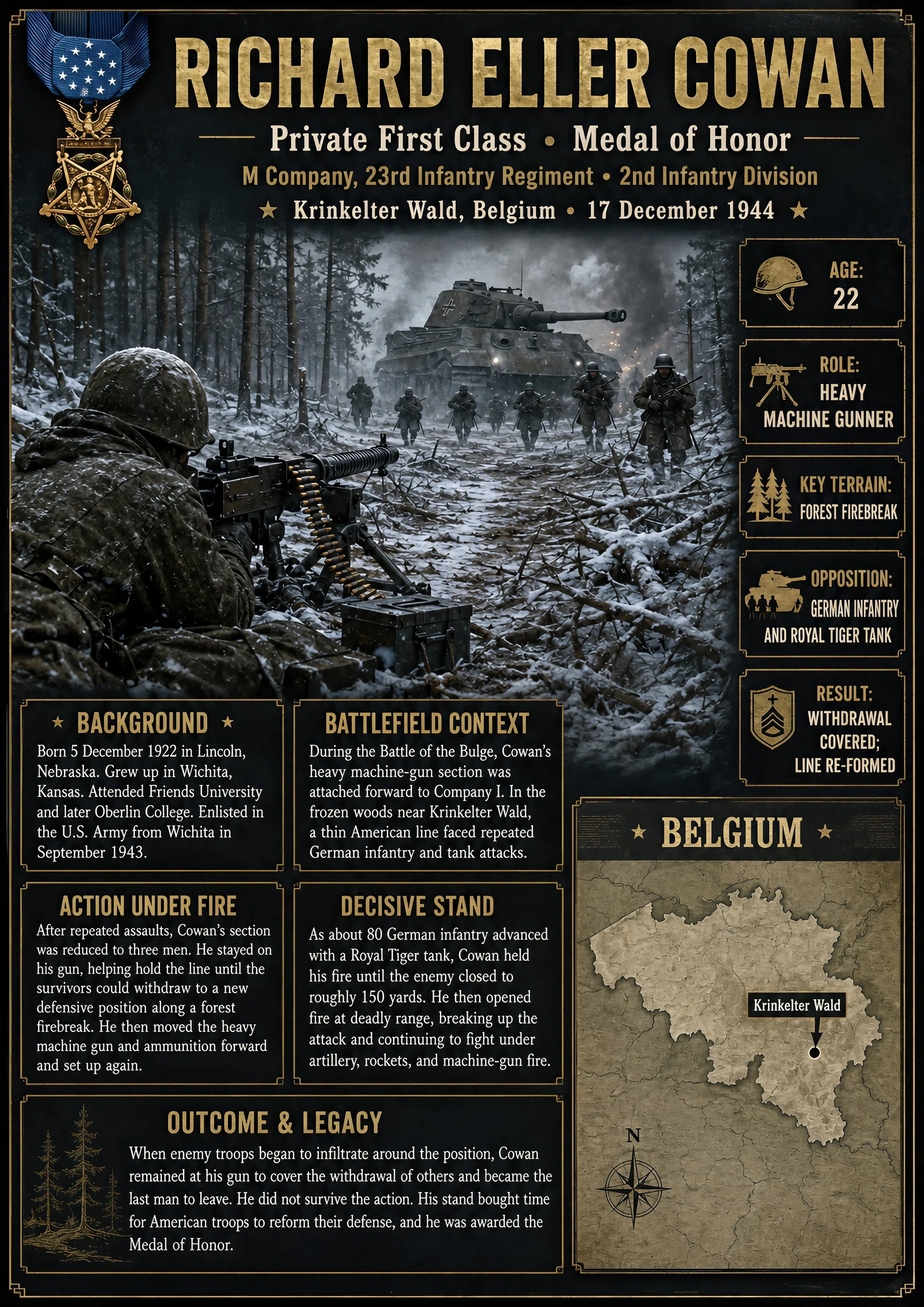
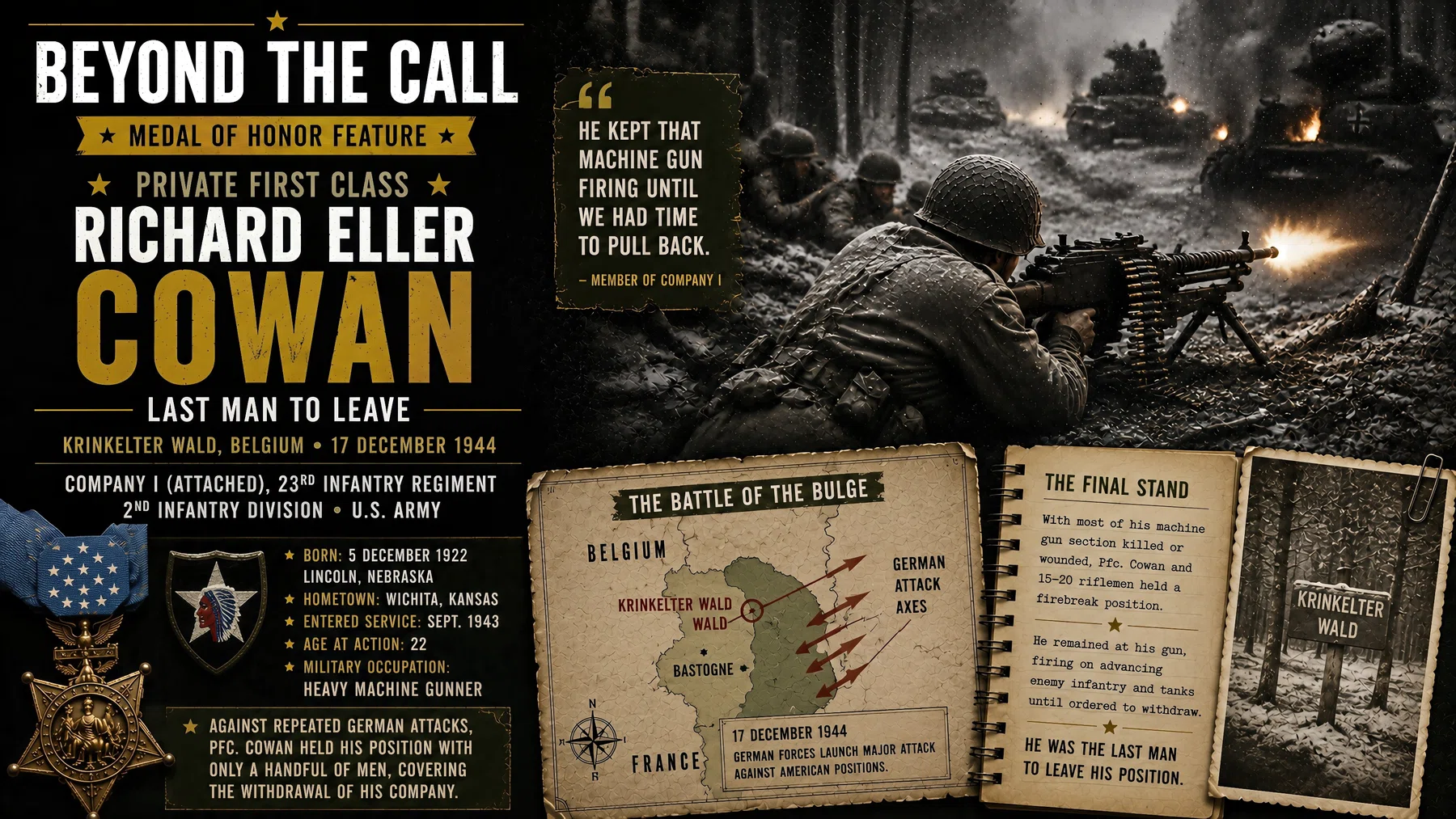
The woods around Krinkelter Wald in Belgium were dark, cold, and crowded with men who hadn’t slept. It was the second day of the German winter offensive that would become known as the Battle of the Bulge. Along a thin American line, soldiers of the 2nd Infantry Division scraped foxholes out of frozen ground and waited for whatever came next. Among them was a young heavy machine gunner, Private First Class Richard Eller Cowan of M Company, 23rd Infantry. His section had been attached forward to Company I, one of the rifle companies bracing for a major attack.
Just 12 days past his twenty-second birthday, Cowan had drawn a job that demanded equal parts steel and patience. A heavy machine gun in World War II could dominate open ground, shredding any infantry who tried to cross it. But the gun and its tripod were bulky, the ammunition belts heavy, and the crew tied to a fixed position that enemy artillery and tanks would inevitably try to smash. In the pre-dawn quiet of 17 December 1944, Cowan and his crew knew they would be among the first targets if the Germans came.
They did. A numerically superior force of German infantry and tanks slammed into Company I’s positions near Krinkelter Wald. Cowan’s gun opened up, raking the first waves of attackers and helping break up repeated assaults. For a time, the machine gun section and the riflemen around them held. Then a seventh drive, this one with tanks pushing close behind the infantry, tore into the line. Shells burst in and around the American positions. By the time the smoke cleared, all but three men in Cowan’s section were dead or wounded.
Most soldiers would have been justified in falling back immediately, but the line still needed time to reform. Cowan stayed on his gun. Supported now by only a small group of about 15 to 20 riflemen, he kept firing until the shattered American force could pull back to a new defensive line along a firebreak in the forest. Only then did he drag his heavy gun and ammunition to the new position, preparing to face the attackers again. The fighting that followed, and the choices he made in those crucial minutes, would earn him the Medal of Honor.
From Lincoln to Wichita to the war
The formal black-and-white portrait reproduced in his biographical records shows a young man with smooth features, neatly combed hair, and a serious gaze that seems older than his years. It is a reminder that before he became a Medal of Honor recipient, Richard Cowan was a college student from the American Midwest with ambitions that had nothing to do with machine guns or frozen Belgian forests.
Cowan was born on December 5, 1922, in Lincoln, Nebraska, but he grew up in Wichita, Kansas. His family had strong ties to higher education: his father, grandfather, and uncles were all graduates of Oberlin College in Ohio, and Richard hoped to become the third generation of Cowans to walk those campus paths. He attended school in Wichita and first enrolled at a local institution, Friends University, before transferring to Oberlin in the fall of 1942 to pursue that dream.
Like many young Americans of his generation, he found his plans overtaken by global events. The United States was already at war when he arrived at Oberlin, and the news from North Africa, the Pacific, and then Italy made it clear that the conflict would be long and costly. Within a year, Cowan left college and enlisted in the U.S. Army from his hometown of Wichita in September 1943. After training as an infantryman and machine gunner, he was assigned to the 23rd Infantry Regiment of the 2nd Infantry Division, a unit that would spend 1944 fighting its way across Western Europe. By that winter, the division was dug in along the Belgian-German border—just in time to meet the last great German offensive of the war, and for Cowan to face the test that would define his legacy.
Holding the firebreak
When the battered American line finally fell back from its first positions, the retreat was anything but orderly. Men staggered through the snow-choked woods, some wounded, all of them shaken by hours of fire. Along a narrow firebreak carved through the trees, a new defensive line began to take shape. Cowan, still one of the few men in his section left standing, hauled his heavy machine gun and boxes of ammunition forward alone. It was brutal work in freezing conditions, but the firebreak offered something the woods did not: a clear field of fire where his weapon could make every round count.
Supported now by only a small knot of riflemen, he set up his gun to cover the open lane through the trees. The men around him scraped shallow firing positions along the edge of the firebreak, glancing back toward the rear where the rest of the shattered company tried to reorganize. Everyone understood that this second line would have to buy time. If the Germans broke through here, there would be little to stop them from rolling up the thin American positions behind. Cowan’s machine gun, squat and dark against the snow, became the anchor of that improvised stand. He checked the belt feed, sighted along the barrel into the murk of the woods, and waited for the enemy to appear again.
The lull did not last long. Soon shapes began to move among the trees, probing ahead, testing the new line. When they showed themselves, Cowan went back to work, stitching the firebreak with bursts that broke up each attempt to rush the position. Rifle fire on either side of him added to the wall of lead. Time and again, the enemy pushed forward and fell back, and time and again his gun hammered them in the narrow corridor of open ground. Every minute he held the firebreak was another minute for other units to dig in, shift reserves, and brace for the next blow of the offensive that had erupted all along the front.
The Royal Tiger in the trees
The next blow came in the form of one of Germany’s most feared weapons: a massive heavy tank the soldiers knew as a Royal Tiger, backed by a large body of infantry. For the men of Company I, the sight of that vehicle rumbling toward their thin line must have been chilling. Its thick armor and powerful 88-millimeter gun were designed to smash through positions exactly like theirs. As the tank edged closer through the woods, about eighty German infantrymen advanced with it, spreading out to use the firebreak as a killing zone once they closed the distance.
Cowan did something that required enormous discipline for a front-line soldier: he held his fire. Letting a tank and its escort draw nearer went against every instinct for self-preservation, but he understood that his machine gun would be most deadly when the infantry bunched up at closer range. Only when the enemy reached a distance of roughly 150 yards did he squeeze the trigger. His first long burst ripped into the advancing troops, cutting down or wounding a large share of them in seconds and throwing the attack into confusion. Bodies fell into the snow; the survivors scrambled for cover as his fire raked the firebreak again and again.
The Royal Tiger answered with a thunderous blast. An 88-millimeter shell rocked his position, showering him with dirt and splinters, but he stayed on the gun and kept firing when the shaken German infantry tried to move again. Another shell came in close, barely missing him. Three enemy machine guns joined in, and small-arms fire snapped and whined around his emplacement. At one point a rocket struck nearby, jolting him hard enough that others thought he might be thrown out of action, but he refused to leave the weapon. By now enemy infiltrators were beginning to slip around the flanks, making the firebreak untenable. When the order finally came to withdraw, Cowan remained at his post, covering the movement of the men on either side. Only after the others had pulled back did he give ground himself. He did not survive the fight, but the withdrawal succeeded because he had chosen to be the last man to leave.
“Last man to leave”
For the men who had fallen back behind him, the image of Cowan still firing as they withdrew stayed with them. In the chaos of the wider German offensive, there was little time in that moment to think about what his choice meant. Survival and the next line of resistance were all that mattered. Only later, after American forces counterattacked and regained the ground near the firebreak, did the full story of his last stand become clear. Search parties moving through the churned-up snow and splintered trees found the heavy machine gun position where he had made his final stand.
There, beside his weapon, lay Cowan’s body. Around him were the bodies of many German soldiers who had tried to rush the gun and been cut down. The position itself bore the scars of repeated impacts. The trees nearby were stripped and shredded by shell bursts; the earth was torn open by rockets and high-explosive rounds. Yet the gun remained in place, evidence that its crew—reduced finally to one determined gunner—had refused to abandon it until the very end. For the soldiers who saw that small patch of ground, the phrase “last man to leave” stopped being an expression and became something concrete, tied forever to a young Kansan who had turned a narrow firebreak into a wall the enemy could not pass without paying dearly.
Words on paper, actions in the snow
In the months that followed, officers and eyewitnesses reconstructed the battle in reports and recommendations. Out of that paperwork emerged the formal nomination that would carry Cowan’s name to the nation’s highest military award for valor. The official Medal of Honor citation describes how he manned his machine gun after his section had been reduced to three men, how he covered the withdrawal to the firebreak, and how he chose to hold his fire until the enemy infantry closed to a deadly range before tearing into their ranks. It emphasizes that he remained at his gun under direct fire from heavy artillery, rockets, and multiple machine guns, and that he continued to fight even as enemy troops infiltrated around his position.
On paper, those words form a compact narrative of heroism, distilled and carefully phrased. On the ground, what they meant was a terrified but resolute twenty-two-year-old staying in place while everything around him seemed designed to make him run. His actions bought precious time for others to escape encirclement and form a new line. In a battle where minutes could decide whether a unit was overrun or could stand, that time mattered. When the citation notes that his “unflinching courage and self-sacrifice” were in keeping with the highest traditions of the service, it speaks not just to the violence of that single day, but to the broader idea that one person’s refusal to yield can alter the fate of many.
Legacy of a machine gunner
Richard Eller Cowan never returned to Oberlin to finish his studies, and he never resumed the quiet prewar life that had once seemed so certain. Instead, his story joined those of other young Americans whose lives ended in unfamiliar fields and forests across Europe and the Pacific. He was laid to rest with honors, his name added to the roll of Medal of Honor recipients whose deeds are remembered far beyond their hometowns. For his family in Wichita and Lincoln, the medal could not make up for the son they lost, but it did affirm that the country had taken notice of what he had done on that frozen Belgian morning.
For students of military history, Cowan’s stand at Krinkelter Wald offers a clear view of how individual initiative and courage can shape events in battles that seem, at first glance, to be driven only by divisions and corps. A single machine gun position, handled with skill and determination, delayed a superior force at a crucial moment in a major offensive. For veterans and serving soldiers, his story underscores the bond between those who hold a line and those who depend on them to do so. And for readers of Beyond the Call and listeners to the companion podcast, it is a reminder that behind every citation is a young person who made a choice under fire, often at the cost of their life, so that others might have a chance to live.