Smoke, Splinters, and a New Name
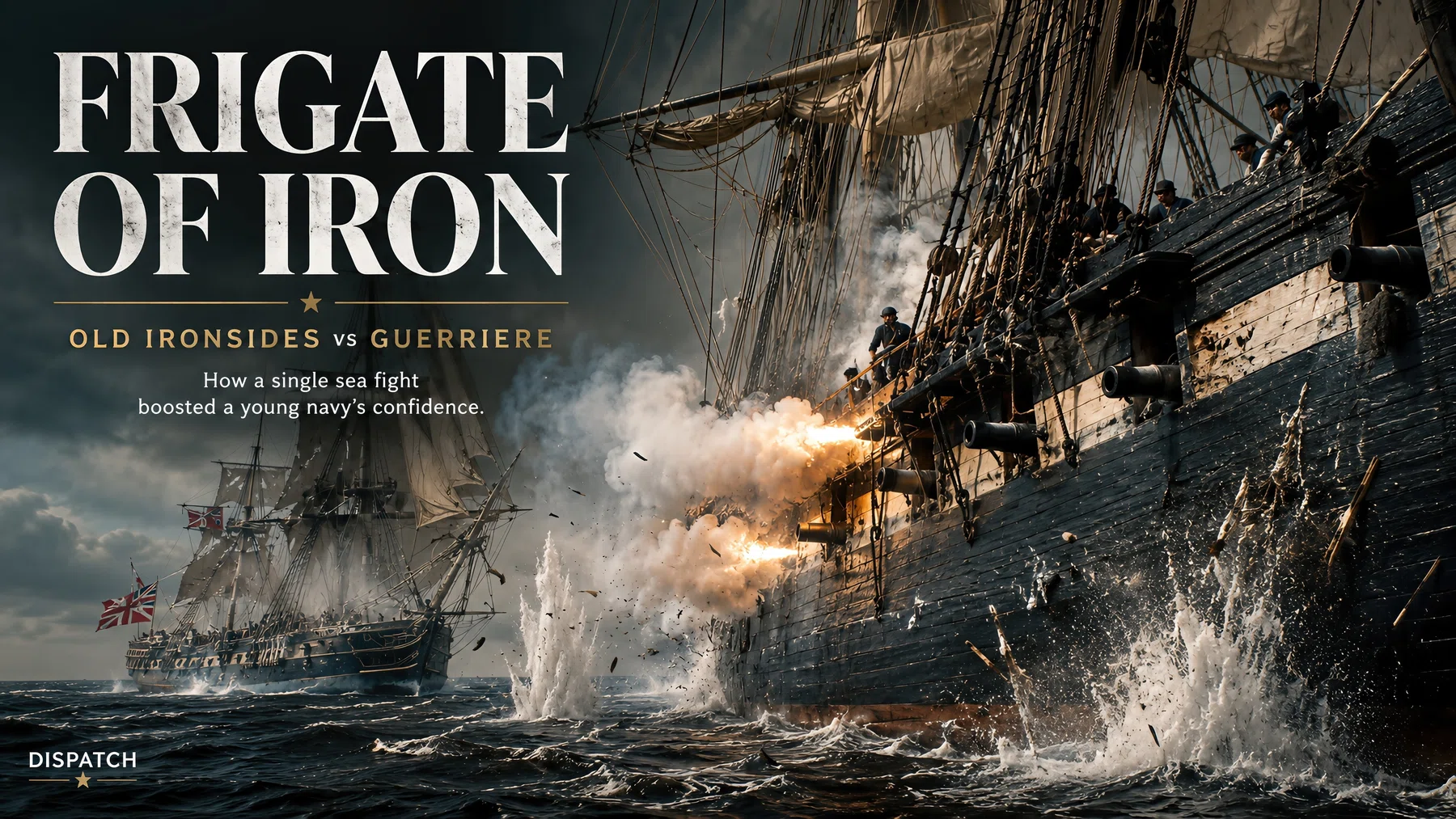
Late afternoon in August 1812, the Atlantic is heaving under gray clouds as a heavy American frigate bears down on a distant sail. On the quarterdeck of USS Constitution, Captain Isaac Hull watches through his glass while signal flags snap in the wind and gun crews stand ready at their stations. Men in sweat-darkened shirts strip down for battle, bare feet gripping the planks, rammers and sponges stacked nearby. Powder monkeys wait in the dim hatchways, hands on cartridge boxes, feeling the ship’s timbers tremble with every change of course. Ahead lies HMS Guerriere, a British frigate that has spent months hunting American merchantmen and now turns to meet this challenger.
The first exchanges are long-range, guns booming across the waves while water plumes leap up short or wide. Constitution’s crew feels each recoil, smells the scorched powder, but sees little damage in return. As the ships close, the duel becomes personal. The British gunners finally land solid hits, and yet something strange happens: round shot thuds into Constitution’s thick live oak hull and bounces away, leaving scars but not gaping holes. Sailors cheer as splinters fly outward instead of inward, yelling that her sides are made of iron. Amid gusts of smoke and shouted orders, the nickname “Old Ironsides” takes root right there on the gun deck. The air is filled with cannon blasts, torn canvas, and the grinding creak of timbers, but underneath the chaos something larger is beginning. This is no longer just another single-ship action; it is becoming a proof-of-concept for a navy barely a generation old.
Heavy Frigates and a Risky Atlantic Cruise
The road to that smoky August afternoon began years earlier, when American leaders decided that if they could not match the Royal Navy ship for ship, they could at least build a few unusually tough frigates. Naval architect Joshua Humphreys designed vessels like Constitution to be longer, stronger, and more heavily armed than typical ships of their class. Thick live oak frames, dense planking, and a heavy main battery of 24-pounder guns meant these frigates could hit harder and stand up to punishment that would cripple lighter opponents. Before the War of 1812, Constitution had already patrolled against French privateers and Barbary corsairs, gaining seasoning for both the ship and her officers. The crew knew their hull was stout and their guns powerful, but they had not yet faced a first-class British adversary head-on.
When war came in June 1812, British squadrons moved quickly to bottle up or hunt down the small American fleet. Captain Isaac Hull, who had recently taken command of Constitution, found himself pursued off the American coast by a powerful British force and survived only through skilful seamanship. His crew worked the ship around the clock, towing with boats and “kedging” with anchors to creep away in light winds while the enemy struggled to close. That escape was more than a narrow miss; it taught Hull which of his people could be trusted when exhaustion set in and how his frigate behaved at the edge of disaster. Meanwhile, across the Atlantic, HMS Guerriere had fought French opponents and harried American merchantmen, building the kind of hard-edged confidence common in the Royal Navy. Under Captain James Dacres, she patrolled with the assurance that British gunnery and discipline would handle any American challenger. When Constitution and Guerriere finally crossed paths on the open Atlantic, both captains brought to the encounter not just their ships and crews but the accumulated habits, drills, and assumptions of years at sea.
Closing the Range and Breaking a Opponent
On the day of battle, the first step was simply to make contact and hold it. Hull, wary after his earlier near-capture, did not charge blindly. He edged Constitution into a position where the wind favored him, trimming sail and testing how quickly he could turn without losing control in the swell. Guerriere, spotting the American frigate and eager for action, hoisted her colors and steered to engage, confident that British training would make short work of a rebel ship. As the distance narrowed, both captains ordered their crews to clear for action: hammocks stowed, bulkheads struck down for better fields of fire, decks sanded to keep blood-slick planks from becoming deathtraps. The ship’s bell marked time, but soon the rhythm that mattered came from the guns themselves.
The early firing was a matter of testing ranges and nerves. Guerriere fired broadsides that mostly fell short or over, while Constitution’s captain held his fire longer, unwilling to waste powder and shot. Men at the American guns gritted their teeth, listening to enemy iron whine past or smash into rigging and spars overhead. Only when Hull judged the range to be decisive did he give the order that unleashed Constitution’s heavy 24-pounders in earnest. The difference showed quickly. American broadsides slammed into Guerriere’s hull and lower masts, sending showers of splinters across her gun decks and tearing into her rigging. Within a short span, the British frigate’s mizzenmast toppled over the stern, dragging in the water and hampering her ability to maneuver.
With Guerriere partly crippled, the fight lurched into a closer, more chaotic phase. The two ships yawed and closed until they were nearly alongside at pistol shot. Rigging fouled, spars locked, and for tense minutes the battle threatened to turn into a brutal boarding action. Muskets cracked from the tops, Marines on both sides fired into clustered figures below, and officers shouted for boarding parties to stand ready. Yet it was the sustained hammering from Constitution’s guns, delivered at close range with powder-blackened precision, that slowly ground down the British ship. Guerriere’s main and foremast could not endure the punishment forever. One after another they gave way, crashing over the side and leaving the British frigate a dismasted hulk rolling in the Atlantic swell.
In that final, grim phase, Guerriere could no longer bring most of her guns to bear. Her decks were a tangle of fallen spars, torn canvas, and wounded men. Dacres, himself injured, saw that further resistance would mean only more dead without changing the outcome. The British colors came down, signaling surrender to the American frigate that still floated with masts upright and guns ready. On Constitution’s decks, cheers mixed with the groans of the wounded and the sharp commands of officers trying to restore order among smashed boats and scorched gun carriages. The duel had been fought and decided in less than an afternoon, but the reasons for that outcome ran deeper than luck or a single broadside. Those reasons, from ship design to training and tactical choices, would shape how both navies read the lesson of Old Ironsides’ victory.
Design, Discipline, and a Calm Hand
What turned the duel in Constitution’s favor was not a single lucky shot, but the way several advantages stacked together once the guns opened in earnest. The first and most obvious was the ship herself. Humphreys’s design gave Constitution thicker sides and heavier long guns than a typical frigate of her rating, which meant that when Hull chose to close the range and trade full broadsides, his 24-pound shot smashed deeper into Guerriere’s hull and lower masts. The same live oak that shrugged off British cannonballs early in the fight also gave American gun crews a psychological edge. When they saw enemy rounds bouncing, they believed even more strongly that they could stand and hammer.
Training and fire discipline mattered just as much as timber and iron. Hull refused to be drawn into an ineffective long-range exchange, holding his fire until the range suited his heavier guns. Once engaged, American crews worked in a tight, practiced rhythm: run out, fire, sponge, and reload, aiming low into hull and rigging rather than scattering shot into empty sky. On the British side, Guerriere’s officers and men were brave and experienced, but they found themselves fighting a ship that could endure more punishment than they were used to seeing from a frigate opponent. With her mizzenmast gone and steering impaired, Guerriere lost the ability to control the distance and angle of the fight, which had been one of the Royal Navy’s traditional strengths.
Finally, leadership on both quarterdecks helped shape the outcome. Hull’s calm handling of his ship, informed by his earlier escape from a British squadron, kept Constitution from being caught in a bad position when the wind shifted and the sea grew confused by wreckage. He pressed the advantage once Guerriere’s damage became clear, staying close enough to keep his broadsides telling but not so entangled that a boarding disaster could snatch away victory. Dacres, wounded and surrounded by shattered spars and rising casualties, had to weigh honor against the reality of a dismasted, uncontrollable ship in open ocean. His decision to strike preserved lives but sealed the American victory in the eyes of both navies. Together, design choices made years earlier, practiced gunnery, and a steady hand in command turned one afternoon’s duel into a decisive statement.
From One Duel to a Lasting Legend
In the immediate aftermath, the practical results were stark. Guerriere was so badly mauled that she could not be saved as a prize; after removing prisoners and valuables, Constitution’s crew burned the wreck rather than risk towing a crippled hull across the Atlantic. American casualties were comparatively light, while British losses in killed and wounded were significantly heavier. When Hull brought Constitution into port, he carried not just captured officers and crew, but proof that an American frigate had met a comparable Royal Navy opponent and won cleanly in single combat. News of the victory spread quickly along docks, in taverns, and through newspapers, lifting spirits in a war that had begun with setbacks on land.
At the campaign level, one frigate duel did not overturn British dominance of the sea. The Royal Navy remained able to blockade American ports and restrict trade. Yet the psychological effect was out of proportion to the tonnage involved. For American sailors and officers, Constitution’s victory validated their belief in their ships and training. For British observers, it was an uncomfortable reminder that newer American frigates, handled boldly, could not be dismissed as mere provincial curiosities. Subsequent single-ship actions, both victories and losses on each side, would add layers to that developing picture, but Old Ironsides’ triumph over Guerriere stood out as an early, sharp shock.
Over time, the story of the duel fed into something larger: the making of a national symbol. The nickname “Old Ironsides,” born in powder smoke and shouted over bouncing shot, followed the ship into later fights and peacetime cruises. Decades after the War of 1812, when plans surfaced to scrap the aging frigate, public outcry helped save her, fueled in part by memories of that day when she humbled a British opponent in the open Atlantic. Today, visitors walking her decks hear about the thunder of the guns, the cheer when shot glanced off her hull, and the confidence that spread through a young navy after the smoke cleared. In a single fight, a wooden frigate did more than win a tactical contest; it gave a small maritime nation proof that its ships and sailors could meet the world’s best and come away stronger.
