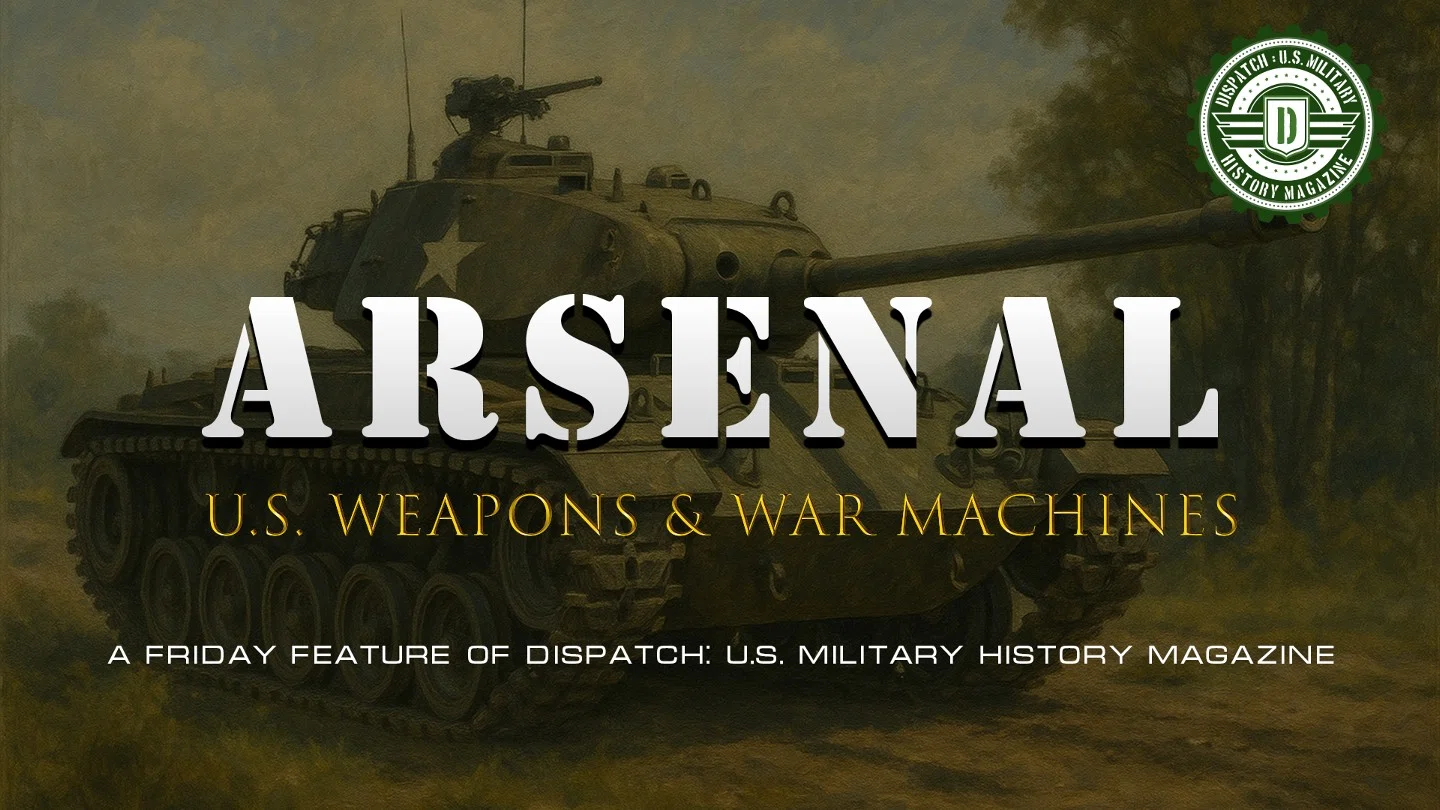
In Action
The lead M41 bounces hard as it crests the low rise, its torsion bars flexing under the sudden shift in weight. Early 1970s, along the dusty Laotian border, the light tank’s four-man South Vietnamese crew squints through periscopes and gunsights at a tree line that should be quiet and empty. Instead, dark shapes are moving there, low and boxy, the unmistakable silhouettes of approaching enemy armor. The tank commander calls corrections into his throat microphone, voice just audible above the engine’s high, ragged roar.
Inside the turret it is cramped and hot. The loader braces his boots, hauls a 76 millimeter round from the ready rack, and slams it home. Brass clatters underfoot, mingling with the smell of cordite and gasoline. The gunner rides the powered traverse, trying to keep a weaving enemy tank centered in his sight as red tracer flashes through the dust. These light tanks were meant to scout, to move, to peek and slip away. Today there is nowhere to go and no heavier armor to hide behind.
Out front, the M41’s first shot goes high, then the second strikes home with a dull flash against a Soviet-built hull. Enemy guns answer back, heavier shells ripping the earth and showering dirt across the Bulldog’s thin armor. The crew works the turret as fast as they dare, trading mobility and a quick-firing gun against opponents that can kill them with a single well-placed hit. On this ridge, in this moment, the vehicle’s promise and its compromises are laid bare. The M41 was born from a demand for a light, hard-hitting scout. In the Cold War’s proxy battles, that design would be tested far beyond the drawing board.
The Problem It Was Built To Solve
The M41’s story began not in the jungles of Southeast Asia but in the uneasy first years after the Second World War. The United States Army had gone to war with the M24 Chaffee as its primary light tank, a nimble machine whose 75 millimeter gun and thin armor were adequate for late-war reconnaissance. By 1945, however, it was clear that any future conflict against the Soviet Union would pit American armor against increasingly capable medium tanks like the T-34 and its successors. A scout that could only observe and then flee was no longer enough.
Postwar armored doctrine demanded a light tank that could move quickly with mechanized forces, probe ahead of heavier formations, and still carry a gun with at least a fighting chance against enemy armor. At the same time, the vehicle had to be light enough for easy transport and simple enough to maintain with existing industrial tools. The old Chaffee was wearing out, its parts aging and its armament already behind the curve. Armored officers wanted a replacement that could keep up on modern battlefields without becoming a full-sized medium tank in disguise.
Budget cuts and peacetime complacency slowed progress. Engineers sketched and tested new concepts under designations like T37 and T41, searching for the balance between firepower, protection, and weight. The outbreak of the Korean War jolted the system awake. Reports from the fighting, where American light tanks once again faced well-armed enemy vehicles, sharpened the argument for something better. The answer would be a new 76 millimeter gun tank: compact, fast, and armed to do more than simply watch the enemy roll past. Under the name M41, it was pushed from concept into production as a Cold War tool for armed reconnaissance, ready to take its place on the front lines of a very different world.
From Design Board To Production
The path from paper sketches to the M41 Walker Bulldog that rolled off the line ran through a series of awkward prototypes. In the late 1940s, designers wrapped their heads around the T37 concept, a compact light tank meant to outgun the aging M24 without growing too heavy to airlift or rail across oceans. They tried different turrets, gun mounts, and fire control layouts, chasing a gun that could threaten contemporary Soviet mediums while still living on a chassis that mechanics already understood. Out of that process came the T41, essentially the second phase of the T37 idea, with a refined 76 millimeter gun and a hull shaped for better internal volume and protection.
The Korean War did not design the M41, but it did light a fire under the program. As reports flowed back from the peninsula about rough terrain, rushed movements, and cramped supply lines, a fast tank with a hard-hitting gun looked less like a luxury and more like a necessity. The Ordnance Department pushed the T41E1 into standardization, and Cadillac’s production expertise turned drawings into steel. Between 1951 and 1954 more than five thousand vehicles were built, an impressive total for a light tank in the early Cold War. In United States service it entered the books as the 76 millimeter gun tank M41, later gaining the Walker Bulldog name in honor of General Walton Walker.
At a glance, this new machine was a classic early Cold War light tank: an American four man crew, a welded steel hull, and a 76 millimeter high velocity gun as its primary armament. It served mainly with the United States Army in the 1950s and 1960s, then spread widely through military aid to allies in Asia, Latin America, and elsewhere. Weighing under twenty five tons but powered by a roughly five hundred horsepower gasoline engine, it could reach road speeds that made it one of the fastest tanks of its day, though that speed came at the cost of heavy fuel consumption and thin armor.
By the time the United States retired the Bulldog from frontline duty in the late 1960s, it had done exactly what planners expected and less of what crews in hard fights sometimes needed. It had filled the light tank slot in armored divisions, led columns, and served as a sharp export tool in the wider Cold War contest. The same mix of strengths and compromises that came out of the design board would follow it into every jungle valley and border skirmish where it later fought.
Inside The Weapon
Walk up to an M41 and you meet a compact, purposeful shape. The hull is a welded steel box with a sharply sloped glacis plate at the front, five medium-sized road wheels on each side, and tall exhausts at the rear corners that give it a distinctive silhouette. Under the rear deck sits a Continental air cooled gasoline engine linked to a cross drive transmission, a combination that gives the tank brisk acceleration and a high top speed on roads. Torsion bar suspension and hydraulic shock absorbers at key wheel stations try to tame the ride, but crews still remember a machine that bounced and lurched when pushed hard across broken ground. afvdatabase.com+2
Inside, the layout follows the familiar pattern of mid century American tanks. The driver sits in the front left of the hull, accessing his position through a single hatch and peering out through several periscopes set into the roof. There is an emergency escape hatch beneath him, a reassuring feature in a vehicle whose thin armor could admit splinters and spall under serious fire. Behind the driver, separated by a bulkhead, the engine compartment hums and howls, creating constant background noise and heat that seep into the crew space. The rest of the crew lives in the turret basket, suspended over the hull floor as the turret swings. vietnam.net.pl+2
The turret itself is a mix of cast and welded steel, compact but high enough to give the commander a reasonable view when standing in his cupola on the right side. Below him, also on the right, is the gunner, gripping his hand controls and working through a telescopic sight to put the 76 millimeter gun on target. On the left sits the loader, his world defined by ammunition racks, the breech of the main gun, and the roof hatch he uses to bring more rounds in from outside. Over their heads, the commander’s cupola offers multiple vision blocks and, on many tanks, a heavy machine gun mount that doubles as an anti aircraft and local defense weapon. afvdatabase.com+2
In training diagrams the Bulldog’s crew workflow looks neat and efficient. The driver keeps the tank moving, the commander searches for targets and issues orders, the gunner tracks and fires, and the loader feeds the gun in a steady rhythm. In the field, especially in hot climates like Vietnam, those roles blur under sweat and tension. The compact turret that keeps the tank’s profile low also means elbows collide, ammunition racks are close to bodies, and everyone feels the turret swing in their knees and backs. The main gun’s recoil shakes the entire vehicle, and expended brass underfoot adds another trip hazard as the fight wears on.
Subsystems reflect the design’s emphasis on speed and firepower over endurance. The 76 millimeter gun uses a vertical sliding breech and a recoil system designed to bring the barrel back on target quickly, while a coaxial machine gun and a roof mounted heavy machine gun provide close range and anti infantry fire. The turret traverse is powered, fast enough to swing through a full circle in roughly ten seconds when the system is healthy, which crews appreciated in ambush country where threats could appear from any direction. What the Bulldog lacks are the thicker armor plates, advanced stabilization, and comfortable crew space later generations would take for granted. In combat, veterans remember a tank that was quick to accelerate and quick to burn if hit, a machine you could learn to fight from but never really relax inside.
Baptism Of Fire
The M41’s first harsh test came not in a global war but on a lonely Cuban beach in 1961. A small platoon of anti-Castro exiles, trained in secret and equipped with five Bulldogs, rolled ashore during the Bay of Pigs invasion. Instructors had drilled them on how to use speed and the 76 millimeter gun to offset thin armor, and for a short time it worked. Their tanks knocked out several Soviet built T-34s along the narrow coastal road, using quick shots and the ability to reposition faster than their heavier opponents could react. For a moment, the light tank seemed to punch far above its weight.
That early success did not last. Without sustained air support or resupply, the exiles’ M41s ran short of ammunition and found themselves isolated, hemmed in by enemy armor and infantry. When the beachhead collapsed, the Bulldogs were abandoned or captured, a stark reminder that even a well handled light tank cannot carry an operation on its own. In American hands the M41 never fought as part of a United States Army armored thrust, but its export story ensured it would see plenty of fire elsewhere.
In Vietnam, the tank found its main war. Delivered in large numbers from the mid 1960s, M41s became the primary tanks of the Army of the Republic of Vietnam, replacing worn out Chaffees in frontline units. South Vietnamese crews took to the Bulldog quickly, appreciating its responsive controls, fast turret, and a gun that finally gave them a real chance against enemy armor. In Operation Lam Son 719 in 1971, M41 units crossed into Laos alongside armored personnel carriers and airborne infantry, tasked with disrupting the Ho Chi Minh Trail. There they ran into North Vietnamese formations equipped with T-54 and PT-76 tanks, producing some of the first major tank-on-tank battles of the conflict.
Accounts describe M41s using hull-down positions and quick relocation to engage heavier opponents, scoring multiple kills but suffering heavily from mines, rockets, and return fire. Later, during the 1972 Easter Offensive and the final campaigns of 1975, many South Vietnamese crews fought from dug-in positions, their light tanks used as static gun platforms to stiffen defensive lines. This tactic traded away mobility, leaving the Bulldogs vulnerable to flanking attacks and guided missiles, but in city streets and chokepoints their fast-firing guns still mattered. By the end of the war hundreds of M41s had been destroyed, abandoned, or captured, yet veterans on both sides remembered them as hard-fighting machines that kept showing up on new fronts as the Cold War’s proxy battles flared.
Strengths And Weaknesses
What crews liked most about the M41 was obvious from the first drive. It was quick, with a power-to-weight ratio that made it leap forward on roads and scramble through broken ground where heavier tanks bogged down. The 76 millimeter gun, while not the last word in tank killing, offered high velocity rounds that could damage or destroy many contemporary threats from the flank or at moderate ranges. Commanders appreciated a turret that traversed rapidly, letting gunners swing onto threats faster than many opponents, and maintainers valued the fact that the Bulldog’s automotive systems were familiar evolutions of existing American practice rather than exotic experiments. For smaller framed South Vietnamese crews, the cramped turret was tolerable, and the tank felt lively and responsive compared to older designs they had known.
The flip side of that performance was vulnerability. To keep weight down, armor thickness stayed modest, enough to stop small arms and shell splinters but not enough to shrug off modern anti tank guns, high explosive rounds, or shaped charge weapons. As Soviet designs evolved, newer medium and main battle tanks outclassed the Bulldog in both firepower and protection, especially from the front. The gasoline engine consumed fuel at a high rate and produced a distinctive exhaust signature and noise that made the tank easy to detect, and its limited range constrained operations without strong logistics. When M41s were dug in as static strongpoints, they lost the ability to exploit their speed and became easier targets for anti tank guided missiles and flanking armor.
Enemies learned quickly what to fear and what to exploit. Infantry respected the tank’s rapid fire support and coaxial machine gun, especially in built-up areas, and tank crews on the other side understood that a careless flank or rear exposure could end badly if an M41 was nearby. At the same time, commanders facing Bulldogs prioritized artillery, missiles, and heavier armor to break their positions. Compared with later light tanks and armored reconnaissance vehicles, the Walker Bulldog sits in a middle ground: more heavily armed than many scouts, more mobile than most mediums of its era, yet increasingly out of place as battlefield threats grew deadlier.
Variants And Evolution
Over its service life the basic M41 spawned a family of variants as armies tried to stretch the usefulness of a solid but aging design. Early on, incremental changes produced the M41A1 and M41A2, refining internal systems and addressing teething issues without transforming the tank’s overall character. Later production standardized as the M41A3, the version most widely exported under American military assistance programs. In these forms the Bulldog populated armored battalions from Denmark to South Vietnam, each user adapting the tank’s employment to local terrain and doctrine.
As decades passed, several countries undertook deeper rebuilds. Brazil fielded upgraded versions commonly known as M41B and M41C, which combined diesel engines, improved fire control, and in some cases a 90 millimeter gun to restore relevance against newer threats. Uruguay’s M41A1UR similarly received local improvements, while Taiwan developed the M41D program, modernizing engines, optics, and electronics to keep its fleet viable into the twenty first century. These upgrades reflected a common judgment: the Bulldog’s chassis and basic layout were sound enough to justify investment when budgets or politics made outright replacement difficult.
In United States service the M41’s evolutionary path ended with replacement rather than radical conversion. By the late 1960s, planners concluded that a new light tank was needed, one that promised better air portability and a more effective main weapon against modern armor. The result was the M551 Sheridan, a very different and controversial answer to the light tank question. As Sheridans entered service, Bulldogs left American frontline units, their future increasingly tied to foreign users and upgrade programs rather than new domestic development.
Legacy And Where To See It Today
The Walker Bulldog’s legacy lies less in a single famous battle and more in the way it bridged eras. It embodied the first postwar attempt to create a truly modern light tank for armed reconnaissance, combining a powerful gun with high mobility in a compact hull. Lessons from its use, and from its limits, shaped thinking about what later light armor should and should not try to do. The tension between wanting a tank that could scout, fight, deploy quickly, and still survive on a battlefield crowded with heavy guns runs through every subsequent design debate.
On the ground, its influence is visible in the armies that used it for decades. In South Vietnam it was the mainstay of an armored corps that fought a long and difficult war. In Brazil, Taiwan, and several Latin American and African states, it served as the first true modern tank for crews who had previously known only older Second World War designs or light armored cars. Exported Bulldogs helped train generations of officers and mechanics, built up local industry’s ability to overhaul and upgrade armored vehicles, and provided the backbone for national defense plans long after the United States had moved on. Even today, a handful of upgraded examples remain in service, a testament to how a well understood machine can outlive its designers’ original timeline.
For readers who want to see a Walker Bulldog in person, museum and memorial examples are scattered across several continents. In the United States, visitors can find them at institutions such as the First Division Museum in Illinois or the Fort Meade museum in Maryland, where preserved tanks show the compact hull and turret details up close. Other examples sit in outdoor displays at military vehicle collections and base gate guards, including restored machines at regional museums that focus on Cold War armor. Photographs and video walk-throughs, the kind often highlighted in Dispatch and on Trackpads platforms, offer additional ways to explore the vehicle’s interior and hear from those who served on it. However you encounter it, the M41 Walker Bulldog stands as a reminder that behind every fast moving silhouette on a distant ridgeline are crews making split second decisions in steel boxes whose design shaped their odds of coming home.