In Action
Midnight over Baghdad, January 1991. From the cockpit of an F-117 Nighthawk, the city looks almost peaceful at first: a soft orange glow on the horizon, a dark ribbon of river, scattered pinpoints of light. The pilot flies alone, high above a capital ringed with some of the most formidable air defenses in the world. Down there are radars, missiles, guns, and crews who have spent years training to kill aircraft exactly like his. What they are not prepared for is an attacker they cannot see.
On the jet’s multi-function displays, the target complex resolves into crisp symbology: an air defense command node on the outskirts of the city. The pilot arms his weapons, steadies the cursor, and rides the countdown in quiet, pressurized air. Outside, searchlights and tracers grope wildly at the night, stabbing at empty sky. Surface-to-air missile batteries launch in blind arcs, their exhaust flares blooming far below, chasing ghosts.
The F-117 flies a pre-programmed path, its faceted skin and radar-absorbing materials bending and swallowing energy that would have bounced clean off a conventional jet. The bomb bay doors open for only a few seconds. Two laser-guided bombs fall away, guided by an invisible beam onto a precise aim point. In the distance, an orange flash marks the destruction of a key node in Iraq’s integrated air defense system.
Then the doors close, the jet turns for home, and the pilot vanishes back into the dark — one of only a handful of aircraft trusted to strike the most heavily defended targets on the first night of the war. That lonely flight profile, and the strange, angular jet that made it possible, grew out of a very specific problem that had haunted air planners for decades.
The Problem It Was Built To Solve
The F-117 Nighthawk did not begin as a futuristic shape on a designer’s sketchpad. It began as a growing fear inside the United States Air Force: that modern air defenses were catching up with, and might soon outrun, traditional ideas of air power. In the skies over North Vietnam, radar-guided missiles and dense anti-aircraft artillery had taken a heavy toll on strike aircraft. Later conflicts only reinforced the lesson. Networks of radar sites tied to mobile missile launchers made it increasingly dangerous to fly conventional bombers and fighters against well-prepared opponents.
By the 1970s, the problem was clear. To hit vital command centers, air defense hubs, and hardened infrastructure deep inside enemy territory, planners had to send in large strike packages: bombers, escort fighters, jamming aircraft, and specialized “Wild Weasel” jets hunting enemy radars. These armadas could deliver devastating blows, but they were complex to plan and vulnerable to surprise. As radar systems became more sensitive, and missiles gained better seekers and longer reach, the cost of forcing a way through dense air defenses looked likely to rise even further.
Traditional answers focused on speed, altitude, and jamming. Fly higher, faster, or lower. Carry more powerful electronic warfare pods. Build aircraft that could outrun or out-climb incoming missiles. Yet each of these approaches ran into limits. There was only so far pilots could push low-level flight before fatigue and terrain masked their own errors. There was only so much power that could be poured into jamming before enemy systems adapted with new frequencies, modes, and tactics.
What if, some engineers and tacticians began to ask, you could design an aircraft that did not merely confuse radar, but largely sidestepped it? Rather than meeting the threat head-on with more speed and more noise in the spectrum, perhaps the answer was to become extremely difficult to detect in the first place. That idea — low observability as a core design principle rather than an afterthought — pointed toward a radically different kind of attack aircraft. The decision to pursue it would lead, step by careful step, to the secretive program that produced the world’s first operational stealth attack jet: the F-117 Nighthawk.
From Design Board To Production
The path to the F-117 Nighthawk began in the shadows of the 1970s, when a handful of engineers set out to answer a simple but radical question: what if an aircraft could be shaped and coated so that radars would struggle to see it at all. Mathematical work on how radar energy reflected from flat panels and sharp edges suggested that the right geometry could dramatically shrink an aircraft’s radar cross section. Lockheed’s Skunk Works team took that abstract idea and turned it into a flying experiment known as Have Blue, a small, angular test aircraft that looked nothing like a traditional fighter or bomber. Those early prototypes were difficult to fly and rough around the edges, but they proved that low observable shaping and special surface materials could make an aircraft surprisingly hard to detect.
From there, the Air Force and Lockheed moved into a tightly classified program to build an operational strike jet around the same principles. Tradeoffs defined every step. Stealth and precision were the goals, which meant accepting subsonic speed, limited payload, and a narrow mission profile in exchange for very low observability. Instead of a versatile multirole fighter, designers focused on a dedicated night attack aircraft that would slip through defenses to hit high value targets on the first night of a war. The jet’s faceted skin, internal weapons bays, shielded engine intakes, and carefully managed exhaust all reflected this single purpose.
At a glance, the F-117 Nighthawk was a single seat, twin engine stealth attack aircraft built in the United States for the United States Air Force in the closing decades of the Cold War. It carried one pilot, relied on internal bays for up to two precision guided bombs in the two thousand pound class, and flew at high subsonic speeds with a combat radius of several hundred miles that could be extended by aerial refueling.
Production remained relatively small and secret. Just over sixty aircraft were built, organized into units that operated from remote bases in the American Southwest under cover designations and training stories. Pilots and maintainers volunteered into a world of long absences, tight security, and little public recognition. By the early 1980s the first operational F-117s were flying at night over the Nevada desert, giving the Air Force a new kind of attack aircraft that almost no one outside a narrow circle even knew existed. When crises loomed, these jets were earmarked for the most heavily defended targets, the very problem they had been designed to solve.
Inside The Weapon
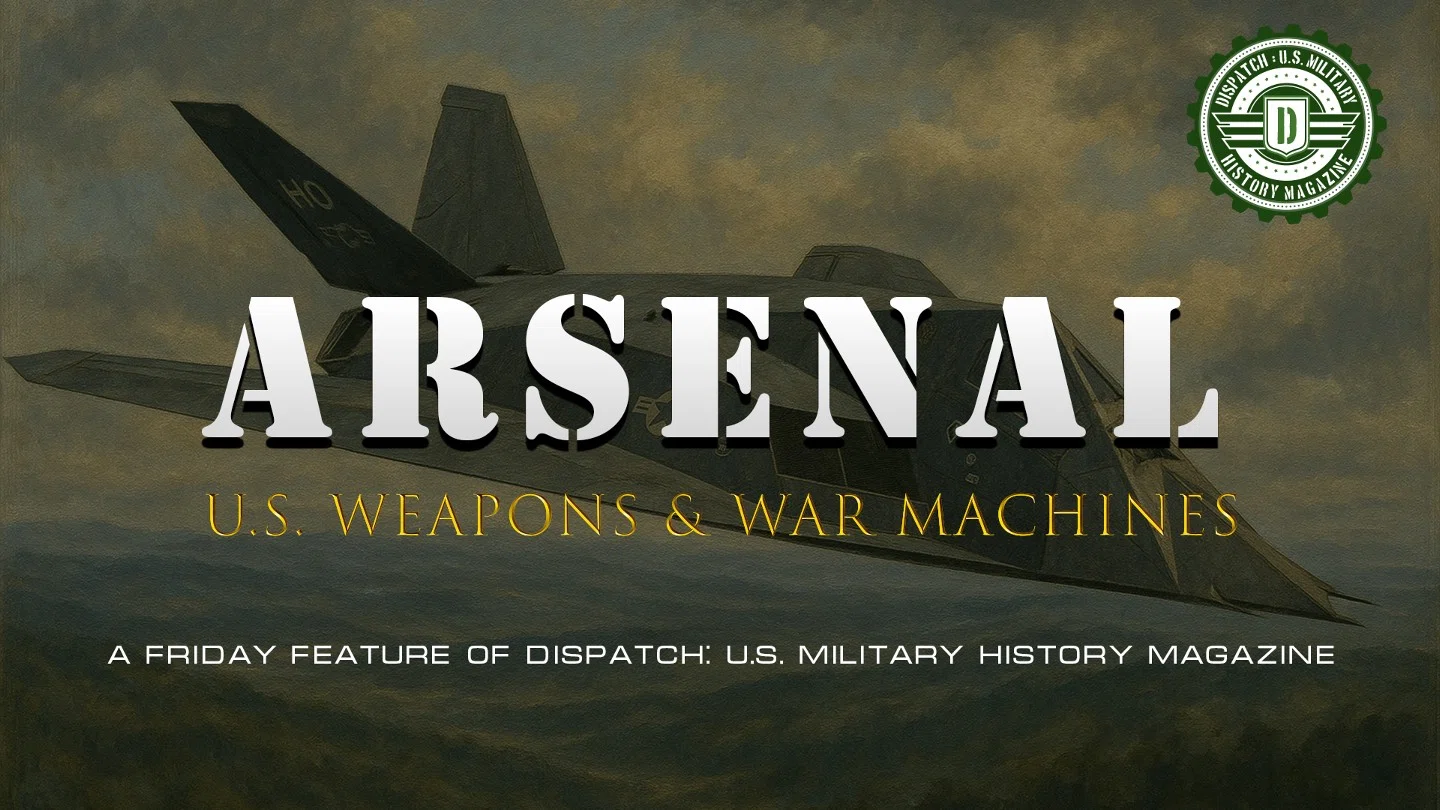
Seen on the ramp, the F-117 Nighthawk does not look like any conventional fighter. Its fuselage is a collection of flat, angular facets that bend smoothly into a sharply canted tail, with no sweeping curves or graceful lines. Every edge is aligned to scatter radar energy away from the transmitting antenna. Panel joins, antenna locations, and access doors are all treated and shaped with low observability in mind. The result is a jet that appears almost alien, covered in dark, radar absorbing coatings that require careful handling from the ground crew. The wings are broad and straight, giving good lift at subsonic speeds but adding to the odd, bat like silhouette that spotters later learned to recognize.
Climb the ladder and you arrive at a snug single seat cockpit set high in the forward fuselage. The pilot sits under a hinged canopy with relatively small windows compared to many fighters, trading some outward visibility for stealth friendly framing and armor. In front of the seat, large multi function displays and a head up display dominate the instrument panel. The F-117 has no air to air radar. Instead, the pilot relies on infrared sensors and laser designator systems that feed imagery and cues to the screens, along with inertial and later satellite aided navigation. At night, much of the flight is flown by reference to these glowing displays and to the aircraft’s flight control computers rather than to a clear view outside.
Beneath the cockpit and center fuselage sit the internal weapons bays. Their doors remain tightly closed for most of a mission to preserve low observability, opening only for brief periods to release weapons. Inside, the jet usually carries one or two precision guided bombs, often laser guided weapons aimed at critical nodes such as command bunkers, radar control centers, or hardened aircraft shelters. The pilot manages weapon selection and release through the displays and a carefully arranged set of controls on the throttles and stick so that eyes can stay mostly on the instruments.
Power comes from two turbofan engines buried deep in the fuselage. Air reaches them through S shaped intakes that hide the engine compressor faces from radar. Exhaust gases flow out through broad, flattened nozzles over the upper surface of the aircraft, mixed and cooled to reduce the infrared signature. This arrangement, combined with the faceted shape, exacts a price in performance. The F-117 is agile enough to maneuver into its attack runs and escape, but it is not a dogfighter. It has no cannon and carries no air to air missiles. Its defenses come from being very hard to find in the first place.
Life with the Nighthawk is a partnership between the lone pilot and a large support team. Before each mission, maintainers swarm the jet to check flight control systems, inspect stealth coatings, and load weapons and fuel. They work under strict rules to protect the surfaces and edges that give the jet its low radar cross section. Inside the cockpit, the pilot straps in for long, solitary flights in darkness, trusting the aircraft’s fly by wire computers to keep an inherently unstable shape under control. Communication with other aircraft and controllers is steady but disciplined, since emissions can also reveal presence. Pilots who flew the F-117 often described it as both demanding and reassuring. Demanding, because the workload and isolation were high. Reassuring, because when everything worked as designed, enemy defenses seemed to lash out at empty air while the Nighthawk slipped past to put its bombs exactly where planners needed them.
Baptism Of Fire
When the F-117 Nighthawk flew into combat for the first time, it did so quietly, at night, and with very little fanfare. In December 1989, during the United States intervention in Panama, a handful of F-117s were used in a limited way to drop precision bombs near key targets, a cautious first trial of the new stealth attack concept. Those early missions were important, but it was Operation Desert Storm in 1991 that truly burned the Nighthawk into the public imagination. There, the aircraft was tasked with some of the most heavily defended targets in Iraq, including air defense command centers, communication hubs, and hardened bunkers in and around Baghdad.
On the opening night of the air campaign, F-117s crossed the border before most other strike aircraft, threading their way through overlapping radar coverage and missile belts that planners had worried about for months. Their mission was to break the eyes and ears of Iraq’s integrated air defense system by hitting key nodes. Each jet carried only a pair of precision guided bombs, but each weapon was aimed at a specific aim point inside a larger complex, such as a bunker ventilation shaft or a particular corner of an operations building. This was not area bombing. It was surgical cutting of nerves inside a larger system.
Coalition aircraft flying non stealthy types still had to contend with surface to air missiles and anti aircraft artillery, but the F-117s themselves returned with very few scars. Reports from that first week repeatedly emphasized how the jets seemed to pass through the most dangerous zones with little reaction until after their weapons hit. When Iraqi operators saw flashes on the ground, they often responded by firing wildly into the sky, unsure of where the attacking aircraft actually were. The Nighthawk’s success in Desert Storm did not mean it was invulnerable. One was later lost to enemy fire over Serbia in 1999 when a skilled opponent exploited predictable routes and older radar frequencies. However, the Desert Storm campaign demonstrated that a carefully planned stealth strike could reliably open air defenses for other aircraft, profoundly changing how air planners approached the first nights of a war.
Strengths And Weaknesses
Crews, planners, and commanders who worked with the F-117 tended to describe it in terms of trust. Its greatest strength was the way it allowed a single pilot in a single aircraft to strike a high value target deep inside a defended area with high confidence of both weapon accuracy and survival. The combination of low observability, precise navigation, and laser guided munitions meant that a relatively small force of Nighthawks could do, on the first night of a campaign, what once required large strike packages with extensive electronic warfare support. This freed up other aircraft for different missions and reduced the risk to aircrew across the force.
Pilots praised the jet’s stable bombing platform and the clarity of its targeting displays once they had settled into an attack run. Many described a sense of quiet isolation in the cockpit that helped them focus on the task, even as distant flashes and tracer arcs marked where enemy defenses were reacting. Commanders valued the Nighthawk as a tool for hitting command posts, hardened aircraft shelters, and infrastructure that might otherwise require repeated attacks. The psychological impact on opponents was also real. Knowing that a stealthy aircraft could strike leadership and control sites without warning tended to force enemy forces to disperse, hide, and dilute their own efficiency.
The aircraft’s weaknesses were just as real. It was not versatile. The F-117 could not dogfight, had no radar of its own, carried no air to air missiles, and offered only limited self defense options if detected. It depended heavily on darkness, good mission planning, and reliable navigation and targeting systems. Laser guided bombs worked best in clear weather with minimal dust, smoke, or cloud between the jet and the target. Prolonged bad weather could restrict its employment. Maintenance demands were high. Stealth coatings required careful inspection and repair, and the angular structure demanded tight control over panel alignment and surface condition. Enemies who studied its patterns, as in the case of the Serbian air defenses, could sometimes anticipate routes and altitudes and bring older, lower frequency radars and missiles to bear in a narrow window of opportunity. The Nighthawk was a powerful instrument, but one that had to be used with discipline and respect for its limits.
Variants And Evolution
Unlike some aircraft families that grow through a long list of major variants, the F-117 fleet remained relatively small and focused. All operational aircraft carried the F-117A designation, and the basic external shape changed little over their service life. Evolution came instead through internal upgrades and refinements. Avionics were improved, navigation systems were modernized, and new weapon options were integrated so that the jet could make use of more advanced precision guided bombs as they became available. These changes did not create clearly distinct variants that would look different on a ramp, but they did keep the Nighthawk tactically relevant as precision strike expectations grew.
Experience in Panama, Desert Storm, and later operations over the Balkans fed directly back into how missions were planned and how pilots were trained. Tactics were adjusted to reduce predictable patterns, and integration with other aircraft, such as tankers and electronic support platforms, was refined. The aircraft also served as a test bed at times, helping engineers explore new coatings, materials, and mission system concepts that would find their way into later designs. As newer stealth aircraft like the B-2 bomber and later fighter sized designs matured, it became clear that the narrow, pure attack focus of the F-117 would eventually give way to platforms that could combine stealth with broader mission flexibility.
By the early twenty first century, plans were in motion to retire the Nighthawk. Officially withdrawn from frontline service before many expected, the jet left behind a body of lessons about maintenance, sortie generation, and stealth sustainment that shaped how later stealth fleets were supported. A small number of aircraft continued to fly in limited roles for testing and training, even after formal retirement, hinting at ongoing work in stealth tactics and defensive planning. Although there was never a two seat trainer version or a widely exported variant, the F-117’s true “variant tree” can be seen in the family of stealth aircraft that followed, all of which owe something to the path it opened.
Legacy And Where To See It Today
The F-117 Nighthawk’s most important legacy lies in how it changed the mental picture of deep strike operations. Before it, planners tended to think of opening an enemy air defense system with large, noisy blows. After it, they increasingly imagined precise cuts delivered by small numbers of low observable aircraft that could slip in, blind key sensors, and walk away before opponents fully understood what had happened. The idea that a nation could remove leadership and control nodes early in a conflict with relatively low risk to aircrews became a central assumption in many air campaigns. Stealth was no longer a speculative technology. It was a proven tool that had worked over one of the most heavily defended capitals in the world.
Doctrinally, the Nighthawk helped push air forces toward greater emphasis on precision, timing, and information. Its missions were only as effective as the intelligence and planning behind them. That reinforced the importance of accurate target development, detailed studies of enemy radar networks, and close coordination with other assets that could exploit the openings stealth strikes created. Later stealth aircraft took these principles further, combining low observability with broader sensor suites and multirole flexibility, but they did so along a path first cleared by the F-117.
For those who want to see the aircraft itself, several retired Nighthawks now sit in American air museums and on display at bases where visitors can walk around the once secret shape in daylight. Others stand as gate guards, their angular forms welcoming personnel and guests to units that worked closely with stealth operations. Photographs and video from exercises and combat tours, including detailed ramp shots and in flight images, are widely shared in military history communities and collections, including platforms associated with Dispatch and Trackpads. These images help translate what was once a shadowy silhouette into a familiar part of aviation history.
The F-117’s story connects naturally to other features in the Dispatch family. Medal of Honor narratives and broader campaign histories often describe the ground side of the conflicts in which the Nighthawk flew, while Living History style interviews with pilots, planners, and maintainers bring out the human detail behind the black jets. Other Arsenal pieces on later stealth platforms make clear how concepts first proven over Baghdad matured into the broader stealth era. At the heart of all these stories are the people who strapped into a cockpit or turned a wrench on a machine that depended on their skill, judgment, and courage to turn mathematical theory into real, decisive strikes in war.