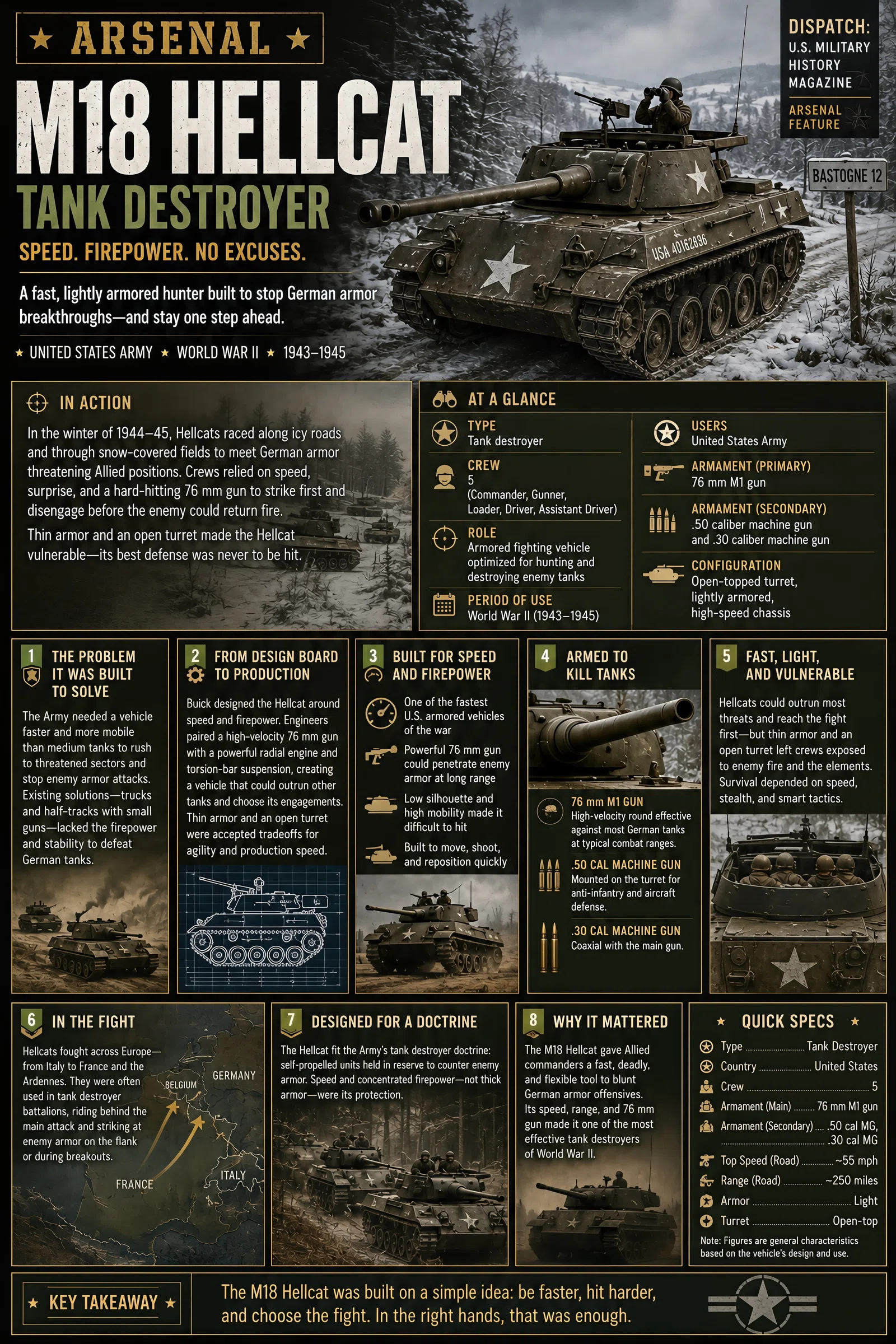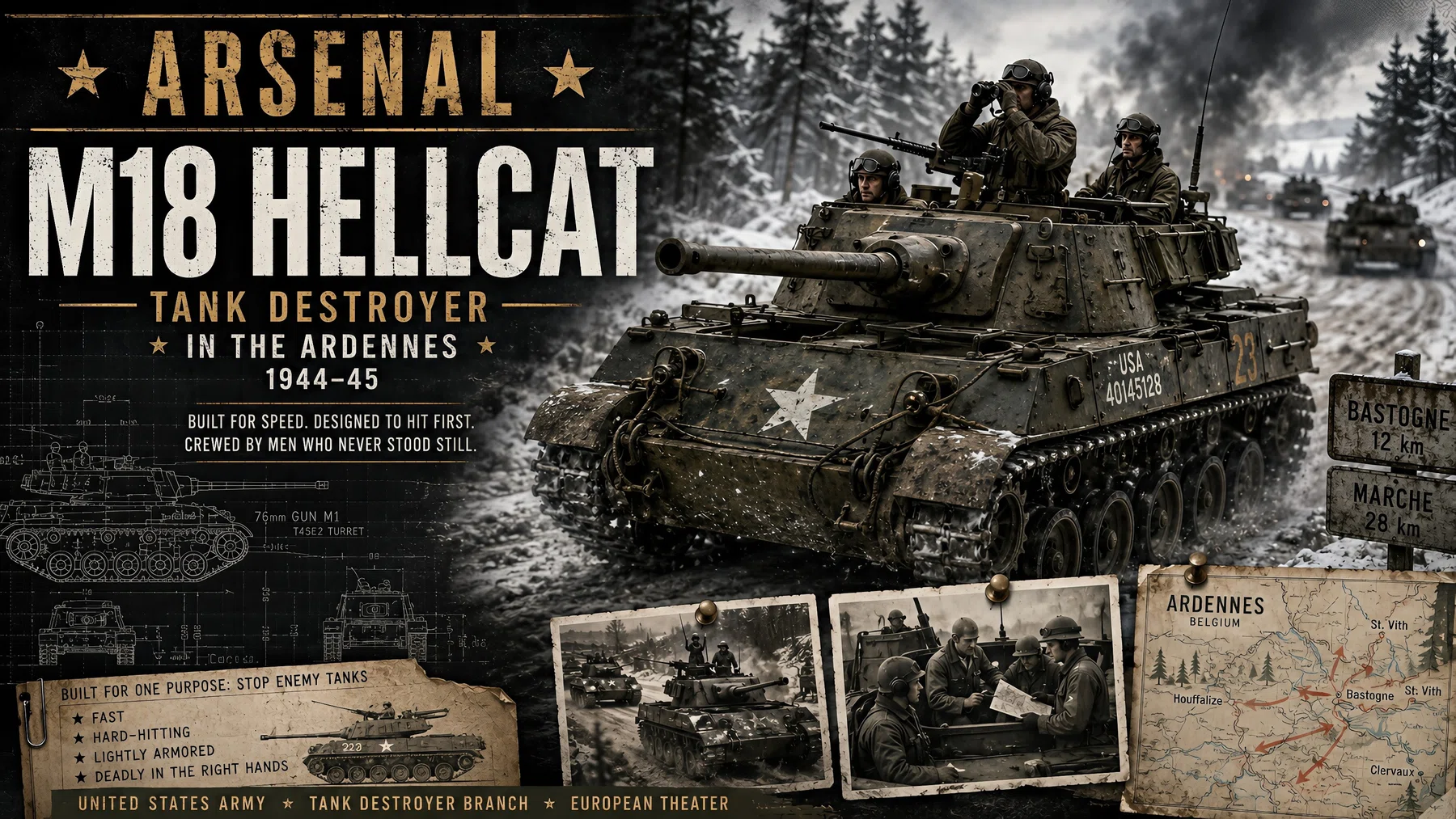
In Action
Snow hangs in the air over the approaches to Bastogne, turning the world into a blur of white and exhaust. The five-man crew of the M18 Hellcat hunch low in the open-topped turret as the tank destroyer jolts along a frozen Belgian road, engine howling in a pitch they have learned to read like a heartbeat. Ahead, the road bends toward a slight rise and the dark smudge of trees. Somewhere beyond that tree line, German armor is feeling for a way into the town.
The commander stands half out of the turret, binoculars glued to his face, scanning for the flat silhouettes of Panzer IVs and Panthers. The gunner’s hands rest lightly on the elevation and traverse wheels, left foot hovering over the pedal that slams the turret into motion. The driver fights the ice, coaxing the lightweight chassis up to a speed no other tracked vehicle on the road can match. They are fast, but they are also exposed: thin armor plates, an open fighting compartment, and nothing but speed and a 76 mm gun between them and a German shell.
A call crackles over the radio: enemy armor, closing on a road junction. The Hellcat lurches off the main track, cutting across a snowy field to get a flanking angle. As they crest a low rise, the gunner finally sees it—dark hulls moving through the haze, German tanks intent on the town behind him. He swings the turret, calls out the lead range, and feels the recoil slam through the vehicle as the first shot goes downrange.
In that moment, the Hellcat is doing exactly what it was built for: racing to meet a breakthrough, trading protection for the chance to hit first and fade away. How the United States Army ended up with this fast, fragile tank destroyer is a story that begins years earlier, with a very different kind of war the planners thought they would have to fight.
The Problem It Was Built To Solve
The M18 Hellcat grew out of a pre-war fear that shaped much of United States Army thinking in the early 1940s: the fear of German-style massed armored thrusts breaking through thinly held fronts. In Poland and France, panzer divisions had punched deep into the enemy rear, overrunning artillery, supply lines, and command posts before slower units could react. American planners looked at their own force and saw medium tanks and towed anti-tank guns that might hold a line, but would struggle to rush to wherever the crisis broke out.
Early attempts to field mobile tank killers were improvised and unsatisfying. The M6 mounted a small 37 mm gun on a modified truck; the M3 half-track carried a low-velocity 75 mm gun. Both could move quickly on roads, but they lacked protection, stability, and the high-velocity firepower needed to reliably stop panzers frontally at typical combat ranges. As combat reports came back from North Africa, it became painfully clear that the Army needed something better than lightly armed trucks and hastily adapted half-tracks.
At the same time, the Army’s new tank destroyer branch was being built around a specific idea: self-propelled units, held in reserve, that could move rapidly to threatened sectors and engage enemy armor with concentrated fire. That concept demanded vehicles faster and more agile than the standard medium tanks, with guns powerful enough to defeat German armor but without the burden of thick, all-round protection. In theory, speed, stealth, and flexible tactics would be the tank destroyers’ shield, not armor plate.
This mix of doctrinal theory and battlefield experience created a clear design brief. The Army needed a vehicle that could outpace its own armored and infantry formations, arrive ahead of an enemy thrust, and deliver accurate anti-tank fire from the flank or at medium range. It would have to be light, mechanically reliable, and simple enough to build in large numbers within the constraints of American industry. Out of that requirement came a request to industry—most notably the Buick division of General Motors—for a dedicated, fast tank destroyer design that would become the M18 Hellcat.
From Design Board To Production
The Hellcat’s path from paper sketch to frontline machine ran through the drawing offices and test tracks of Buick, which received the contract to turn the tank destroyer concept into a practical vehicle. Early experimental designs tried different chassis, turret shapes, and gun mounts, all circling around the same problem: how to carry a high-velocity 76 mm gun on a platform that was light and fast, yet stable enough to shoot accurately on uneven ground. Engineers shaved weight wherever they could, using thinner armor and a compact hull, and paired the gun with a powerful radial engine and a torsion-bar suspension that gave the vehicle its distinctive speed and agility.
Trials at American proving grounds showed that the new design could outrun existing tanks by a wide margin, reaching road speeds that seemed astonishing for a tracked vehicle. Test crews quickly learned, however, that this agility came at a price. Thin armor meant that even medium-caliber enemy fire could be deadly, and the open-topped turret exposed the crew to shell splinters and the elements. The Army accepted these tradeoffs because they fit the tank destroyer doctrine: these vehicles were not meant to trade blows in a slugging match, but to move quickly, choose favorable positions, and ambush enemy armor.
At a glance, the M18 Hellcat was a United States tank destroyer designed for the Army’s tank destroyer battalions in the middle years of the Second World War. It typically carried a five-man crew of commander, gunner, loader, driver, and assistant driver, and its main armament was a 76 mm high-velocity gun backed by a coaxial and hull-mounted machine gun for close defense. Powered by a radial gasoline engine, it could achieve road speeds that approached those of wheeled vehicles, with a useful operational range that allowed it to keep pace with advancing formations. Production ran into the low thousands, enough to equip dedicated battalions that would see action in Italy, France, and the final push into Germany.
By the time the Hellcat reached Europe in significant numbers, Allied forces were already committed to large offensives in Italy and Normandy. Production units flowed across the Atlantic, filling out tank destroyer battalions that had previously relied on older, slower vehicles. The M18’s combination of speed and firepower promised to give commanders a mobile reserve capable of stretching across fluid fronts, and factory refinements continued even as combat experience began feeding back into minor modifications on the line.
Inside The Weapon
Walking around an M18 Hellcat, the first things that stand out are its low, compact hull and the relatively small, open-topped turret perched on top. The front armor slopes back at a shallow angle, giving the vehicle a sleek profile but leaving only thin plate between the crew and incoming fire. Along the fenders, storage boxes and spare track links hint at the long road marches these tank destroyers often undertook to reach their firing positions. At the rear, exhausts and access panels mark where the radial engine sits, the beating heart that lets the Hellcat sprint and maneuver in ways most tanks cannot match.
Climb up into the turret and the vehicle feels more like a Spartan gun platform than a tank. The 76 mm gun dominates the fighting compartment, its breech taking up much of the space between the gunner and the loader. The gunner sits to the left, eye pressed to a telescopic sight, hands on the controls that traverse and elevate the weapon. The loader works to the right, feeding shells from racks that line the turret and hull, always conscious that the open top exposes him to weather, tree branches, and any enemy fragments that fall from above. The commander stands behind them, often half-exposed, using his view of the battlefield to call out targets and corrections.
Forward in the hull, the driver and assistant driver sit side by side behind modest armor, each with their own hatch and vision blocks. The driver wrestles with the steering levers and gears that keep the light chassis under control at high speed, especially on narrow European roads slick with mud or ice. The assistant driver helps with navigation, radios, and, when needed, mans a hull machine gun to fend off infantry. Communication between all five men is constant, whether over the intercom or shouted over engine noise and gun blast, because the Hellcat’s strength lies in coordinated movement and rapid target engagement.
Daily life in the Hellcat reflects its design philosophy. Crews appreciate the roomy feel compared to some cramped tanks, and the open turret offers excellent visibility and ventilation in hot weather. At the same time, they feel every gust of cold rain or winter wind, and they know that artillery airbursts or mortar fragments can reach them more easily. On training ranges, instructors emphasize shoot-and-scoot tactics, using the vehicle’s speed to change positions before enemy guns can zero in. In combat, veterans recall that the Hellcat rewarded crews who stayed alert, used cover, and treated speed as their armor, while punishing any lapse with brutal suddenness.
Baptism Of Fire
By the time the German offensive crashed into the Ardennes in December 1944, the M18 Hellcat was no longer brand new. It had already seen action in Italy, where narrow roads and steep hills rewarded its agility. But it was in the snow-covered villages and forests of Belgium and Luxembourg that the tank destroyer concept met the kind of armored thrust it had been built to stop. Tank destroyer battalions equipped with Hellcats were thrown into the path of German spearheads, often arriving at crossroads or ridgelines only hours ahead of advancing Panthers and Panzer IVs.
Around Bastogne, Hellcats supported paratroopers, infantry, and armored units trying to hold key road junctions. Crews used their speed to move from one threatened sector to another, slipping into hull-down positions on the flanks of likely approach routes. When German tanks appeared, the Hellcats tried to fire first from cover, then relocate before enemy gunners could find them. In several engagements, small groups of M18s were credited with halting or confusing larger armored formations, knocking out lead vehicles and forcing columns to bunch up or seek alternate routes under artillery fire.
These actions did not come without cost. The thin armor that made the Hellcat fast also meant that any hit from a German tank or anti-tank gun was likely to be catastrophic, and the open turret exposed crews to artillery fragments and small-arms fire. Yet veterans remembered that when they had room to maneuver and good communication with infantry and artillery, the Hellcat gave them options they would not have had in slower, heavier vehicles. In the Ardennes, its baptism of fire showed both sides of the design: it could be a sharp, mobile shield against armored breakthroughs, or a fragile shell that failed its crew if used like a conventional tank in head-on, close-range fighting.
Strengths And Weaknesses
Crews who spent time in the Hellcat usually mentioned its speed first. On roads and firm ground, it could dart from one position to another faster than most opponents expected, making it ideal for ambushes and rapid redeployment. The 76 mm gun, while not the most powerful weapon on the battlefield, could penetrate the front or flank of many German tanks at typical combat ranges when using appropriate ammunition. Good visibility from the open turret and the relatively roomy fighting compartment also helped crews acquire targets quickly and keep situational awareness in confused engagements.
The same features that made the Hellcat nimble also defined its weaknesses. Armor protection was intentionally thin, barely enough to stop small-caliber fire and shell splinters from certain angles, and it offered little margin if the vehicle was caught in the open or engaged at close range. The open top that crews appreciated for visibility and ventilation became a serious liability under artillery airbursts, in urban combat, or in bad weather. Compared with the more heavily armored M10 tank destroyer or the ubiquitous M4 Sherman, Hellcat crews had to accept that a direct hit from an anti-tank round would almost certainly be fatal.
From the German perspective, the M18 could be a frustrating target when used well. Its low silhouette and quick sprints between firing positions made it hard to pin down, especially in broken terrain with woods and hedgerows. At the same time, German tank and gun crews learned that if they forced Hellcats into close-range duels, or caught them moving across open ground, the American vehicles were vulnerable. In practice, the Hellcat’s reputation rested less on raw comparative statistics and more on how well commanders and crews leaned into its strengths—mobility, surprise, and coordinated fire—while respecting its very real limitations.
Variants And Evolution
The M18 line did not spawn a long family of dramatically different combat variants, but there were noteworthy paths branching from the basic design. Early prototypes carried different turret and hull configurations as engineers searched for the right balance of gun mounting, armor layout, and crew space. Once the standard production model settled into place, most changes were incremental: adjustments to stowage, minor improvements in sights and radios, and refinements to make field maintenance easier for overworked crews and mechanics pushing through long campaigns.
One of the most interesting offshoots was the M39 armored utility vehicle, which adapted the Hellcat’s chassis into an armored personnel and cargo carrier. Removing the turret created space for troops, ammunition, or towing duties, giving units a flexible support platform that shared many components with the tank destroyer. Postwar, some Hellcats served on in training roles or with foreign armies, but the broader evolution of armored doctrine moved away from the dedicated tank destroyer branch. Experience in the Second World War encouraged many armies, including the United States, to fold anti-tank responsibilities into more heavily armed and armored main battle tanks, self-propelled guns, and later guided missile systems, leaving the Hellcat as a representative of a specific moment in doctrinal thinking.
Legacy And Where To See It Today
The M18 Hellcat’s legacy lies less in direct descendants than in lessons learned. Its wartime record underscored the value of mobility, flexible employment, and good communication in anti-tank warfare, while also highlighting the risks of vehicles that rely almost entirely on speed and tactics for survival. Elements of its design—such as emphasizing agility, a powerful gun on a light chassis, and a focus on hit-and-run engagements—echoed later in fast reconnaissance vehicles and in how armored forces thought about using lighter units on the edges of heavier formations. The broader tank destroyer concept, however, gradually faded as armies embraced more versatile main battle tanks and integrated anti-tank weapons across different branches.
Today, surviving Hellcats can be found in museums and collections in the United States and abroad, often displayed alongside the German tanks they once hunted. Visitors can see examples at major armor collections, regional military museums, and sometimes as restored runners in living history events and parades, where their speed and distinctive engine note still turn heads. Photo and video archives, including the material showcased across Dispatch features and Trackpads channels, give a sense of how these vehicles looked and moved in period conditions. For readers who want to follow the human stories behind the hardware, Beyond the Call profiles of soldiers who fought in the Ardennes and Living History interviews with tank destroyer veterans and museum curators provide natural companions to this Arsenal feature, reminding us that every Hellcat crew faced the same hard tradeoff between speed and protection in the frozen fields of 1944 and 1945.