In Action
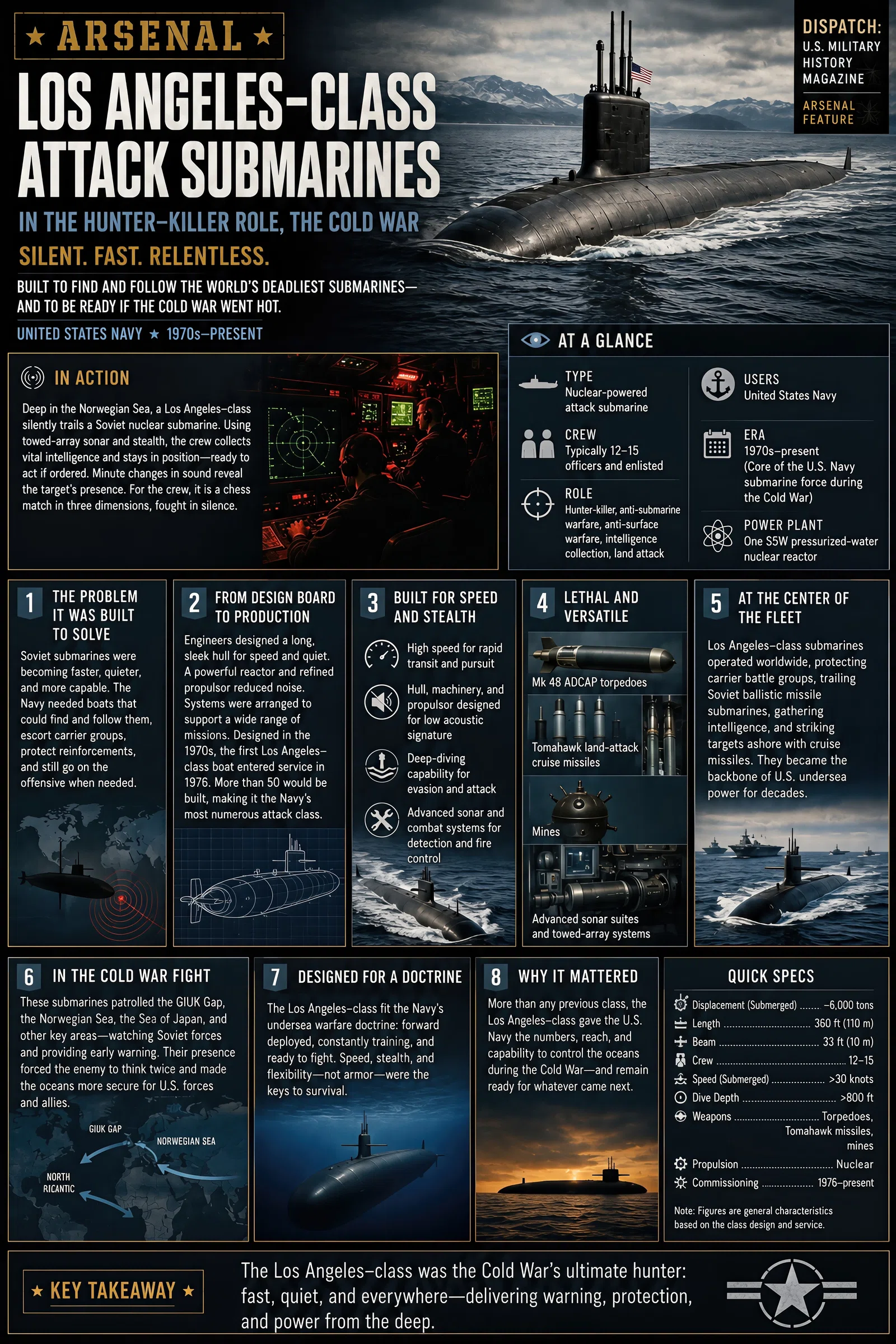
The control room lights are dimmed to a deep red, more suggestion than illumination. Somewhere under the gray chop of the Norwegian Sea in the mid-1980s, a Los Angeles–class attack submarine rides its own pressure wave, silent and unseen. The only real motion is the slow sweep of the sonar display and the occasional hand scribbling bearings and times in grease pencil on a clear plotting board.
A contact has appeared exactly where the crew hoped it would not: a faint line on the towed-array trace, steady in bearing, drifting just enough in frequency to hint at a Soviet nuclear submarine. The sonarmen lean closer to their headsets, filtering the ocean’s background noise by experience as much as by electronics. A tiny change in propeller rhythm, a subtle pump whine, the ghost of a blade rate – all are clues that mean the difference between a phantom and a firing solution.
The officer of the deck murmurs updates to the captain, who stands still, one hand on the periscope stand though the scope itself is stowed. Course changes are ordered in quiet, clipped phrases. The submarine slides deeper, trading a little speed for stealth, angling to slip astern of the contact. Torpedo tubes are prepared, but the crew knows their real mission is not to fire. It is to follow, to keep this Soviet boat pinned in an invisible crosshairs, ready to die in minutes if ever the Cold War’s threats turn real.
For now, it is a chess match in three dimensions, waged in sound and silence. The Los Angeles–class submarine exists for exactly this kind of night: a machine built to stalk the most dangerous submarines ever put to sea, and to give carrier battle groups and coastal cities a margin of safety measured in minutes of warning instead of none. How the Navy reached this point – and why this particular class became the backbone of America’s undersea hunters – is a story that begins two decades earlier.
The Problem It Was Built To Solve
By the late 1960s, the balance of power beneath the oceans was shifting in uncomfortable ways. Earlier in the Cold War, Soviet submarines were loud, limited in endurance, and easier for Western antisubmarine forces to track. That was still dangerous, but it was a problem the United States Navy understood. Then newer Soviet designs began to appear, with higher speed, longer range, and better weapons. Nuclear-powered attack submarines could sprint fast enough to keep pace with carrier groups, while ballistic missile submarines could lurk farther from the American coastline and still hold cities at risk.
The United States already had nuclear attack submarines – the Skipjack, Thresher/Permit, and Sturgeon classes – but each generation was a stepping stone, not a final answer. The Sturgeons were capable hunters, yet the Navy faced a bigger task than individual duels. It needed boats that could escort carrier battle groups across entire oceans, screen reinforcement convoys to Europe, trail Soviet ballistic missile submarines for weeks at a time, and still have the speed and stealth to go on the offensive against enemy attack submarines and surface task groups.
All of that had to be done within real industrial and budget limits. The Navy needed not just a handful of highly capable boats, but a large class that could be built in numbers, maintained over long careers, and upgraded as sensors, weapons, and quieting technologies improved. The design would have to balance speed against silence, size against cost, and cutting-edge systems against the need for reliability on deployments far from support.
Out of those pressures came the requirement for what became the Los Angeles–class: a new generation of fast attack submarines that could outrun, out-dive, and outlast their predecessors while staying quiet enough to survive against improving Soviet sonar. In staff papers and design meetings, the class was envisioned as the Navy’s primary undersea shield and spear, a hunter-killer that would patrol the Cold War’s front lines in the deep. The decision to move from concept to steel would turn that vision into the most numerous class of nuclear attack submarines the United States had ever built.
From Design Board To Production
The Los Angeles–class story began as a set of requirements more than as a single sketch. Designers needed a submarine that could cruise quietly for long stretches, then sprint at very high speed when a contact had to be closed or a carrier group needed protection. That meant a long, sleek hull optimized for submerged performance, a powerful nuclear reactor, and a propulsor refined to shed as little noise as possible into the surrounding water. It also meant careful placement of machinery on isolation mounts, miles of piping and cabling routed with noise in mind, and hull coatings chosen to make the boat harder to detect.
The result was a nuclear-powered attack submarine with a single pressurized-water reactor, a teardrop hull, and a focus on speed and deep diving. In broad terms, this was an American boat designed first and foremost to fight underwater, not on the surface. As the design matured, its mission set expanded: anti-submarine warfare, anti-surface warfare, intelligence collection, land-attack with cruise missiles, and support to carrier and amphibious task forces. That range of roles drove choices in sonar fit, fire control systems, and torpedo room layout, because the submarine had to carry weapons and sensors for very different kinds of missions without becoming unmanageable for its crew.
At a glance, the Los Angeles–class is a United States nuclear-powered fast attack submarine serving mainly with the United States Navy from the mid-1970s onward. A typical crew numbers just over one hundred sailors and officers, including specialists in navigation, nuclear propulsion, weapons, and sonar. Primary armament centers on heavyweight torpedoes and, in later units, Tomahawk cruise missiles fired through vertical launch tubes as well as torpedo tubes. The boats can sustain high submerged speeds, often described in public sources only as “in excess of twenty knots,” and they are built to operate at depths that keep them well below most surface threats.
Production began in the early 1970s and continued for decades, with multiple shipyards turning out hulls that evolved in blocks as experience and technology advanced. The first units focused on core hunter-killer roles, while later “flight” improvements added vertical launch systems, improved sonar, and structural changes for under-ice operations. By the end of the Cold War, the Los Angeles–class formed the bulk of the United States attack submarine force, spread across Atlantic and Pacific homeports and forward-deployed bases, ready to surge into patrol areas from the Barents Sea to the western Pacific.
Inside The Weapon
To understand a Los Angeles–class submarine, it helps to start with the basic shape: a long, cylindrical hull with a rounded bow, a sail rising from the upper surface, and cruciform control surfaces at the stern. Beneath the outer hull, a strong pressure hull holds the crew and vital systems in a metal cocoon designed to withstand the crushing pressures of deep water. Forward, the bow houses the main sonar sphere and, in earlier units without vertical launch tubes, the torpedo room with its banks of tubes and racks of weapons. Later versions shifted some functions to accommodate new sensors and missile systems, but the fundamental layout remained a balance between fighting spaces, living spaces, and engineering spaces.
Inside, the atmosphere is crowded, functional, and surprisingly lived-in. The control room sits beneath the sail, packed with consoles for navigation, fire control, and ship control. Here officers of the deck, diving officers, and helmsmen manage the submarine’s depth, course, and speed, responding to information from sonar, navigation systems, and the captain’s intent. The combat control center, often adjoining or integrated, is dominated by sonar displays and tactical plots where contacts are tracked and engagements planned. In a tense moment, this area becomes the submarine’s brain, turning faint sounds into decisions about maneuver and weapons.
The forward compartment doubles as both armory and home. The torpedo room holds heavyweight torpedoes, mines, and sometimes unmanned vehicles or other special gear, with sailors working around and under these massive weapons to sling hammocks or set up bunks when space runs short. Crew berthing areas are tight, with stacked bunks and narrow aisles, privacy measured in curtains rather than doors. A small galley and mess provide food and a social center, where off-watch sailors grab coffee, write letters, or watch a movie during rare quiet hours. Life support systems are constantly scrubbing carbon dioxide from the air, generating oxygen, and purifying water, making the submarine effectively a self-contained ship for months at a time.
Aft, the engineering spaces are dominated by the reactor compartment and the machinery that turns nuclear heat into useful power. Reactor operators, electricians, and machinist’s mates stand long watches in a maze of piping, valves, and instruments, keeping the propulsion plant safe and reliable. Propulsion turbines spin the shaft that turns the propeller, while generators feed electrical power to the rest of the ship. Noise control is a constant theme: pumps are mounted on special foundations, machinery is balanced and maintained carefully, and even small maintenance jobs are evaluated for their impact on acoustic signature. For the crew that lives there, the submarine is both workplace and home, a place where every compartment, from sonar shack to engine room, has its own rhythms and pressures. All of it exists to give the captain enough information and enough quiet power to stay hidden, press close to an enemy, and, if ordered, strike first.
Baptism Of Fire
The Cold War’s undersea campaign never erupted into the kind of open battle planners feared, but for Los Angeles–class crews the stakes felt real enough. In the late 1970s and 1980s, their “baptism of fire” came in the form of extended patrols in the North Atlantic and Pacific approaches, where the job was to track Soviet nuclear submarines without ever being detected in return. A patrol could mean weeks of near-continuous tracking, with tired sonarmen nursing a single bearing line, officers refining firing solutions that everyone hoped would never leave the plotting board, and the captain constantly weighing how close to push his luck. One mistake could mean losing contact on a ballistic missile submarine that carried enough warheads to change the course of a war.
These quiet duels were backed by more visible tension. When carrier battle groups steamed into contested waters, Los Angeles–class boats often went ahead of them, sweeping likely submarine approaches and positioning themselves where a Soviet attack boat might try to ambush the surface ships. In exercises that simulated full war, crews practiced punching through screens of enemy submarines, executing simulated torpedo attacks, then vanishing into deep water before counter-attacks could arrive. At the same time, the intelligence mission expanded, with boats slipping near foreign coasts to listen, watch, and collect information that would help planners understand the capabilities and patterns of rival fleets.
The first real shots came after the Cold War’s political structure began to crack but while its weapons remained very real. As cruise missiles matured into reliable land-attack weapons, Los Angeles–class submarines joined strike packages in regional conflicts, launching Tomahawk missiles from the sea against military targets far inland. For the crews, it was a different kind of combat: rather than stalking a single enemy submarine, they calculated missile routes, checked targeting data, and counted down to launch in coordination with aircraft, ships, and allies on distant fronts. When the weapons left their tubes, the boat would often change course and depth, slipping away while its contribution to the strike flew on above the waves.
Across these years, the class proved its worth in the missions it was built for and in tasks not fully imagined when the first hull was laid down. It guarded carrier groups, shadowed strategic submarines, struck land targets, and quietly gathered information that shaped the broader contest at sea. Its combat record is measured less in dramatic single battles than in a long string of operations where things did not go wrong for friendly forces because an unseen submarine did its job.
Strengths And Weaknesses
Crews came to respect the Los Angeles–class for its speed, endurance, and sensors. The boats could reposition quickly when a contact was lost, race ahead of a carrier group to sanitize a choke point, or sprint to reach a distant patrol area without surfacing. Once on station, their nuclear power plants let them remain submerged for months, limited mainly by food and the human strain of long deployments. Modern sonar suites gave skilled operators a wealth of information, and the combination of heavyweight torpedoes and cruise missiles meant that a single submarine could threaten surface ships, submarines, and land targets. Many officers and sailors felt that if they did their jobs well, the boat would give them a fair chance in almost any undersea contest.
Yet there were tradeoffs. Early Los Angeles–class boats were optimized for blue-water operations, which made them less comfortable in extremely shallow or ice-covered environments. Running at very high speed could generate more noise, which meant commanders had to balance the need for rapid movement against the risk of being detected. The hull form and internal layout, while effective, left limited room for later upgrades compared to some newer designs, forcing careful choices about which new systems to fit. Living conditions, though better than on some earlier boats, were still cramped, with “hot-bunking” common and little personal space, especially on long patrols with heavy operational tempo.
From the perspective of potential opponents, Los Angeles–class submarines were both a threat and a puzzle. They were fast and well armed, but they were not invincible. Soviet and later Russian planners worked hard to improve their own submarine quieting, deploy fixed and mobile sonar arrays, and develop tactics that might catch a fast attack submarine off guard, such as using noisy surface forces to mask quieter units or exploiting complex coastal waters. Comparisons with contemporary Soviet attack submarines tended to revolve around quieting, speed, and depth capability, with each side believing it held advantages in certain conditions. In practice, much depended on the skill of crews and the specifics of a given encounter.
Variants And Evolution
Over a production run that stretched for decades, the Los Angeles–class evolved through several distinct waves of improvement. Early boats reflected the original vision: fast, deep-diving hunter-killers focused on tracking and, if necessary, destroying enemy submarines and surface combatants. As new threats and technologies emerged, the Navy began folding in changes that reshaped both the silhouette and the internal systems of later units.
One major step was the addition of vertical launch systems for Tomahawk cruise missiles. By moving some of the missile load out of the torpedo room and into dedicated launch tubes in the bow, designers increased the submarine’s strike capacity without giving up as many torpedo-room positions. This change turned later Los Angeles–class boats into potent land-attack platforms, capable of delivering surprise strikes while still keeping a full load of torpedoes for undersea and surface warfare. Alongside this, sonar fits were upgraded, with more capable arrays and processing systems that could draw more information from faint signals in a noisy ocean.
Another wave of changes focused on operations in challenging environments. Later boats incorporated strengthened sails and improved control surfaces that made under-ice navigation more practical, a reflection of strategic interest in Arctic routes and northern bastions. Quieting measures were refined, with new materials, machinery arrangements, and construction techniques aimed at shaving precious decibels from the boat’s acoustic footprint. Throughout, the Navy used refits and overhauls to update combat systems and communications, allowing earlier hulls to benefit from some of the advances built into their younger sisters.
By the time production ended, the Los Angeles–class had become not a single design, but a family of related submarines sharing a common core. That evolution helped bridge the gap to newer classes, carrying lessons about quieting, ergonomics, and mission flexibility straight into the drawing boards that produced the next generation of fast attack submarines.
Legacy And Where To See It Today
The Los Angeles–class left its mark in several overlapping ways. It provided the backbone of the United States attack submarine force during some of the Cold War’s most tense years and continued to serve as a mainstay in the decades that followed. Its combination of speed, endurance, and multi-mission capability shaped how naval planners thought about undersea warfare, encouraging doctrines that treated fast attack submarines as both independent hunters and integral parts of larger task forces. The class also demonstrated how a single hull form could be adapted over time, absorbing new weapons, sensors, and mission sets without losing its core identity as a stealthy predator.
For sailors who served aboard, the legacy is personal: long patrols remembered in fragments of sound and routine, friendships forged in cramped compartments, and the knowledge that their work in the dark underpinned the freedom of movement enjoyed by fleets and merchant shipping above. For their counterparts in other navies, Los Angeles–class boats were ever-present shadows that had to be accounted for in any serious plan. Later designs, both in the United States and abroad, show traces of the same focus on quieting, flexible payloads, and the ability to shift rapidly between hunting submarines, striking surface ships, and attacking land targets.
Most Los Angeles–class submarines that leave service do so quietly, moving through defueling and recycling processes rather than becoming museum attractions. That makes them harder to visit directly than older diesel submarines preserved at naval museums. Still, their story is represented in exhibits on nuclear submarine operations, Cold War antisubmarine warfare, and modern undersea technology at maritime museums and heritage centers. Photographs and video footage, including material shared through outlets like Trackpads and Dispatch, preserve glimpses of their external lines, interior spaces, and life at sea.
For readers who want to connect this hardware to human stories, related features in Dispatch can guide the way: accounts of carrier battle groups guarded by unseen escorts, interviews with submariners who describe the rhythm of long patrols, and other Arsenal pieces on earlier and later attack submarines that show how ideas evolve from one generation to the next. In the end, the Los Angeles–class stands as a reminder that beneath every calm sea lies a hidden contest of skill, technology, and nerve, and that behind every steel hull are crews whose lives depended on remaining unheard.