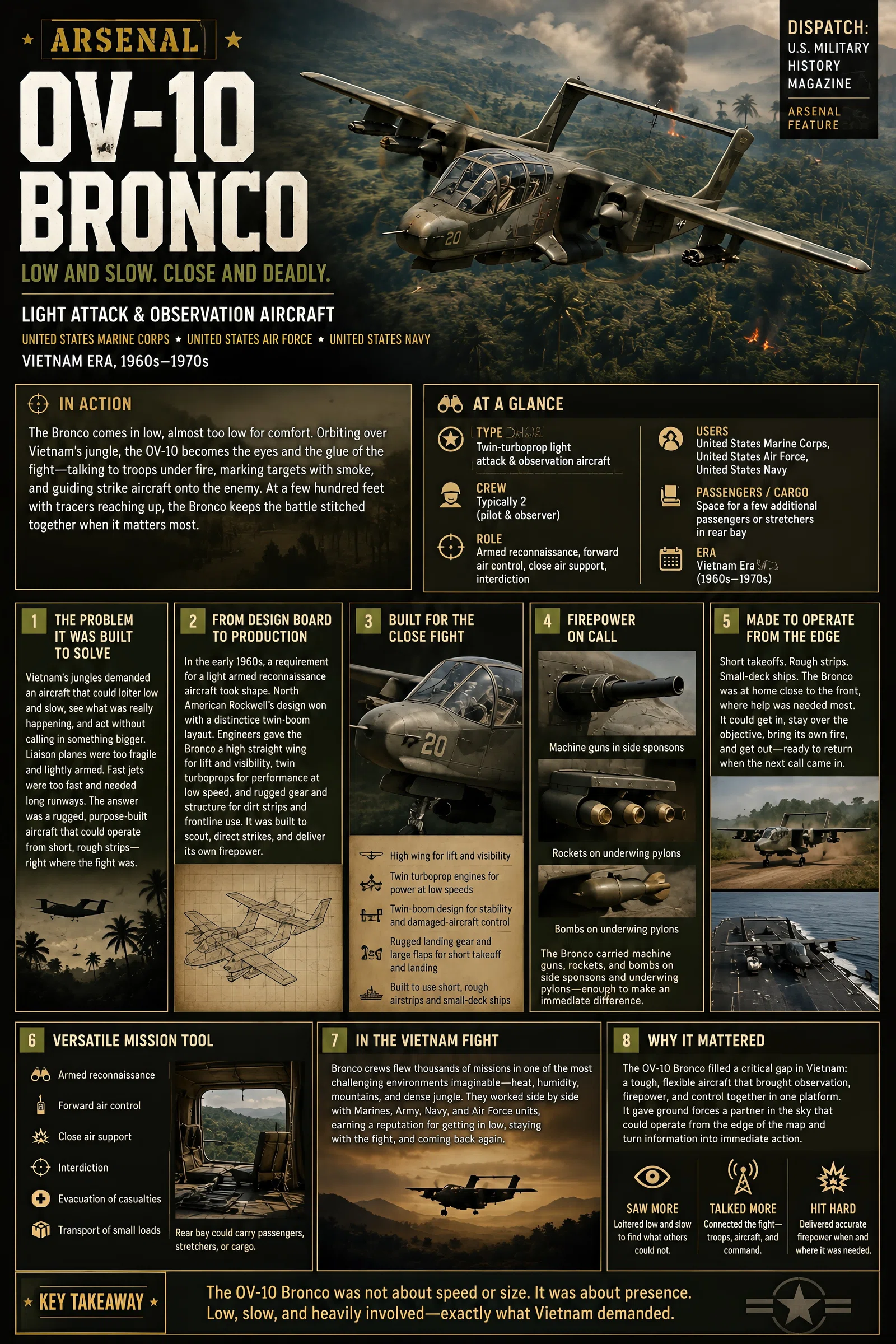
In Action
The Bronco comes in low, almost too low for comfort. It is just after first light over the Central Highlands, and a United States Marine Corps OV-10 is running a tight orbit over a patch of jungle that looks no different from the rest—until you know what you are seeing. Down below, a Special Forces-led patrol is pinned in a tree line. The radio calls are clipped and tense, the kind of calm that only shows up when people are scared and very busy.
From the front seat, the pilot leans forward in his harness, scanning through the tall canopy for any hint of muzzle flash. The back-seater, the observer and forward air controller, is juggling radios: one ear on the troops below, another on the fast jets stacking up miles away, waiting for a target mark. The Bronco’s twin turboprops hum steadily, the aircraft almost hanging in the air as it banks, flaps out, claws of lift biting into the hot, thin morning.
A burst of ground fire snaps past the right wing. The pilot shoves the nose down, then eases it back up into the orbit. The observer thumbs on a smoke rocket, talking the patrol’s leader onto where it will hit. When the white streak leaves the wing and slams into the jungle, he keys the air-to-air radio and clears in a pair of strike aircraft to follow the mark. High above, the jets will get the credit for the explosions. Down here, at a few hundred feet with tracers reaching up, the Bronco is the one keeping the fight stitched together. This is exactly the kind of work it was built for.
The Problem It Was Built To Solve
The OV-10 Bronco grew out of a simple, stubborn problem that modern jet aircraft could not quite solve in Vietnam: how do you watch a battlefield that is more jungle than map, stay overhead long enough to matter, and still hit what you see without calling in something bigger? Early in the war, light liaison aircraft and converted trainers did the observation and forward air control work. They could loiter and see, but they were slow, fragile, and lightly armed. On the other end of the spectrum, supersonic fighters and heavy attack jets brought speed and payload, but they flashed over targets too fast to sort out complex firefights on the ground, and they needed long, prepared runways far from many of the units that needed help most.
For the United States Marine Corps, the problem was even sharper. Marine aviation was built around the idea of close cooperation with Marines on the ground. Units scattered along coastlines, rivers, and jungle valleys needed an aircraft that could live close by, operate from short, rough strips or even small-deck ships, and carry both eyes and weapons into the fight. The Air Force and Navy saw similar gaps in their ability to monitor guerrilla activity, interdict supply trails, and shepherd strike packages onto hidden targets.
The result was a push for a purpose-built light armed reconnaissance aircraft: something that could take off from a clearing, fly low and slow without falling out of the sky, survive small-arms fire better than a fabric-wing liaison plane, and still carry enough guns, rockets, or bombs to make an immediate difference. The Bronco answered that call. Its unusual shape and twin-boom layout were not a stylistic flourish; they were the direct response to a battlefield that demanded patience, visibility, and the ability to fight from short, forgotten corners of the map. The decision to move from stopgap aircraft to a new design set the stage for one of the most distinctive machines of the Vietnam era.
From Design Board To Production
The Bronco’s path from idea to hardware started in the early nineteen sixties, when several branches of the United States military were wrestling with the same counterinsurgency puzzle. They needed an aircraft that could loiter at low speed, shrug off small-arms fire better than a fabric-covered spotter plane, and operate close to the front from crude strips. A requirement for a light armed reconnaissance aircraft took shape, calling for something that could scout, direct air strikes, and add its own firepower without demanding long runways or elaborate support. The concept invited creative thinking, and the winning design would come from North American Rockwell with a configuration that looked nothing like the sleek jets filling recruiting posters.
Engineers gave the Bronco a high straight wing for lift and visibility, twin tail booms, and a short central fuselage that could carry both crew and a compact cargo bay. Twin turboprop engines promised better acceleration and climb than piston designs while staying efficient at the low speeds the mission demanded. Designers pushed for rugged landing gear, large flaps, and sturdy airframe structure so the aircraft could use dirt roads or pierced-steel mat strips near frontline units. They had to juggle demands from different services, each wanting its own radios, weapons fits, and mission equipment.
At a glance, the OV-10 Bronco was a twin-turboprop light attack and observation aircraft built in the United States, serving mainly with the United States Marine Corps, United States Air Force, and United States Navy during the Vietnam era. It typically carried a crew of two, pilot and observer, with space for a few additional passengers or stretchers in the rear bay. Primary armament centered on machine guns and rockets mounted on side sponsons and underwing pylons, with performance focused on low-speed handling, short takeoff and landing, and long loiter rather than raw speed.
Once prototypes proved that the odd-looking twin-boom machine could leap off short strips and fly gracefully at low speeds, production followed, and Broncos began to appear at forward bases where helicopters, light airplanes, and jets already jostled for space. The new aircraft promised to knit together observation, control, and immediate fire support in a single, compact package.
Inside The Weapon
Walking up to a Bronco on a forward strip, what strikes most people first is how small and purposeful it seems compared to a jet fighter. The high wing spans overhead on slender struts, with the twin tail booms running back to a wide tailplane that frames the central fuselage like a doorway. Under the wing roots, short side sponsons jut out, housing fixed machine guns and pylons for rockets or small bombs. The landing gear looks simple and sturdy, built to shrug off rough surfaces and firm arrivals. Ground crews move easily around the aircraft, loading ordnance, refueling, and checking access panels without needing elaborate stands.
Climb the ladder to the cockpit and the Bronco’s mission becomes even clearer. The canopy is broad and heavily framed, but the view from the front seat is excellent, with the pilot sitting high above the nose to see both ahead and down into the terrain. Immediately behind sits the observer, sometimes called the back-seater or forward air controller, with his own console of radios and navigation gear. Between them, they manage a web of communication: one set of radios for troops on the ground, others for coordinating with fast jets, helicopters, and higher headquarters. The cockpit is busy but not luxurious, filled with practical switches and gauges rather than high-end comforts.
Behind the crew seats, the Bronco’s fuselage hides a small but flexible cargo bay. This space can hold extra fuel, supplies, sensors, or a handful of troops, and it can be configured for casualties on stretchers. That ability to carry people or cargo, even in such a compact frame, made the aircraft useful for liaison, resupply, and emergency evacuation in places where helicopter availability was limited or weather made rotorcraft work risky. The twin turboprops, mounted outboard on the wing, give a distinctive vibration and hum that crews remember decades later.
From the pilot’s perspective, flying the Bronco in its element meant working at low altitude and low speed, constantly balancing lift, drag, and terrain while the observer focused on the fight below. The aircraft’s control responses at those speeds were deliberately gentle, helping it carve tight orbits over a small patch of jungle or a village without snapping into a stall. The observer used that steady platform to spot enemy movement, mark targets with smoke rockets, or roll in with guns and rockets when troops below needed immediate help. In training, the aircraft felt like an unusually tough, forgiving light airplane; in combat, it became a nervous system in the sky, connecting scattered units and weapon systems into a single, coordinated fight.
Baptism Of Fire
By the time Broncos were fully worked into the order of battle in Vietnam, the kind of desperate morning orbit described earlier had become a familiar rhythm. United States Marine Corps observation squadrons flew them from coastal bases and rough inland strips, while Air Force crews used them to keep watch over supply routes and firebases. The aircraft’s first real test came in the messy, small-unit fights that defined so much of the war: Special Forces outposts under mortar fire, Republic of Vietnam units trying to clear a treeline, convoys ambushed on narrow roads winding through jungle and paddies. In those fights, the Bronco proved that it could do more than just observe.
A typical engagement might begin with a call from a patrol that had blundered into a well-prepared enemy position. The Bronco would arrive low and fast, then throttle back into a tight orbit, observer working the map board with grease pencil marks while the pilot kept the aircraft just above the trees. First came identification: sorting friend from foe in terrain that seemed determined to hide both. Then the smoke rockets, fired ahead of enemy positions so fast jets or artillery could home in. When the ground situation was fluid or the target too close to friendly lines, the Bronco’s own guns and rockets came into play, walking fire along hedgerows or bunker lines while the observer talked directly to the troops below.
In larger campaigns the Bronco acted as shepherd for entire strike packages. Over dense trail networks and border regions, it prowled for traffic, radio chatter steady as the observer called in attack aircraft, adjusted artillery, and kept a running picture of what the enemy was trying to do. Enemy gunners learned to hate the small twin-boom silhouette that lingered overhead and adjusted their tactics to shoot at it whenever possible. Losses did occur, and crews knew that operating at low level inside small-arms range was a calculated risk. Yet time and again, reports from the field credited the Bronco’s persistence and coordination with breaking ambushes, saving isolated outposts, or turning a confusing skirmish into a controlled fight. Its baptism of fire confirmed that the strange-looking aircraft had a real place in a very demanding war.
Strengths And Weaknesses
Ask crews and supported troops what they valued most about the Bronco, and several themes repeat. They remember how quickly it could be brought to bear from nearby forward strips, cutting response time when minutes mattered. They talk about the way it could loiter, circling patiently over a contact instead of flashing past in a single pass like a jet. They also praise its visibility: from the cockpit a pilot and observer could see into valleys, across rivers, and along roads in a way that made spotting movement and adjusting fire feel almost like walking the ground. For infantry on the receiving end of support, hearing the turboprops overhead meant that someone was watching, coordinating, and ready to act.
From a maintenance perspective, the Bronco’s simple, rugged construction and turboprop engines made it easier to keep flying than more delicate aircraft, especially on rough strips and in harsh weather. The short takeoff and landing performance expanded where it could operate, sometimes from locations that would have seemed more suited to trucks than aircraft. Its mix of guns and rockets, while modest compared to a heavy attack jet, was usually enough to influence a small engagement quickly, particularly when paired with artillery or other aircraft under its control.
The same qualities that made the Bronco effective also exposed its limits. Operating low and slow in the envelope where it could see and control best placed it in the heart of small-arms and light anti-aircraft fire. Armor and redundancy improved survivability over earlier liaison planes, but a determined enemy with heavy machine guns or concentrated fire could still bring one down. Its payload and speed left little margin for larger-scale strikes or deep interdiction work; it was never meant to replace fast jets or heavy gunships. In higher-intensity air defense environments, the Bronco’s relative lack of speed and protection would have been a serious handicap. Even in Vietnam, commanders had to weigh its utility against the risk whenever enemy fire grew thicker.
Variants And Evolution
Over its service life, the Bronco evolved in response to experience and changing missions. The early production models established the basic pattern: twin turboprops, two-seat cockpit, internal bay, and gun and rocket armament on sponsons and wings. As crews and commanders learned what worked in combat, later versions incorporated improved sensors, navigation equipment, and night-operations capability. Upgrades brought better radios and sighting systems so the aircraft could manage more complex air strikes and support operations after dark or in poor visibility.
Some variants focused on specific service needs. Naval units operating from coastal bases and small-deck ships emphasized corrosion protection and compatibility with maritime operations. Export versions adapted avionics and weapons fits to local demands and budget realities, allowing partner nations to use the Bronco concept for border patrol, counterinsurgency, and internal security missions long after the Vietnam War ended. In a few cases, specialized equipment such as infrared sensors and laser designators turned later Broncos into more capable night hunters, able to spot and mark targets far more precisely than the original models.
Budget pressures, the drawdown after major conflicts, and the rise of more advanced sensors and platforms gradually pushed the Bronco out of front-line service in the United States. Yet its core idea—an efficient, rugged, manned aircraft that can loiter close to the fight, see clearly, and deliver modest but timely firepower—never really disappeared. Elements of that design philosophy can be seen in later light attack and surveillance aircraft used in other conflicts and by other nations. The Bronco’s variants traced the arc from an urgent counterinsurgency need in Southeast Asia to a broader understanding of what a dedicated armed observation platform could offer.
Legacy And Where To See It Today
Today, the OV-10 Bronco occupies a distinctive niche in the story of airpower. It stands as a reminder that not every important combat aircraft is a fast jet or a heavy bomber. Its legacy runs through doctrines that emphasize close integration between air and ground forces, especially in complex terrain where information and coordination can count as much as raw destructive power. The aircraft’s performance in Vietnam and in later, smaller conflicts helped convince planners that purpose-built light attack and observation platforms had enduring value, particularly for counterinsurgency, border security, and support to special operations.
Surviving Broncos can be found in museums and collections across the United States and abroad. Some sit as gate guards at bases where they once operated, their high wings and twin booms instantly recognizable to veterans who served around them. Others are preserved in aviation museums, where visitors can look into the cockpit and see how close the crew sat to the action, or study the rugged landing gear and weapon mounts that spoke to the aircraft’s rough-and-ready mission. A few restored examples still fly at airshows, their turboprops and agile handling demonstrating a different side of Vietnam-era aviation than the more famous jets.
For readers of Dispatch, the Bronco also offers a natural bridge to other features: stories of infantry and advisors who relied on its watchful presence, interviews with aircrew who flew low and slow over hostile territory, and future Arsenal pieces that trace how air support evolved in later wars. Photographs and film of the Bronco in service capture not just a curious shape in the sky, but a working tool of small-unit warfare. Behind every airframe were pilots, observers, maintainers, and ground troops whose chances in a firefight rose or fell with how well this compact machine did its job.