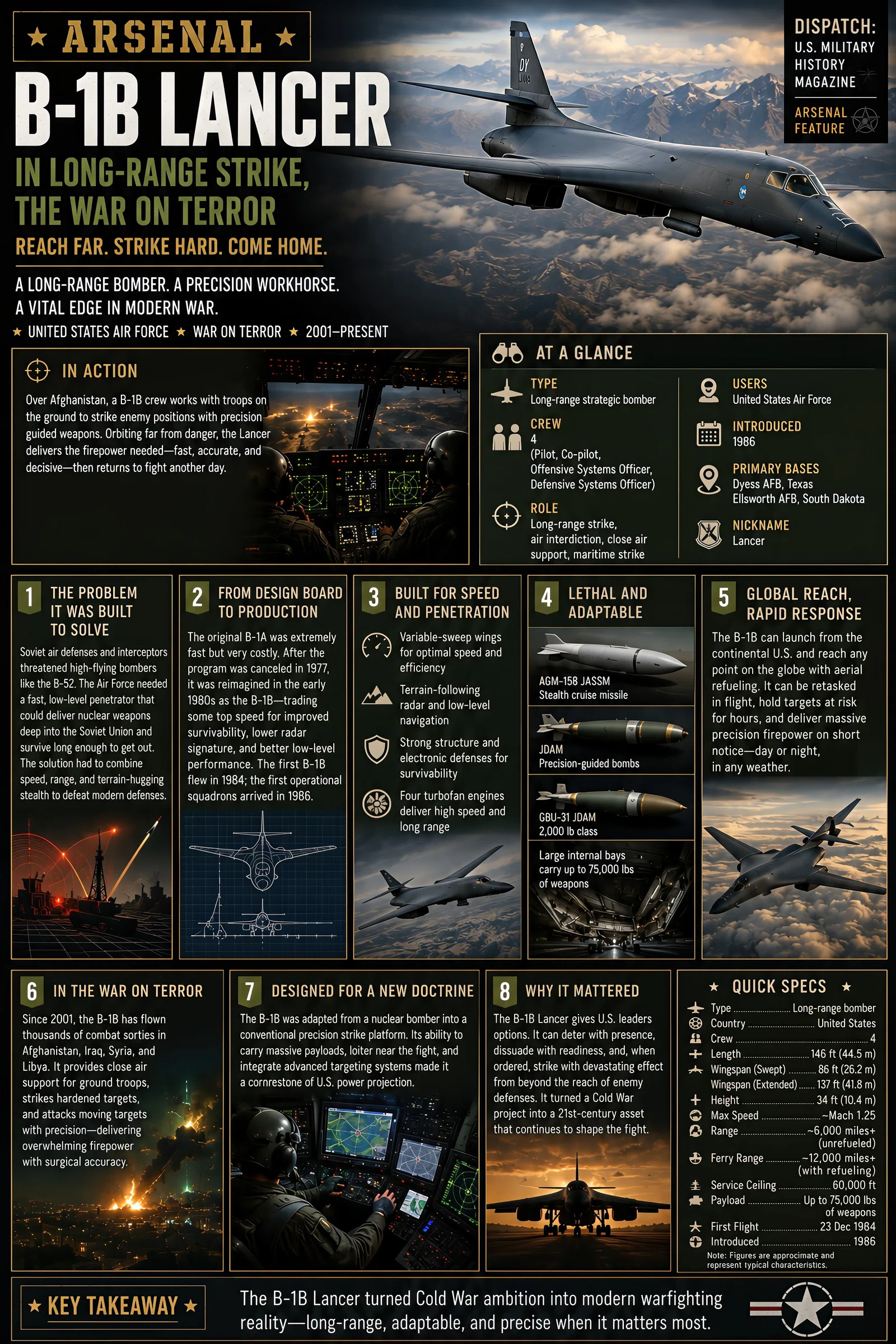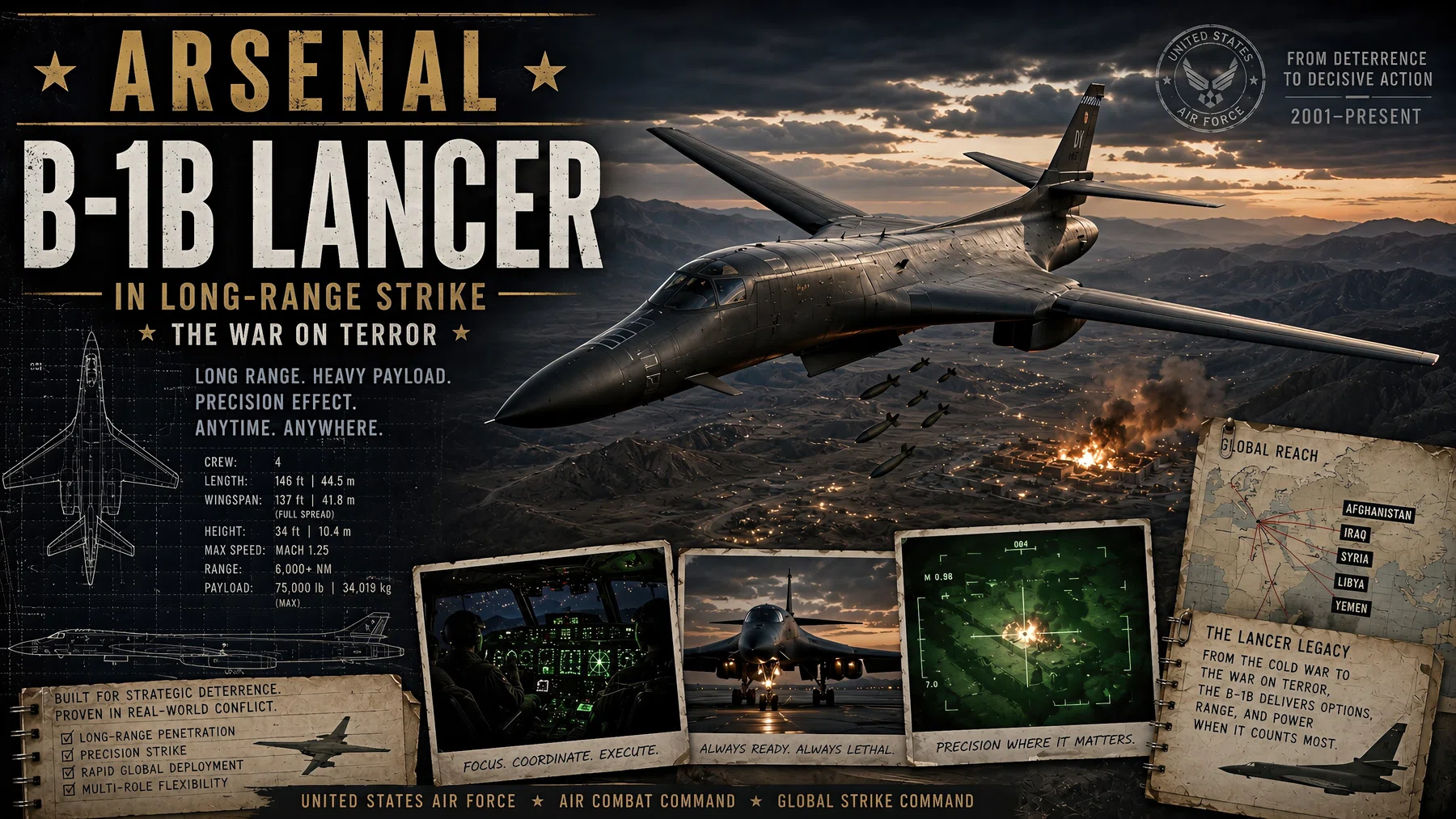
In Action
The crew has been awake for hours before anyone squeezes the bomb release triggers. Far below their cockpit, the mountains of eastern Afghanistan are nothing but jagged shadows, broken by the occasional flicker of tracer fire and the brief, ugly bloom of explosions. Up here, at high altitude and high subsonic speed, the air is smooth and the stars are sharp, but the interphone is busy. A joint terminal attack controller on the ground is talking them onto a target, voice tight but controlled as he calls in enemy positions closing on a pinned-down patrol.
The aircraft’s radar scope, targeting pod display, and moving map are a wall of light in the dim cockpit. The offensive systems officer and defensive systems officer work in a quiet rhythm, sorting coordinates, confirming friend and foe, checking for threats. The pilot arcs the B-1B into a wide orbit, keeping the jet’s four engines spooled and ready to sprint if a surface-to-air missile warning appears. The bomber has been on station for hours, cycling through refuelings, a heavy magazine of precision-guided bombs still slung in its internal bays.
On the ground, the patrol cannot see the bomber. They hear only the distant rumble, feel only the confidence that something big is finally overhead. When the release comes, it is almost anticlimactic: numbers, confirmations, then the steady voice of the weapons officer as guided bombs fall away in sequence. Moments later, the controller’s tone changes. The fire slackens. The patrol lives to move again. For the people under fire, the B-1B is no longer an abstract Cold War machine. It is a guardian orbiting in the dark, part of a much larger story about why this bomber was built and how it was transformed for new wars.
The Problem It Was Built To Solve
The B-1 story begins long before Afghanistan. In the late stages of the Cold War, leaders in the United States Air Force worried that their long-serving B-52 bombers would not survive deep strikes into a Soviet homeland defended by modern surface-to-air missiles and high-performance interceptors. The basic problem was simple to describe and hard to solve: deliver nuclear weapons from intercontinental range, against a heavily defended target, while giving the bomber crew a realistic chance of getting in and out alive. High-flying bombers were increasingly vulnerable. Missiles were precise but inflexible once launched. Something else was needed.
That “something” was a new generation of manned bomber optimized for high-speed, low-altitude penetration. Flying fast at low level, following the folds of terrain with advanced navigation and terrain-following radar, a bomber could hide in ground clutter and reduce the time enemy defenses had to react. Variable-sweep, or “swing,” wings promised the ability to cruise efficiently with wings extended yet still dash at very high speed with the wings swept back. Designers were asked to combine the long legs of a strategic bomber with the agility and survivability of a strike aircraft built to knife through defensive belts.
At the same time, there were political, budgetary, and technological crosswinds. Intercontinental ballistic missiles and submarine-launched missiles offered their own powerful deterrent, prompting some to question whether an expensive new bomber was needed at all. Early stealth concepts suggested that a later, more radical design might leapfrog any interim aircraft. Arms control agreements and shifting administrations added more uncertainty. Even so, the perceived vulnerability of existing bombers and the desire to keep a manned, recallable, and flexible leg in the strategic triad kept the requirement alive. Out of that mix of fear, ambition, and compromise came the path that would lead from early B-1 prototypes to the B-1B Lancer that would eventually trade its original nuclear role for conventional precision strike in very different wars.
From Design Board To Production
The path from drawing board to the B-1B Lancer that crews fly today runs through two distinct generations. In the late nineteen sixties, the United States Air Force launched what became the B-1A program, awarding North American Rockwell the job of building a bomber that could combine the long range and payload of the B-52 with the high speed of earlier supersonic bombers. Early prototypes pushed past twice the speed of sound at altitude and were meant to sprint over or through Soviet defenses before missiles and fighters could react. The resulting aircraft was impressive but expensive, and it arrived just as cruise missiles and early stealth concepts promised cheaper or more survivable ways to hold distant targets at risk.
In nineteen seventy seven, the first version of the program was canceled, officially in favor of modernized B-52s armed with long-range cruise missiles and a growing missile force at sea and on land. Yet the basic operational problem never went away. Planners still wanted a manned bomber that could be retasked in flight, show the flag on deterrent patrols, and offer presidents a controlled, recallable strike option. When a new administration took office in the early nineteen eighties, the idea returned in revised form. The B-1B would trade some of the raw top speed of the B-1A for a tougher structure, improved electronic defenses, lower radar signature, and better low-level performance, accepting a maximum speed around Mach one and a quarter in exchange for stronger penetration at high subsonic speeds close to the deck. Production restarted, and by the late nineteen eighties one hundred B-1B bombers had been delivered and were standing nuclear alert with Strategic Air Command.
At a glance, the finished aircraft was a long-range, supersonic, variable-sweep wing heavy bomber built in the United States for the United States Air Force, crewed by four people and capable of carrying up to roughly seventy five thousand pounds of ordnance entirely inside three weapons bays. It was designed as a strategic nuclear bomber for the late Cold War but would later shift into a conventional role, flying long-endurance missions from continental bases or forward locations. As arms control agreements took hold and the Cold War ended, its nuclear wiring was removed, and investment shifted toward the Conventional Mission Upgrade Program, which steadily added the ability to drop precision-guided munitions such as satellite-guided bombs and stand-off weapons. By the time of Afghanistan and Iraq, the B-1B had fully reinvented itself as a fast, long-legged conventional strike platform that could loiter with a deep magazine of guided weapons and respond flexibly across a theater.
Inside The Weapon
Seen from outside, the B-1B Lancer looks almost like a stretched fighter, with a long, narrow fuselage, sharply pointed nose, and wings that can swing from a broad, straight configuration for takeoff and cruise to a sharply swept shape for high-speed flight. Four afterburning turbofan engines are buried in the wing roots, their intakes blended into the fuselage to reduce radar reflections, and the vertical tail rises from a high-mounted horizontal stabilizer at the rear. On the ground, with the wings forward and flaps down, it appears surprisingly compact for a heavy bomber. In the air with the wings swept, it becomes a dart built to carve through thin air at high subsonic or low supersonic speeds.
Inside the cockpit, two pilots sit side by side in the forward section, each in a modern ejection seat with large windows giving good forward and side visibility. Behind them, on a slightly lower deck, sit the offensive systems officer and defensive systems officer, facing forward at consoles filled with screens, keypads, and controls. The offensive systems officer manages navigation, targeting, and weapon release, while the defensive systems officer watches the electronic warfare displays and manages countermeasures, threat warning systems, and communications. Voice lines, interphone circuits, and standardized callouts knit the crew together so that a radar contact, a change in rules of engagement, or a last-second update from a ground controller can flow quickly to the person who needs it most.
Further back, three large internal weapons bays run along the underside of the fuselage. Each bay can carry racks of conventional bombs, precision-guided munitions, or specialized loads such as stand-off missiles, all mounted on rotating or fixed launchers that present the weapons to the slipstream when the doors open. Keeping the entire load inside the fuselage reduces drag and radar signature, and it allows the bomber to sprint without the penalty of external stores. Fuel tanks fill much of the remaining space, giving the aircraft intercontinental range with aerial refueling and allowing it to orbit for hours over distant battlefields once it arrives.
The crew lives in a world of sensors and displays. A terrain-following radar and advanced navigation system, upgraded over the years, allow the bomber to fly at low level in poor weather or darkness, while modern targeting pods mounted externally give the offensive systems officer a high-resolution view of the ground, including the ability to track vehicles, mark targets, and assess bomb damage in real time. Defensive systems search for hostile radar emissions, cueing jammers and towed decoys that can confuse incoming missiles. Life support, lighting, and layout reflect the reality of very long missions: there is room to stretch slightly, systems are designed to be operated in shifts, and checklists break the work into manageable cycles. On paper it is a machine of numbers and systems diagrams; in practice it is a flying workspace where four people must manage fatigue, information overload, and risk while making sure that, when a controller on the ground calls for help, the right weapons leave the bay at the right moment.
Baptism Of Fire
When the B-1B finally went to war, it did so not over Central Europe but over Iraq. In December nineteen ninety eight, during Operation Desert Fox, the bomber made its combat debut, launching from the Persian Gulf region to strike regime targets in a tightly choreographed four-day campaign. Crews who had spent their careers training for a nuclear mission instead found themselves hauling unguided bombs against air defense sites and barracks, proving that the big swing-wing aircraft could flow into a conventional air plan and hit precise aim points under real pressure. It was a short, sharp test, but it broke the psychological barrier between “alert bomber” and “combat aircraft.”
The next step came over the Balkans, where Lancers joined the late nineteen nineties air war over Kosovo. There, they were part of a complex NATO strike architecture, flying long-duration missions to deliver conventional weapons against dispersed and often well-hidden targets. Those operations highlighted both the strengths and the frustrations of the design. Its range, payload, and sensor suite made it valuable, but the aircraft was still optimized around older conventional tactics and weapons. The real transformation came after the attacks of September eleven, when upgraded B-1Bs, armed with satellite-guided bombs, began orbiting over Afghanistan. In the opening months of Operation Enduring Freedom, a handful of aircraft dropped a striking share of the total tonnage, mixing high-capacity loads with the precision needed to support small ground units in broken terrain.
A typical mission might launch from the continental United States or a forward base in the region, tank en route, then arrive over a mountainous battlespace where special operations teams and conventional units were in contact. Controllers on the ground called for strikes on ridgelines, cave complexes, or vehicles fleeing down valley tracks, and the bomber’s crew would work through their procedures: confirm coordinates, cross-check friendlies, visualize the ground with targeting pods, and then release guided bombs in carefully timed sequences. In Iraq, similar missions saw B-1Bs dropping dozens of precision weapons in a single sortie, servicing multiple “kill boxes” across the theater as the ground campaign surged north.
The scene described in the cold open over eastern Afghanistan sits squarely in that era. By then, the Lancer’s original nuclear wiring was gone, its conventional mission upgrades were in place, and crews were treating the aircraft less as a one-time penetration platform and more as an airborne artillery magazine with jet engines. Coalition forces on the ground learned that the distant rumble overhead often meant that, if they could get a clear talk-on and a solid set of coordinates, heavy ordnance would arrive within minutes. Enemies learned that lingering in the open, even at night and even far from large airfields, could invite sudden, precise destruction from a bomber they could not see. The B-1B’s baptism of fire thus stretched over years and campaigns, reshaping its identity from a Cold War deterrent into a central player in twenty-first century long-range strike.
Strengths And Weaknesses
Ask crews and planners what made the B-1B valuable, and certain themes repeat. First is payload. With three internal bays and the ability to carry up to roughly seventy five thousand pounds of weapons, the aircraft can mix dozens of satellite-guided bombs, stand-off weapons, or other stores in a single sortie, then sequence them across multiple targets. That deep magazine matters in theaters where tankers, fighters, surveillance aircraft, and command-and-control platforms all compete for space in the air plan. A single Lancer can take the place of several smaller jets in terms of bombs delivered.
Second is reach and flexibility. The bomber’s range, especially when combined with aerial refueling, allows it to launch from distant bases, insert into a theater, and then loiter for hours as an on-call asset. Its high-subsonic dash speed and variable-sweep wing give it the ability to reposition quickly between widely separated kill boxes, which is why ground controllers came to appreciate it as a persistent, responsive presence despite the “strategic” label. The modernized radar, navigation, and targeting systems mean it can work in darkness, through weather, and in complex terrain, matching the needs of dispersed ground forces more closely than its original designers ever imagined.
But the aircraft also carries real burdens. Maintenance crews know it as a demanding machine, with aging structures and intricate systems that require many hours of inspection and repair for every hour in the air. As the fleet accrued heavy use in the War on Terror, structural fatigue and system issues led to grounded periods, reduced low-level training, and, eventually, the retirement of some airframes to protect the health of the remainder. That maintenance appetite affects availability and drives cost, even if its per-flight-hour expense remains competitive with other large bombers.
There are operational constraints as well. The B-1B does not carry nuclear weapons anymore, having been converted fully to a conventional role under arms control agreements and service decisions. Its survivability in the face of modern, layered air defenses depends on support from electronic warfare assets, stealthier aircraft, and stand-off tactics rather than the low-level dash profile imagined in the nineteen seventies. Enemies equipped with advanced radar and long-range missiles are less likely to see it overhead than to encounter its weapons arriving from outside their immediate visual range. In that sense, the bomber’s strengths shine brightest in conflicts where air superiority is established and the main challenge is sustaining precise, responsive firepower over vast distances.
Variants And Evolution
On paper, the B-1 line is simple: an original B-1A and the later B-1B Lancer. In practice, the aircraft has evolved through a steady series of upgrades and proposed offshoots that changed its role and capabilities. The B-1A prototypes of the nineteen seventies were optimized for very high speed at altitude, with different inlets, radar, and systems. The B-1B, revived in the early nineteen eighties, accepted a lower maximum speed in exchange for a stronger structure, reduced radar signature, and improved low-level performance, optimized for penetrating Soviet air defenses with nuclear weapons on board.
With the Cold War’s end, the most important variant was not a new letter but a new mission set. The Conventional Mission Upgrade Program rewired the bomber for smart weapons, adding interfaces, computers, and avionics needed to employ satellite-guided bombs, stand-off missiles, and other modern munitions from its internal bays. Successive “blocks” folded in improved radar modes, towed decoys, secure communications, and compatibility with a growing family of precision weapons. Later, the Integrated Battle Station upgrade reshaped the cockpit with new displays and mission systems, improving crew situational awareness and making it easier to manage complex strike packages and dynamic tasking over long missions.
There were also more ambitious paper studies. One conceptual path, often called a regional or fighter-like variant, imagined fitting the bomber with different engines, radar, and air-to-air missiles so it could act as a high-speed multi-role aircraft closer to the front. Ideas like that reflected faith in the underlying airframe but ultimately remained proposals rather than fleet-wide conversions. In reality, the most consequential evolution has been quieter: steady software, hardware, and tactics updates that turned a nuclear penetrator into a conventional workhorse able to deliver a wide mix of precision weapons anywhere from desert valleys to maritime chokepoints.
Legacy And Where To See It Today
Today, the B-1B Lancer occupies a distinctive place in United States bomber history. It bridged the gap between the classic, subsonic B-52 and the stealthy flying wing that followed, combining high speed, heavy payload, and advanced avionics in a package that could be retasked in flight and kept orbiting over a fight for hours. Its heavy use in Afghanistan, Iraq, and later campaigns against insurgent and terrorist forces gave it a reputation less as a distant strategic symbol and more as a reliable provider of on-call firepower for patrols, convoys, and special operations teams scattered across harsh terrain.
At the same time, the Lancer’s story is now entering its final chapters. Structural wear, changing budgets, and the arrival of a new stealth bomber have driven a gradual reduction in fleet size, with some airframes retired to desert storage and others kept flying through careful life-extension measures. Plans call for the remaining aircraft to leave service in the next decade or so as the new generation of bombers takes over the long-range strike mission. Yet in those new designs, one can see echoes of the B-1’s lessons about payload flexibility, multi-role employment, and the importance of pairing sensors, weapons, and crews in a system that can adapt across conflicts rather than being built for a single scenario.
For readers and listeners who want to see the aircraft up close, several B-1s and their B-1A ancestor are on display. One early prototype stands at a museum in Colorado, while retired B-1Bs can be found at bases and air parks in Texas, South Dakota, Kansas, Georgia, and other locations, often preserved with unit markings that speak to their Cold War alert days and later deployments. Surviving operational jets continue to fly from active bases, where their low, fast approaches and characteristic engine howl still draw eyes upward. Collections of photographs and video, including material curated through Trackpads and featured across Dispatch, help bridge the gap for those who cannot travel.
In the end, the B-1B’s legacy is not only its swept wings, black nose, or long list of weapons codes. It is the memory of crews strapped into a dark cockpit at three in the morning, maintenance teams coaxing aging systems into one more sortie, and soldiers and Marines on the ground who heard the distant rumble and knew that help was coming. You can also hear narrated versions of Arsenal features as part of the Trackpads podcast feeds and Dispatch audio editions.