Overview
Dispatch: U.S. Military History Magazine • Developed by Trackpads.com
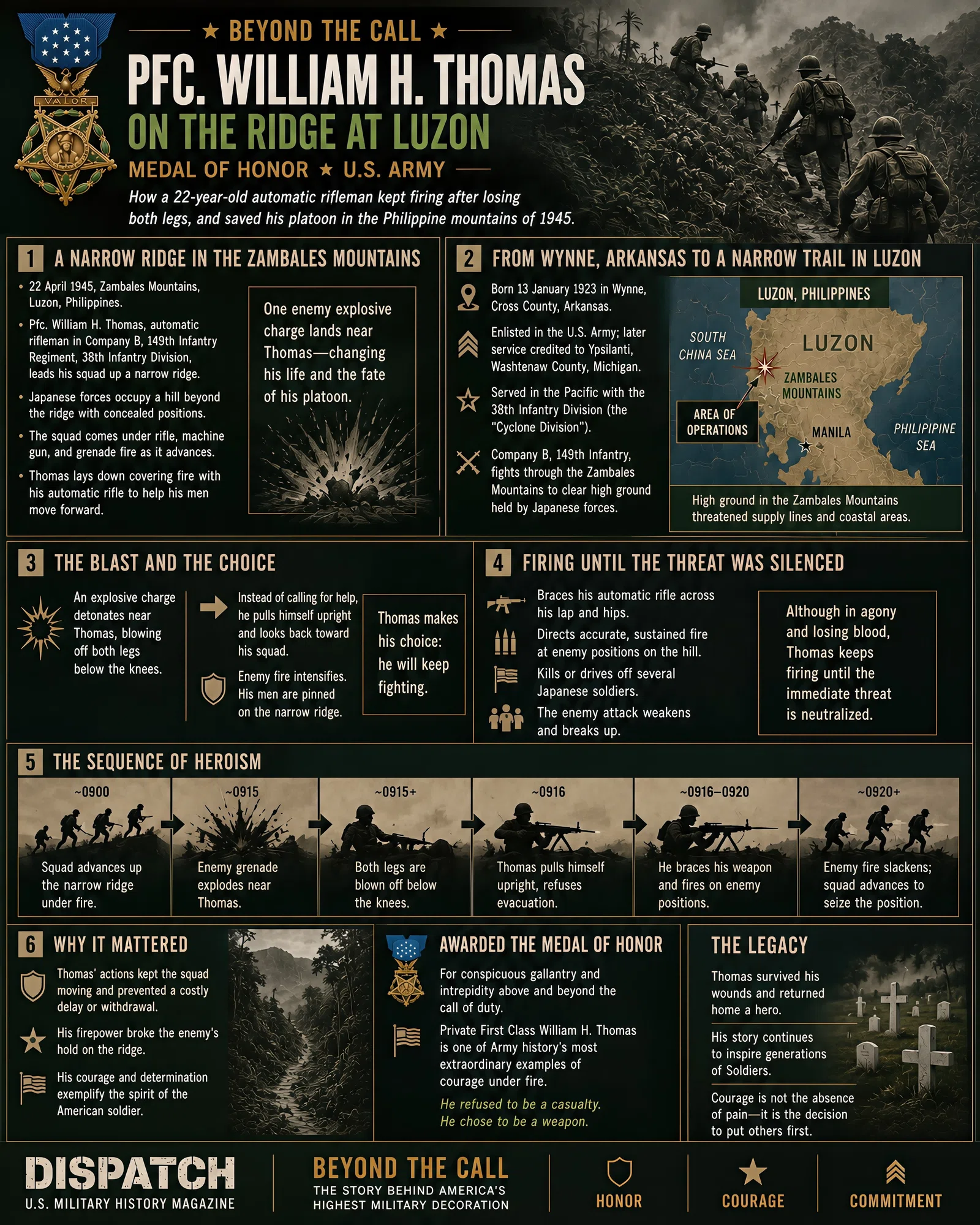
A Narrow Ridge in the Zambales Mountains
The ridge was too narrow for comfort—just enough space for a file of soldiers to work their way up, single file, toward an enemy they could not yet see.
It was 22 April 1945 in the Zambales Mountains of Luzon. The Philippines campaign was in its brutal final chapters. Japanese forces, retreating into the interior, had dug into high ground overlooking approaches to the plains. For the infantrymen climbing that wooded spine of earth, every step forward meant moving closer to camouflaged positions waiting above them.
In the leading squad of Company B, 149th Infantry Regiment, 38th Infantry Division, a young automatic rifleman named Private First Class William H. Thomas moved with the point element. At just 22 years old, he was already a veteran of the Pacific war, carrying the heavy automatic rifle that gave his squad the sustained firepower it needed when things went bad.
The mission that day was simple to describe and hard to survive: drive a strongly entrenched enemy from a hill beyond the ridge, where they controlled the ground with overlapping fields of fire and cleverly concealed positions. The trail was lined with thick vegetation; every tangle of brush might hide a rifle barrel or a grenade. Ahead, the enemy began to react—rifle fire at first, then the harsher chatter of machine guns, and finally the arc of explosive charges thrown down from above.
Thomas and his fellow riflemen pressed on. To halt on the open ridge was to invite disaster; the only safety lay in closing the distance and breaking through. Automatic rifle at the ready, Thomas laid down bursts of covering fire as the squad advanced, his weapon anchoring the fire line as they clawed their way up the slope.
One of the enemy’s explosive charges landed close—too close. In an instant of blinding light and concussive force, the trajectory of Thomas’s life, and of the men around him, changed forever.
We’ll come back to that moment. To understand the full weight of what happened on that ridge, it helps to know who William Thomas was, and how an Arkansas-born young man came to be leading a squad’s firepower in the mountains of Luzon.
From Wynne, Arkansas to a Narrow Trail in Luzon
William H. Thomas was born on 13 January 1923 in Wynne, a small community in Cross County, Arkansas. He grew up in a generation marked by the tail end of World War I and the long shadow of the Great Depression. For young Americans like Thomas, adulthood arrived early and hard. Work, responsibility, and service to something larger than oneself were not abstract values—they were daily realities.
When the United States went to war after Pearl Harbor, Thomas was barely out of his teens. The Army would later credit his service to Ypsilanti in Washtenaw County, Michigan, a reminder that wartime America was constantly on the move—families chasing work, young men and women scattering to factories, training bases, and recruiting stations across the country.
Thomas entered the U.S. Army at a time when the Pacific war was still very much in doubt. Island by island, ridge by ridge, American forces were learning how costly it would be to pry the Japanese Empire out of fortified terrain. The 38th Infantry Division—the “Cyclone Division”—trained and deployed for exactly that kind of grinding campaign.
By early 1945, the division was fighting its way through Luzon, part of the broader effort to liberate the Philippines. Their operations in the Zambales Mountains were more than just another set of hills on a map. The high ground controlled approaches to vital coastal areas and threatened American supply lines. Clearing those mountains meant isolating remaining Japanese forces and securing the flank of larger operations aimed at Manila and beyond.
Company B of the 149th Infantry was one of the units tasked with the dangerous business of pushing into that broken country of ridges, ravines, and thick jungle. Automatic riflemen like Pfc. Thomas were crucial to those small-unit fights. An automatic rifle was lighter and more mobile than a full machine gun, but it could still put out rapid, sustained fire. In close terrain, that firepower often meant the difference between a stalled attack and a successful push.
So it was that, on that April day, William Thomas found himself in the leading squad on a narrow wooded ridge, climbing toward camouflaged enemy emplacements that commanded the hill beyond. Above him, Japanese soldiers hurled explosives and poured down small-arms fire, trying to break the attack before it reached their positions.
One of those charges struck him directly.
The blast took both his legs below the knees.
What Thomas did next would echo through the memories of his comrades, the official record of his division, and ultimately in the Medal of Honor that now bears his name.
The Blast and the Choice
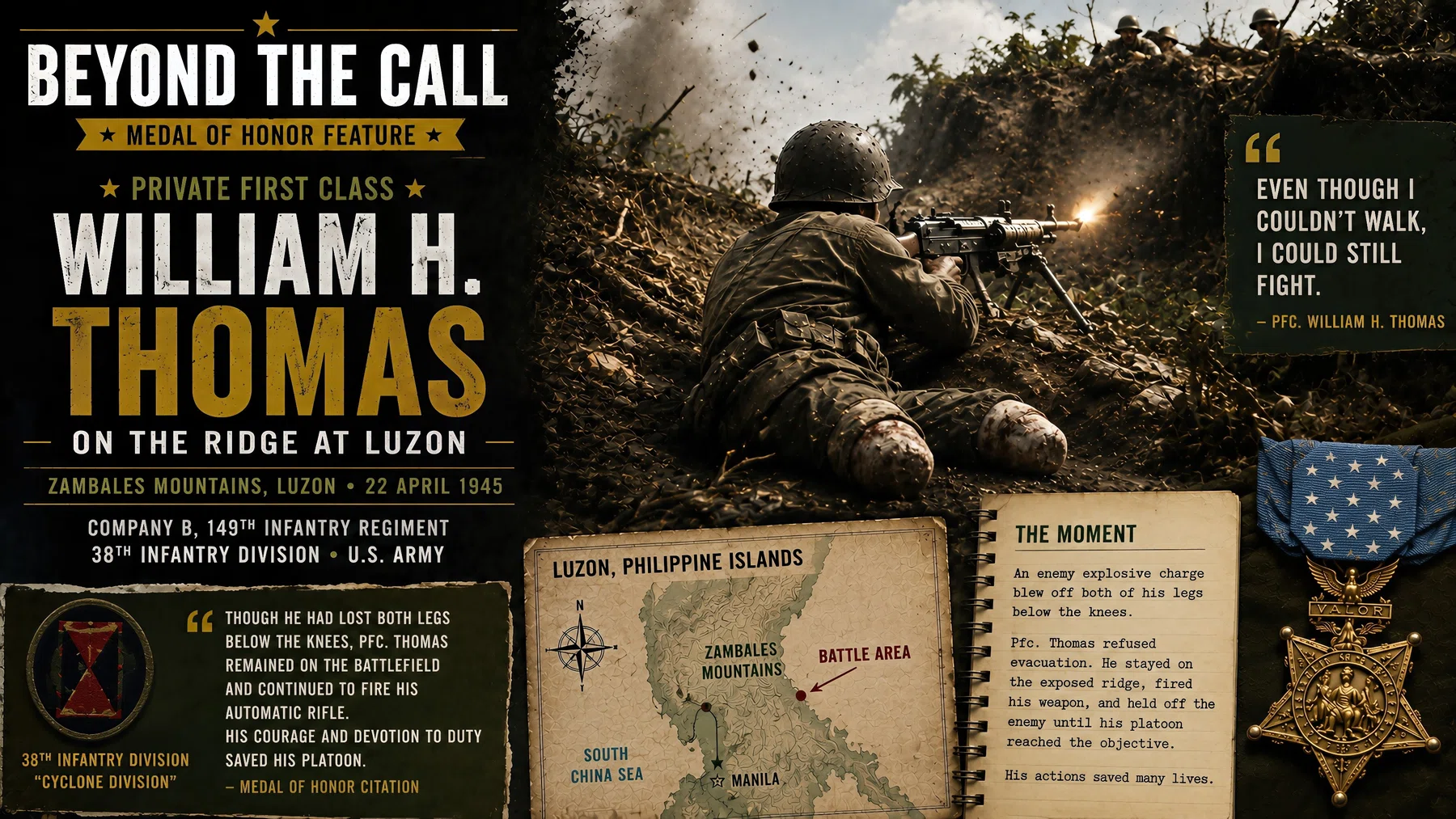
When the explosive charge struck, it did not simply wound William Thomas; it tore both of his legs away below the knees. The force of the blast hurled fragments of metal and earth across the ridge, and for a moment the squad’s line of march staggered under the shock. Any other soldier could have been forgiven for sinking into the ground and calling for a medic. Instead, Thomas pulled himself upright as best he could, braced behind his weapon, and looked back toward the men still trying to move forward along that narrow spine of earth. The enemy fire was not letting up. If anything, the storm of bullets and more explosives intensified now that the Americans had been checked.
Medics and comrades tried to reach him. The standard procedure was clear: stabilize the wounded man, get him off the exposed ridge, and keep the attack moving under the protection of other guns. Thomas refused. He waved off attempts to drag him back and insisted on staying in place. Cradling his automatic rifle, he continued to fire up the slope, pouring rounds into the enemy’s camouflaged positions. His fire did more than inflict casualties. It reassured the men behind him that the lead gun was still in action, still hammering away, still keeping the enemy’s heads down so they could crawl, run, and scramble past him toward the crest.
Even as blood loss and shock took their toll, Thomas held to that decision. The automatic rifle was his tool, his responsibility, and he meant to use it as long as it would work. Accounts describe him propped in place on the ground, body shattered but upper frame still driving the weapon, the muzzle climbing and settling with each burst. The enemy, realizing he was grievously hurt, did not spare him. Bullets cracked and snapped around him; one finally struck his weapon and disabled it. At that point, most soldiers would have had no choice but to accept evacuation. Thomas had prepared for that possibility in another way. He still had his grenades.
Grenades in Hand, Holding the Ridge
With his rifle destroyed, Thomas shifted tactics without moving from the spot that anchored his platoon’s advance. He pulled the safety pins from his remaining grenades and, judging distance by training and instinct, lobbed them toward the enemy positions. They were not wild throws born of desperation. Each grenade was placed with the same deliberate focus he had brought to his automatic rifle fire. The explosions tore into the defenders who had been trying to break the American attack, killing several and throwing the rest off balance at a crucial moment. The citation for his Medal of Honor credits him with destroying three enemy soldiers after he had already lost both legs, a measure of just how effective those last throws were.
Still he refused medical aid. The ridge was no place for sentiment; every man understood that if the front of the attack faltered, the enemy could roll grenades and fire down the length of the trail, turning a narrow approach into a killing zone. Thomas’s insistence on staying in place meant that his comrades could press on without having to shift their fire plan or re-form the line under direct observation. Behind him, the platoon surged past, using his final bursts and grenade blasts as cover to close with the enemy positions on the hill beyond. In the chaos and smoke, his broken body remained where the fight had fixed it, a lone figure between the rest of Company B and the ground they still needed to take.
The wounds Thomas suffered were mortal. He would die later that day, never seeing the full result of what his stand on the ridge had purchased. But his fire and his grenades had done exactly what an automatic rifleman’s work at the point of an attack is meant to do: they kept the enemy suppressed, prevented the repulse of his platoon, and helped assure that the hostile position would be captured rather than lost. The men who finally overran those camouflaged emplacements knew what it had cost him to hold that place. For the rest of their lives, the image of a young Arkansan, legless yet still fighting, would stand for the kind of courage that cannot be ordered, only offered.
The Citation and the Cost
When the Army later recorded what had happened on that narrow ridge, the language of the official Medal of Honor citation tried to capture both the violence of the moment and the quiet resolve that followed. It described the explosive charge that ripped away both of Thomas’s legs below the knees and inflicted additional wounds. It noted his refusal of medical aid and his insistence on remaining in position, even though he had every reason to accept evacuation. It detailed how he continued to fire his automatic rifle until it was disabled by enemy fire, and then calmly shifted to throwing grenades, killing several enemy soldiers and breaking the momentum of their defense. But even careful, formal wording could not fully convey what his comrades saw: a young man, grievously wounded, using every remaining second of his strength to protect others.
The cost of that decision was absolute. Thomas did not survive his wounds. He died later that day, before he could learn that his platoon had secured the hill his actions had opened. For the survivors, the ridge and the captured enemy position were not just tactical objectives; they were the visible proof that his sacrifice had not been in vain. The unit could count its own casualties and see what might have happened if the lead element had broken. For the families back home, the citation and later accounts became a way of understanding how a son, brother, or friend had spent his last moments. They showed that his final acts were shaped not by fear, but by a determination to do his duty even when every personal reason to stop had been stripped away.
A Young Man Remembered
William H. Thomas never lived to see the end of the war he helped to win. He died at twenty-two, an age when most people are just beginning to imagine their futures. In peacetime he might have been known in Wynne, Arkansas, for his work, his family, or his place in a small-town community. Instead, his name is preserved in the rolls of the nation’s highest award for valor, attached forever to a few desperate minutes on a ridge in the Philippines. The Medal of Honor, awarded to him posthumously, formally recognized what his fellow soldiers already knew: that his selfless courage had turned the tide of a fight that could easily have gone the other way.
In the years after the war, his story has lived on in unit histories, local remembrances, and the collective memory of the division that fought through Luzon. For veterans of the 38th Infantry Division, Thomas represented the best in the citizen-soldier tradition: a quiet young man who bore the heaviest weapon in his squad, accepted the dangers that came with that role, and in the end chose to stand and fight when every instinct might have urged him to seek help. For people who learn about him today, his life invites reflection on what ordinary Americans were asked to do in the Pacific and how they responded. His courage was not an abstraction; it took shape in specific choices on a specific patch of ground, under enemy fire, with the lives of known faces tied directly to what he decided in those moments.
Beyond the Call
Stories like that of Pfc. William H. Thomas help us understand war at the level where it is most real: in the experiences of individuals who had to make impossible decisions with no time to think and no guarantee they would be remembered. On a staff map, the ridge in the Zambales Mountains was just a piece of terrain that had to be taken. For Thomas and his platoon, it was a place where the line between survival and disaster was measured in feet and seconds. His decision to stay in place, to continue firing and then to throw his grenades after losing his legs, shows how the actions of a single soldier can shape the fate of many.
Looking back, it is easy to see the broader arc of the Luzon campaign and the eventual collapse of Japanese resistance in the Philippines. What can be harder to see is that those large movements depended on countless moments like the one on that ridge. Every hill taken, every strongpoint reduced, rested on someone’s choice to move forward when everything around them screamed to stop. Beyond the Call exists to bring those moments back into focus, not to glorify war, but to honor the men and women who bore its weight. In remembering Pfc. William H. Thomas, we remember not only his sacrifice, but also the comrades he saved and the ideals he believed were worth his last full measure of devotion.