Overview
Beyond the Call: Medal of Honor Stories – Dispatch: U. S. Military History Magazine, from Trackpads dot com
1. A childhood in the shadow of hatred
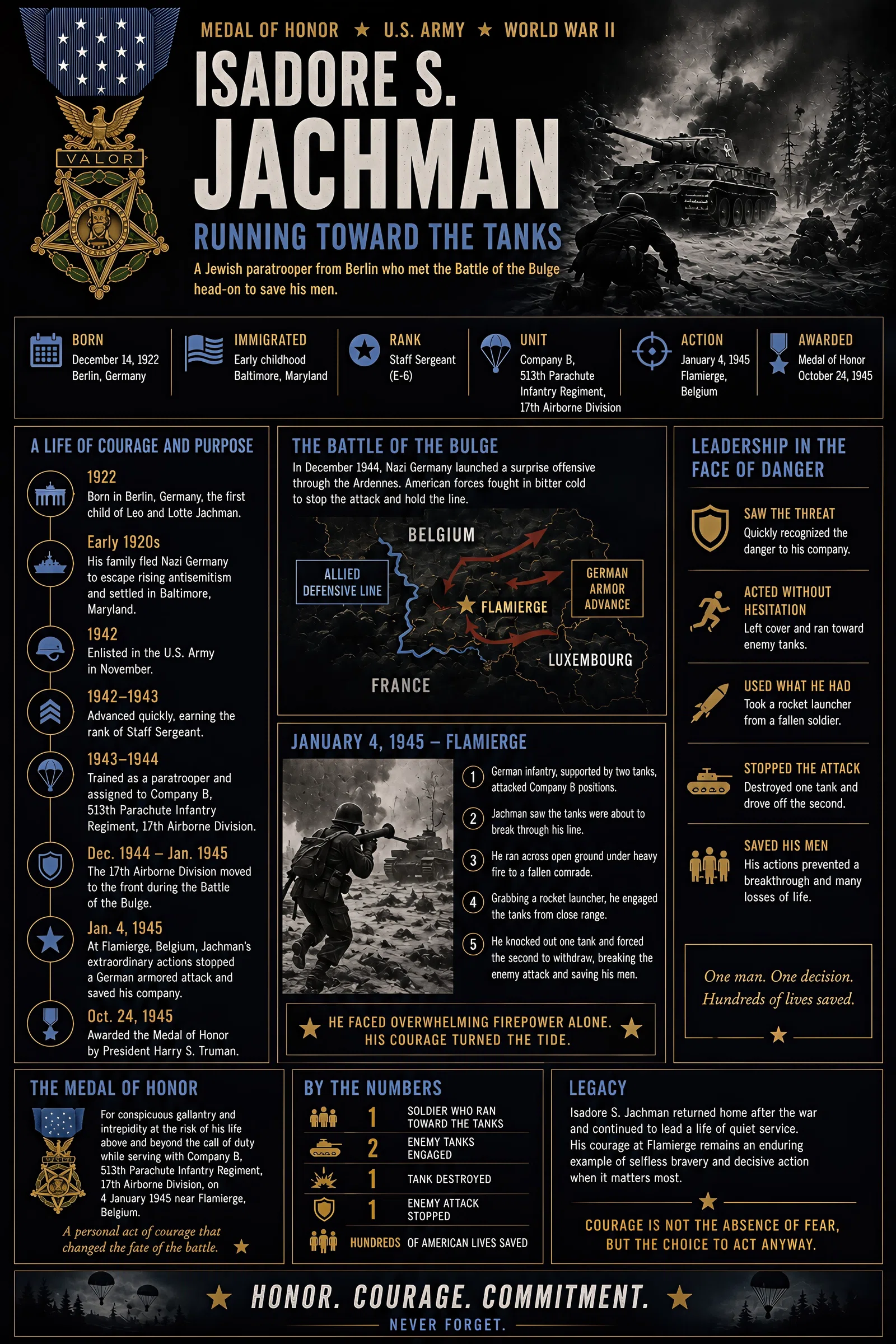
On paper, Isadore Siegfried Jachman’s story begins like so many others: born in Berlin on 14 December 1922, the first child of Leo and Lotte Jachman. In reality, his life started in a country sliding toward dictatorship and state-sponsored antisemitism. The Jachmans were Jewish, and as the new regime hardened into the Nazi state, their future narrowed by the month. When Isadore was still a toddler the family made a choice that would save their lives—they left Germany and began again in the United States, settling in Baltimore, Maryland.
Baltimore became home in every sense. Neighbors and classmates knew him simply as “Izzy.” He grew up speaking English, not German, and worked his way through Baltimore City College, a public high school known for its demanding academics. He was American by upbringing and attitude, but his relatives overseas were not as fortunate. By the time he was in his late teens, news filtered back that several members of his extended family—six aunts and uncles among them—had been murdered in the Holocaust. The war in Europe was not an abstraction for him; it had names and faces.
When the United States entered World War II after Pearl Harbor, Jachman was nineteen. The country was already mobilizing on an enormous scale, but for him, enlistment was more than a matter of national duty. It was also personal. In November 1942 he joined the U. S. Army, trading Baltimore’s streets for the rigid rhythm of Army life: early formations, route marches, weapons ranges, and the constant push to turn civilians into combat soldiers. As a natural leader with a calm, steady demeanor, he advanced quickly, eventually earning his stripes as a staff sergeant.
2. From training grounds to a frozen front
The Army steered Jachman toward a relatively new and demanding branch of service: airborne infantry. Paratroopers were expected to fight as light infantry but also to jump from aircraft, land scattered behind enemy lines, and pull themselves together under fire. The training was punishing—tower jumps, practice exits from mock fuselages, and long days of field problems with full kit—but it filtered for soldiers who could keep their heads when everything around them was chaos. Jachman found his place in Company B, 513th Parachute Infantry Regiment, part of the 17th Airborne Division.
For much of 1944, the 17th Airborne remained in reserve in England, training and waiting while other airborne divisions made the high-profile jumps into Normandy and Holland. By winter the division finally received its call. The German surprise offensive in the Ardennes—the Battle of the Bulge—had smashed through thinly held American lines in Belgium and Luxembourg. Armored spearheads pushed west under cover of snow, fog, and forest, threatening to split Allied armies. To plug the gaps and blunt the advance, U. S. commanders threw in whatever mobile units they had, including the freshly committed 17th Airborne Division.
In late December and early January, Jachman and his fellow paratroopers moved toward the front through a landscape of Belgian villages, narrow roads, and dense woods. The cold was brutal; troops marched and rode on open trucks through sleet and snow, wrapping themselves in blankets and extra clothing where they could find it. As they neared the small village of Flamierge, the men of Company B knew only that German armor and infantry were in the area and that they would likely be facing them soon. For Staff Sergeant Isadore Jachman, barely three weeks past his twenty-second birthday, the war that had uprooted his family from Germany and claimed the lives of his relatives was about to become intensely, irrevocably personal.
3. Running toward the tanks at Flamierge
On the morning of 4 January 1945, the village of Flamierge was a frozen knot of stone houses, churned-up fields, and narrow roads packed with snow and ice. Company B of the 513th Parachute Infantry Regiment held positions around the village, dug into shallow foxholes and cellars that offered only thin protection from what they knew was coming. A wartime portrait of Isadore Jachman, often reproduced in background materials, shows a young paratrooper with an open smile and an airborne patch on his cap; that is the same twenty-two-year-old who now moved among his men, checking weapons and positions as they waited in the cold.
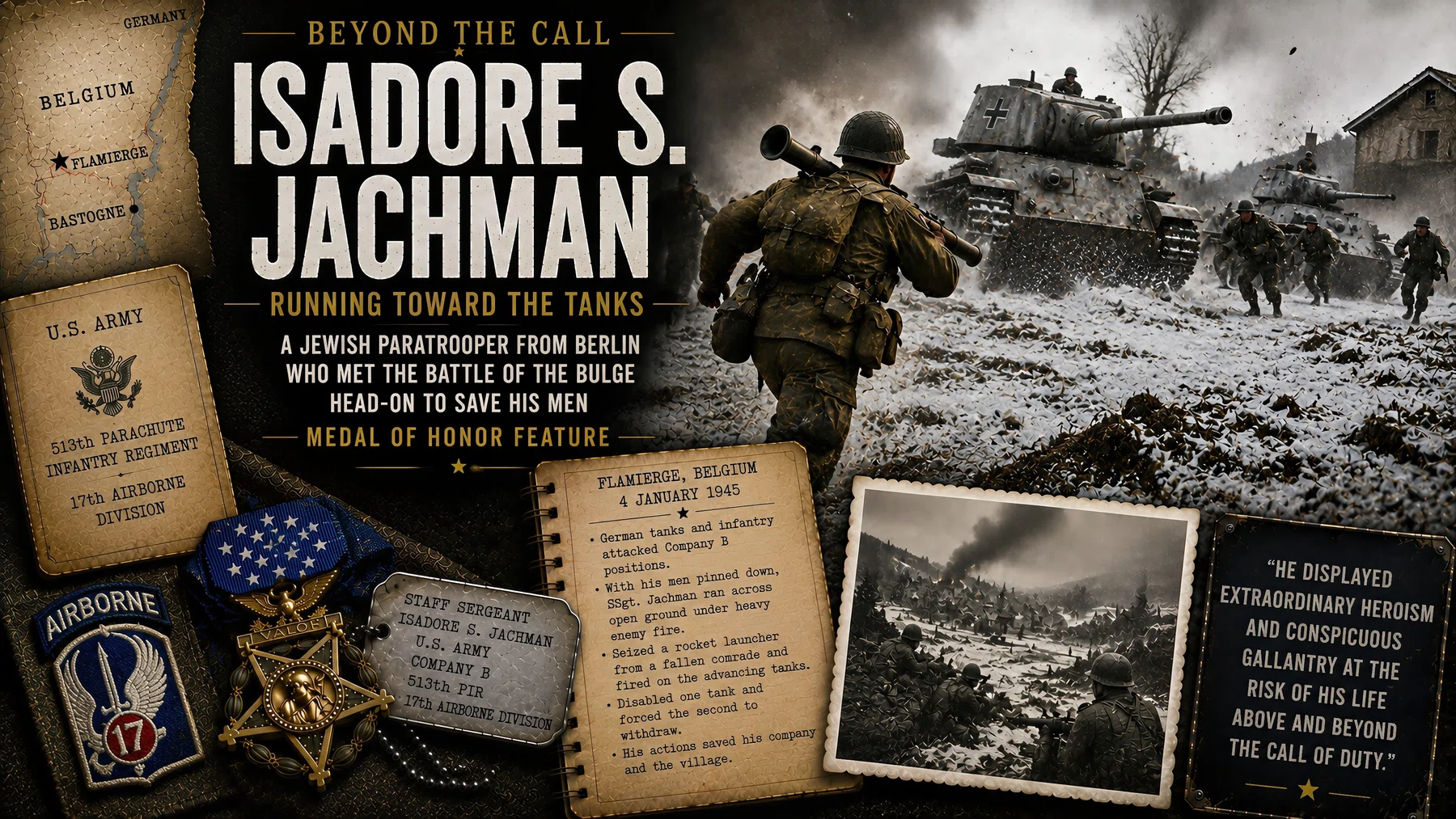
When the attack came, it arrived with the full weight of German firepower. Artillery and mortars bracketed the village, throwing up fountains of earth and snow while small-arms fire raked the American lines. Two enemy tanks pushed forward with the infantry, using their cannons and machine guns to blast at any sign of movement. Company B began to take serious casualties, and men pinned in exposed spots could not shift position without drawing more fire. In that moment, Jachman saw that if someone did not stop the tanks, the line would collapse and the village would likely be overrun.
Acting on that realization, he left the relative safety of his cover and sprinted across open ground that was being swept by shells and bullets. Reaching the body of a fallen comrade, he seized a rocket launcher and ammunition, then continued forward alone toward the tanks that were now concentrating their fire on him. Standing where he could get a clear shot, he fired again and again. One tank was hit and crippled, and the crew of the second decided they wanted no part of the lone paratrooper who was suddenly a greater threat than the company he was defending. Both vehicles pulled back, and the German infantry attack lost its spearhead. In the exchange, Jachman was struck by enemy fire and fatally wounded, but his action had smashed the momentum of the assault and given his men a chance to survive.
4. Holding the line and counting the cost
With the tanks retreating, the paratroopers of Company B were able to reorganize their positions and bring more effective fire on the enemy infantry. What had threatened to become a breakthrough instead turned into a checked advance, and the defenders held Flamierge through a critical phase of the Battle of the Bulge. In after-action accounts, officers and enlisted men alike pointed to the moment when one staff sergeant ran toward the tanks as the turning point that prevented their company from being destroyed in place. His decision to expose himself drew the most dangerous fire away from his pinned comrades and shattered the coordination of the German attack.
Medics and nearby soldiers carried Jachman away from the front line, but the wounds he suffered in those few minutes proved mortal. He died in Belgium on the same day as his action, far from the streets of Baltimore where he had grown up and from the relatives whose fate under Nazi rule had helped shape his resolve. He was later laid to rest in a Jewish cemetery in the Baltimore area, bringing him home in death to the community that had taken in his family as refugees. Years later, the official Medal of Honor citation would describe how his gallantry “disrupted the entire enemy attack” and reflected the highest credit on himself and the parachute infantry he served.
In the immediate postwar years, the military worked through an enormous backlog of decorations recommended during intense combat. For Jachman, that recognition culminated in a formal Medal of Honor presentation in the summer of 1950 at Fort George G. Meade in Maryland, where senior Army leaders placed the nation’s highest award for valor into the hands of his parents. The ceremony connected the quiet Baltimore family who had fled Berlin years earlier with the battlefield near Flamierge where their son had made his stand. It also ensured that the story of a young Jewish paratrooper who ran toward two tanks in a Belgian winter would be preserved not just in unit memories, but in the permanent roll of American military heroism.
5. A refugee who fought back
To understand the weight of what happened at Flamierge, it helps to see it through the lens of where Jachman began. He had been born into a Germany that turned on its Jewish citizens, forcing his family to flee or face persecution and likely death. Years later, as a U. S. paratrooper in the Ardennes, he found himself in combat against the same regime that had driven his parents out and murdered his relatives. The enemy tanks in front of him were not just military threats; they were armored symbols of a system that had tried to erase his people. That background does not lessen the universal nature of his courage, but it does add a layer of meaning to his decision to stand and fight rather than yield ground.
His story also counters simplistic ideas about who fought and died for the United States in World War II. Jachman’s path—from refugee child to airborne staff sergeant—was not unique, but it was remarkable. The Army of that era contained first-generation immigrants, children of refugees, and men whose ties to Europe were direct and painful. For them, the war was both an American struggle and a deeply personal reckoning. When Jachman ran toward the tanks, he did so as a noncommissioned officer protecting his men and as a Jewish American answering the brutality that had changed his family’s life. That blend of identities is part of what makes his story resonate so strongly today.
6. Memory, identity, and the Medal of Honor
The Medal of Honor is the United States’ highest award for valor in combat, reserved for actions that go far beyond what is expected, even in war. In Jachman’s case, the citation describes a single, brief episode—crossing open ground under fire, seizing a fallen comrade’s weapon, and halting an armored attack—that lasted only minutes but changed the fate of his company. In those minutes, everything he had been shaped who he was: the refugee child from Berlin, the Baltimore student, the paratrooper forged in training, the staff sergeant responsible for the lives around him. The medal placed his name among a small group of Americans whose battlefield decisions have become part of the country’s shared story.
At the same time, his legacy rests not only in formal honors but also in the quieter ways people remember him. Families in Baltimore knew him as “Izzy,” a son and brother whose empty place at the table was a daily reminder of the cost of war. His fellow paratroopers remembered a calm, steady noncommissioned officer who kept moving when others might have frozen. For Jewish communities in the United States and beyond, his story offered a powerful example of someone who had survived the forces of antisemitism, then confronted them in battle and refused to back down. The Medal of Honor helped ensure that these threads of identity and memory would not fade with time.
7. Why Staff Sergeant Jachman’s story matters now
Decades have passed since the winter of 1945, but the questions raised by Jachman’s actions remain current. His story asks what it means to carry responsibility for others, and how individuals respond when that responsibility collides with extreme danger. It highlights the role of noncommissioned officers, those leaders who stand closest to the enlisted soldiers they guide, and whose split-second decisions often decide whether units hold or break. It also reminds us that the American story in World War II included people whose ties to the conflict were intensely personal, and who chose to serve the very country that had given them refuge.
For students of military history, his life offers a window into airborne operations in the European theater, the brutal conditions of the Battle of the Bulge, and the human factors that influence combat decisions. For families with their own histories of migration, persecution, or military service, it offers a narrative of courage that grew out of loss rather than being untouched by it. Above all, Staff Sergeant Isadore Siegfried Jachman’s decision to run toward the tanks at Flamierge stands as a clear example of what “beyond the call” can mean: a young man who faced the forces that had scarred his early life and chose to confront them head-on to save the soldiers under his care.