Overview
Beyond the Call: Medal of Honor Stories — Dispatch: U.S. Military History Magazine (a Trackpads dot com project)
1. A carrier in trouble off Japan
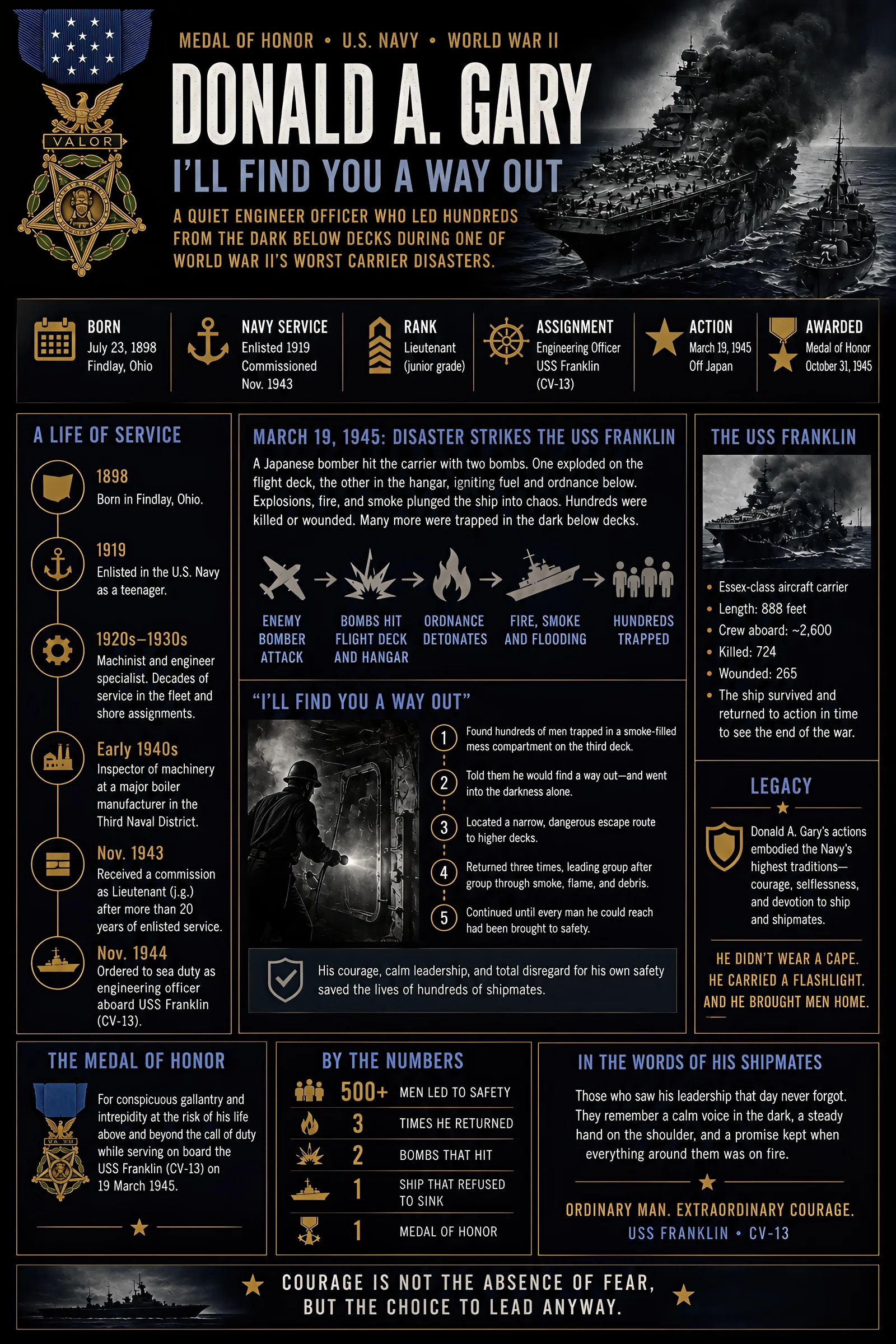
On the morning of March 19, 1945, the aircraft carrier USS Franklin pushed closer to Japan than any other U.S. carrier had yet dared. She was operating near the Japanese home islands, preparing to launch more strikes against targets around Kobe. The big ship—nearly 900 feet of steel packed with aircraft, fuel, and ordnance—was busy with the routine of war at sea: planes being armed, crews moving across the hangar and flight deck, boilers driving her forward into enemy waters.
Then, without much warning, disaster crashed down from a single enemy aircraft.
A Japanese bomber slipped through the clouds and the combat air patrol and planted two bombs into Franklin’s flight deck. One plowed into the hangar, detonating among armed aircraft. The other punched deeper, setting off a chain reaction in the ship’s own bombs, rockets, and ammunition stored below. In seconds, the carrier became a maze of shock, darkness, and flame.
Explosions rolled through the decks. Fuel and ordnance cooked off in vicious bursts. Compartments that had been brightly lit workspaces became smoke-choked traps. Hundreds of men were killed instantly; hundreds more were wounded, stunned, or simply lost in the blacked-out interior of the ship. The carrier began to list, her flight deck a jagged, burning skyline above the sea.
A wartime photograph from the period shows Franklin heeling over, smoke boiling from her island superstructure while sailors crowd her exposed deck and a cruiser steams dangerously close alongside to help. It is the picture of a ship on the edge of death—and of a crew whose survival would depend on a few people willing to go back into the dark when everyone else was trying to get out.
One of those people was a relatively unknown officer in his early forties, a former enlisted machinist turned engineer: Lieutenant (junior grade) Donald Arthur Gary.
2. The engineer from Ohio
Gary’s path to that burning carrier began far from the Pacific, in the small city of Findlay, Ohio. Born there on July 23, he grew up far from the sea but joined the U.S. Navy as a teenager in December 1919, just after World War I. Like many long-service sailors of his generation, he spent more than two decades in the enlisted ranks, learning the Navy the hard way—from the deckplates up.
His specialty was machinery. Gary became intimately familiar with the boilers, pipes, pumps, and engines that kept the fleet moving. By the early 1940s, he was working in the stateside Third Naval District as an inspector of machinery at a major boiler manufacturer, helping ensure that the Navy’s new ships would have reliable power plants. That job was technical, demanding, and—compared to the front lines—relatively safe.
But war has a way of pulling experienced hands toward the fight. In November 1943, after more than twenty years in uniform, Gary received a commission as a lieutenant, junior grade. A year later he was ordered to sea duty as an engineering officer aboard the Essex-class carrier USS Franklin. His world shifted from factory floors and inspection reports to steel passageways, roaring firerooms, and the relentless tempo of carrier operations in the Pacific.
An engineering officer’s job is simple to describe but hard to do: keep the ship alive. He is responsible for the power that turns the screws, the steam and electricity that feed every system on board, and the complex network of spaces and people that make that happen. In combat, those spaces are some of the most dangerous places on the ship—deep below the waterline, full of fuel and high-pressure steam, and difficult to escape if things go wrong.
On March 19, 1945, Gary was on the third deck when the bombs hit. Lights went out. Bulkheads buckled. The familiar hum of machinery turned into a roar of explosions and the low, frightening sound of a wounded ship. Somewhere nearby, men were shouting in the dark.
Groping through smoke-filled passageways, he found them: hundreds of sailors jammed into a mess compartment, the air thick with fumes, exits blocked or invisible, panic rising as more detonations shook the ship. They believed they were trapped in a steel coffin.
Gary told them something different.
He promised he would find them a way out—and then disappeared alone into the dark to make that promise real.
3. “I’ll find you a way out”
Inside the darkened mess compartment, the trapped men knew only that the ship was burning and that there was nowhere to go. Smoke rolled in low and thick. The escape routes they’d used in countless drills were blocked by twisted metal or choked off by fire. In that confusion, Lieutenant (j.g.) Donald Gary spoke up with a calm that cut through the panic. He told the men he would find them a way out, then slipped alone through a hatch into the passageway beyond, feeling his way along bulkheads he could no longer see. Accounts describe him moving through debris-strewn corridors, past open spaces that glowed red with reflected flame, searching for any path that still led upward.
He finally located an escape route—a narrow, hazardous path that threaded through damaged spaces and under hanging cables toward higher decks. Having found it, Gary did not take it for himself. Instead, he went back into the mess compartment and began leading men out in groups, each time explaining the route, steadying the frightened, and physically guiding those who could not see or were half-stunned by the blasts. He made that journey three times, each trip through the smoke and the threat of sudden new explosions, until the compartment that had held several hundred men was finally empty.
Witnesses later recalled the contrast between the chaos of the ship and his steady presence. While ammunition continued to cook off and the carrier’s structure groaned around them, Gary’s focus stayed on one simple task: get every man he could find to a place where they could breathe and see again. By the time he brought the last group clear of the smoke, the cost of inaction was obvious on the decks above. The fires were far from under control, and the question was no longer just how many men could be saved, but whether USS Franklin herself would live long enough to reach safe waters.
4. Keeping USS Franklin alive
Rescuing the trapped men might have been enough to mark Gary’s day as extraordinary, but his work aboard Franklin was only beginning. Once those sailors were clear of the death trap below, he turned to the more brutal task of fighting the ship’s fires. Ordnance and fueled aircraft were still burning on the flight deck, and explosions continued to shake the carrier. Gary repeatedly organized and led small firefighting parties into those exposed spaces, directing hose lines and attack angles in conditions where a single misstep could mean being swept overboard or caught in a fresh blast of shrapnel and flame.
Even as damage control teams worked topside, another crisis was unfolding below the waterline. Two of the carrier’s main firerooms—vital spaces that fed steam to the engines and generators—had been knocked out or rendered inoperable. Without steam, the ship would lose power for pumps, steering, and firefighting equipment, and she would be at the mercy of the sea and any further attacks. Recognizing the danger, Gary made his way to the remaining fireroom and took charge. In that hot, confined space, with leaks, damage, and the ever-present risk of further explosions, he directed the raising of steam in one boiler, step by step, until meaningful power was restored.
That act changed the course of the day. With steam back on the line, Franklin could support damage control, maintain some way on in the water, and avoid becoming a drifting, burning hulk. Other officers and crew members played crucial roles in keeping the carrier afloat, but Gary’s combination of rescue work and engineering leadership tied together two essential elements of survival: saving the men and saving the ship that still carried them. By nightfall, the battered carrier remained afloat and under tow, her decks ruined but her hull intact enough to limp away from Japan. Inside her blackened compartments and scorched machinery spaces lay the quiet evidence of choices made under fire—choices that would soon be recognized as “above and beyond the call of duty.”
5. Above and beyond the call
In the months after USS Franklin limped away from Japan, the Navy pieced together what had happened in those dark, smoke-filled compartments. Survivors told investigators and shipmates about the engineering officer who appeared in their sealed-off space, promised to find them a way out, and then kept returning until everyone he could reach was clear. When the official Medal of Honor citation for Lieutenant (j.g.) Donald Arthur Gary was drafted, it emphasized the same core actions that his shipmates remembered: his repeated trips through burning, debris-strewn passages to guide hundreds of trapped men to safety, and his later leadership in restoring power in a damaged fireroom while explosions and fires continued around him. The language of the citation, like all such documents, is formal and measured. Its conclusion is not. It makes plain that his conduct “was in keeping with the highest traditions of the United States Naval Service,” and that he acted at the risk of his own life, far beyond what duty required.
The image of a single officer taking responsibility for so many others stands out even against the larger disaster that day. USS Franklin suffered some of the worst casualties of any U.S. warship that survived the war, and yet hundreds of men who might have died below decks instead found their way to air and light because one person refused to accept that they were trapped. For the Navy and for the country, Gary’s award became not only a recognition of individual courage, but also a symbol of how skill, experience, and quiet resolve could turn a hopeless situation into a fighting chance. The story of March 19, 1945, is the story of explosions, fire, and loss—but it is also the story of stubborn, determined rescue work in the dark.
6. A lifetime in uniform and a ship that bore his name
The Medal of Honor did not end Gary’s service; it marked a high point in a career that continued for several more years. Promoted in the wake of his actions aboard Franklin, he served in other assignments as the Navy shifted from total war to uneasy peace. He brought to those posts the same long-honed engineering expertise and deckplate familiarity that had guided his decisions in the fireroom and the mess decks. Colleagues later described him as a professional sailor first and a decorated hero second, a man more comfortable talking about how to keep a ship running than about his own place in history. After decades in uniform, he eventually retired at the rank of commander, having served through the closing years of the First World War’s aftermath, the interwar Navy, and the global conflict of World War II.
Donald A. Gary died in the late 1970s, far from the waters off Japan where his most famous day unfolded, but the Navy found a way to carry his name back to sea. In the early 1980s, an Oliver Hazard Perry–class guided missile frigate was commissioned as USS Gary, in his honor. The sleek, modern warship bore little resemblance to the massive, propeller-driven carrier on which he had earned the Medal of Honor, yet the connection was clear. Sailors who walked her decks served aboard a ship named not for an admiral or a famous battle, but for an engineering officer who had gone back into the fire when others were trying to escape it. In this way, Gary’s story slipped quietly into the everyday rhythm of the fleet, present in the simple fact of a name stenciled on a hull.
7. Legacy of a promise kept in the dark
Today, the story of Donald A. Gary and USS Franklin sits at the crossroads of engineering, leadership, and raw courage. It is a reminder that war at sea is not only fought on the bridge or the flight deck, but also in the maze of compartments below, where the difference between life and death can hinge on whether someone knows the ship well enough—and cares enough—to go looking for a way out. Gary was not a household name, and his heroism did not take the form of a dramatic charge across open ground. Instead, it was a series of deliberate choices made in near-total darkness: to take responsibility for others, to risk his life over and over again, and to treat the survival of both his men and his ship as problems to be solved, not reasons to surrender.
For students of military history, his actions underscore the importance of preparation and technical skill in moments of crisis. Years spent learning the layout of ships, mastering machinery, and understanding how systems fit together gave Gary the confidence to move through a crippled carrier and to coax life from a battered fireroom. For veterans and those still serving, his story offers a quieter kind of inspiration—a model of leadership that begins with a simple promise made to scared, trapped shipmates and ends with that promise kept. And for the rest of us, his Medal of Honor reminds us that even in the worst moments of war, courage often looks like a steady voice in the dark saying, “I’ll find you a way out,” and then walking into the smoke to prove it true.