Overview
1. “We’re Hit” Over Leipzig
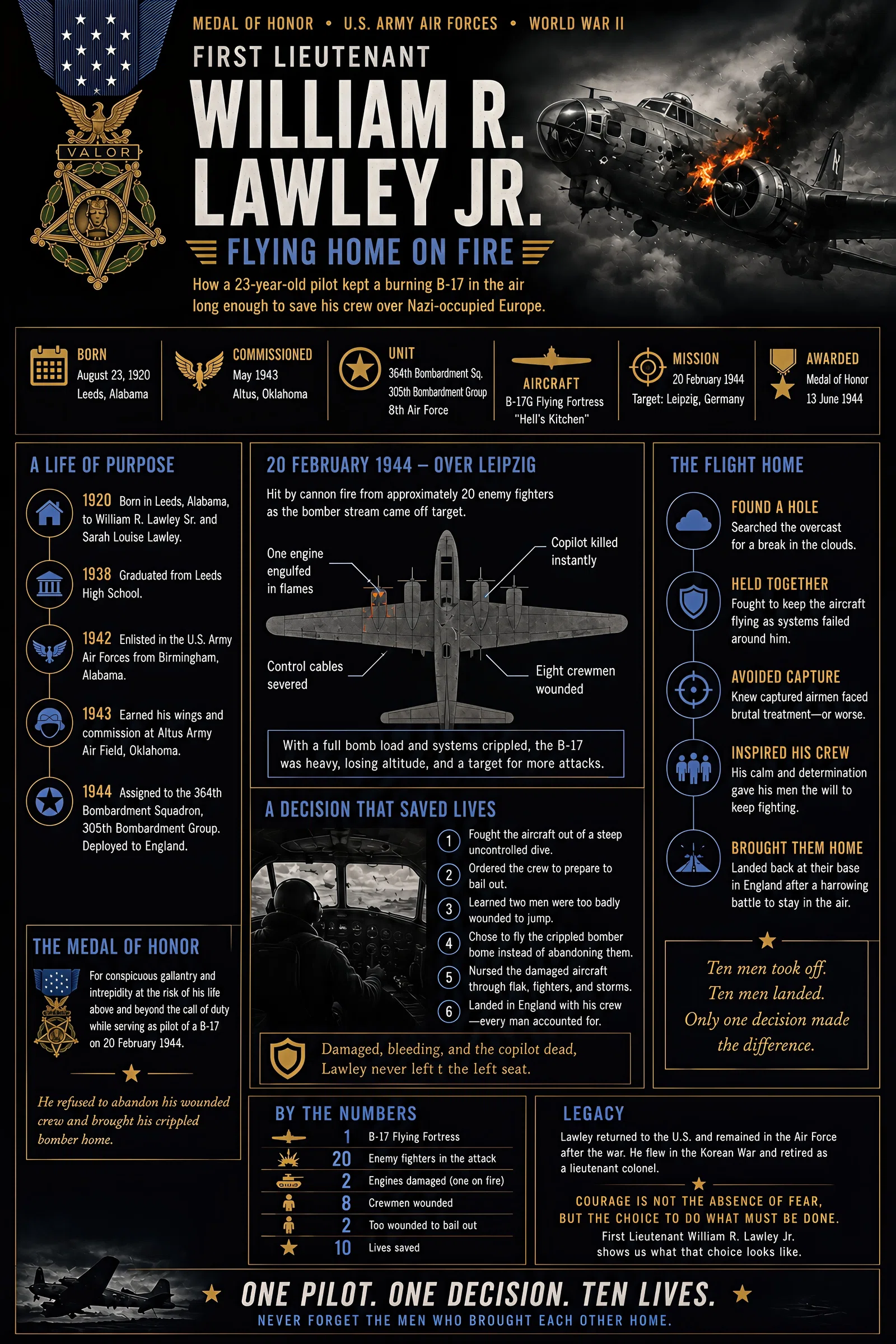
The first shells slammed into the big Boeing B-17 just as it came off the target.
It was the morning of 20 February 1944, high over Nazi-held Europe. First Lieutenant William Robert Lawley Jr., a 23-year-old pilot from Alabama, sat in the left-hand seat of a Flying Fortress from the 364th Bombardment Squadron, 305th Bombardment Group, part of the Eighth Air Force’s daylight offensive against Germany. Below and behind him, the bomber stream was turning away from a target area near Leipzig, engines straining in the thin winter air.
Then the fighters arrived.
Roughly twenty enemy aircraft pounced on Lawley’s formation, diving and rolling through the bomber stream. The sky that had been full of orderly contrails and black puffs of flak exploded into chaos. The Fortress shuddered as cannon shells and machine-gun rounds hammered into the fuselage. Oxygen lines were cut. Control cables snapped. Glass burst into glittering dust.
In the right-hand seat, the copilot slumped over, killed instantly by a 20-millimeter shell. Shards of metal slashed across Lawley’s face, leaving him bleeding and half-blinded. The B-17 rolled sharply and nosed over into a steep, uncontrolled dive.
For a few sickening seconds, it looked like the crew’s war—and their lives—were over.
Lawley’s world narrowed to the cockpit. Dead weight pinned the control yoke forward. With blood running into his eyes and his right arm nearly useless, he forced his copilot’s body off the controls, grabbed the yoke with his left hand, and fought the big bomber out of its dive. The airspeed needle crept back from the red. The horizon came level again.
He had no time to take stock, but the damage report was grim. One engine was on fire. Another was smoking. Control surfaces had been shot away. Eight of his crew were wounded to one degree or another. The Fortress still carried a full load of bombs—the release racks frozen by the cold—which made the crippled aircraft heavy and sluggish.
Standard procedure said to jettison the bombs, get the crew out, and let the dying airplane go.
Instead, Lawley tried to buy them a few more minutes of life.
He ordered the crew to prepare to bail out while he searched the overcast for a break. Somewhere behind those clouds was England. Somewhere below them were German fields and villages, and prison camps waiting for captured airmen. Above and around them, enemy fighters were still hunting.
Then a voice came over the interphone from the waist of the aircraft: two of the crew were too badly wounded to jump. If everyone bailed out, those men would die in the wreckage.
William Lawley absorbed that information, bleeding in his cockpit, hand locked on the controls of a burning, bomb-laden bomber that was losing altitude over enemy territory. In that moment, he made the decision that would define his life.
He would not leave his wounded behind. If it was humanly possible, he would fly the Fortress home.
2. From Leeds, Alabama, to the Left Seat of a Fortress
To the crew, it might have been hard to imagine that the quiet, steady pilot fighting for their lives over Germany had grown up in a small Alabama mill town.
William Robert Lawley Jr. was born on 23 August 1920 in Leeds, a community on the eastern edge of Birmingham. He came of age during the lean years of the Great Depression, graduating from high school in 1938. Like many young men of his generation, he was drawn to the promise of aviation—new, dangerous, and full of opportunity for those willing to learn quickly and shoulder responsibility.
When the United States edged closer to war, Lawley enlisted from nearby Birmingham in April 1942, joining what Americans still often called the Army Air Corps. He earned his wings and his officer’s bars at a training base near Altus, Oklahoma, in the spring of 1943. Flight school selected for more than just hands on the controls; instructors looked for judgment, calm under stress, and the kind of reliability that made other men trust you with their lives. Lawley fit that mold.
By early 1944, he was a first lieutenant in the 364th Bombardment Squadron, flying B-17 Flying Fortresses from chilly airfields in England as part of the strategic bombing campaign against Germany. The mission on 20 February was one of many large-scale strikes intended to cripple German industry and draw out the Luftwaffe’s fighters, wearing down enemy air power ahead of the coming invasion of Western Europe.
On the ground, the crews called the B-17 a “Fort” for a reason. With four engines, self-sealing fuel tanks, and a shell of riveted aluminum, it famously absorbed shocking amounts of damage and still limped home. Ten men lived and worked inside that metal shell: pilot and copilot, navigator and bombardier, engineer, radio operator, and a small army of gunners.
Lawley had flown enough missions to know exactly what was at stake. Enemy fighters and flak took a brutal toll on bomber crews; some units measured survival in missions flown, not months served. Even among veterans, superstition became second nature—a lucky scarf, a certain way of stepping onto the aircraft, a ritual knock on the fuselage.
Yet by all accounts, Lawley wasn’t a loud or flamboyant personality. He was the sort of officer who did his job, looked after his men, and kept his worries to himself. That quiet steadiness had earned his crew’s confidence long before they crossed the German coast that February morning.
Now, with their aircraft savaged and the sky around them full of enemies, that same steadiness would be tested to the limit.
In the shattered cockpit of the B-17 over Leipzig, William Lawley tightened his grip on the yoke with his one good hand, refused first aid, and committed himself fully to an almost impossible task: keep a burning, over-loaded bomber in the air long enough to reach friendly soil—without abandoning the wounded men depending on him to live.
3. “I’m Staying With the Ship
When word came up from the waist of the aircraft that two men were too badly wounded to jump, Lawley understood exactly what that meant. If he ordered the rest of the crew out, those men would die where they lay. If he stayed, there was at least a chance—however slim—that he could get them home. In the cockpit, blood still ran down his face from the shrapnel wound that had nearly blinded him. One engine burned hot on the wing, another coughed and sputtered, and the bomber still carried its full load of bombs because the release mechanism had frozen in the cold high over Germany.
He chose to stay with the crippled B-17 and bring the wounded back if it was humanly possible. Lawley gave the order that anyone physically able to bail out could do so, but he was not leaving. The crew stayed. In the chaos of combat, that unity mattered as much as any control movement. Fire still licked from the crippled engine, threatening an explosion that could break the wing, so Lawley used the tools he had left—rudder, remaining power, and careful banking—to smother the flames with his own airflow. Even as he fought the fire, enemy fighters swung in for another pass, forcing him into violent evasive maneuvers while the wounded groaned behind him.
Accounts of that second attack emphasize how much of the airplane’s original strength was already gone. Guns were out, oxygen was compromised, and the Fortress no longer had a full defensive ring of fire. Yet Lawley’s handling forced the fighters to overshoot, bought moments of relative safety, and kept the crew from further casualties. Inside the aircraft, the bombardier and other surviving crewmen worked to treat the wounded as best they could, improvising bandages and trying to keep men conscious in the freezing, thin air. The mission to Leipzig—planned in briefings as one more step in a long air campaign—had become a single aircraft’s desperate fight for survival, led by a pilot who refused to measure success by bombs on target alone.
4. Nursing a Dying Fortress Back to England
With the immediate attacks beaten off and the flames on one engine temporarily under control, Lawley pointed the battered bomber toward the distant west. The plan was simple in concept and brutally hard in practice: lose altitude enough to get out of the worst cold, stay low enough to avoid some radar-guided defenses, and keep the airplane in the air with whatever power remained. The instruments were smeared with blood, the windshield was a patchwork of shattered glass, and visibility through the forward panes was almost nonexistent, forcing him to rely on side views and his memory of how the aircraft felt when it flew straight and level.
He still refused first aid, knowing that any time spent away from the controls might be time the bomber did not have. As they droned on, one of the engines lost fuel and had to be “feathered,” its propeller blades turned edge-on to the wind to reduce drag, a standard emergency procedure that nonetheless robbed the Fortress of more power. Another engine began to overheat and catch fire again, and once more Lawley used sideslips and careful banking to choke the flames without tearing the weakened airframe apart. Each adjustment sent new pain shooting through his injured arm and face. Behind him, the crew watched the altimeter and fuel gauges, well aware that a forced landing in occupied Europe or in the icy Channel remained a real possibility.
The long minutes stretched into an hour and more as the B-17 limped toward the English coast. Lawley’s strength finally gave out; he collapsed at the controls from blood loss, shock, and exhaustion, slumping in the seat he had refused to leave. The bombardier pulled him back, administered emergency first aid, and kept the aircraft steady as best he could. That might have been the end of Lawley’s part in the story, but as the bomber neared friendly territory he regained consciousness. Weak, still bleeding, and barely able to see, he took the controls again. Somewhere below, an emergency field—little more than a fighter strip—waited. If he could keep the aircraft together for just a few more miles, the wounded men in the back might live to see home again.
5. Betting Everything on One Landing
The emergency field that finally came into sight was never designed to receive a shot-up B-17 heavy bomber. It was a small fighter strip, with limited runway length and none of the margin Lawley would have preferred for a landing with wounded men, damaged controls, and a full bomb load that still had not released. There would be no second attempt; if he misjudged the approach or bounced off the runway, the aircraft would almost certainly break up, and the men inside would pay the price. In the cockpit, his vision was still blurred and his body weakened by blood loss, but he focused on the simple sequence of actions needed to put the wheels—or the belly—of the Fortress on the ground in one piece.
Another engine failed as they lined up, turning a difficult landing into a near impossibility. With asymmetric power and damaged control surfaces, the aircraft wanted to yaw and roll instead of track straight. Lawley chose to bring the bomber in as gently as he could manage, accepting that it might have to settle hard and slide rather than roll to a textbook stop. The crew braced at their stations, strapped in and clustered near the wounded to shield them from the worst of any impact. When the B-17 finally met the runway and the surrounding ground, it did so in a chaos of screeching metal and tearing aluminum, but it stayed mostly intact. Fuel, bombs, and human lives had all combined to create a narrow margin between survival and disaster, and the pilot’s judgment kept the crew on the right side of that line.
When the aircraft finally shuddered to a halt, fire crews and medics rushed forward. The wounded who had been too fragile to bail out were alive. Apart from the copilot killed in the air and those already gravely hurt, every man aboard the Fortress had reached friendly soil. For William Lawley, who had stayed in the cockpit when he could have abandoned ship, that was the only measure of success that mattered in that moment.
6. A Medal for a Pilot Who Wouldn’t Quit
News of the mission, and of the young pilot’s determination to keep his wounded crew with him at any cost, moved quickly through his bomb group and beyond. In hospitals and rest areas, other airmen heard the story of the B-17 that had been nursed back across Germany and over the Channel by a bleeding pilot who repeatedly refused first aid so he could stay at the controls. The daylight bombing offensive was full of heroism, but even in that company Lawley’s actions stood out. He had not only fought enemy fighters and fire; he had faced the stark moral choice between saving himself and risking everything to give badly wounded men a chance to live.
Eventually, the formal recognition caught up with the informal admiration. The official Medal of Honor citation emphasized his “extraordinary courage and skill” in regaining control of a crippled, burning bomber, his refusal to leave his post despite serious wounds, and his determination to bring his unconscious and badly injured crewmen home rather than order them abandoned over enemy territory. The language was precise and formal, but underneath it lay the vivid images from that February day: a cockpit spattered with blood, a dead copilot pushed off the controls, engines failing one by one, and a pilot holding on until his body literally gave out. When he finally received the nation’s highest military decoration, he did so as a representative of an entire generation of aircrew who had climbed into their aircraft knowing that the odds of coming back from each mission were far from guaranteed.
Lawley himself, like many recipients, tended to downplay his role, pointing instead to the crew around him and the countless other missions flown by Eighth Air Force bomber groups. For historians and fellow airmen, however, his story distilled something essential about the air war over Europe: the combination of technical skill, physical endurance, and deep loyalty to one’s crew that kept men in their seats long after self-preservation alone would have told them to let go.
7. Legacy of a Quiet, Stubborn Courage
After the war, William Robert Lawley Jr. continued to serve in the evolving United States Air Force, carrying the experience of that mission with him through a long career that saw the transition from propeller-driven bombers to jet-powered aircraft and a new era of strategic competition. In time, he returned to a more ordinary life, but the events of 20 February 1944 never entirely receded. Reunion photos, unit histories, and the memories of surviving crew members kept the story of his decision over Leipzig alive. For those men and their families, every birthday, graduation, and quiet moment at home owed something to the fact that their pilot had refused to leave them when the sky turned hostile.
Lawley passed away decades later, long after the B-17 had become a museum piece and the airfields of wartime England had fallen silent or been repurposed. Yet his name remains on the rolls of Medal of Honor recipients, and his story continues to be told in unit briefings, museums, and among students of military history. It is not just a tale of a dramatic flight; it is a reminder that leadership in combat often comes down to a series of intensely personal choices, made in seconds, under unbearable pressure. The quiet, stubborn insistence that “I’m not leaving my men” mattered as much as any maneuver he executed in the cockpit.
For readers and listeners today, the image of a young pilot wrestling a broken bomber home on one good arm, refusing morphine and bandages so he could keep flying, offers a window into the character of those who earned the Medal of Honor in the air war over Europe. Beyond the Call exists to keep such moments in view—not as distant legends, but as human stories of responsibility, sacrifice, and courage when everything seemed to be coming apart at once.