The Moment of Decision
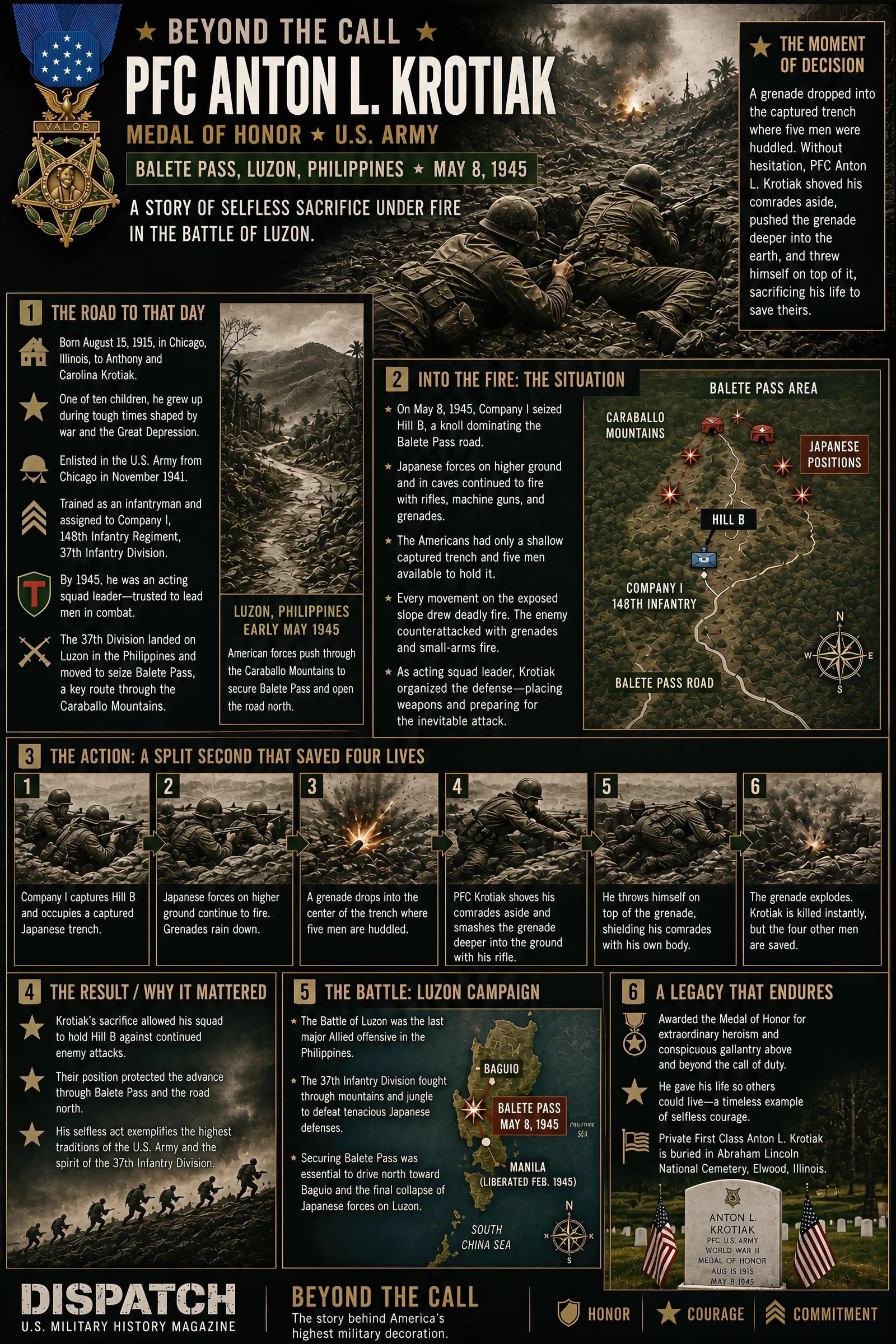
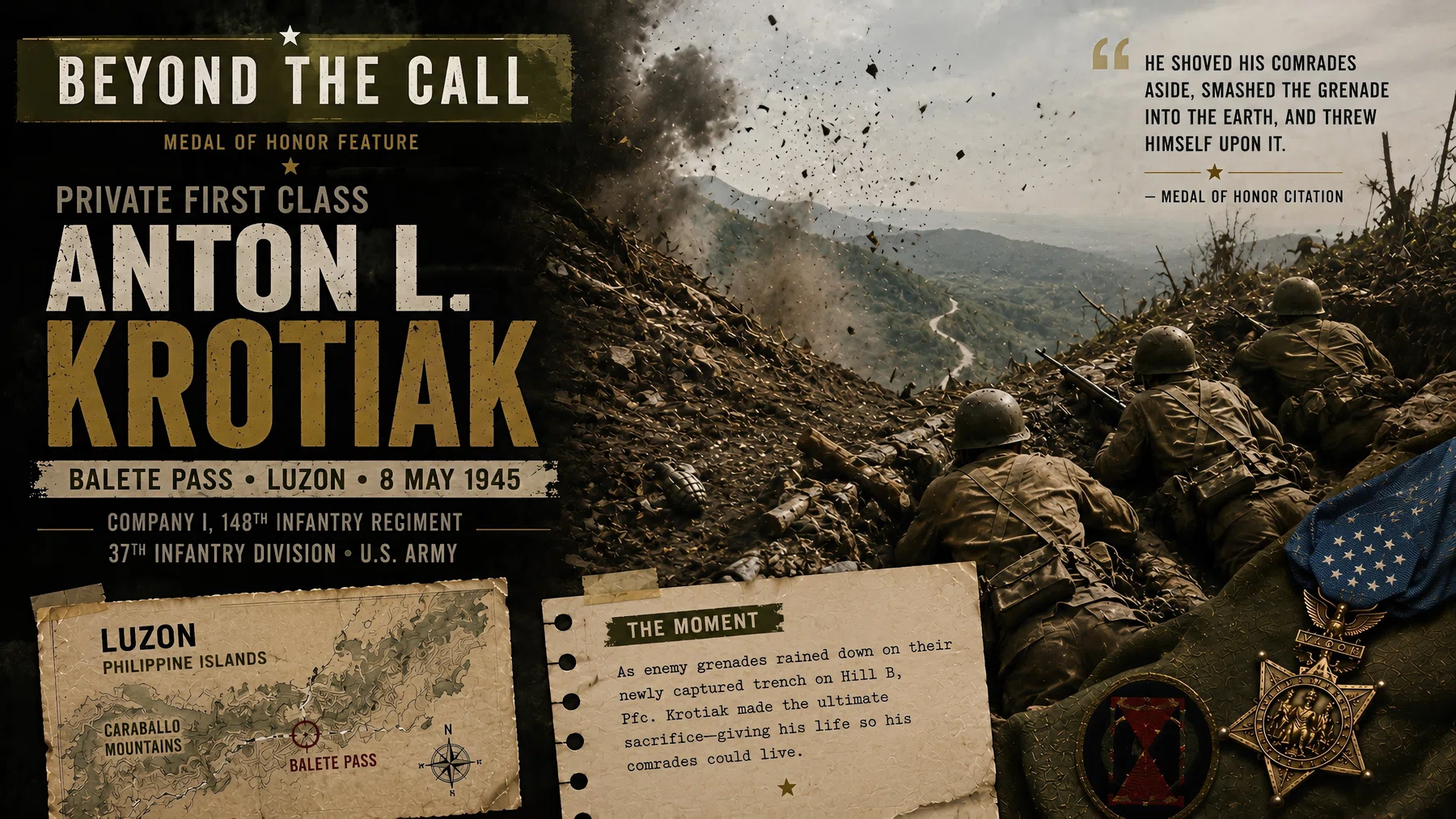
The air over Balete Pass crackled with small-arms fire and the flat explosions of grenades. On the steep slope of Hill B, a narrow finger of ground jutting out above the zigzag road that threaded the Caraballo Mountains, five exhausted American infantrymen hugged the earth around a captured Japanese trench. It was 8 May 1945, deep in the Battle of Luzon, and Private First Class Anton L. Krotiak—an acting squad leader in Company I, 148th Infantry—was trying to turn this shattered scrap of hillside into a defensible position before the enemy took it back.
Above them, Japanese soldiers still clung to caves, spider holes, and firing pits that had watched the Americans climb for days. Every movement on the exposed slope drew a new burst of fire, bullets chewing splinters from stunted trees and throwing up puffs of dust from the rocky soil. Grenades clattered down from unseen hands, exploding just far enough away to keep the men pinned but not yet out of the fight. Krotiak moved from man to man along the trench, shouting over the din, placing each rifle where it could cover the approaches and trying to knit this handful of men into something that looked like a line.
Then another grenade came down. It dropped from the high ground above, bounced once off the lip of the trench, and landed in the exact center of the huddled group. There was no time to throw it back, no room to run, nowhere to hide. In that sliver of a second—no longer than the closing of a fist—Anton Krotiak shoved his comrades aside, smashed the grenade deeper into the earth with the butt of his rifle, and threw himself over it, turning his own body into their only shield.
The Road to That Day
Thirty years earlier, on 15 August 1915, Anton Krotiak had been born in Chicago, Illinois, to Anthony and Carolina Krotiak. He grew up one of ten children in a crowded household where there was always another chore and another younger sibling to look after. The First World War, and then the long grind of the Great Depression, shaped the city around him, and like many young men of his generation he learned early that steady work and reliability mattered more than talk.
The surviving record does not overflow with anecdotes, but the formal black-and-white portrait that now accompanies his Medal of Honor record suggests a quiet, dutiful son rather than a headline-seeking daredevil. In it, he wears his Army uniform with calm, understated seriousness—the look of a man who understands that what lies ahead is dangerous, and has accepted that quietly.
Anton enlisted in the Army from his native Chicago in November 1941, just weeks before Pearl Harbor pulled the United States fully into war. He learned the routines of drill fields and rifle ranges at stateside camps and was assigned to Company I of the 148th Infantry Regiment, part of the 37th Infantry Division, a National Guard division from Ohio bound for the Pacific war.
As the war ground on, combat and casualties reshaped infantry platoons. By early 1945, when the 37th Division landed on Luzon, Krotiak had become an acting squad leader—one of the enlisted men trusted to pull others together in the thick of a firefight. At Balete Pass, where the main road north climbed through the Caraballo Mountains, Japanese forces had dug into caves and ridges to block the advance. Here, on a knoll designated Hill B, Company I seized a hard-won position on 8 May and began to dig in, knowing the enemy would counterattack.
What happened in the minutes that followed would turn this quiet acting squad leader into a Medal of Honor recipient and leave four of his fellow soldiers alive because of a choice he made in a single heartbeat.
Into the Fire
By early May 1945, the fight for Luzon had shifted into the mountains, where steep ridges and narrow roads gave the defenders every advantage. Balete Pass, a twisting gap through the Caraballo range, controlled one of the main routes toward northern Luzon. The Japanese had turned each knoll and spur into a fort, with trenches, caves, and tunnels that could pour fire onto any unit trying to move along the road. Company I of the 148th Infantry was ordered to seize and hold a protruding hilltop, known on the maps as Hill B, whose slopes fell away sharply toward the road. From that ground, American rifles and machine guns could watch the approaches and protect the division’s advance.
Taking the hill meant climbing exposed ground in daylight, under the eyes of concealed positions that had survived artillery and air strikes. Krotiak’s company moved in short rushes, hugging shallow folds in the earth, trading fire with well-hidden opponents who knew the terrain intimately. Mortar rounds burst in the scrub, spraying fragments through the thin cover of grass and brush. The men advanced a few yards at a time, sliding into every shell crater they could find while squad leaders shouted directions and tried to keep the attack from stalling. It was the kind of uphill fight that had become grimly familiar in the Pacific war, measured in yards rather than miles.
At some point in that climb, Hill B changed hands. Company I’s assault broke through the forward edge of the Japanese line, and the defenders pulled back to still higher ground and alternate foxholes. The Americans pushed over the crest and into positions that only minutes before had been firing on them. These newly won trenches and weapon pits were shallow, crudely built, and swept by fire from the next ridge up. Consolidating that ground—turning it from a foothold into a defensible strongpoint—fell to the small-unit leaders who could still move and be heard above the noise, men like acting squad leader Anton Krotiak.
Krotiak gathered four of his soldiers near an abandoned Japanese trench that offered the best shelter available. The trench was not ideal; it had been dug to face a different direction and lacked proper overhead cover, but its low earthen walls still stood between the men and the bullets cracking past. As he moved them into position, he had to think about interlocking fields of fire, the likely avenues for a counterattack, and the need to keep his tiny group tied into the rest of the company’s patchwork line. There was no clear map in that moment, only instinct and experience telling him where the danger would come from next.
The enemy did not leave him guessing for long. Having lost their forward pits, Japanese soldiers on the higher slope began to drown the captured trench in small-arms fire and grenades. Bullets smacked into the parapet and snapped through the scrub just inches over the men’s helmets. Grenades arced down from above, bouncing and rolling in unpredictable paths before exploding with sharp, deafening blasts. Each detonation stole another second in which the squad could not move or reposition, pinning them in the open while the rest of the company struggled to bring up more men and weapons to secure the hill.
Under this pressure, Krotiak continued to direct his group, shifting one rifleman to watch a gap between rocks, sending another to cover a spur of ground that dropped toward the road, and trying to steady nerves with a shouted word here and there. He understood that if Hill B fell back into enemy hands, the attack would have to be fought all over again, at terrible cost. Just as importantly, he knew that the four men near him depended on his judgment. The difference between a hasty, panicked move and a measured one could mean the difference between a grenade landing outside the trench and one falling directly into it.
Then the worst-case moment arrived. From somewhere above the rim of the trench, another grenade came tumbling down. This time its path carried it straight into the center of the small group, landing among boots and knees on the narrow trench floor. In that position, there was almost no space to react. To pick it up and throw it back would require bending down, finding it by feel, and standing into the incoming fire. Scrambling out of the trench would expose the men to bullets and fragments at the same instant.
Krotiak did not take time to weigh options in words. In a reflex that combined training, a sense of responsibility, and raw courage, he shoved the nearest men away from the grenade. At the same time he drove the butt of his rifle down, jamming the grenade deeper into the earth in the hope of containing some of the blast. Then he threw himself flat over it, pressing his body against the weapon he knew would explode a heartbeat later. In that instant he turned himself into a living shield, accepting that the cost would almost certainly be his own life.
The explosion killed him within minutes, just as the Medal of Honor citation later recorded, but the four men he had pushed aside survived. They were battered by the concussion and showered with dirt and fragments, but the worst of the blast had been absorbed by the body of their squad leader. Hill B did not fall; Company I held its precious foothold, and other elements of the regiment were able to secure and deepen the position. On a hillside thousands of miles from his native Chicago, Anton L. Krotiak’s last decision preserved the strength of his squad and helped keep the advance through Balete Pass moving forward.
The Citation, Decoded
The official Medal of Honor citation for Private First Class Anton L. Krotiak is brief, as many from the Second World War are, but every phrase carries weight. It begins by identifying him as an acting squad leader “directing his men in consolidating a newly won position” on Hill B. That line captures both the chaos and the responsibility of the moment. The assault phase was over; the unit had taken its objective. Yet the hill was far from secure, and small-unit leaders were working under fire to place men, check ammunition, and turn scattered gains into a coherent defense. To be acting squad leader under those conditions meant carrying authority without the comfort or clarity of a peacetime promotion.
The citation then describes how “the enemy concentrated small-arms fire and grenades upon him and four others, driving them to cover in an abandoned Japanese trench.” This is not a casual phrase. Concentrated fire meant that the attackers had identified this little cluster of soldiers as a critical point and were deliberately trying to break it. The mention of grenades “thrown from above” hints at the terrain, where defenders on higher ground could drop explosives into positions that seemed safe from direct rifle fire. An “abandoned Japanese trench” sounds like shelter, but on that slope it was a trap as well, oriented the wrong way, with open sky and hostile rifles overlooking its shallow lip.
The heart of the citation comes in the lines that follow: Krotiak, it says, “instantly” pushed his comrades aside, jammed the grenade into the earth with his rifle butt, and “threw himself over it, making a shield of his body” to protect the others. Here, words like “instantly” and “deliberately giving his life” work together. There was no time for discussion or orders; the action had to be immediate. Yet the citation insists that this was not a blind flinch. It was a conscious choice to trade his own survival for theirs, a decision rooted in a soldier’s sense of duty and in personal courage. When the closing sentence declares that his self-sacrifice “reflects the highest traditions of the military service,” it is not indulging in empty ceremony. It is stating that in a few seconds on a hillside in the Philippines, an acting squad leader from Chicago lived out the ideal to which his service aspired, leaving behind both a secured position on Hill B and four living men who would carry his memory into the postwar years.
Why It Mattered
On a map of the Luzon campaign, Hill B at Balete Pass is a tiny feature, one of many notches and ridges along a twisting mountain road. On the ground, however, it was a critical perch above the highway that funneled American columns toward northern Luzon. Holding that knoll meant rifles and machine guns could reach down into the pass, disrupt enemy movement, and protect the engineers and supply units inching forward behind the infantry. Losing it would have opened gaps in the 148th Infantry’s line and forced commanders to spend more lives retaking the same deadly slope. In mountain warfare, every yard of high ground taken and held becomes a small anchor for the whole advance.
Anton Krotiak’s decision to smother the grenade with his own body preserved that anchor. By saving four experienced riflemen in an exposed, newly captured trench, he ensured that Company I had enough men in place to keep Hill B from slipping back into enemy hands at the moment it was most vulnerable. Those four soldiers did not have to be replaced by green reinforcements, and the company did not have to reorganize under fire after losing its acting squad leader and much of his squad. At the tactical level, that meant steadier fire on the approaches and fewer breaks in the line; at the operational level, it meant one more foothold through the Caraballo Mountains remained secure, helping keep the larger advance through Balete Pass moving forward rather than stalling on yet another bloodied hillside.
Leadership and Character
Leadership, in the way Anton Krotiak exercised it, was not about rank on a chart but about what happened in the narrowest, most dangerous spaces of a battlefield. As an acting squad leader, he carried responsibility without the formal insignia, yet his actions on Hill B show a man who understood that his first duty was to his soldiers. He did the quiet work of leadership before the crisis ever came, guiding his men into a captured trench, placing them where they could best cover the approaches, and trying to knit this small group into a coherent defense while enemy fire searched for any sign of weakness. His calm movement along the trench, thinking about fields of fire while grenades rained down, reveals a habit of mind shaped by training and experience rather than impulse.
When the grenade landed among his men, Krotiak’s instinct was outward, not inward. He pushed his comrades away from danger instead of diving for cover himself. He used his rifle not as a weapon but as a tool, ramming the grenade deeper into the earth to blunt its force. Then he made the choice to cover it with his own body, fully aware of what that meant. In that instant he modeled a form of moral courage that transcends doctrine and tactics: the willingness to accept ultimate risk so that others might live. For today’s leaders—military or civilian—the lesson is not that heroism is about dramatic gestures alone, but that the most extraordinary acts often grow out of a pattern of steady responsibility, clear thinking under pressure, and a deeply held conviction that the lives of those you lead matter more than your own safety.
Legacy and Memory
Anton L. Krotiak did not live to see the end of the Second World War. He died on Hill B within minutes of the grenade blast, his life ending at the exact moment he ensured that four others would continue. His Medal of Honor was awarded posthumously, and the decoration itself was placed into the hands of his family, who had sent a son and brother from crowded Chicago streets to far-off Luzon. For them, the medal was both a symbol of the nation’s gratitude and a reminder that the price of that honor was a seat forever empty at the table. His name joined the roll of Medal of Honor recipients from the Pacific war, a list built one sacrifice at a time.
Today, his story lives on in unit histories, campaign narratives, and the curated spaces of museums and memorials that interpret the fighting in the Philippines. His name appears on grave markers and memorial plaques that ensure it is spoken aloud by more than just his descendants. School groups and visitors who pause before those markers encounter not a legend from a distant age but a young acting squad leader whose defining moment came in a trench only yards long. Remembering Anton Krotiak as more than a line in a citation means seeing the man behind the medal—a quiet soldier who, when faced with an impossible choice, used his last second of life to save the men around him.