Panzers in a Narrow Pass
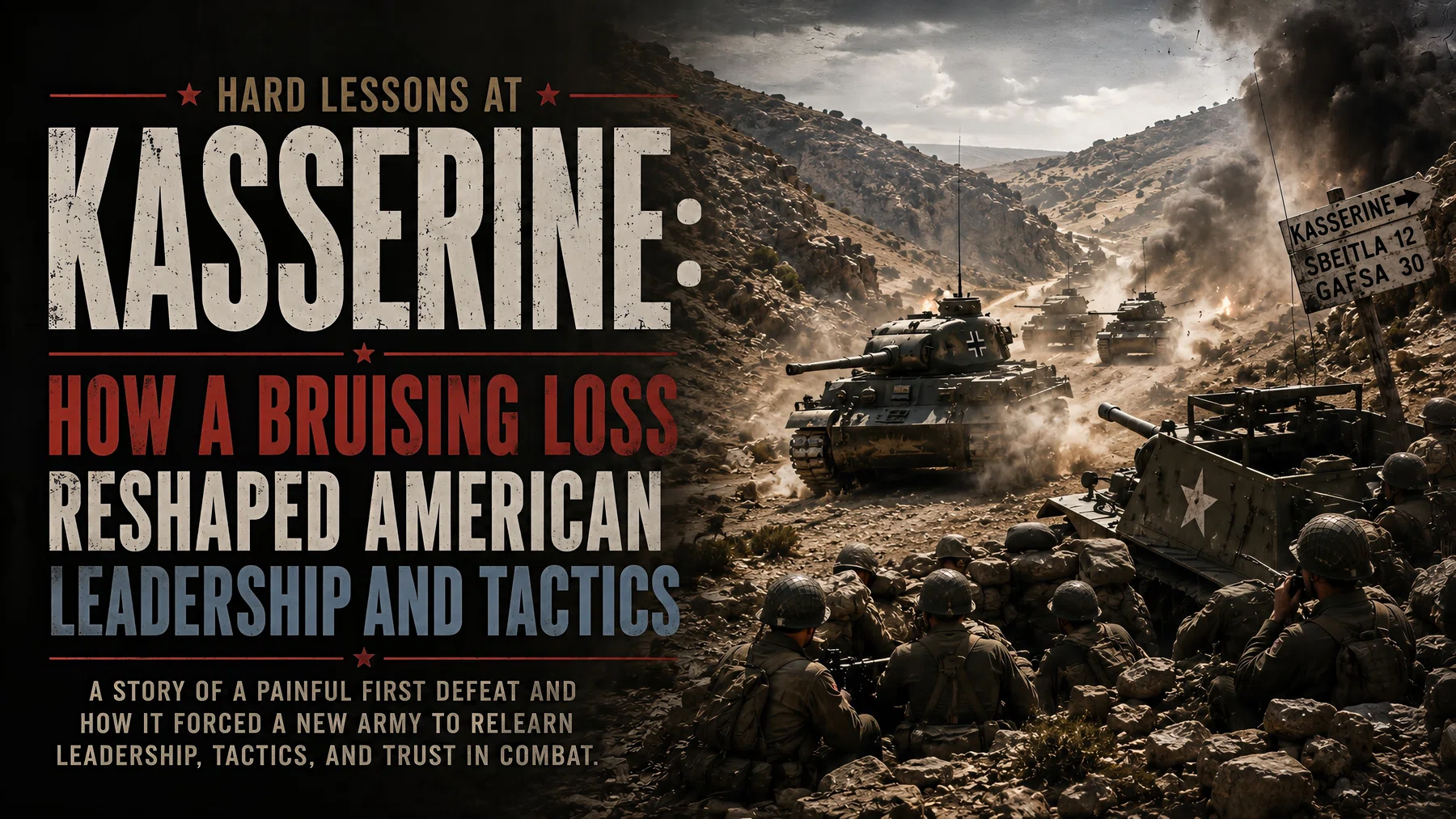
Cold wind came knifing through the cleft in the Tunisian hills as the first light bled into Kasserine Pass. American engineers had scraped shallow foxholes into rocky soil, stringing wire and mines across ground they barely knew, while tank destroyers and thin-skinned halftracks huddled under the sparse cover of scrub and boulders. The men of the United States II Corps were new to this kind of war; many had arrived in North Africa only weeks earlier, with training that still smelled of stateside ranges and classroom maps. Now they watched a distant line of dust creep along the valley floor, carrying a sound they were still learning to fear: the steady grind of German armor closing in.
The first shells came in as dull flashes on the ridgeline, followed a heartbeat later by tearing explosions and the shriek of shrapnel over rock. German guns walked their fire along the American positions, feeling for range, smashing trucks and gun pits that had been sited in haste and sometimes in the wrong places altogether. Radio nets crackled with overlapping voices, commands and questions tumbling into each other as junior officers tried to understand what was happening over the chaos. Somewhere beyond the curtain of dust and smoke, experienced panzer crews were already probing for weak spots, slipping through draws and folds in the terrain that the defenders had not yet learned to read.
For soldiers who had grown up hearing about trench warfare in France, the speed and violence of the German attack felt like something else entirely. Units that had never fought together under fire tried to hold their sectors while neighboring positions bent or broke, leaving gaps no one had planned for. The narrow pass that looked so defensible on a map began to feel like a trap, with enemy armor forcing its way forward and infantry following behind. Men who had expected a measured, orderly test of their training instead found themselves in a swirling, confused fight against veterans who knew exactly how to turn inexperience into panic. And as the day wore on, it became clear that what was happening at Kasserine was more than just one bad morning on a lonely stretch of mountain road.
A Young Army’s First Trial
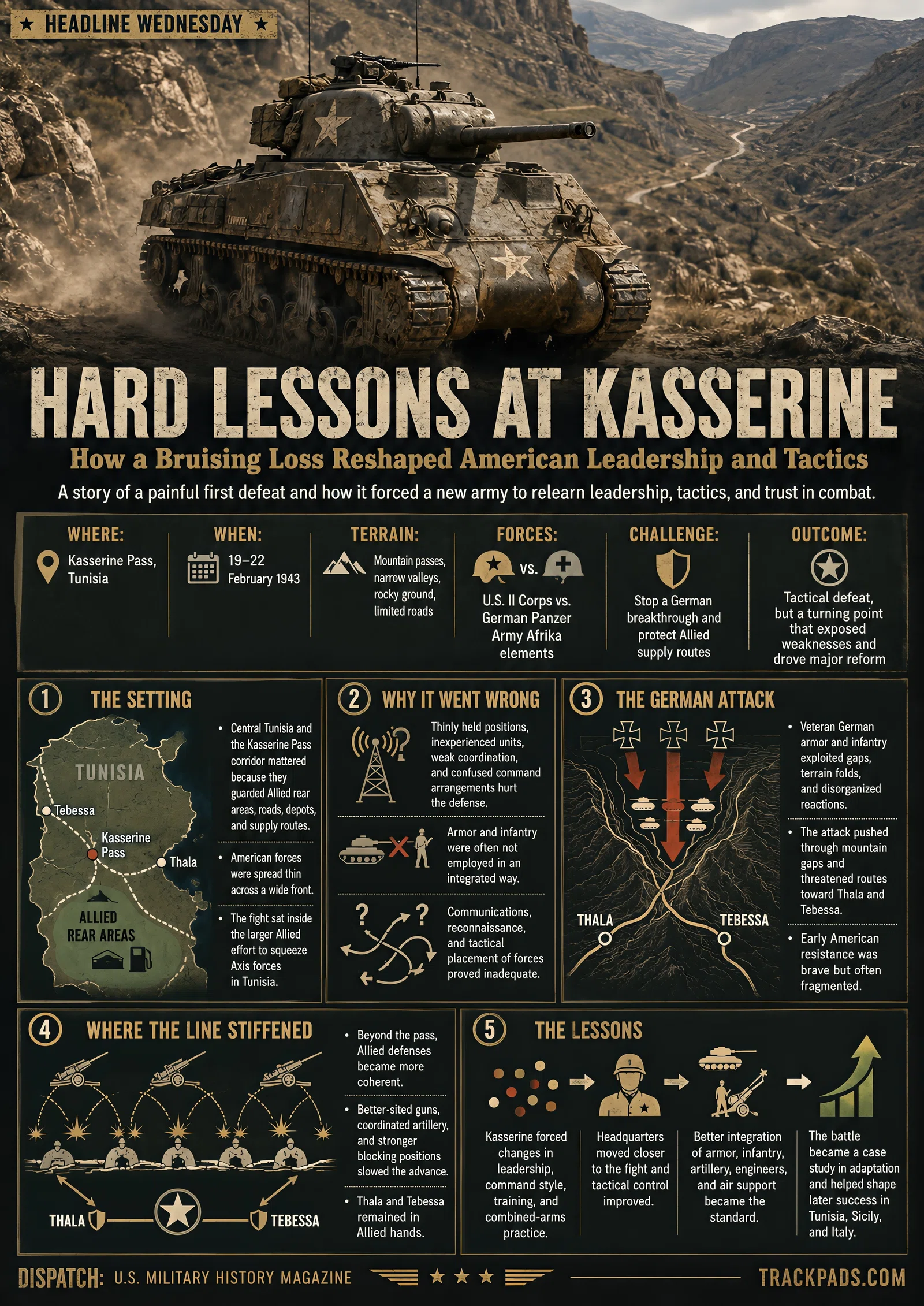
To understand why those ridge lines and wadis in central Tunisia mattered so much, you have to pull the camera back to the winter of 1943. The Allied landings in North Africa had brought American troops into the European war in large numbers for the first time, linking up in Tunisia with battle-hardened British forces that had chased Axis armies west from Egypt and Libya. The plan was simple in concept and brutal in execution: squeeze German and Italian forces in Tunisia between British units driving from the east and newly arrived American-led forces pressing from the west until the Axis bridgehead collapsed. Geography turned that idea into a fight for mountain passes, supply roads, and small towns that controlled them.
Kasserine Pass was one of those gateways, a cut through the Eastern Dorsal of the Atlas Mountains that offered a route from interior Tunisia toward the Allied rear areas. Behind it lay fuel dumps, supply depots, and the road networks that fed the front. If German armor could shove II Corps aside and punch through, they could scatter green American divisions, smash their logistics, and delay the Allied timetable by months. For the Axis, success here might buy time, political breathing room in Europe, and the chance to bloody an inexperienced opponent so badly that Allied leaders hesitated before the next bold move.
For the Americans, the stakes ran deeper than just one pass. II Corps was commanded and organized by men who had not yet been forced to prove their ideas in the fire of a modern campaign. The British, who had been fighting the Afrika Korps for years, were already watching to see whether their new partner could carry its share of the load. A serious defeat risked more than casualties; it threatened Allied confidence in American leadership, doctrine, and tactical judgment. The German attack into Kasserine was therefore not only a local thrust against thin lines in rocky hills. It was an examination, under live fire, of how a rapidly expanding army would handle its first real trial against one of the most experienced opponents in the world. And as the passes shook with gunfire, that exam was going badly.
Green Corps on a Fragile Front
The road into Kasserine Pass did not become a battlefield by accident. In the weeks after the November landings in North Africa, American units had pushed inland from the Algerian coast, taking over stretches of the front from worn British formations and extending lines across ridges and valleys that few of them had ever heard of before. II Corps, under Lieutenant General Lloyd Fredendall, found itself responsible for a wide swath of central Tunisia with divisions scattered across separate pockets, linked more by long radio circuits and bad roads than by any sense of a tightly knit front. Units dug in around places like Sidi Bou Zid, Gafsa, and the approaches to the Eastern Dorsal, often occupying positions chosen quickly and without the hard-earned instincts that come from fighting an enemy who knows every fold in the ground.
Across the line, German and Italian forces in Tunisia were under pressure of their own, but they were led and manned by veterans. Officers like Hans-Jürgen von Arnim and Erwin Rommel understood that the newly arrived Americans were still finding their feet and that the terrain gave them opportunities to exploit that inexperience. Rather than wait passively for the Allied squeeze to tighten, the Axis command opted for a series of sharp blows aimed at the weaker western flank. That plan would use seasoned panzer and panzergrenadier units to smash isolated American positions, seize key passes, and, if possible, roll into the Allied rear areas before defenses hardened.
The first shocks came at Sidi Bou Zid and Sbeitla, where American armor and infantry were hit by coordinated German attacks that combined tanks, artillery, and air support with a precision the green troops had not yet encountered. Tanks were often posted on exposed high ground that looked commanding on a map but offered little cover from well-placed German guns. Communications lagged, orders were confused, and counterattacks went in piecemeal rather than as part of a coherent plan. When those positions broke, the retreat rippled back toward the mountains, turning Kasserine and neighboring passes into the obvious next line to hold.
Behind the units scrambling to re-form defenses in the hills, senior Allied commanders were grappling with strained relationships and mismatched expectations. British officers, hardened by years of desert fighting, had already voiced concerns about American doctrine and staff work, while some American leaders bristled at what they saw as condescension. Those tensions fed into decisions about how and where to commit reserves, when to counterattack, and who would control scarce air support. By the time German columns turned toward Kasserine, the pass was not only a tactical choke point. It was the place where all the seams in a young coalition and a young army were about to be tested at once.
Panzers Drive Into the Mountain Gaps
When German armored spearheads finally moved into the approaches to Kasserine Pass in mid-February 1943, they were advancing against defenders still reeling from earlier blows. American units had been ordered to hold the high ground and block the gap, but many positions were improvised, sited under pressure, and manned by troops who had never ridden out a sustained attack on such complex terrain. The pass itself narrowed between steep, rock-studded slopes, funneling vehicles and guns into a confined space where one well-placed artillery battery could, in theory, dominate the road. In practice, the attackers used their experience to probe around those obvious choke points, feeling for flanks and gaps that had opened during the hasty withdrawal from the plains.
The first serious contacts around the pass followed a familiar pattern: German artillery and mortars softened up known defensive points, while reconnaissance elements tested American reactions. When they found sectors where return fire was weak or disorganized, panzer units pushed forward in strength, their tanks using cover from the folds of the hills to avoid silhouetting themselves. American gunners and tank destroyer crews fought back, knocking out vehicles that exposed themselves too boldly, but ammunition resupply was uncertain and fire control often broke down under the noise and confusion. In some locations, rifle companies stood firm until German infantry and tanks worked around their sides, forcing a retreat to avoid being cut off entirely.
As the battle deepened, the fight spread beyond the immediate throat of Kasserine into neighboring passes and valleys. Axis forces sought to punch not just through a single gap but through the whole American defensive belt, exploiting any breakthrough to roll up the line from the rear. Columns pushed toward vital junctions leading to Thala and Tebessa, aiming at the supply routes and headquarters that kept II Corps functioning. On the ground, that meant convoys of American trucks and artillery pieces grinding up narrow roads in the dark, headlights hooded, as staff officers tried to position reserves where they could blunt the advance without leaving other sectors naked.
Within the pass itself and on the adjoining ridges, small-unit actions piled atop one another into a confused, grinding struggle. Platoons that had been scattered by shelling re-formed behind rocky outcrops and wadi banks, only to be driven back again by another push of tanks and supporting infantry. Engineers blew demolitions and laid mines under fire, trying to slow the enemy armor long enough for fresh positions to be occupied. At the same time, Allied air units, operating from rough forward airfields, hunted for breaks in the weather to strike the advancing columns, sometimes hitting hard and at other times missing targets or running afoul of flak screens that thickened around key road bends.
For the Germans and Italians, early gains were undeniable. American positions were overrun, guns abandoned, and prisoners taken in numbers that shocked senior leaders on the Allied side. Yet even as the Axis thrusts drove deeper, signs of friction appeared. Conflicting plans and divided command authority between Rommel and other German leaders complicated the choice of objectives. Logistical strains grew as tanks and trucks wound their way through narrow mountain roads that could be blocked by a single wreck. Every hour spent sorting out traffic or arguing over the next move bought time for Allied commanders to rush British and American reinforcements into blocking positions beyond the pass. What had begun as a promising opportunity to shatter II Corps was slowly becoming a race between a veteran attacker and a bruised defender learning, under fire, how to bend without breaking.
Thala’s Guns Draw a Line
The German thrust that had rolled American positions back through Kasserine Pass finally met something solid in the hills beyond. As panzer columns pushed toward Thala and Tebessa, they ran into a hastily assembled but well-handled screen of British and American units who had been rushed forward to block the roads. Here the ground narrowed again into a series of ridges and spurs overlooking key junctions, and Allied commanders chose those features carefully, massing artillery in ways the green troops at Kasserine had not yet learned to do. Instead of scattered guns firing independently, batteries were tied into coordinated fire plans that could concentrate dozens of tubes on a single road bend or wadi mouth.
When German armor tried to force those positions, they found themselves under sudden, crushing barrages that bracketed roadways and pounded forming-up areas. Tanks that had confidently driven through earlier American lines now ground forward more cautiously, their crews aware that any exposed halt might draw a storm of shellbursts. Infantry who tried to work around the flanks were met by better-sited defensive positions, dug into reverse slopes and supported by overlapping fields of machine-gun fire. The defenders still took losses, but this time withdrawals were measured and tied to planned fall-back lines rather than panicked flight. Every hour the line held in front of Thala and along the approaches to Tebessa bled momentum from the Axis offensive.
Behind the firing batteries and rifle pits, a quieter transformation was taking shape. Senior American leaders who had watched Kasserine unravel began to make hard judgments about command arrangements and tactical habits. They saw that armor could not be left perched on exposed ridges like stationary forts; it needed to be handled as a mobile weapon, working with infantry and artillery instead of sitting apart from them. They saw that headquarters buried deep in rear-area bunkers could not feel the fight or react quickly enough when things went wrong. Even in the middle of the battle, messages were already moving about changes that would have been unthinkable a month earlier.
For the Axis, the combination of stiffening Allied resistance, narrowing roads, and fraying logistics slowly turned a promising breakthrough into a stalled drive. Fuel and ammunition had to come forward through the same constricted mountain routes that tanks and trucks were using to press the attack. Any wreck or crater could choke the flow. At the same time, disagreements within the German command about objectives and priorities dulled the sharp edge that had cut through II Corps at Kasserine. Instead of a clean penetration into the Allied rear, the offensive settled into a grinding series of local attacks against an enemy that was, day by day, learning how to absorb blows without collapsing. When the order finally came for Axis forces to pull back from their deepest gains, the physical ground lost and gained was only part of the story. The larger shift was that the Americans had taken their first major hit, survived, and begun to change.
From Tunisian Shock to Backbone
In the immediate aftermath, the map of central Tunisia told a sobering story. American units had been shoved back from early positions, equipment littered the routes of retreat, and casualty lists from Kasserine and the surrounding passes cut into formations that had only recently arrived overseas. The German and Italian forces could claim a clear tactical victory: they had inflicted heavy losses, taken prisoners, and shown the vulnerability of Allied lines when handled poorly. Yet they had not achieved their deeper aims. Thala and Tebessa still stood in Allied hands, the rear-area supply network remained bruised but functioning, and the door to a wider Axis exploitation stayed shut. The battered II Corps was bloodied, not broken.
What followed in the weeks and months after Kasserine mattered even more than the fight itself. American leadership in North Africa underwent swift, visible changes. Lloyd Fredendall was relieved, and harder-edged commanders like George Patton and later Omar Bradley took over key roles in shaping II Corps. Headquarters moved closer to the front, where senior officers could see terrain with their own eyes and feel the tempo of operations instead of relying solely on filtered reports. Training, even in-theater, shifted emphasis toward combined arms: tanks, infantry, artillery, and air support were drilled to work as a coordinated team rather than separate branches fighting parallel battles.
Those changes did not erase the pain of Kasserine, but they did turn it into a kind of crucible. American units that later fought in Tunisia, Sicily, and Italy carried forward lessons learned the hard way in the passes: the danger of overextending lines, the need for disciplined withdrawals instead of routs, and the value of massed artillery and well-planned defensive belts. British partners, having seen both the worst and the best of their new ally in a short span, adjusted too. Over time, the coalition command structure tightened, with clearer lines of authority and more deliberate coordination between British and American headquarters. The uneasy relationship that had existed before Kasserine began to evolve into the more effective partnership that would later be seen in Normandy and beyond.
For soldiers and junior leaders who survived the fight, the memory of Kasserine often became a personal measuring stick. Many would later say that nothing they faced afterward felt quite as chaotic as those first days under concentrated German attack, because they now understood what to look for in terrain, how to read the behavior of an enemy probing for weak spots, and when to push back versus when to dig in. At the institutional level, staff rides and professional studies of Kasserine turned a near disaster into a case study in adaptation. The passes in central Tunisia are still quiet today, their rocks and scrub hiding most traces of that winter’s fighting. But for anyone who studies how an army grows from raw potential into a capable force, the story of Kasserine Pass remains a reminder that early defeats, if faced honestly, can become the backbone of later success.