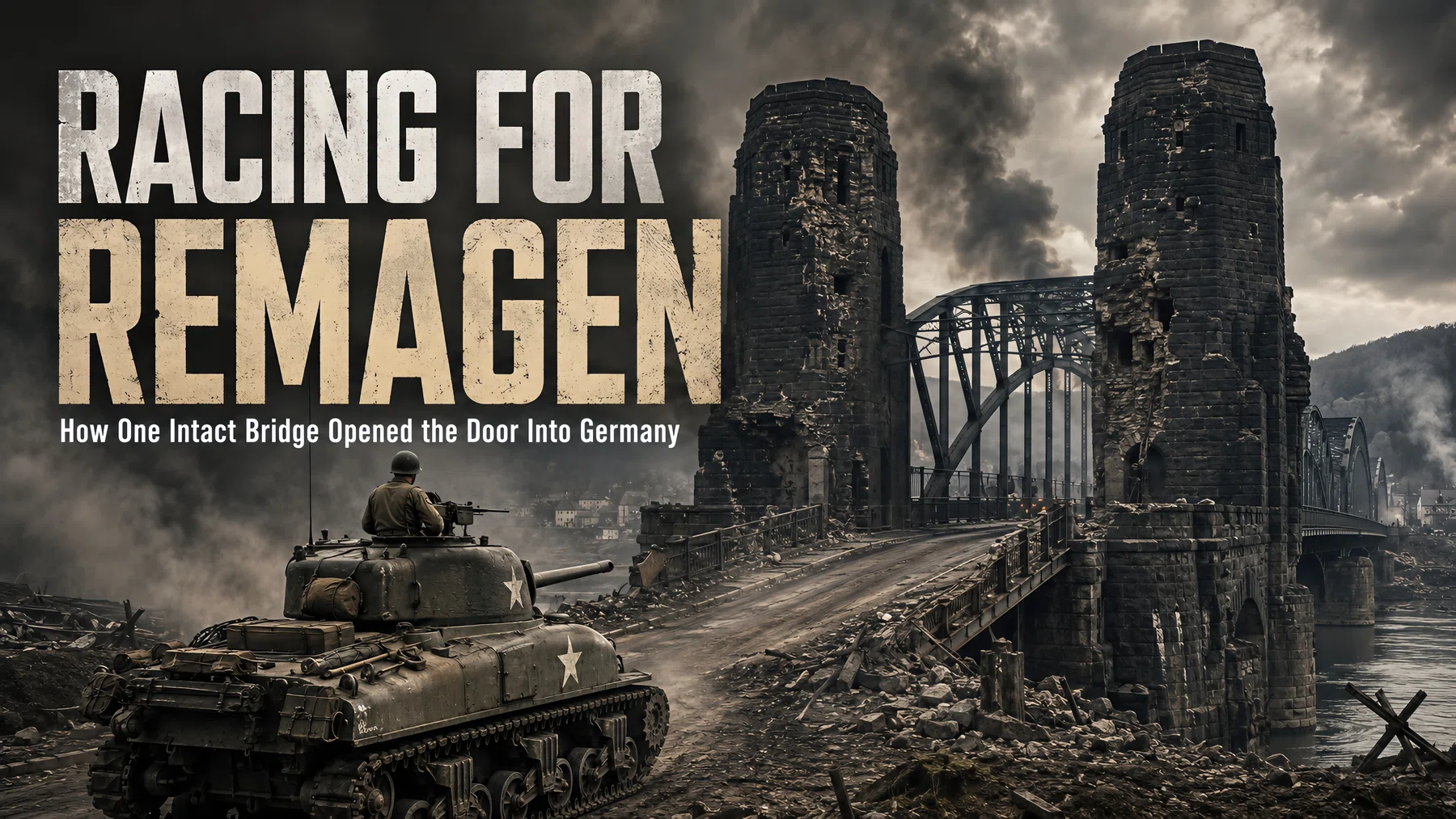
Tanks at the Ludendorff Bridge
The afternoon light over the Rhine was dull and flat, more gray than gold, when American armored columns rolled down toward the little town of Remagen. The war in Europe was in its bloody final act, but for the soldiers of the United States 9th Armored Division and the infantry riding its tanks, the fight felt anything but finished. Ahead of them, the Ludendorff Bridge stood where no one truly expected a crossing to be left standing: a long steel lattice over the broad river, scarred by bomb craters, draped in smoke, and still, unbelievably, intact. Engine noise echoed between the steep valley walls as tank commanders scanned for mines, roadblocks, and the flash of German guns hidden in the ruins.
Artillery thumped in the distance, and closer in, scattered German defenders fired from cellars and upper windows as the column pushed through Remagen’s narrow streets. Every corner felt like an ambush point; every building might be wired with charges. Near the riverbank, soldiers could see the bridge towers rising over the water with blackened scars on their stone faces, and they knew that somewhere inside those towers, German engineers had been laying explosives for weeks. The question was whether those charges were still there, and whether someone was about to blow the span out from under them.
As lead elements reached the approaches, they saw planks torn up, sections twisted, and smoke drifting from the bridge deck, but the main steel arches were still standing. German troops were scrambling on the far bank, and a few last vehicles were trying to escape across. The scene felt impossible: in a war where every major river crossing had been blown sky-high, this one had not yet vanished into the Rhine. The Americans had stumbled into a fleeting, dangerous opportunity, and in those first minutes at the water’s edge, no one could be sure how long it would last.
A Gap in the Last Great Barrier
For months, every Allied plan in northwest Europe had treated the Rhine River as the final wall protecting the heart of Germany. This was not just another water obstacle; it was a wide, fast-flowing line backed by flak towers, artillery, and prepared defensive belts. Bridges over the Rhine were the hinges of the entire campaign. German commanders understood that once Allied armies seized a firm bridgehead on the far side, enemy armor and logistics could pour into the industrial Ruhr basin and beyond. That would turn a fighting retreat into a collapse. Because of that, orders were clear: if German forces could not hold a Rhine bridge, they were to destroy it.
On the Allied side, senior leaders assumed they would have to cross the river the hard way: deliberate assaults, pontoon bridging, and carefully timed airborne and ground operations. Each army group had rehearsed river-crossing drills, stockpiled assault boats, and mapped likely crossing sites. The expectation was that every major bridge would be blown well before American or British spearheads arrived. The Rhine would be forced, not inherited. In that mental map, Remagen was just one small town on a long defensive line, with a double-track rail bridge that should have been nothing but twisted metal by the time American tanks rolled within sight of it.
Instead, the collapse of German forces in the west had outpaced their ability to execute all of their own demolition plans. Some units were exhausted or scattered. Others were paralyzed by conflicting orders, fuel shortages, and air attacks. When elements of the United States First Army drove faster than expected toward the Rhine, they collided with a defensive system that still existed on paper but was fraying in reality. That is what made Remagen so dangerous and so important. One bridge left standing did not just offer a shortcut; it threatened to unravel the last coherent defensive line inside Germany and accelerate the end of the war in Europe in ways no one on either side had fully anticipated.
From the Bulge to the Rhine
The road to Remagen began in the snow and smoke of the Ardennes. In December 1944, German forces had hurled a surprise offensive against thin Allied lines, driving a wedge into Belgium and Luxembourg and temporarily throwing the front into chaos. The Battle of the Bulge cost the Allies dearly, but when the offensive finally stalled and was beaten back, the German Army in the west was left burned out and bleeding. By early 1945, American armies were no longer just restoring the line; they were surging east toward the German frontier, pushing through the Siegfried Line and the wooded hills of the Eifel. Bridges and crossroads that had been fought over in one direction during the winter were now being seized in the other.
The United States First Army, under Courtney Hodges, drove toward the Rhine with a mix of infantry and armored divisions, probing for gaps and weak points. The 9th Armored Division was not expected to be the star of any grand crossing plan. Its mission was to advance rapidly, seize key towns, and block German escape routes ahead of larger infantry formations. On maps in higher headquarters, the Ludendorff Bridge at Remagen was noted but not circled in red as a likely prize. The assumption was that German engineers would have reduced it to rubble days, if not weeks, before any American spearhead could reach it.
On the German side, orders and reality were drifting further apart. The high command demanded that the Rhine be held as an unbroken shield and that every bridge be wired for demolition and blown only on explicit authority. Local commanders faced impossible choices. Blow a bridge too soon, and they risked court martial for disobedience. Leave it too long, and they might hand the enemy a doorway into the heartland. Air attacks, fuel shortages, and broken communications only worsened the confusion. At Remagen, scattered elements of German units were passing through, retreating east, or trying to reorganize for defense. Explosive charges had been laid on the Ludendorff Bridge, but shortages of proper materials, hasty work, and muddled authority meant the demolition plan was fragile before the first American tank ever saw the river.
As the 9th Armored Division pushed through the hills toward the Rhine, its commanders were focused on speed and opportunity. Combat commands probed side roads and river valleys, looking for undefended crossings and bottlenecks. When forward elements crested the heights above Remagen and reported that the bridge still appeared to be standing, it cut across everything the staff thought they knew about the enemy’s defensive plans. Within hours, a routine advance against retreating forces had turned into a race: reach the bridge before the Germans could finish what their explosive charges had started, and somehow get troops across a span everyone assumed was marked for death.
Charging Onto a Doomed Bridge
The fight for the Ludendorff Bridge unfolded in a blur of decisions taken under fire. As American tanks and armored infantry pushed down into Remagen, they met pockets of resistance from German rear guards firing from alleys, gardens, and upper floors. Machine-gun bursts and panzerfaust shots echoed off stone walls while engineers and officers tried to get eyes on the bridge itself. Smoke curled from the towers, and witnesses reported seeing German soldiers moving frantically along the span. The fear was simple and immediate: at any moment the entire structure could heave, twist, and collapse into the river, taking with it any men unlucky enough to be on it when the plunger went down.
German engineers did try to finish the job. A demolition charge was fired in a thunderous blast that rocked the valley and threw mud and water into the air. When the dust settled and the spray drifted away, the bridge was damaged but still standing. Some of the main charges had failed, either because the fuses were faulty, the wiring had been damaged in air raids, or the explosives were poorly placed. Steel members were bent, holes gaped in the deck, but the great arches were still there, daring someone to cross. That failure turned minutes into the most valuable commodity on the battlefield. The Germans would try again if given time; the Americans decided not to give it.
Officers on the scene, backed quickly by higher headquarters on the radio, chose to seize the moment. Infantry squads were ordered forward to storm the approaches, clear the stone towers, and get onto the bridge despite the danger. Under fire from German machine guns and artillery on the east bank, small groups of soldiers sprinted onto the damaged deck, picking their way around holes and twisted rails. Combat engineers followed with wire cutters and tools, hunting for remaining demolition cables. Men crawled along the sides, hacking at cords and tossing smaller charges into the river, all while exposed to sniper fire and bursting shells. Every step onto that span felt like a wager that the next detonation would not come.
From the far bank and the high ground beyond, German forces poured fire into the crossing. Artillery shells slammed into the river and the approaches, throwing up plumes of water and earth. Anti-aircraft guns were depressed to fire at ground targets. Despite this, American troops kept moving, one squad at a time, then platoons, then larger elements. Radio reports crackled back that the far end of the bridge was reached, that a toehold had been seized in the tunnel and on the rising ground beyond. The crossing was no longer a fantasy; an actual bridgehead now existed on the east bank of the Rhine.
As the first infantry secured positions, commanders pushed to exploit the fragile success. Tanks were a different matter. The bridge had been designed for heavy rail traffic, but it was visibly damaged, and every vibration felt like it might be the last. Engineers inspected the structure as best they could under fire, declared it risky but passable, and then watched as the first armored vehicles crept across at a crawl, spaced out to reduce strain. The groan of steel under their tracks and the constant hammer of enemy fire created a kind of rolling suspense. Yet vehicle by vehicle, the weight of the crossing grew. What had started as a desperate dash by a few squads was turning into something else: a sustained flow of men and machines across a bridge that should, by every expectation, have already been lying in the bottom of the Rhine.
Seizing One Fragile Chance
What turned Remagen from a lucky discovery into a genuine breakthrough was the willingness of field commanders and front-line soldiers to act before the situation hardened. The failure of the main German demolition charges created a window measured in minutes, not days. Instead of pausing for lengthy staff studies or waiting for carefully staged river-crossing plans to catch up, officers on the scene chose to gamble. They pushed infantry onto the bridge, sent engineers crawling over beams and into tower chambers, and began clearing explosives even while shells landed around them. That combination of initiative and technical skill kept the Ludendorff Bridge standing long enough for a crossing to become more than a daring raid.
Once a foothold existed on the far bank, the fight shifted from seizing an opportunity to reinforcing it faster than the enemy could respond. American engineers worked under fire to shore up the damaged structure, laying planks, patching holes, and checking key members for dangerous cracks. Anti-aircraft units moved into position to shield the bridge against Luftwaffe attacks that soon came in waves: dive-bombers, fighter-bombers, and even new jet aircraft trying to smash the crossing. On the German side, artillery and rockets were concentrated to hammer bridge and bridgehead, turning the valley into a constant churn of explosions and smoke. The bridge sagged and shuddered, but stayed up.
Commanders backed the risk with logistics. Pontoon bridges were pushed forward and anchored nearby to supplement the Ludendorff span, turning a single, fragile crossing into a cluster of routes feeding the east bank. More infantry and armor flooded into the bridgehead, digging in on the ridges and in the villages beyond Remagen. German counterattacks, including hastily assembled infantry units and armored thrusts, slammed against these positions but found American forces already in depth. The turning point was not a single dramatic charge, but the accumulation of thousands of small actions: a wire cut here, a truck guided across in darkness there, a platoon holding a hill long enough for others to arrive. By the time German engineers and pilots managed to inflict serious structural damage, the battle for the far bank had quietly tipped in the Allies’ favor.
A Bridgehead That Shocked a Nation
The immediate aftermath of the Remagen crossing was messy and costly. The Ludendorff Bridge remained a prime target, and German attacks did not stop just because American flags flew on the far side. Artillery barrages chewed at the approaches, and aircraft dove again and again through curtains of flak. German frogmen tried to blow up support piers from the water, and heavy guns were brought to bear from longer range. Ten days after the first crossing, the battered span finally gave way and collapsed into the Rhine, killing and injuring American engineers still working on and under it. Yet by then, its strategic work was largely done. Multiple pontoon bridges were already carrying traffic, and the bridgehead on the east bank had been firmly established.
At the operational level, Remagen threw German planning into disarray. The Rhine line, long treated as a last solid barrier, had been compromised earlier and more deeply than expected. Allied forces used the bridgehead as a springboard to expand eastward, helping to unhinge German defenses in the region and hasten the encirclement of the Ruhr industrial heartland. News of the captured bridge also had a powerful psychological effect. For Allied troops, it was a sign that the end of the war in Europe might truly be in sight. For many in Germany, it underscored how far the situation had deteriorated when a key bridge could be taken intact and held in the face of desperate counterstrikes.
The legacy of Remagen reaches beyond that single valley on the Rhine. Military professionals study it as a case in exploiting fleeting opportunities, where lower-level initiative and engineering skill could change the tempo of an entire campaign. It highlights the vulnerability of rigid demolition orders in a fluid battlefield and the value of leaders willing to accept risk when the potential payoff is enormous. For museum visitors and students of history today, the story of the Ludendorff Bridge is a reminder that wars often pivot on moments that seem accidental at first glance, but are cemented into history by the decisions people make under fire. A bridge that was supposed to vanish instead became a path into the heart of Germany, and the men who raced across it helped slam the door on a collapsing regime.
