Overview
Beyond the Call: Medal of Honor Stories — A Dispatch: U. S. Military History Magazine feature from Trackpads dot com
1. Wake Island, December 1941
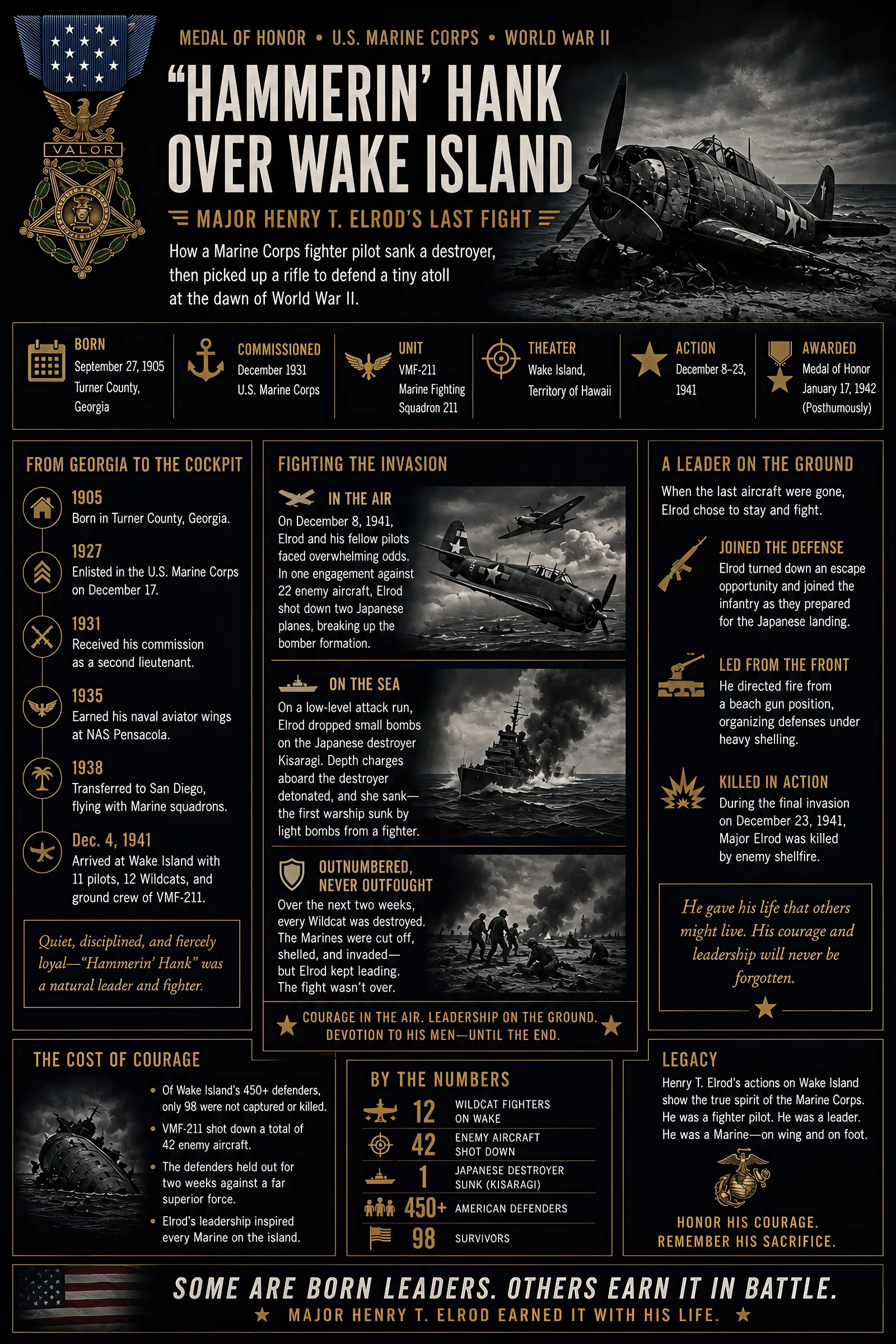
Just days after Pearl Harbor, the war found Wake Island before most Americans had even learned its name. The atoll was little more than a coral airstrip and a handful of gun positions jutting out of the Pacific, halfway between Hawaii and Japan. On its scrubby sand and crushed coral runway, a dozen Marine Corps F4F Wildcat fighters were all that stood between the island’s garrison and the Imperial Japanese Navy.
One of those pilots was Captain Henry Talmage Elrod, executive officer of Marine Fighting Squadron 211—VMF-211 in Marine notation. To his fellow Marines he was “Hammerin’ Hank,” a quiet Georgian whose calm in the cockpit masked an aggressive streak once the throttles went forward.
When the first Japanese bombers appeared over Wake on 8 December 1941 (local time), Elrod and his fellow pilots clawed for altitude in their stub-winged Wildcats, Navy-designed carrier fighters hurriedly based on the island. Over the next several days, the small Marine squadron fought against formations that outnumbered them many times over. In one clash with a 22-plane enemy strike force, Elrod bored straight in, weaving through defensive fire to break up the bomber formation and knock two aircraft out of the sky.
The fighting quickly shifted from daring intercepts to desperate survival. On low-level attack runs against Japanese ships bombarding the island, Elrod flew so close that his Wildcat’s wings nearly skimmed the whitecaps. On one of these passes he released small bombs onto the stern of the destroyer Kisaragi. Moments later, secondary explosions—likely the destroyer’s own depth charges—ripped the ship apart and sent her under. It was the first time a major warship had been sunk by light bombs dropped from a single-seat fighter.
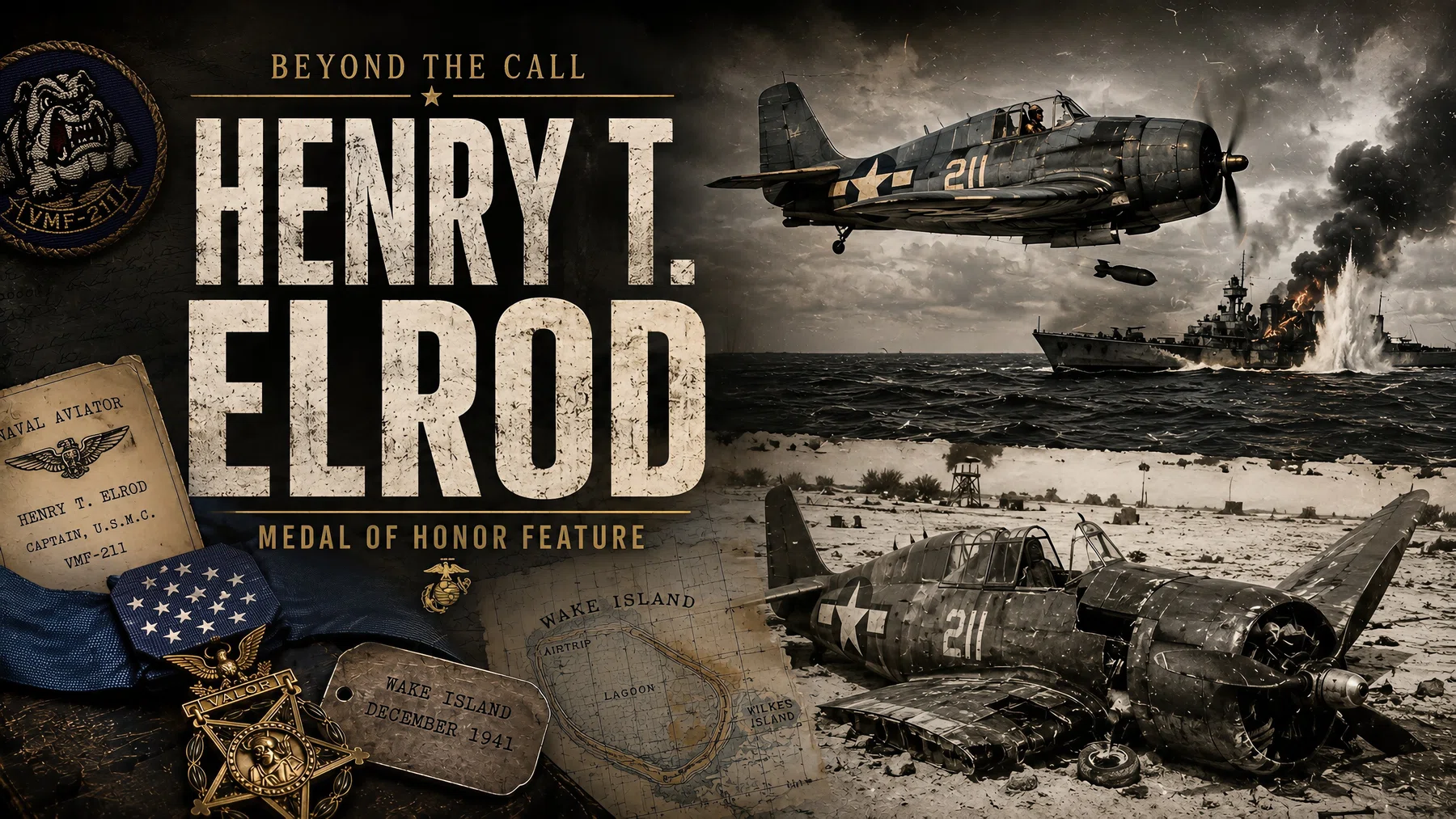
Photos from the period, including the image of Elrod’s Wildcat wrecked on Wake’s coral airstrip, hint at the cost of those days. The aircraft sits crumpled on its nose, propeller bent, surrounded by the flat, exposed terrain that left both pilots and ground crews with nowhere to hide. The defenders of Wake were running out of airplanes—but not out of fight.
Within two weeks of the first attack, every American aircraft on Wake would be destroyed. For Henry Elrod, the battle was only halfway done.
2. From Turner County to the Wildcat Cockpit
To understand how a man ends up flying a single fighter against an invading fleet and later leading Marines in a beach gun pit, you have to start far from any ocean—on the red soil of south-central Georgia.
Henry Talmage Elrod was born on September 27, 1905, in Turner County, Georgia, not far from the small town of Ashburn. Like many young men of his generation, he grew up in a rural community where hard work was expected and opportunities were something you chased, not something that arrived on the doorstep. He attended the University of Georgia and later Yale, experiences that exposed him to a wider world but didn’t change his basic orientation toward service.
In December 1927, at age twenty-two, Elrod enlisted in the United States Marine Corps. Four years later he earned his commission as a second lieutenant. The Corps of the late 1920s and early 1930s was small, close-knit, and still very much a naval infantry force, but aviation was beginning to come into its own. Elrod gravitated toward this new frontier.
He went through the long grind of flight training, starting with over a year at the Marine Corps Basic School in Philadelphia and then moving on to Naval Air Station Pensacola in Florida, the cradle of generations of naval aviators. There he balanced duties as a company officer with the demanding syllabus of a student pilot—navigation, gunnery, formation flying, and carrier-style landings that punished any lapse in concentration. He earned his wings in February 1935 and reported to Marine Corps Base Quantico as a freshly minted Marine aviator.
At Quantico he flew with one of the Corps’ aviation squadrons and picked up additional responsibilities as a school, personnel, and welfare officer. The extra duty says something about how his superiors saw him: not just as a good pilot, but as a dependable leader who could manage people as well as airplanes.
In 1938, Elrod transferred to a squadron in San Diego, trading the wooded hills of Virginia for the dry air of Southern California. There he served as material, parachute, and personnel officer—jobs that required attention to detail and a sense of accountability for other Marines’ lives. By early 1941 he was bound west again, detached to the Hawaiian area as tensions with Japan continued to build.
On December 4, 1941, four days before the attack on Pearl Harbor, Captain Elrod flew into Wake Island with eleven other pilots, a dozen Wildcats, and the ground crew of VMF-211. The unit was there to turn a remote atoll into a fortified outpost, a speed bump for any Japanese advance across the Central Pacific.
No one on that coral runway knew it yet, but within a week, the pilots of VMF-211—and their executive officer, “Hammerin’ Hank” Elrod—would be among the first Americans to fight a sustained battle of World War II. And when the last Wildcat was gone, Elrod would face a new choice: stop fighting, or pick up a rifle and stand in the sand with the infantry.
3. Fighting the Invasion from the Sky and Sea
When war reached Wake Island, the Marines of VMF-211 were thrown straight into a battle of attrition. The first Japanese strike on December 8 tore into the airfield, destroying several Wildcats on the ground and killing precious ground crew, the enlisted specialists who kept the fighters flying. The surviving pilots, including Captain Elrod, scrambled from rough shelters to their aircraft whenever spotters called incoming raids. Each takeoff was essentially a charge uphill; they were climbing through anti-aircraft bursts and weaving into tight bomber formations that outnumbered them many times over. On one of these early fights, Elrod went straight at a group of enemy bombers and shot down two, helping break up their attack on the island’s defenses.
Air attacks were only half the story. Offshore, Japanese warships probed Wake’s defenses, bombarding the small garrison and trying to soften it up for an eventual landing. Elrod and his fellow pilots shifted from intercepting bombers to low-level strikes against ships, flying in at wave-top height to drop small bombs and rake decks with machine-gun fire. On December 12 he pressed home a series of runs on a destroyer at such close range that he had to yank the Wildcat up sharply to clear the mast. His bombs fell across the ship’s stern and triggered a catastrophic explosion in her own depth charges, sending the destroyer under and marking the first time a major warship was sunk by light bombs from a single-seat fighter. The feat earned him admiration across the garrison, but every sortie cost fuel, ammunition, and sometimes aircraft that Wake could not replace.
Day by day, the Marine squadron was whittled away. Replacement parts were scarce, the runway was cratered, and each raid meant more casualties among the mechanics and armorers working in the open. Eventually Elrod’s own Wildcat was disabled by enemy fire, leaving him without a plane. By mid-December, VMF-211 had effectively ceased to exist as a flying unit. The pilots who had been the island’s offensive punch now faced a stark reality: the next phase of the fight would be on foot, side by side with the infantry and civilian defenders, against an enemy force preparing to come ashore in strength.
4. “Hold This Line”: Captain Elrod on the Beach
With the last aircraft destroyed, Elrod did not rotate to the rear or seek evacuation; there was nowhere to go. Instead, he moved to the sand. As Japanese preparations for a landing became clear, the Marines and civilian workers on Wake reorganized into ad-hoc rifle units to reinforce the island’s coastal gun positions. Elrod was given command of one flank of the defensive line, a mix of Marines and other personnel who would have to meet the enemy at the water’s edge. It was a very different kind of combat than aerial dogfights, but the same calm aggression that had served him in the cockpit now guided his decisions on the ground.
The landing attempt on December 23 turned the beaches and coral ledges into a chaos of gunfire, smoke, and shouted orders. Japanese troops pushed hard, trying to overwhelm the small garrison with sheer numbers and automatic weapons. Elrod moved among his men under intense fire, directing fields of fire and encouraging them to hold their shallow positions. When ammunition had to be brought forward to a vital gun emplacement, he repeatedly exposed himself to enemy fire, stepping into open ground to provide covering fire for unarmed ammunition carriers. At one point, during a rush by Japanese troops, he seized an enemy automatic weapon and passed his own firearm to another Marine, continuing the fight with whatever gun was at hand.
Those actions bought time and space for the defenders on his sector to keep firing. But courage could not change the balance of forces forever. During one of these efforts to protect the men hauling ammunition, Elrod was struck and mortally wounded. The Marines on his flank continued to resist, inspired in part by the example he had just set, until higher command judged further resistance hopeless and ordered a surrender to prevent a massacre of the remaining personnel. Wake Island fell, but the story of its defense—and of the Marine captain who fought first in the sky and then in the sand—would echo far beyond that isolated atoll, becoming an early symbol of American resolve in a war that had only just begun.
5. The Medal of Honor and a Promotion After Death
When Wake Island fell and the surviving garrison went into captivity, many of Captain Henry T. Elrod’s actions were known only to the men who had watched him work. They remembered the quiet pilot who had hunted bombers at altitude, skimmed waves to strike a destroyer, and then, when his fighter was gone, stepped into a rifle pit to command a thin line in the sand. Those memories traveled home through official reports and personal accounts, eventually shaping the case for the nation’s highest award for valor. After careful review of the battle, the Marine Corps and the Navy Department concluded that Elrod’s conduct during the defense of Wake Island met the standard of “above and beyond the call of duty.
In November 1946, nearly five years after his death, he was posthumously promoted to the rank of major. Around the same period, the Medal of Honor was approved and prepared for presentation. The citation that accompanied the award did more than list isolated exploits. It tied together a single story: a Marine aviator who shot down enemy aircraft against heavy odds, who sank a warship with a fighter’s small bombs, who organized a beach defense after losing every plane, and who ultimately died shielding his men as they carried ammunition to a gun that still needed to fire. It recognized not only a few moments of daring, but a pattern of leadership and sacrifice sustained over two brutal weeks on a remote atoll.
6. A Widow’s Service and a Grave at Arlington
The Medal of Honor was presented to his widow, Elizabeth Hogun Jackson Elrod, herself a commissioned officer in the Marine Corps Women’s Reserve. In that moment, the story of Wake Island reached into a stateside ceremony, linking a front-line fight with the quiet, enduring service of families who carried the loss. Elizabeth came from a Navy family and was the niece of a senior admiral, but she was also a Marine officer in her own right, part of a generation of women whose work made it possible to field and sustain the forces that fought overseas. Receiving her husband’s medal, she stood not only as his next of kin but as a fellow Marine, recognizing in official language what she already knew from the men who had served with him.
Major Elrod’s body did not come home immediately. He was first buried on Wake Island itself, one of many defenders laid to rest where they fell. Only after the war, when the United States recovered and consolidated remains from battle sites across the Pacific, was he brought back to American soil. In October 1947 he was reinterred at Arlington National Cemetery in Virginia. Today his grave is one of many white headstones in that rolling landscape, but for those who know the story, the inscription anchors a very specific image: a Wildcat pilot turned beach commander, fighting through the opening days of a global war. Visitors who pause there join a chain of remembrance that stretches back to the men on Wake who first told others what “Hammerin’ Hank” had done.
7. The Long Shadow of “Hammerin’ Hank
Over time, the Marine Corps and his home state wove Henry T. Elrod’s name into the places where new generations learn to serve. The main road leading into Marine Corps Officer Candidates School in Virginia bears his name, greeting every prospective officer who arrives to begin the demanding process of becoming a Marine lieutenant. For candidates who later learn his story, that road is more than pavement; it is a quiet reminder that the gold bars they seek carry with them the possibility of decisions under fire like those on Wake. In Ashburn, Georgia, the county seat near his birthplace, a public park honors him as a local son whose path from rural roots led to national recognition.
The Navy carried his memory to sea by naming an Oliver Hazard Perry–class frigate USS Elrod, a warship whose crews sailed under his name on deployments around the world. In 1995 he was inducted into the Georgia Aviation Hall of Fame, placing him alongside other flyers who expanded the reach of American airpower. Together, these honors form a scattered but connected map: a road at a training base, a park in a small town, a ship’s crest, a museum plaque. Each points back to Wake Island and to a Marine who fought first in the sky and then on the ground, refusing to yield while any means of resistance remained. For Beyond the Call, his story stands as a clear example of what it means when ordinary Americans are asked to do extraordinary things—and answer with their lives.