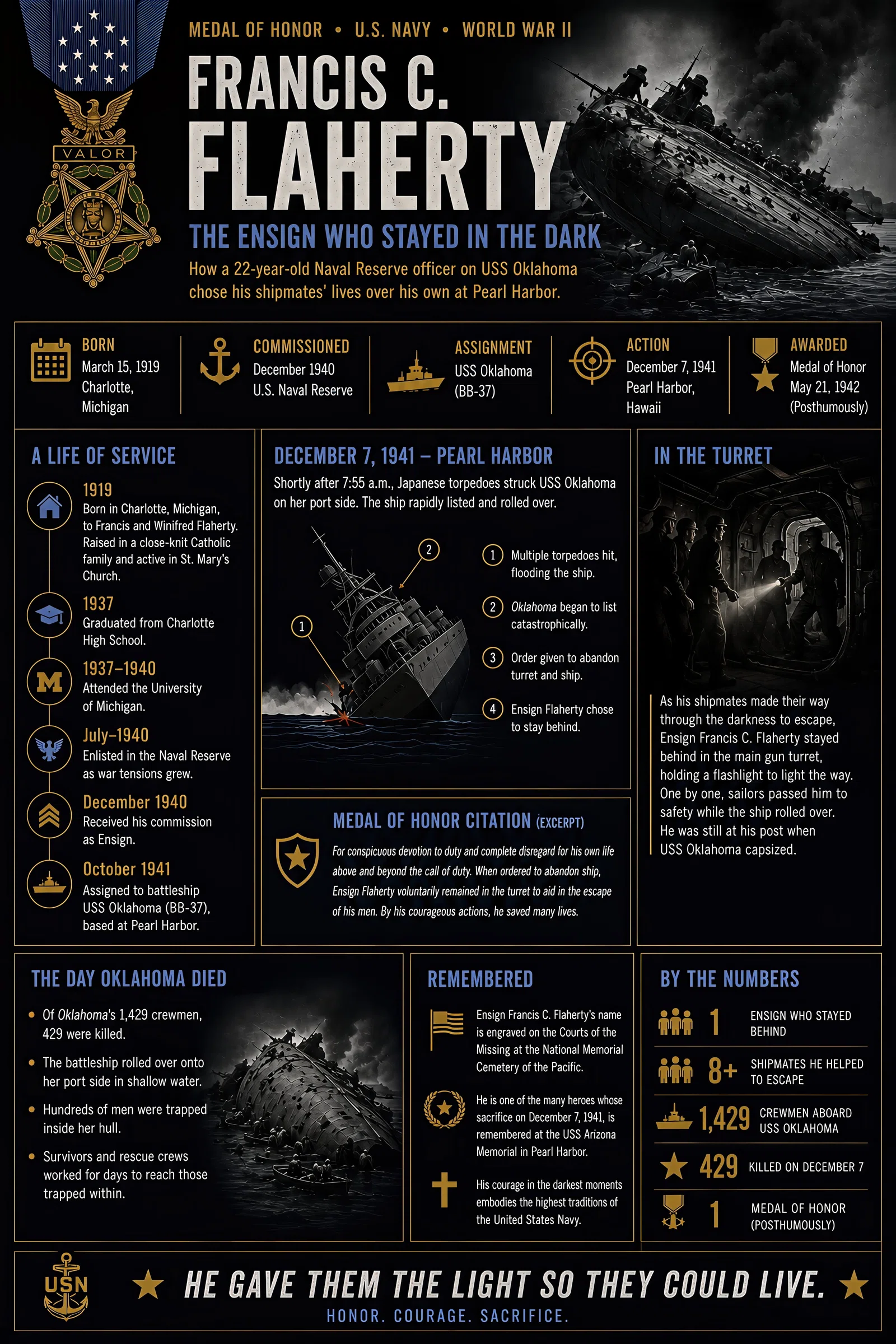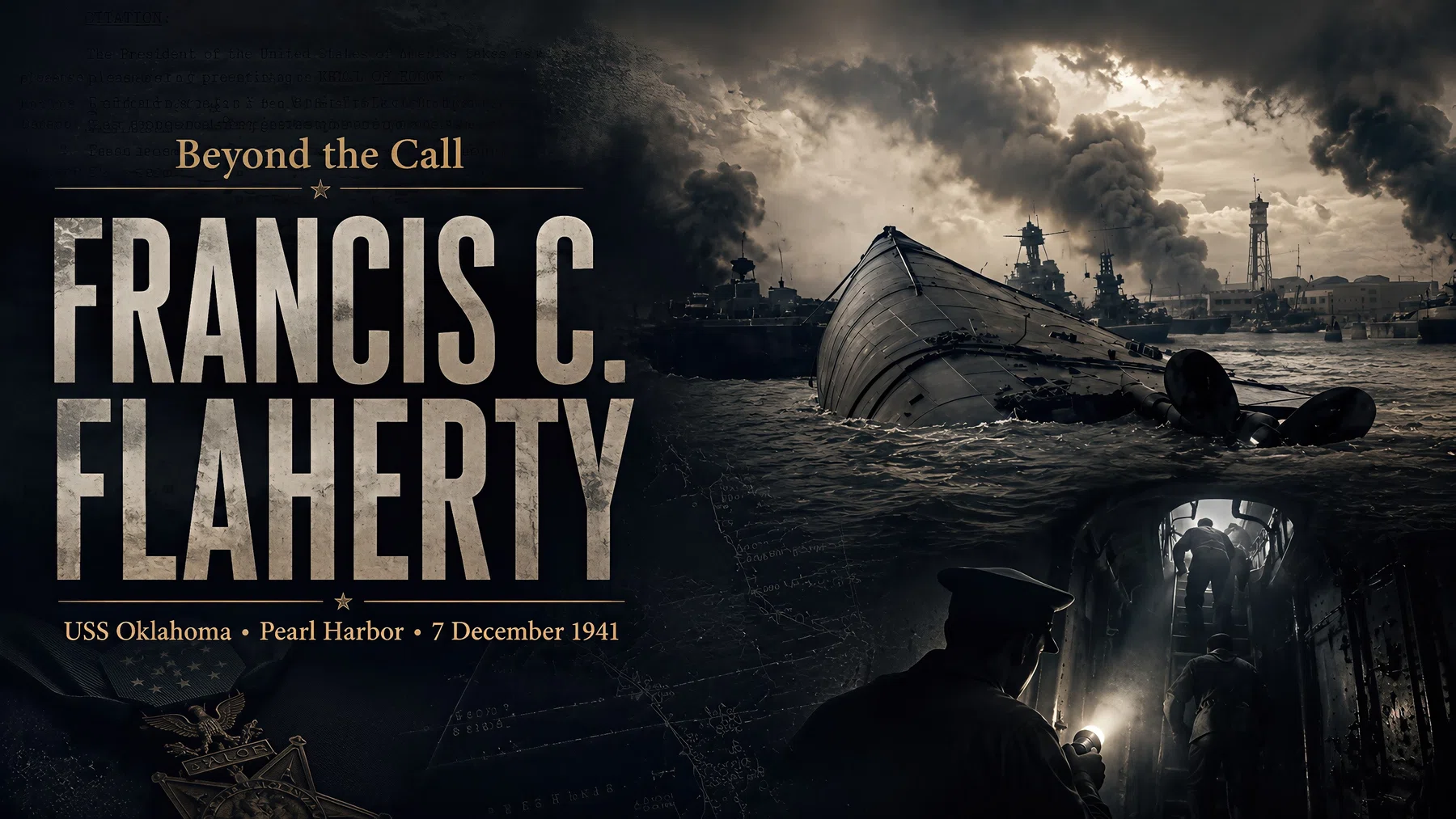
1. A ship rolling over, a single beam of light
Just after dawn on 7 December 1941, Battleship Row at Pearl Harbor was waking up. On board USS Oklahoma, moored outboard of USS Maryland, the routine of a quiet Sunday was beginning—breakfast, inspections, and thoughts of liberty ashore later in the day.
Then the first Japanese torpedoes slammed into the battleship’s port side.
Men were thrown from bunks and breakfast tables as the great ship lurched violently. General quarters sounded. Within minutes, more torpedoes struck home, tearing open the hull. Oklahoma began to list so fast that sailors had to fight simply to keep their footing as decks turned into walls.
Deep inside the ship, in one of the main gun turrets, Ensign Francis Charles Flaherty and his crew tried to make sense of the chaos. A turret on a battleship is a massive armored structure housing the big guns and the machinery that feeds them. In action, it is noisy, cramped, and demanding; in a surprise attack, it can become a steel trap.
Word came down: the ship was going to capsize. The order was given to abandon turret and ship. In the smoke and darkness, the path out was a twisting maze of ladders and narrow passages.
Flaherty made a choice.
As his shipmates groped for a way to escape the dying battleship, the young ensign stayed behind, bracing himself in the confined space and holding a flashlight to light the way. The official citation would later speak of his “conspicuous devotion to duty” and his complete disregard for his own life, but in the moment it was simpler than that. He was the one who could see the way out, so he made sure others could see it too.
One by one, sailors squeezed past him toward whatever chance of survival waited beyond the turret. Behind them, the list of the ship grew steeper, the noise more terrible, the light more precious. When Oklahoma finally rolled over, trapping hundreds of men inside her hull, Francis Flaherty was still at his post. He had given his shipmates their best shot at escape, and spent his own life buying them time.
2. From Charlotte, Michigan, to Battleship Row
To the sailors who scrambled past that flashlight beam, Flaherty was simply “Ens. Flaherty,” the young officer from the turret. Back home in Charlotte, Michigan, he was Frank, the son of a small-town family and a familiar face at St. Mary’s Catholic Church. Born on 15 March 1919, he grew up in a Midwestern community where the Great Depression had left its mark but where expectations for the future remained stubbornly hopeful.
He attended Charlotte High School and then enrolled at the University of Michigan, part of a generation coming of age between two world wars. The Navy offered opportunity, purpose, and a way to see beyond the horizons of Eaton County. In July 1940, with war already raging in Europe and tensions mounting in the Pacific, Flaherty enlisted in the Naval Reserve. Within months he completed training and, in December of that year, received his commission as an ensign.
By late 1941, Ensign Flaherty was serving aboard USS Oklahoma, a battleship that had steamed to Hawaii as part of the U. S. Pacific Fleet’s forward deterrent. Life on board was demanding but, for many, still felt far removed from actual combat. Sailors drilled for damage control and gunnery but wrote home about movies on the fantail, liberty in Honolulu, and the beauty of Oahu’s mountains. The United States was not yet officially at war; for a 22-year-old officer from Michigan, the future might have seemed wide open.
That illusion ended in the space of a few terrible minutes on the morning of 7 December. On a capsizing ship, in a darkened turret, Francis Charles Flaherty’s years of preparation, his sense of duty, and his quiet upbringing in Charlotte came together in a single, irreversible decision to stay in the dark so others could reach the light.
3. In the turret as the ship died
When USS Oklahoma began to roll, the men in the turret suddenly found themselves in a world that no longer had an up or down. Heavy shells shifted in their racks, loose gear turned into hazards, and the familiar passageways out of the compartment twisted at impossible angles as the ship listed farther and farther to port. The order to abandon ship cut through the noise, a final acknowledgment that the battleship was lost. The only hope now was individual escape.
In that chaos, light became as valuable as oxygen. With power failing and smoke and dust filling the air, even a few feet of corridor could disappear into blackness. Ensign Francis Flaherty understood that if everyone rushed for the same exit at once, men would pile up in blind corners and narrow hatches and none of them would get clear in time. Instead of pushing to be first up the ladder, he moved to where he could do the most good. Bracing himself against the tilting steel, he held his flashlight steady over the one route that still offered a chance.
One after another, sailors squeezed past him, using that beam to find handholds, duck through openings, and turn the right way at junctions that were now on their sides. For the turret crew, the sight of their young officer staying put while the ship overturned around them was something they would never forget. The battleship continued to roll, water and debris rushing in, but Flaherty did not move. By the time the hull finally settled upside down in the harbor mud, he was still where duty and instinct had placed him, spending his last seconds making sure others had a path to live.
4. Loss, salvage, and a posthumous honor
From the shore and from neighboring ships, witnesses saw Oklahoma turn turtle in less than fifteen minutes. Rescue parties swarmed over the exposed bottom, pounding on the plates and cutting through the hull wherever they heard answering taps. They brought hundreds of men out alive over the next two days, but not everyone could be reached in time. In all, 429 sailors and Marines were entombed within the wreck, including the ensign who had given up his escape route so his turret crew could find theirs.
For families back home in places like Charlotte, Michigan, the first word came in the stark language of wartime telegrams: missing in action, presumed dead. Only gradually did stories emerge of the young officer who had stayed with a flashlight in the darkness of a capsizing battleship. His conduct during the attack impressed shipmates and superiors alike, and after the war a grateful nation formally recognized what he had done. In March 1946, Francis Charles Flaherty was awarded the Medal of Honor posthumously, the decoration presented to his brother as the tangible symbol of a choice already etched into the memories of those he had saved.
Raising and salvaging Oklahoma took years. The battered ship was eventually refloated in 1943, her dead recovered as best as wartime conditions and technology allowed. Many of the remains, too damaged or commingled to be individually identified at the time, were buried in mass graves marked only as “Unknowns” at the National Memorial Cemetery of the Pacific in Honolulu. Among them rested Ensign Flaherty, known to his family and hometown but officially without a named grave, even as his Medal of Honor took its place among the stories of Pearl Harbor heroism.
5. From “Unknown” to identified
For decades after the attack, the story of Ensign Flaherty was complete in one sense and unfinished in another. His courage in the turret was well known, his Medal of Honor citation was clear, and his name was remembered among the fallen of Pearl Harbor. But his physical resting place remained uncertain. Like so many of the 429 men lost on Oklahoma, his remains were among those recovered without a way to match them to a specific name. They lay under the quiet grass of the National Memorial Cemetery of the Pacific, marked only as unknowns from the battleship that had rolled over in the harbor.
As time passed, technology changed. New methods of forensic analysis, including the ability to compare DNA samples from families with remains long buried, opened a door that had been closed since the war. The United States undertook a large-scale effort to exhume, study, and, wherever possible, identify the Oklahoma unknowns. It was detailed, meticulous work that unfolded far from the dramatic images of Pearl Harbor, but it carried its own quiet weight. Piece by piece, the project turned statistics back into individuals. Among those finally identified was the young ensign from Michigan whose last act had lit the way for his shipmates in the darkness of a capsizing turret.
6. Coming home to Charlotte
When word reached Michigan that Francis Flaherty’s remains had been identified and would be coming home, it closed a circle that had been open since 1941. Charlotte, the town that had watched him grow up and then watched the war take him away, now had the chance to welcome him back properly. Local veterans, civic leaders, and families who had heard his story for years gathered to see him laid to rest with full honors. Flags lined the streets, uniforms from different generations stood at attention, and the town’s church bells marked the return of a son whose name had long been carved in stone but whose body had never before come home.
At the graveside, words like duty and sacrifice sounded less abstract than they often do at public ceremonies. The community knew that the young man they were burying had been given a chance to save himself and had instead chosen to stand in harm’s way so that others might live. For the families of those turret sailors who survived, his name had always carried a particular meaning. Now, for the people of Charlotte, that meaning was etched into a headstone they could visit, a place where memory and history met.
7. A beam of light that still matters
Today, when people study the attack on Pearl Harbor, they often focus on the sweeping movements of fleets and aircraft, the strategic failures and the larger currents that drew nations into war. Within that vast picture, Ensign Francis C. Flaherty’s story is small in scale but immense in moral weight. On a ship that was dying, in a space where seconds counted and panic would have been understandable, he chose clarity over fear and responsibility over survival. He did not command a division, write a famous order, or turn the tide of a battle. He held a flashlight and refused to leave his post, and in doing so he turned a narrow passageway into a lifeline.
For students of military history, his actions offer a reminder that heroism often takes the form of steady, deliberate choices made out of sight of any camera or headline. For veterans and those still serving, his example speaks to the core of what it means to look after the people beside you, even when the cost is absolute. And for the broader public, the story of a 22-year-old ensign from a small town in Michigan standing firm in the dark so others could reach the light is one more proof that courage, at its deepest level, is simply the refusal to abandon others when they need you most.