The Moment of Decision
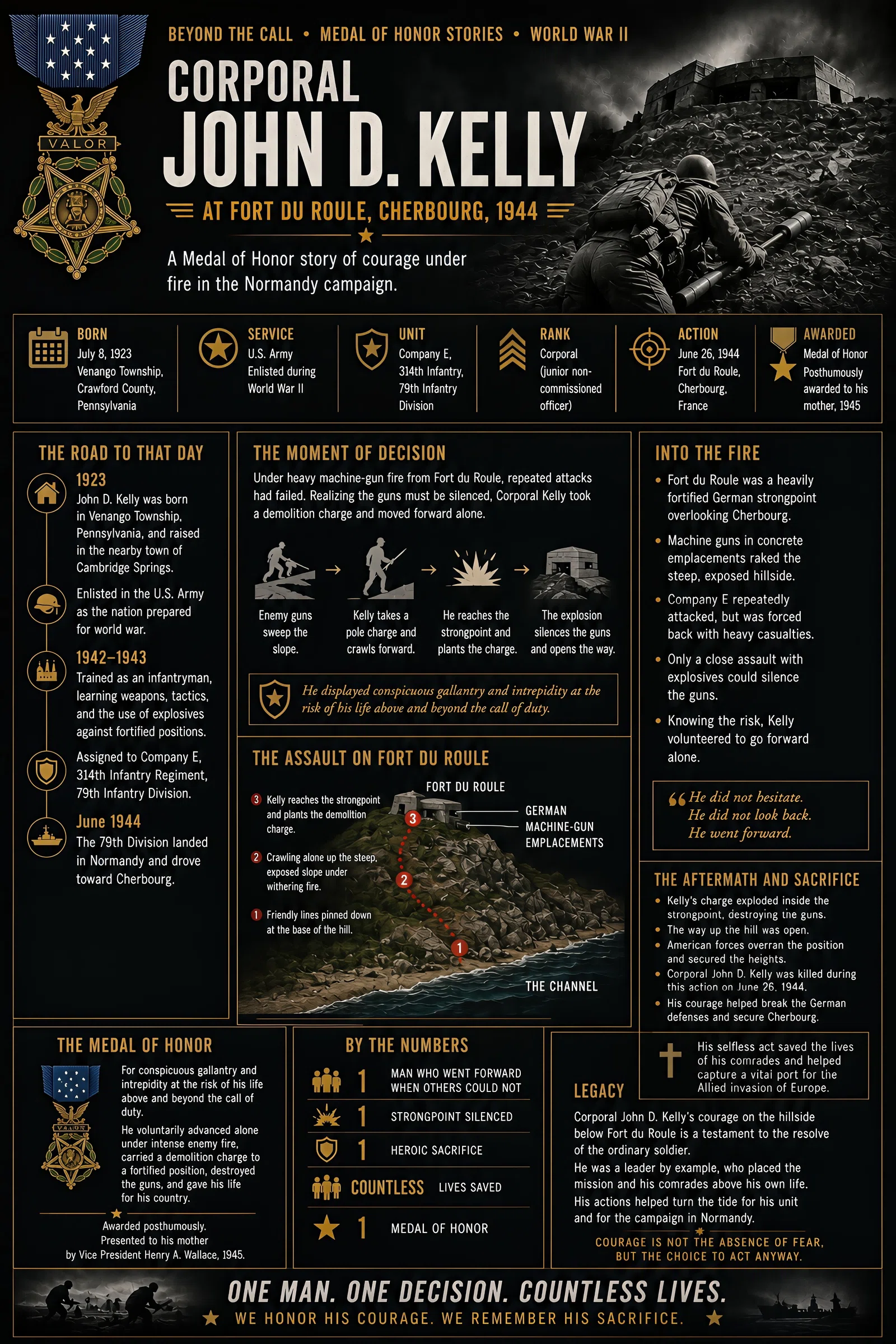
The hillside below Fort du Roule was too steep and too bare for comfort. Loose rock and scrub offered almost no cover, and every movement seemed to draw another burst of German machine-gun fire from the concrete strongpoint dug into the slope above. Late in June 1944, clouds of dust and cordite hung in the air as an American infantry company tried, and failed, to claw its way upward toward the fort that dominated the port of Cherbourg. Men hugged the ground, pressed into shallow folds of earth that suddenly felt far too shallow.
Among them lay a young corporal from Company E, 314th Infantry, 79th Infantry Division, his uniform streaked with dirt and sweat. The order was simple on paper: take the slope, silence the guns, and open the way to the fortress above. In practice, every attempt to move ended in sudden casualties and more men sliding back down the hill. The German position was anchored in concrete, its guns firing from narrow openings, perfectly placed to sweep the approach.
The company commander knew that without those guns knocked out, nothing else on that hillside was going to move. Demolition charges were available, but someone would have to get them close—far closer than seemed remotely survivable. As the officers and NCOs weighed their options, the corporal studied the slope and the strongpoint. He saw the fear in the faces around him, felt it in his own chest, and understood that waiting any longer would only cost more lives.
Then he did something no one had ordered. The corporal stepped forward, took hold of a long, awkward pole charge loaded with explosives, and prepared to climb the hill alone. In that instant, he chose to move when everyone else had to stay down.
The Road to That Day
John D. Kelly began life far from the cliffs of Normandy. He was born on July 8, 1923, in Venango Township, Crawford County, Pennsylvania, and his service record is officially credited to the nearby town of Cambridge Springs. It was a small-town upbringing in western Pennsylvania, the kind of place where hard work and close-knit families were the norm long before war loomed on the horizon. By the time he was old enough to wear a uniform, the world was already at war and the United States was racing to build the forces it would send overseas.
Like thousands of young men from rural communities, Kelly entered the Army during World War II and trained as an infantryman. The Army’s doctrine demanded more than just marksmanship; riflemen were expected to handle grenades, explosives, and specialized charges to crack open bunkers and fortifications. Kelly was assigned to Company E, 314th Infantry Regiment, part of the 79th Infantry Division, a unit that would soon be molded from a stateside formation into a combat team fit for assault landings and urban fighting in Europe.
Training hammered home the basics: moving under fire, coordinating with supporting weapons, and pushing forward even when the terrain and the enemy seemed to favor the defense. For a corporal like Kelly, it also meant learning how to lead a small group of soldiers—keeping them focused, calm, and moving in the right direction when fear and confusion threatened to take over.
Those who look back at his record see only a few lines: a young man who rose to be a junior noncommissioned officer, who would eventually be recognized posthumously with the nation’s highest award for valor. But behind those dry entries was a son and a brother, a soldier whose mother would one day stand in his place to receive his Medal of Honor from the vice president of the United States. By the summer of 1944, Kelly and his comrades of the 79th Division had crossed the Atlantic, landed in Normandy, and were driving toward Cherbourg. Their next objective was the fortress on the heights: Fort du Roule, and the guns that barred the way.
Into the Fire
The battle for Cherbourg in June 1944 was more than a local fight. For the Allied armies pushing inland from the Normandy beaches, the capture of the port promised a lifeline of supplies for the campaign in France. On the southern approaches to the city, Fort du Roule sat on high ground that overlooked the harbor and the routes American units needed to secure. Its guns were dug into the rock and housed in reinforced concrete, with interlocking fields of fire that covered the steep slopes below. The 79th Infantry Division received the task of prying this fortress open, a job that would fall down to battalions, then companies, and finally individual soldiers.
Company E of the 314th Infantry advanced against one of the strongpoints that guarded the hill. The approach was a miserable mix of loose stone and exposed earth, dotted with only a few shallow depressions where a soldier could press himself flat. The German machine guns inside the position fired through narrow embrasures cut into the concrete so that only the muzzles and flashes could be seen. Every attempt to climb ended the same way, with bursts of fire sweeping the slope and men sliding back down to what little cover they could find. Mortar rounds burst above and behind them, showering the hillside with fragments and adding to the confusion.
Officers and noncommissioned officers tried to organize another push, but the problem was obvious. As long as that strongpoint remained intact, the company would stay pinned. Supporting weapons could suppress it for short bursts, yet the guns always came alive again once the fire lifted. The answer lay in getting explosives right up against the concrete. Engineers and infantry units in this campaign carried pole charges, long shafts with a block of explosive fixed at the far end. They were meant for exactly this sort of work, but using one here meant crossing open ground under the full attention of the enemy crews.
Cpl. John D. Kelly volunteered to make the attempt. He took up a pole charge roughly ten feet long with about fifteen pounds of explosive attached, hefting the awkward weight as the men around him watched. Then he moved out from the shallow cover and began working his way up the hill alone. Tracers snapped past and cracked into the stones around him while the machine guns hammered at his path. Kelly pushed upward, using what little concealment the slope offered, until he could jam the charge against the base of the strongpoint and withdraw before the timed fuse ran out. The explosion shook the hillside, but when the smoke cleared the guns inside were still firing.
Most soldiers would have counted themselves lucky to have survived that first climb. Kelly did not stop. Without waiting for orders, he picked up a second pole charge and started back up the same deadly route he had just traveled. The enemy gunners knew exactly where to look this time, and the fire only intensified, but again he reached the position, set the charge, and scrambled away. The second blast sheared off the protruding ends of the enemy guns and stunned the crews, reducing their ability to cover the slope with effective fire.
Even damaged, the strongpoint still blocked the company’s path, and the defenders were not finished. Kelly decided that one more attack could end the threat completely. He seized another charge and climbed the hill for a third time, angling along the slope to reach the rear entrance of the position. The climb was just as exposed as before, and every step meant another chance for a bullet to find him. He reached the doorway, set the charge, and withdrew as it tore open the entrance. With the structure breached, he moved close enough to throw grenades inside, forcing the remaining German gunners to abandon their weapons and surrender. In the space of those three solitary climbs, Kelly had broken open the strongpoint that had stalled his company and opened the path toward Fort du Roule.
The Citation, Decoded
The official Medal of Honor citation for John D. Kelly begins with the familiar words “for conspicuous gallantry and intrepidity at the risk of his life above and beyond the call of duty.” In practical terms, that phrase captures the way he repeatedly chose the most dangerous task on the field, not once but three times, when simply remaining under cover would have been understandable. “Conspicuous” meant that everyone around him could see what he was doing. “Intrepidity” pointed to the steadiness he showed in the face of fire that had already stopped larger groups of men.
The citation notes that his unit was “pinned down by heavy enemy machine gun fire emanating from a deeply entrenched strongpoint on the slope leading up to the fort.” Those words describe the tactical deadlock on the hillside. The strongpoint’s construction in concrete and rock made it resistant to indirect fire, and its position on the slope gave it clear lanes over every approach. Being pinned down was not a figure of speech; it meant that any attempt to stand, run, or even crawl in certain directions invited immediate bursts from the guns above. Kelly’s decision to attack with a pole charge directly addressed that specific problem rather than simply trading fire at long range.
The citation then explains that, armed with a pole charge about ten feet long and carrying fifteen pounds of explosive, he climbed the slope under a “withering blast of machine gun fire” and placed the charge at the base of the strongpoint. The length of the pole mattered. It allowed him to push the explosives into the most vulnerable angle of the structure while remaining as low as possible, though not low enough to escape the enemy’s aim. That first blast failing to destroy the position highlights just how strong the fortification was. Kelly’s choice to repeat the climb, described as acting “alone and unhesitatingly,” turns the story from a single brave dash into a sustained effort.
Finally, the citation recounts his third ascent to place a charge at the rear entrance, then hurl grenades into the breached opening to force the surviving gun crews to surrender. This sequence explains the phrase “tenacity of purpose” in concrete terms. He did not simply attack and withdraw; he stayed focused on neutralizing the strongpoint until it no longer threatened his company. The concluding line that his actions were “an incentive to his comrades and worthy of emulation by all” reflects not only the destruction of an enemy position, but the way his example helped move the entire unit forward against a fortified line guarding Cherbourg.
Why It Mattered
On the day Cpl. John D. Kelly climbed that slope, the immediate problem was brutally simple. His company could not move. The pillbox on the hillside was positioned so that any attempt to stand or crawl forward drew instant fire. By knocking out that position with his pole charges and grenades, he turned a dead ground into passable ground. Riflemen who had been pressed flat into the shallow folds of earth could finally rise, shift, and continue the assault toward Fort du Roule without the same guns raking their ranks. In a matter of minutes, one man’s risk changed the geometry of the fight for every soldier on that slope.
The impact did not stop with a single company. Fort du Roule was a key outwork in the German defense of Cherbourg. Its guns and observation points looked over the harbor and the approaches American units needed to control. As the strongpoints around the fort fell, including the one Kelly assaulted, the garrison’s ability to hold out eroded. The collapse of those positions helped open the path that led to the eventual surrender of the city and the high ground that overlooked it. Cherbourg’s harbor was heavily damaged, but once cleared it became a vital port feeding supplies into the growing Allied presence in France.
It would be misleading to say that one corporal’s charge won the campaign. Battles like Cherbourg are decided by thousands of choices, from generals planning assaults to engineers clearing rubble in the docks. Yet Kelly’s actions are a clear example of how a single, determined decision at squad level can unlock a stalled attack that larger formations depend upon. If that strongpoint had remained intact, the attack on that flank might have required a costly pause, more artillery, and more lives spent on the same few yards of ground. By choosing to attack again and again, he bought his comrades space and time that could not have been gained any other way on that steep, exposed hillside.
Leadership and Character
Kelly’s story offers more than a record of destructive skill with explosives. It is a study in leadership and character from the middle of the ranks. As a corporal, he held responsibility for a small group of men, not for the battle as a whole. No order compelled him to rise from cover with a ten foot pole charge in his hands. He saw the same facts everyone else saw: a stalled advance, wounded friends, and a concrete position that would not yield to ordinary fire. His response was to step forward and accept the most dangerous job available, which is exactly what the Medal of Honor citation means by gallantry and intrepidity.
His persistence under fire reveals another side of that character. Many soldiers have made a single dash under fire to place a charge or retrieve a comrade. Kelly did it three times, adjusting his approach after each blast. When the first explosion failed to silence the guns, he did not treat survival as a reason to stop. The second blast removed the muzzles. The third targeted the rear entrance and turned the position from a fortress into a trap for its occupants. That pattern shows not only courage but a problem solver’s mindset, focused on results rather than on the drama of a single heroic gesture.
Accounts describe Kelly as a former logger from northwestern Pennsylvania, a man used to hard physical work in rough country. Long before he wore chevrons, he had spent days outdoors on uneven ground, handling heavy tools and trusting his balance on steep slopes. Those experiences did not make the bullets at Cherbourg any less lethal, but they likely contributed to his ability to move with confidence on that rocky hillside when others could barely raise their heads. For leaders and students of leadership today, his example underscores that character is built long before the crisis comes. Training, work, and small choices over years shaped a man who, when pinned down with his company, responded with steady, repeated action instead of paralysis or panic.
Legacy and Memory
Kelly survived the assault on Fort du Roule and continued to fight with the 314th Infantry Regiment as the 79th Division pushed across France. In the months that followed, he was wounded, returned to duty, and was promoted to technical sergeant. During that time, his superiors first recognized his actions at Cherbourg with the Distinguished Service Cross. Later, the Army decided that his conduct on June 25, 1944 merited the Medal of Honor, upgrading the earlier decoration. Before that final decision was announced, however, he fell in combat in late November 1944, dying in France while still serving with his unit.
Back home in Pennsylvania, his death turned his family into a Gold Star family, one among many who carried the war’s cost in quiet grief. His wife, Mary, received news of his loss while he was still far from home. In early 1945, she stood with his parents and siblings at a ceremony in Pittsburgh where his Medal of Honor was presented on his behalf, a formal recognition that could never truly balance what had been taken from them. The words read aloud that day described courage and gallantry, but they also froze one violent morning in Normandy into a permanent part of his family’s story.
Today, Kelly rests at the Epinal American Cemetery in eastern France, among thousands of other white markers that trace the path of the Allied advance. His name appears on Medal of Honor rolls, in regimental histories, and in modern accounts of the battle for Cherbourg. 2Wikipedia+2 For visitors walking the rows at Epinal or reading about the fight for Fort du Roule, he is more than a line in a citation. He is a son of Pennsylvania, a husband, a small unit leader, and the soldier who chose to climb a bullet swept slope three times so that others could move forward. Remembering him in that full, human way honors not only his medal, but the life and relationships behind it.