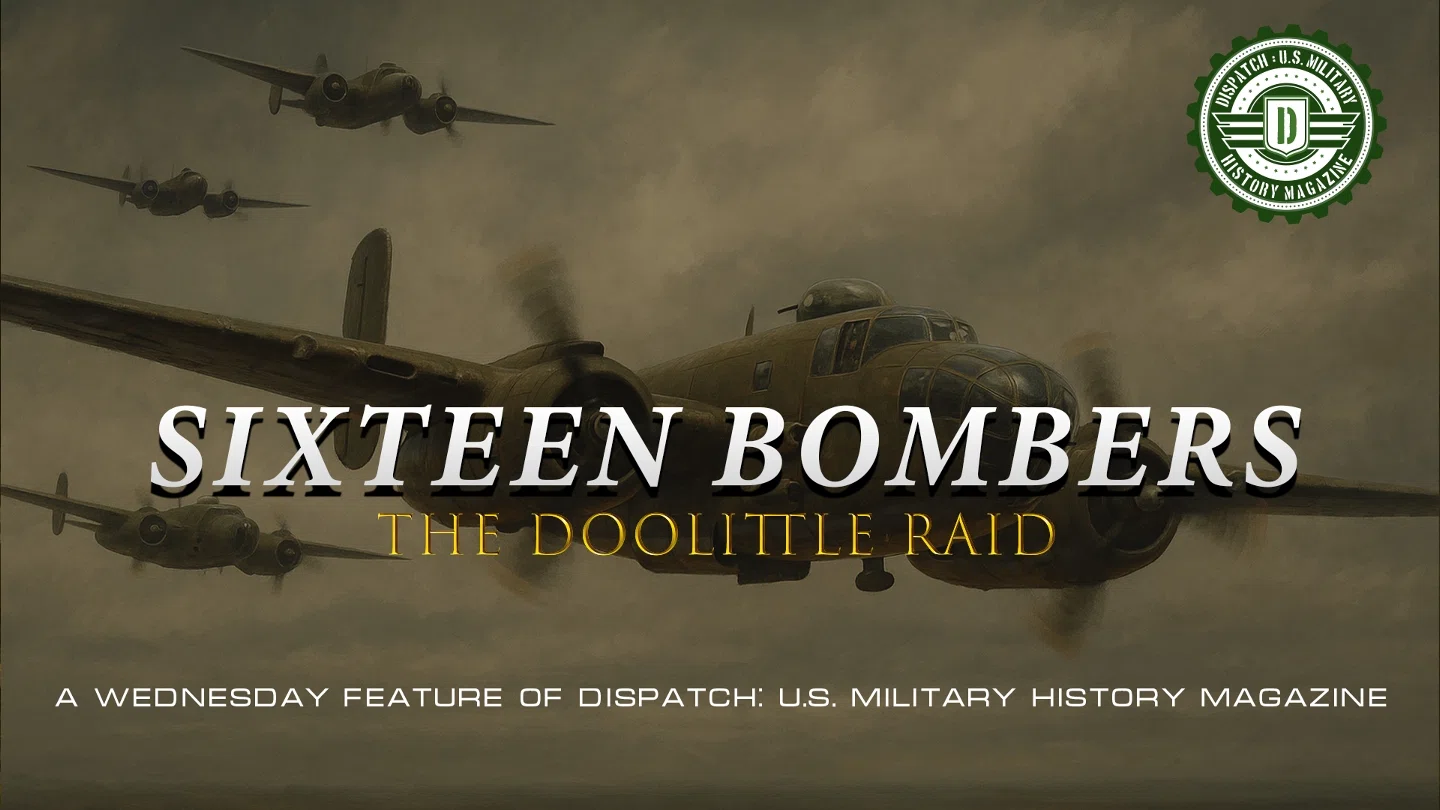
Sixteen Bombers in the Pacific Wind
The sun had not yet burned through the gray Pacific haze when sixteen twin-engine Army bombers sat lashed to the wooden deck of an American carrier built for fighters and dive bombers, not land-based medium bombers. Waves slammed against the bow, sending spray up and over the forward aircraft as crews in heavy jackets moved across the slippery planks, checking fuel caps, bomb shackles, and the makeshift extra gas tanks that filled every possible space. Ahead of them, the carrier’s bow rose and fell in a steady rhythm that made the short takeoff run look even shorter. Somewhere over the horizon lay Japan. Between the two stood miles of cold sea, uncertain weather, and the very real possibility of enemy patrols spotting the task force too soon.
On the lead bomber, Lieutenant Colonel James Doolittle ran through final checks with his crew, each man knowing that, once they left this deck, there would be no coming back to it. The B-25s had been stripped, modified, and trained to lift off in a distance more suited to a small fighter, but there were limits to what engines and faith could do. At the carrier’s island, signal flags and hand gestures passed between ship’s officers and the flight deck crew. Engines roared to full power, propeller wash whipping deck crewmen’s clothes and sending loose objects skittering away. One by one, the bombers crept into position at the very edge of the bow, noses pointed into the wind that meant life or death.
Out beyond the task force, somewhere beyond the curved horizon, were Japanese cities that had not yet seen American aircraft overhead. For sailors on the escorting cruisers and destroyers, and for the pilots strapped into their unfamiliar launching platform, the moment felt like a hand reaching far beyond what the war had so far allowed. When the first bomber staggered off the bow and dipped toward the waves before climbing, the men on deck exhaled as one. This was more than a single takeoff. It was the first American strike at the Japanese home islands, improvised in months and hinging on every aircraft getting safely into the air.
A Daring Raid with Strategic Weight
The scene on that cold April morning in 1942 did not come out of nowhere. Four months earlier, Japanese carriers had smashed the American Pacific Fleet at Pearl Harbor, sinking battleships and killing thousands. Across the Pacific, the United States and its allies were still reeling as Japanese forces advanced into the Philippines, Southeast Asia, and toward vital shipping lanes. At home, anger and shock mixed with frustration as bad news arrived in one report after another. Political leaders and military planners knew they needed more than promises of future victories. They needed a visible blow against Japan itself, one that could reach into the enemy’s heartland and show that the war was not a one-sided story.
The idea that became the Doolittle Raid was simple in concept and complex in execution: use an American carrier to get Army medium bombers close enough to Japan’s home islands for a one-way strike, then send them on toward airfields in China. The United States Navy would provide the ships and the approach. The United States Army Air Forces would provide the aircraft, crews, and bombs. It meant putting a valuable carrier and its escorts dangerously close to an enemy coastline that bristled with patrol planes, submarines, and radio stations. It also meant asking bomber crews to launch knowing that, even if they hit their targets, they likely would not land on friendly soil that night.
The stakes went far beyond the physical damage sixteen bombers could do to factories, dockyards, and military targets in and around Tokyo and other cities. For President Roosevelt and his advisors, a successful strike would boost American morale and force Japan to adjust its defenses, tying up aircraft and ships that might otherwise be used on distant fronts. For Japanese leaders, American bombers appearing over the capital would be a shock to public confidence and a direct challenge to the idea that the home islands were beyond reach. For the men on the ships and in the bombers, the mission carried a more immediate weight: if the task force were discovered early, the enemy could pounce on an exposed carrier, or the bombers might have to launch from even farther out, with fuel margins shrunk to almost nothing. In that balance of risk and necessity, the Doolittle Raid took shape as one dangerous idea the United States was willing to try.
Carriers, Bombers, and a Gamble
In the weeks after Pearl Harbor, American planners faced a simple but stubborn problem: the nation demanded a blow against Japan, yet the means to deliver it were limited. Carrier air groups could strike enemy fleets and island bases, but their dive bombers and torpedo planes did not have the range or bomb load to hit deep inside the home islands and then come home. Long-range Army bombers, on the other hand, could carry the punch, but they were based on runways, not rolling wooden decks at sea. Out of that mismatch came a proposal that sounded almost impossible: load land-based medium bombers onto a carrier, steam them close enough to Japan for a one-way strike, then send them on toward friendly airfields in China.
James Doolittle, already famous as a test pilot and racing aviator, took on the role of planner and leader. He gathered volunteer crews from stateside bomber groups, men who found themselves selected for a mission they were told would be exceptionally dangerous but light on details. The aircraft chosen was the B-25 Mitchell, a twin-engine medium bomber with enough range and toughness to make the idea at least plausible. Mechanics and engineers began modifying the bombers, stripping out unnecessary equipment, adding extra fuel tanks in bomb bays and fuselages, and tuning engines for every bit of power and efficiency they could coax from them. Some defensive guns were removed to save weight, and clever improvisations, like dummy gun barrels in the tail, tried to deter enemy fighters without adding the bulk of real turrets.
Training took place on quiet American fields where a white rectangle on the ground stood in for a carrier deck. Crews practiced short takeoffs again and again, roaring down runways as if they had only a few hundred feet to spare. Navy fliers with deck experience shared tips on judging the end of the “deck” and using the wind. At the same time, the Navy assembled the task force that would carry the bombers across the Pacific. The carrier Hornet would serve as the launching platform, its normal air group left behind to make room on the flight deck. Another carrier, Enterprise, would sail nearby to provide fighters and additional scouting aircraft, while cruisers, destroyers, and support ships formed a protective ring around them. Secret agreements with Chinese authorities arranged for landing fields on the far end of the mission, though maps, weather information, and radio navigation aids could not erase the fact that the crews would be flying into unknown conditions.
By early April 1942, the plan had hardened into orders. The combined force slipped out into the Pacific under strict radio silence. On their decks, sailors walked past Army bombers crowded wingtip to wingtip, a sight that captured the strange and urgent improvisation of the moment. The mission was no longer just a concept. It was now a column of ships heading west, one dangerous idea made of steel, gasoline, and men who understood that the margin for error was thin.
From Carrier Deck to Capital
As the task force pushed deeper into the western Pacific, tension on the ships and among the bomber crews grew with every mile. Lookouts scanned the horizon for signs of Japanese patrol craft. Submarine alerts and rumors flickered through mess decks and ready rooms as the carriers and their escorts edged into waters where discovery could bring enemy aircraft down on them in force. The plan called for launching the bombers when the ships reached a point roughly four hundred to five hundred miles from Japan, close enough to give the B-25s a chance of reaching Chinese fields after dropping their bombs. That assumed good weather, steady tailwinds, and no early alarm.
On the morning of April 18, the fragile balance cracked. American ships spotted and engaged small Japanese picket boats, part of a loose net of scouts spread across likely approaches to the home islands. One of these was sunk, but not before sending at least a fragmentary warning. The American commanders had to assume that their presence was now known. Turning back would abandon the raid and leave the crews to return home having risked the fleet for nothing. Pressing on without change meant sailing closer to an alerted coastline. The decision was made to launch immediately, hundreds of miles farther out than planned. For the men in the bombers, it meant starting their run with fuel margins shaved to a sliver.
On Hornet’s heaving deck, that decision translated into urgent action. Deck crews lashed down loose gear and readied the first bomber for takeoff as the carrier turned into the wind and pushed its engines to maximum speed. Spray broke over the bow, soaking the forward aircraft and blurring the line between deck and sea. Doolittle’s aircraft took the first slot, nose poised over the edge. Engines roared, props blurred, and when the signal came, the bomber rumbled forward, gathering speed along a strip of planking that seemed far too short. For a moment, witnesses saw the wheels leave the deck and the aircraft sink toward the waves, then the nose rose and the B-25 clawed into the air. One by one, the remaining bombers followed, each takeoff a small drama watched by silent sailors lining the island and catwalks.
Once airborne, the raiders formed loose tracks rather than tight formations, each crew responsible for navigating its own path across the empty sea toward assigned targets. Flying low over the water to avoid early detection, they watched the horizon for ships and the sky for changes in weather. Hours later, the hazy outline of Japan’s coastline appeared, a line of hills and cities they had only seen on maps. The bombers climbed to working altitude and split toward their cities: Tokyo, Yokohama, Nagoya, Kobe, and others. Below, Japanese civilians and soldiers looked up at unfamiliar silhouettes and markings. Air raid sirens howled, and anti-aircraft guns swung skyward, but the small number of attacking aircraft, their speed, and the element of surprise worked in the raiders’ favor.
Over Tokyo, Doolittle’s bomber and others swept in over industrial and military districts, releasing bombs aimed at factories, dockyards, and other targets of war. Fires and smoke marked where bombs struck, but the crews had no time to linger and confirm results. They stayed just long enough to complete their runs, then banked away and headed out over the countryside. At Nagoya and other cities, similar scenes played out: low-flying American bombers, startled defenders, bursts of flak, and the quick passage of aircraft that were gone almost as soon as they were fully recognized. Japanese fighters rose, but they struggled to locate and intercept the scattered raiders in time to make more than a few passes.
When the bombs were gone, the mission did not end. The raiders now faced the longest and most uncertain leg of the journey. Turning southwest, they pointed their noses toward China and throttled back to conserve every drop of fuel. The weather worsened as they flew into cloud and thickening darkness. Headwinds stronger than forecast ate into their range, and promised radio beacons failed to provide clear guidance. Fuel gauges crept toward empty as the coastline remained hidden by cloud and night. Crews calculated and recalculated distances and altitudes, weighing the choice between pressing ahead into the unknown or preparing to ditch or bail out over a hostile sea or unfamiliar terrain. The dramatic takeoffs and bomb runs were behind them, but the most personal and perilous decisions were still to come.
Fuel, Weather, and Sheer Nerve
For each crew, the turning point came not over Tokyo’s rooftops but in the hours afterward, when fuel gauges fell and land remained invisible in cloud and darkness. The decision to launch early, forced by the encounter with Japanese picket boats, had already reshaped the mission. It meant every bomber would be short of the fuel cushion they had trained around. Yet that same decision was also what preserved the chance that any of them would reach Japan at all, and it kept the carrier force from sailing into an even deadlier trap. On the ocean’s surface, that call looked like a desperate adjustment. In the larger balance of risk, it was the only move that kept the raid alive.
As night closed in, weather over China turned from ally to obstacle. Headwinds stronger than forecast stole precious miles from every gallon of fuel. Low cloud and rain hid rivers, roads, and airfields that, on a map, had seemed solid and dependable. Crews huddled over charts and compasses, trying to marry dead reckoning with fragmentary radio bearings that flickered in and out. With engines sipping the last reserves in their tanks, pilots and bombardiers faced a simple but brutal choice: press on toward unseen runways or bail out into whatever lay below. Many chose to climb as high as they dared and then order their crews to jump, trading a controlled landing for the hope of scattering across the countryside and surviving to fight another day.
On the ground in China, another set of turning points unfolded. Chinese soldiers, guerrillas, and civilians moved quickly to find downed airmen, guide them away from Japanese forces, and hide or move them along primitive roads and trails. Their actions saved most of the raiders, who would otherwise have faced capture or worse. At the same time, Japanese commanders responded with ferocity, launching campaigns to punish the regions that had sheltered American fliers. Entire towns and villages suffered as a direct consequence of the raid, a grim reminder that decisions made far out at sea could fall hardest on people who never saw the B-25s overhead. The Doolittle Raiders’ courage was unquestioned, but the path that carried them home was paved by the choices of Chinese allies and the harsh reprisals their help brought down.
Shockwaves from a Small Raid
In purely physical terms, the Doolittle Raid did limited damage. Sixteen bombers, each carrying a modest load, could not knock out Japan’s war industries or cripple its rail network in a single morning. Factories and dockyards repaired their buildings and resumed work. Anti-aircraft crews adjusted their sights and procedures. On the surface, the raid looked like a pinprick compared to the vast campaigns that would follow. Yet the true aftermath unfolded in hearts, minds, and planning rooms on both sides of the Pacific, where the sight and sound of American bombers over Tokyo carried far more weight than any single bomb crater.
In the United States, news of the raid arrived at a time when the war’s headlines had been stubbornly bleak. The announcement that American aircraft had struck Tokyo and other cities was a jolt of badly needed relief and pride. Newspapers splashed bold headlines across their front pages. The names of “Tokyo raiders” and their leader, now a brigadier general, became shorthand for daring at a moment when the country needed evidence that the tide could be turned. For the men who had flown the mission, the official recognition stood in sharp contrast to the doubts they had carried. Some had expected to be blamed for the loss of their aircraft. Instead, they were honored for proving that distance and surprise could be bent to American advantage.
In Japan, the raid cut deeply into the belief that the home islands were beyond reach. Seeing enemy bombers over the capital exposed gaps in early-warning systems and air defenses that planners had not fully appreciated. In response, Japanese leaders pulled fighter units and anti-aircraft assets back to protect key cities and launched operations in China aimed at tightening control over regions that had aided the raiders’ escape. The psychological effect also nudged strategic thinking. Protecting the home islands more aggressively, and eliminating American carriers before they could strike again, rose even higher on the list of priorities. Within months, decisions shaped in the raid’s shadow would feed into the chain of events that led to the carrier clash at Midway, where Japan’s naval air arm suffered losses it could not easily replace.
For students of military history, the Doolittle Raid endures as a case study in how an operation with modest immediate damage can carry outsized strategic and emotional impact. It showed how joint planning, improvisation, and willingness to accept risk could reach across oceans and unsettle an opponent’s plans. It also highlighted the hidden costs paid by allies and civilians far from the initial headlines. From a carrier deck crowded with Army bombers to the dark fields and villages of China, the raid traced a thin but powerful line between daring action and long-term consequence, one that still echoes in how nations think about surprise, morale, and the reach of airpower.