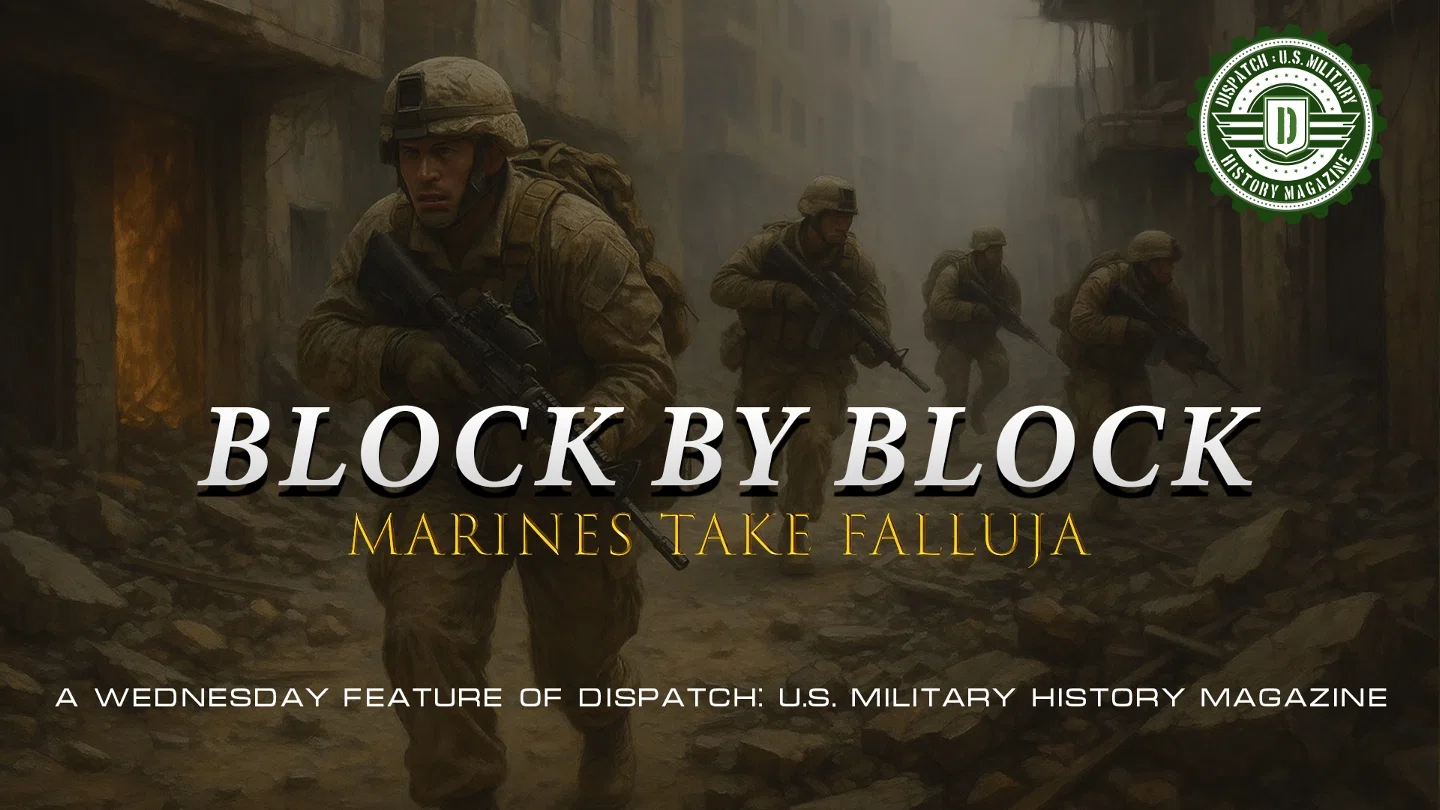
Night Crossing to a Walled City
It is a November night in 2004, and the streets of Fallujah are a dark grid of shuttered shops, walled courtyards, and low concrete homes. Outside the city, along roads and dusty lots on the edge of the Euphrates, Marines and soldiers move under blackout, checking weapons and radios in the dim red glow of filtered lights. Engines growl at idle as armored vehicles line up, their silhouettes hulking against the faint glow of distant fires and the pale wash of flares drifting over the city. Overhead, aircraft circle, the steady thrum and distant roar a reminder that this assault will not be fought by ground forces alone.
On the northern edge of the city, near the railway line and major avenues, assault battalions prepare to cross the berms and breach the outer defenses. Many of the men have been here before, in the first battle for Fallujah earlier that year, when the city became a symbol of resistance and unfinished business. They remember taking fire from alleys that looked just like this, and watching the fight end before the city was truly brought under control. This time, they are told, the mission is different. The goal is not a quick raid or a half-measure but a full return, neighborhood by neighborhood.
Inside the city, insurgent fighters wait in prepared positions, weapons stacked close at hand in houses, mosques, and fortified corners. Streets have been mined, sight lines have been chosen, and killing zones marked out in their minds. To the Marines and soldiers staring toward the dark skyline, Fallujah feels less like a place on a map and more like a single vast strongpoint. The moment when they step off the line and into those streets will begin one of the most intense urban battles of the Iraq War. It is the opening move in a story that will be measured not in sweeping movements on a campaign map but in houses cleared, blocks taken, and lives changed.
If Fallujah Stands, the Insurgency Grows
To understand why this night matters so much, you have to pull back from the edge of the city to see Iraq in late 2004. The United States-led coalition is locked in a grinding fight against a growing Sunni insurgency, and Fallujah has become its most notorious stronghold. After the first battle earlier that year ended with an uneasy compromise, insurgent leaders, foreign fighters, and bomb-makers flooded into the city. For months, Fallujah served as a hub for attacks that reached far beyond its walls, feeding violence along key highways and into Baghdad itself. Every patrol outside the wire felt the reach of those planners and bomb-makers sheltering inside the city.
Politically and militarily, leaving Fallujah in insurgent hands carried heavy costs. It undermined the credibility of the new Iraqi government and the coalition’s promises to restore security. It offered propaganda value to enemy networks that could point to a major city where they moved openly and imposed their own rules. Each week that passed without action allowed more weapons to be stockpiled, more roadside bombs to be assembled, and more fighters to be trained inside dense neighborhoods that would be costly to enter later. Fallujah was not just another point on the map; it was a symbol and a factory for the wider insurgency.
For the Marines and soldiers now tasked with returning to the city, the stakes reached far beyond their own units. If the operation failed, or if it stopped halfway again, insurgent networks would gain momentum and confidence. Attacks across Iraq could increase, coalition casualties could rise, and faith in the mission could erode in the ranks and at home. If the operation succeeded, it might cut a major artery of the insurgency, giving breathing room for Iraqi forces to grow and for other cities to stabilize. That is why the assault planning pulled together Marine regiments, Army battalions, Iraqi units, and a full array of air and armored support. The night on the edge of Fallujah was the threshold to a fight that would test urban warfare skills, joint cooperation, and political resolve all at once.
From Ambush Footage to Assault Orders
The return to Fallujah in November 2004 began months earlier with burning vehicles on a city street and four murdered American contractors. Images of their bodies hanging from a bridge over the Euphrates flashed around the world and became a rallying cry for action. In April, Marines pushed into the city in what became the first battle of Fallujah, but intense fighting, civilian casualties, and political pressure led to a halt and withdrawal. Control of the city was handed to a locally raised security force that quickly crumbled, leaving insurgent factions to carve up neighborhoods and dig in. By late summer, Fallujah was no longer just a trouble spot; it was an openly hostile enclave.
Inside the city, insurgent groups stockpiled weapons, prepared fortified houses, and built a network of lookouts and bomb-makers capable of striking well beyond the city limits. Outside, commanders watched the pattern of roadside bombs, ambushes, and suicide attacks linked back to Fallujah grow more deadly. With national elections looming and pressure mounting to show that the insurgency could be confronted, coalition leaders concluded that another attempt to contain the city from the outside would only prolong the fight. This time, they would bring armor, artillery, and airpower to support a deliberate, coordinated assault.
Planning for the second battle pulled in Marine regimental combat teams, United States Army mechanized battalions, and Iraqi units that needed both combat experience and a symbolic role in retaking an Iraqi city. Staff officers pored over aerial imagery, previous patrol reports, and the lessons of the first battle. They mapped neighborhoods into phase lines, assigned company-by-company objectives, and rehearsed combined arms tactics for dense urban streets. The resulting plan called for a classic envelopment: isolate the city, strike from the north, and grind southward through each block. On paper, the scheme promised control. In practice, everyone knew it meant close-range fighting in a place where every doorway could be a trap.
North to South, Block by Block
When the assault finally began, it opened with days of shaping fires that shook the outskirts of the city. Artillery, aircraft, and naval guns pounded known strongpoints, road intersections, and suspected weapons caches. Then, under cover of night, armored columns and infantry battalions crossed berms and obstacles on the northern edge, punching breaches through railroad embankments and walls. Marines advanced behind tanks and armored bulldozers, their boots crunching over shattered masonry as they moved into the first rows of buildings. Army units with Bradley fighting vehicles and tanks rolled in alongside them, providing heavy firepower to smash through fortified corners and enemy firing points.
At street level, the fight quickly became a pattern of house-by-house clearing that repeated all the way down the city’s spine. Marine rifle squads stacked on doorways, tossed grenades into courtyards, and moved through rooms thick with dust and broken plaster. Army crews scanned from turrets, watching side streets and rooftops for rocket flashes and muzzle bursts. Snipers on both sides hunted for each other across narrow lanes and open lots, turning windows and minarets into dueling positions. Insurgent fighters used their familiarity with the terrain, slipping through back alleys, popping up in unexpected angles, and using pre-sighted choke points to ambush advancing units.
Commanders tried to keep a clear picture of the battle by tracking progress along named phase lines tied to major streets and landmarks. Over the radio net, reports came in block by block: houses cleared, casualties taken, pockets of resistance bypassed or reduced. Air controllers worked to bring in precision strikes on stubborn strongpoints without collapsing entire neighborhoods. Meanwhile, engineers worked under fire to clear improvised explosive devices and punch new paths through walls so units could “mouse-hole” from building to building rather than walk exposed down streets. Each advance of a few hundred meters felt earned, and every turn into a new alley brought the possibility of another sudden, close-range engagement.
As the days went on, the assault pushed deeper toward the central districts, where insurgents had prepared multiple fallback lines. Urban terrain magnified every decision, from when to call for supporting fires to whether to push one more block before halting for the night. The men moving through the city could feel the resistance stiffening in certain sectors and thinning in others, a sign that the battle was entering a more dangerous, complex phase. Ahead lay dense clusters of safe houses, command posts, and last-ditch defensive positions where the outcome would be decided not by maps alone, but by small-unit decisions made in seconds under fire.
Encirclement, Exhaustion, and a Fading Defense
The battle for Fallujah did not turn on a single dramatic charge so much as on a series of grinding advantages that slowly stripped insurgent fighters of options. The first was isolation. Before the main assault crossed the berms, cordons and checkpoints had been tightened around the city, and most civilians had been encouraged or pressured to leave. That meant far fewer noncombatants on the streets and far less political pressure to halt operations once they started. It also meant that many of the men who stayed inside the city were committed fighters, dug into prepared positions but cut off from easy resupply or escape.
As Marine and Army units pushed south through the northern neighborhoods and into the city’s core, they steadily seized key intersections, mosques used as strongpoints, and clusters of buildings that served as command nodes. Each captured position did more than clear a block; it broke parts of the insurgents’ communication network and denied them vantage points they had counted on. Coordinated use of tanks, armored vehicles, and close air support allowed small units pinned by heavy fire to call in precise, overwhelming force. Over time, the defenders found that even well-prepared ambush sites could be dismantled by crews willing to stay in contact, adjust fires, and come back again and again until a position fell.
Another turning factor was adaptation at the small-unit level. Teams that had started the battle fighting room to room developed new ways to use engineers, snipers, and heavy weapons to reduce strongpoints without walking into every choke point the enemy had prepared. Leaders learned which patterns of streets and courtyard walls favored their own movements and which ones exposed them to fire from multiple angles. Iraqi units, though uneven in quality, also played a visible role in clearing certain sectors and searching buildings, signaling to Iraqis watching from a distance that this was not solely an outside force imposing its will. By the time insurgent leaders realized they could not hold the entire city, many of their best positions were gone, and the choice had shifted from fighting as organized units to surviving as scattered cells.
A City Taken, a War Still in Doubt
When major resistance finally cracked, the map of Fallujah looked less like a city reclaimed and more like a set of shattered districts. Streets that had echoed with gunfire and tank treads were lined with rubble, shattered walls, and burned-out vehicles. Marines, soldiers, and Iraqi troops continued to clear pockets of fighters, search for weapons caches, and mark buildings unsafe to enter. Casualty figures on both sides, along with the toll on whatever civilians remained, underscored the cost of fighting a modern urban battle at close range. For the units involved, the battle left a deep imprint: names of neighborhoods, intersections, and houses became as fixed in memory as any famous hill or ridge line from earlier wars.
At the campaign level, retaking Fallujah delivered what planners had hoped for in the short term. A major insurgent stronghold had been broken, many experienced fighters killed or dispersed, and bomb-making workshops and safe houses destroyed. For a time, attacks that had once traced back to the city dropped, and coalition commanders could point to Fallujah as proof that determined, coordinated action could reclaim even the hardest ground. Yet the wider insurgency did not disappear. It adjusted, spreading its networks into other cities and rural areas, proving that one hard-won urban victory could not, by itself, settle the question of Iraq’s future.
The legacy of the second battle of Fallujah reaches well beyond its immediate tactical results. For Marines, soldiers, and Iraqi forces, it became a case study in the realities of high-intensity urban warfare: the value of isolation and shaping fires, the brutal demands of block-by-block clearing, and the constant tension between speed and precision in a populated city. For military professionals and students of history, Fallujah offers lessons about planning, joint operations, and the limits of firepower when facing an enemy woven into civilian terrain. For veterans who fought there, the memory is more personal: names of friends, faces in the dust, and the knowledge that every block taken carried a cost that statistics can never fully capture. In that mix of hard-earned ground and unanswered questions sits the true weight of the battle, and the reason it still deserves a headline.