Dawn Over a Wide, Empty Ocean
Just after first light on 4 June 1942, the Pacific east of Midway Atoll looked strangely quiet. The sea rolled in long gray swells, broken only by the wakes of three American carriers and their escorts pushing through the morning haze. On the flight decks of Enterprise, Hornet, and Yorktown, deck crews in jerseys and float coats hurried between bomb-laden dive bombers and torpedo planes, waving chocks into place and checking tie-downs as engines coughed to life. The word had come in from Midway’s scout planes that an enemy force lay somewhere to the northwest, but no one on those decks had yet seen a single Japanese ship.
In the island combat information centers and flag plots, the picture was only a little clearer. Plotters slid colored markers across a big chart, trying to turn scattered reports and radio bearings into a coherent track of the Japanese advance. Rear Admiral Raymond Spruance watched that board and weighed each new fragment, knowing that somewhere beyond the horizon sailed the same carrier force that had smashed Pearl Harbor’s air power six months earlier. To the west, aboard the Japanese flagship Akagi, Admiral Chuichi Nagumo’s aircrews were recovering from the first strike on Midway’s airfields and preparing for whatever would come next.
Up above, American scout planes pushed outward in thin arcs, crews hunched over navigation boards, scanning the empty sea below. Each pilot knew that a single sighting could bring the whole weight of the United States carrier force crashing down on the enemy. Each also knew that if they failed, the enemy would soon bring its own air groups down on them. In this tense, uncertain dawn, the Battle of Midway balanced on a few lines of radio code and the fuel in a handful of search planes. The blaze that would later consume four Japanese carriers still lay in the future, hidden behind clouds, distance, and a race to find the other side first.
If Midway Falls, the Pacific Opens
To understand why that quiet dawn mattered so much, you have to pull back from the spray on those carrier decks and look at a wider map of the Pacific in mid 1942. The Japanese Empire had surged across Southeast Asia and the western Pacific in a few explosive months, seizing Hong Kong, the Philippines, Malaya, the Dutch East Indies, and a string of island bases. The United States Pacific Fleet, bloodied at Pearl Harbor and forced to retreat from the Philippines, was still rebuilding. Only its carriers and a patchwork of cruisers, destroyers, submarines, and shore bases stood between Japan and a deeper push toward Hawaii and the American west coast.
Midway Atoll, a small speck of coral northwest of Hawaii, suddenly became far more than a dot on the map. With its airstrips and seaplane base, it sat at the outer edge of the Hawaiian defense line. If Japan could seize or neutralize Midway, it could threaten Hawaii from closer range and perhaps draw what remained of the United States fleet into a crushing battle on Japanese terms. Japanese planners saw the operation as a way to finish what Pearl Harbor had started by destroying America’s carrier strength in one decisive stroke.
For the United States Navy, the stakes were just as stark. Lose the carriers at Midway and there would be no quick way to stop further Japanese advances across the Pacific. Hawaiian defenses would look fragile. Morale at home, already shaken by months of bad news, would take another hit. Victory, on the other hand, could blunt Japan’s momentum, protect the central Pacific, and buy time for American industry to turn its massive shipbuilding and aircraft production plans into real combat power. That is why Spruance’s carriers sailed from Pearl Harbor into a calculated ambush, hoping to reverse it and catch Nagumo off balance. The scene at dawn on 4 June was only the surface of a gamble that would decide who held the initiative in the Pacific war.
Codebreakers, Repair Crews, and a Waiting Trap
The road to that quiet June morning began months earlier in rooms far from the ocean, where United States Navy codebreakers pored over streams of Japanese radio traffic. Working from fragments and patterns, they became convinced that the next major Japanese move would be against a target labeled “A F.” To prove it, Midway’s garrison sent an uncoded report about a broken water distillation plant. Soon, intercepted Japanese messages mentioned water shortages at “A F,” confirming that Midway was the objective. That insight gave Admiral Chester Nimitz something Japan believed it still possessed: surprise. Instead of reacting blindly, he could place his carriers where they might ambush the incoming strike force.
There were still hard limits on what he could commit. The Pacific Fleet had only three operational carriers in reach: Enterprise, Hornet, and the battered Yorktown, which had just limped back from the Battle of the Coral Sea. Shipyard crews swarmed over Yorktown in a frantic repair effort, shoring up bulkheads, patching flight decks, and restoring enough machinery to send her back to sea in days rather than months. While welders worked below decks, staff officers worked through the night, planning to concentrate all three carriers northeast of Midway, hidden beyond the horizon where Japanese scouts were least likely to look.
On the other side of the ocean, Admiral Isoroku Yamamoto and his planners designed a more complex operation. A diversionary force would strike the Aleutian Islands to pull American attention north, while Nagumo’s carrier strike force approached Midway from the northwest. Behind them sailed battleships and heavy cruisers ready to finish any surviving American ships. Japanese doctrine still assumed that their carrier air groups and surface guns, used together, could force a decisive battle that would cripple the United States fleet. Crucially, they believed American carriers would arrive late, if at all. As both sides moved into place, Nimitz accepted that he was sailing into an enemy plan. His gamble was that, armed with foreknowledge from his codebreakers and the element of position, he could flip that plan on its head and turn Midway into an ambush instead.
Torpedoes, Smoke Trails, and Dive Bombers
On the morning of 4 June, the first blows at Midway did not come from the American carriers at all, but from the atoll itself. Japanese aircraft lifted off from Nagumo’s carriers in the pre-dawn darkness and struck Midway’s runways and fuel stores, cratered the coral, and set fires that sent dark smoke into the sky. Midway’s defenders, flying everything from Marine Corps fighters to torpedo bombers and Army heavy bombers, launched piecemeal attacks against the Japanese formation. They dove bravely into walls of anti-aircraft fire and swarms of nimble Japanese fighters, scoring little damage but forcing Nagumo to think about a second strike on the island. Reports from these attacks, combined with sightings from long-range patrol planes, confirmed for the Americans at sea that they had indeed found the main carrier force.
Out on Enterprise and Hornet, air groups launched in hurried waves, their squadrons fanning out into the vastness of the Pacific along planned search and attack tracks. Navigation errors, weather, and the sheer size of the search area scattered these groups. Torpedo squadrons from each carrier, flying slow, vulnerable aircraft, found the Japanese first. One after another, they pressed in at low altitude, straight and level, through fighter screens and concentric rings of gunfire. Squadron after squadron was cut to pieces. Torpedoes dropped too far out or failed in the water. Very few made it close to the Japanese hulls. The sacrifice was appalling, and for agonizing minutes it seemed to achieve nothing but losses.
Yet those doomed attacks dragged the Japanese combat air patrol down toward the wave tops and pulled their formation out of its neat patterns. While carrier decks below still bristled with fueled and armed aircraft being spotted and respotted for different missions, another group of American aircraft was closing in from higher altitude. Dive bombers from Enterprise and Yorktown, delayed and redirected by incomplete reports and last-minute course changes, finally spotted a cluster of wakes and dots on the horizon. Guided by a contact from a lone scout plane, they pushed in from the direction of the sun, lining up on what they now recognized as three Japanese carriers with decks crowded by aircraft and ordnance.
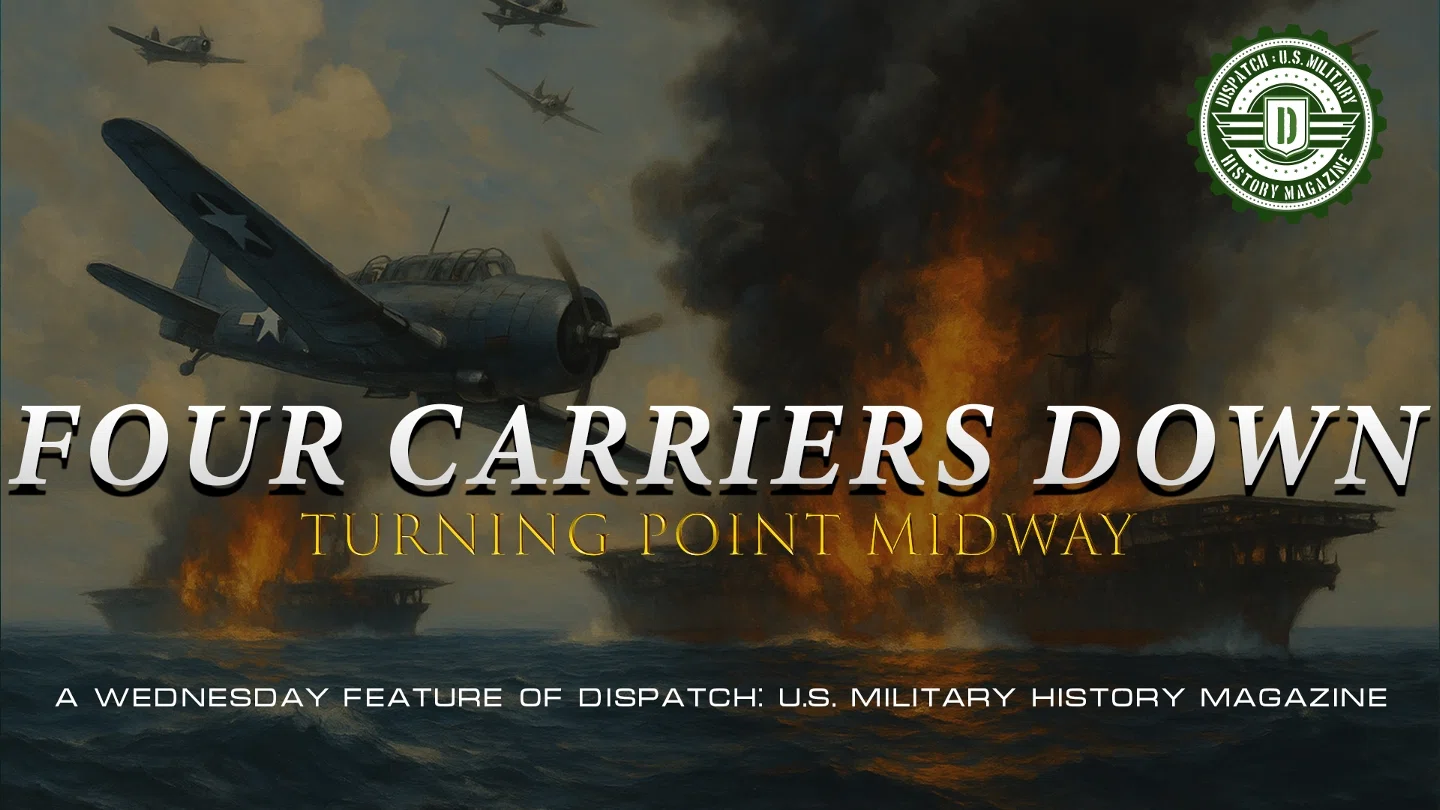
When the American dive bombers rolled over into their steep attacks, the Japanese fleet below was caught at an almost uniquely vulnerable moment. Fighters were low or out of position. Deck crews were in the middle of rearming and refueling planes for another strike. Bombs and torpedoes sat exposed on hangar decks. In a matter of minutes, well-placed bomb hits turned Akagi, Kaga, and Soryu into burning wrecks, their wooden flight decks shattered, hangars aflame, and damage control teams overwhelmed. Smoke rose in towering columns as explosions tore through their interiors. Only Hiryu remained operational, turning away to launch counterstrikes of her own. The battle that had begun as a carefully laid Japanese plan was now lurching into a new and far more desperate phase, with both sides reeling and the final outcome still undecided.
Three Carriers Lost in Minutes
For a brief stretch around midmorning on 4 June, the Pacific near Midway turned into a laboratory for how wars can pivot on timing and human decisions. When the American dive bombers peeled out of the sun and slammed their bombs into Akagi, Kaga, and Soryu, they did more than damage three hulls. They destroyed the heart of Japan’s experienced carrier striking force in a single, concentrated blow. Hangar decks packed with fueled aircraft and stacked ordnance became firetraps. Explosions rolled through compartments that had been carefully arranged for the next wave against Midway or the American fleet. Veteran pilots, irreplaceable deck crews, and the air groups that had led Japan’s early-war victories were suddenly gone or fighting for their lives on burning decks.
Yet the turn at Midway was not a simple, one-sided punch. Hiryu, the one surviving Japanese carrier still able to operate aircraft, launched furious counterattacks. Her dive bombers and torpedo planes found Yorktown and hit her hard, punching holes in the flight deck, starting fires, and temporarily stopping the carrier dead in the water. American damage-control teams fought back with hoses, shoring timbers, and ingenuity, bringing Yorktown back to life long enough to keep her in the fight and confuse Japanese aviators into thinking they had struck two separate carriers instead of one that had been partly restored. Their work, measured in minutes and degrees of list, bought time for American scouts to locate Hiryu.
American commanders pushed their remaining dive bombers toward this last threat as the day wore on. When they finally found Hiryu, she too was in the midst of turning aircraft around for another strike. Bomb hits shattered her flight deck and set off fires that raged out of control. By day’s end, all four Japanese carriers committed to the operation were burning or sinking. The United States had lost Yorktown and many brave aircrews, especially in the torpedo squadrons, but its remaining carriers and Midway itself still stood. What turned Midway was not a single bomb or torpedo. It was the combination of codebreakers’ warnings, a rushed repair job on Yorktown, the sacrifice of torpedo squadrons drawing defenses low, the timing of the dive bombers’ arrival, and Japanese indecision about how to arm their planes. Shift any of those elements by an hour or a few miles, and the day might have ended very differently.
From One Day’s Battle to a Long War
When the sun went down on 4 June and over the next days as crippled ships were abandoned or sunk, the immediate scoreboard at Midway was stark. Japan had lost four frontline fleet carriers and many of the skilled aviators who had led its early campaigns. The United States had lost Yorktown and one destroyer, along with heavy losses among its carrier air groups and Midway’s defending squadrons. On paper, the Japanese fleet still possessed powerful battleships and other carriers. In practice, the carefully trained carrier arm that had been built over many years had suffered a blow it could never fully repair. Carrier hulls could be laid down again in shipyards, but the veteran air groups lost at Midway were gone for good.
Strategically, this meant that Japan would struggle to mount another deep, offensive carrier thrust into the central Pacific on the scale of Pearl Harbor or the early raids. The initiative began to shift. In the months that followed, the United States moved to contest the Solomon Islands and New Guinea, landing Marines on Guadalcanal and sparking a grinding series of sea and air battles. Those campaigns were hard and costly, but they unfolded in a Pacific where Japan no longer enjoyed an overwhelming carrier advantage. Midway did not end the war in the Pacific. It did change the direction of the tide, turning a seemingly unstoppable advance into a contest where American industry, logistics, and growing experience could start to tell.
For today’s readers and listeners, Midway still matters because it shows how intelligence, preparation, and the willingness to take calculated risks can reshape a conflict. It underscores the importance of repair crews as much as pilots, of codebreakers as much as admirals, and of small-unit courage in the face of almost certain loss. Staff rides, wargames, and studies of carrier warfare return again and again to this battle because it captures the shift from battleship-centered fleets to airpower at sea, and the thin line between disaster and opportunity. When you look at photos of Midway’s coral runways or the scarred flight decks of Enterprise and Hornet, you are seeing the places where a single day’s choices changed the Pacific war’s trajectory and, with it, the shape of the postwar world.