In Action
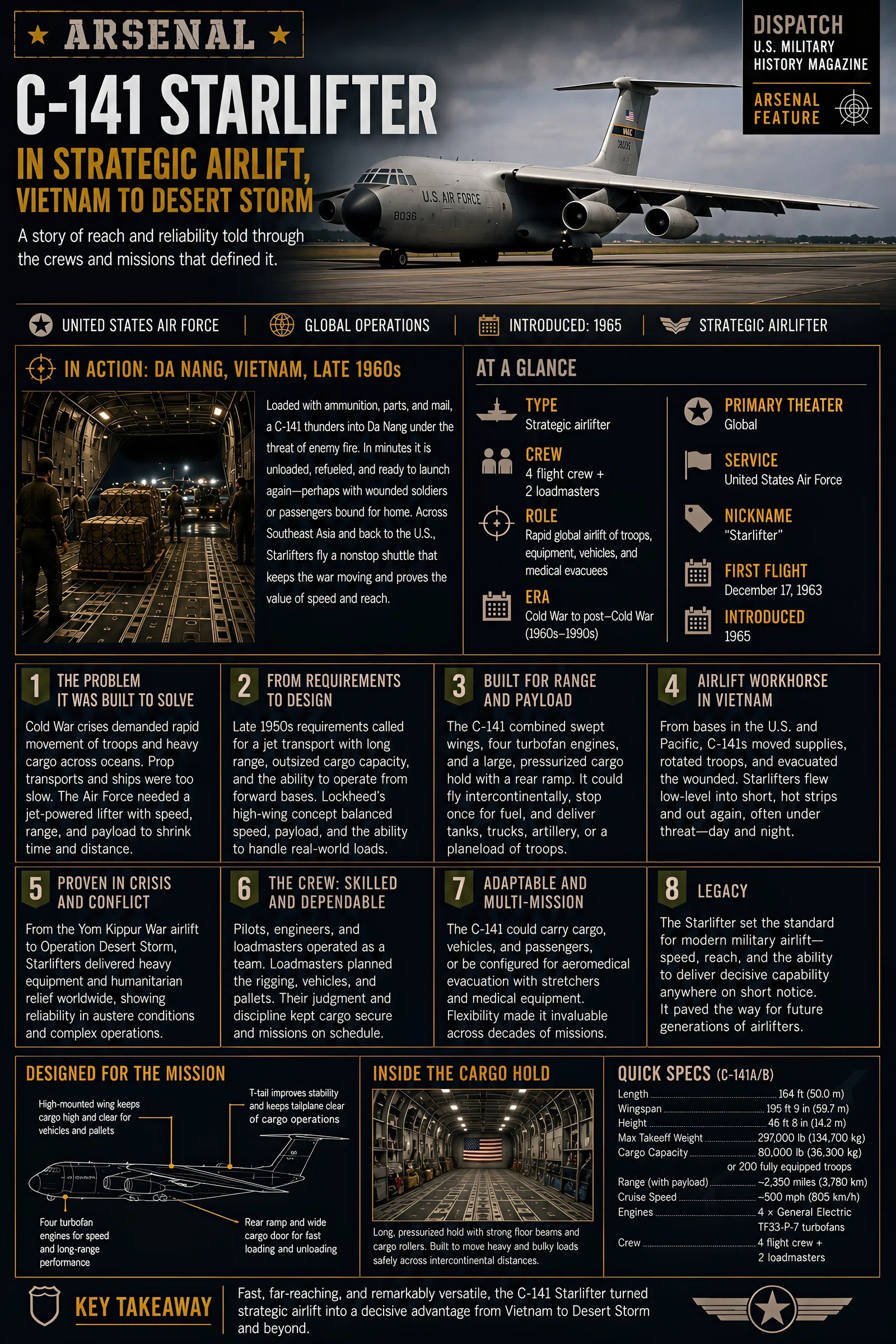
The lights over the cargo bay dim to red as the coastline of South Vietnam slides under the nose. It is the late 1960s, and a C-141 Starlifter is dropping toward Da Nang, heavy with pallets of ammunition, repair parts, and mail. The air outside is hot and hazy, but inside the long, pressurized tube the air is cool and smells faintly of hydraulic fluid, jet exhaust, and canvas webbing. Loadmasters stride down the center aisle, double-checking tie-down chains and cargo locks, making sure nothing will shift when the wheels slam onto the runway.
Up front, the crew rides a steep descent, lined up on a strip that has taken its share of mortars and rockets. The pilot works the throttles, feeling the slight lag of the four turbofan engines as he calls out airspeeds. Beside him, the copilot watches instruments while the flight engineer keeps an eye on fuel, temperatures, and the pressurization system. The radio crackles with terse warnings about possible incoming fire and the need to clear the runway quickly.
Moments after touchdown, the big transport turns off and rumbles toward a hastily lit ramp. The rear cargo door yawns open and the ramp lowers, heat and dust blasting up into the bay. Forklifts and ground crews rush forward. Within minutes, the C-141 will be unloaded, refueled, and ready to lift out again, perhaps this time carrying wounded soldiers or passengers bound for home. For the Starlifter’s crews, this is just one hop in a constant shuttle of people and materiel that stretches from Southeast Asia back to the continental United States. The speed and rhythm of that shuttle are exactly why the Starlifter exists at all.
The Problem It Was Built To Solve
A generation earlier, in the years after the Korean War, the United States Air Force learned the hard way what slow airlift meant. Moving divisions, ammunition, and support equipment across oceans on propeller-driven transports and cargo ships took weeks. Jet fighters and bombers could cross continents in hours, but their logistics tail crawled behind at a fraction of that speed. In a Cold War that could flare into crisis with little warning, that gap was dangerous.
The Air Force needed a machine that could shrink the globe for heavy cargo the way jet bombers had done for weapons. It had to carry outsized loads, troops, and medical evacuees thousands of miles at jet speeds, then land on runways at forward bases that were far from ideal. It needed to be pressurized and comfortable enough for passengers and casualties, yet rugged enough to operate from hot, dusty airfields and icy northern bases alike. Existing transports, descendants of World War II designs, lacked the combination of speed, range, and payload that new commitments demanded.
The emergence of global alliances and nuclear deterrence added more pressure. Units had to be ready to reinforce Europe, respond to crises in Asia, or support interventions and humanitarian operations in remote regions, all on short notice. Sealift remained essential, but it could not handle urgent, high-value loads or rapid movements of key personnel. Commanders imagined a jet-powered cargo aircraft that could launch from the United States, stop once for fuel, and deliver a battalion’s worth of equipment or a planeload of wounded to another continent without days lost in transit.
Out of those requirements came the push for a new strategic airlifter, one that would leap beyond piston engines and World War II-era thinking. The decision to develop what became the C-141 Starlifter was not about luxury or convenience. It was about compressing distance and time so that political decisions and operational plans would no longer be held hostage by the slow pace of older transports.
From Design Board To Production
The Starlifter began as a Cold War requirement written in careful Air Force language but driven by a simple fear: being too slow to matter. In the late nineteen fifties and early nineteen sixties, planners issued demands for a new jet-powered transport that could move heavy cargo quickly across intercontinental distances. Several major aircraft companies studied the problem, but it was Lockheed that proposed a high-wing, rear-loading jet transport tailored to the long, thin routes of global airlift. The concept promised airliner-like speed combined with the ability to carry outsized loads into military bases rather than civil hubs.
Engineers wrestled with tradeoffs from the start. A high wing gave excellent ground clearance and space for a large cargo door and ramp, but it pushed the structure higher off the ground and demanded a tall landing gear. Swept wings and slim, efficient turbofan engines offered speed and fuel economy, yet they pushed the aircraft toward longer runway requirements and higher approach speeds. A T-tail configuration kept the tailplane above the turbulent cargo door area, aiding stability during loading and low-speed flight, but it introduced its own structural challenges. Throughout these debates, the Air Force insisted on pressurization, long range with reasonable fuel stops, and a cargo hold sized around real pallets and vehicles rather than abstract dimensions.
At a glance, the C-141 Starlifter was a four-engine jet transport built in the United States for the United States Air Force, serving mainly under the Military Airlift Command in the Cold War era. It was a strategic airlifter with a typical front-end crew of four and two loadmasters in the cargo compartment, designed to carry troops, medical evacuees, or bulky cargo at jet cruising speeds over ocean-spanning routes. Its payload, range, and speed combined to make it a bridge between older propeller transports and the even larger jet lifters that followed.
Prototypes took to the air in the early nineteen sixties, and the design moved rapidly from initial flight tests into full-rate production. Early models established the basic form: a relatively slender fuselage, powerful turbofan engines under the wings, and a rear ramp that made loading direct from trucks and forklifts straightforward. As the fleet accumulated hours, lessons from real missions fed back into upgrades, including a lengthened fuselage and improved systems to increase payload and flexibility. By the time the Starlifter settled into full operational service, it was already shaping how American leaders thought about time, distance, and the practical reach of their commitments.
Inside The Weapon
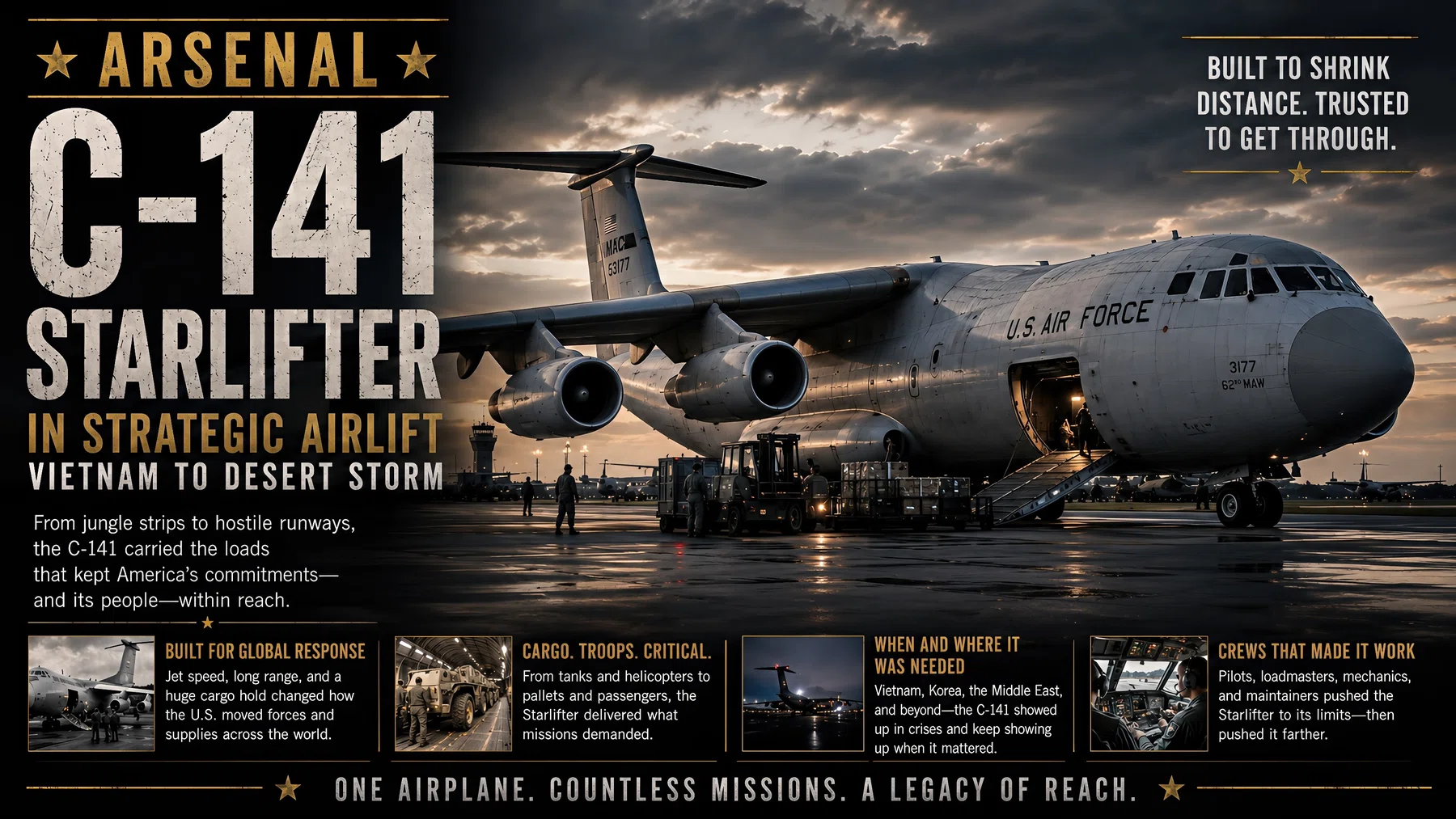
From the outside, a Starlifter on the ramp looked like a jetliner that had been reworked by and for the military. The long, cylindrical fuselage sat high above the ground on sturdy landing gear, its high-mounted wings stretching out with a distinct sweep. Four engines hung beneath the wings, giving the aircraft a purposeful stance that suggested both speed and strength. At the rear, the tall T-tail stood over a wide cargo door and ramp, a clear sign that this aircraft was designed first for loading and unloading, and only second for appearances. A walk around the outside took a crew chief past inspection panels, refueling points, and tire stacks that hinted at the weight and stresses the structure carried on each mission.
Climb the ladder to the forward left door and you entered a world that mixed airliner comforts with military practicality. Just aft of the door, the flight deck sat higher than the cargo floor, with seats for the aircraft commander, copilot, flight engineer, and navigator. The cockpit bristled with analog gauges in the early years, later supplemented by more modern equipment, but always arranged so that the crew could divide tasks logically. The pilot and copilot focused on flying, the flight engineer watched engines and systems, and the navigator managed the route, timing, and fuel planning. Intercom headsets and radios kept the crew tied together as they coordinated with air traffic control, other aircraft, and ground units waiting at the destination.
Step back down onto the main deck and you found the real reason the C-141 existed: the cargo bay. It was a long, cavernous space with a flat floor, tie-down rings, and roller tracks designed to accept standard pallets. Folding web seats along the sides could be rigged for troops, paratroopers, or medical litter patients, depending on the mission. Loadmasters moved through this space like stage managers, directing forklifts and ground crews, checking that every chain and strap was secure, and calculating how weight and balance would affect takeoff and landing. Their workflow had to be both meticulous and fast, because on many missions the aircraft was expected to land, unload, and launch again in a narrow window.
Hidden behind the panels and under the floor were the systems that made the Starlifter more than just a flying warehouse. Hydraulic lines powered landing gear, flaps, and cargo doors; electrical systems fed lights, instruments, and radios; fuel ran in carefully managed tanks inside the wings and fuselage. Pressurization and environmental controls kept the cargo compartment and cockpit at comfortable conditions even as the aircraft cruised high above bad weather. Navigation and weather radar helped crews pick their way through storms and along long routes over water or featureless terrain. To the people on board, all of these systems blended into the background hum of fans, pumps, and blowers that formed the soundtrack of long flights.
Life inside the Starlifter on a long haul was a mix of work and cramped routine. Troops tried to sleep sitting upright on webbing seats, helmets hanging from their knees, while the constant vibration of the airframe and the whine of engines filled the background. Loadmasters walked the cargo bay with flashlights during night flights, checking lashings and listening for odd rattles. Near the front of the cargo deck, modest crew rest spaces and a small galley allowed flight crews to rotate off the controls, grab food, and stretch before returning to duty. Toilets and basic washing facilities were simple but functional, reflecting an aircraft designed for duty rather than comfort.
Training flights showed the aircraft at its neatest, with loads carefully planned and plenty of time to practice procedures. In combat zones and during urgent humanitarian missions, reality was messier. Cargo bays filled with a jumble of vehicles, pallets, and medical equipment, all crammed in to make the most of every cubic foot. Takeoffs from hot, dusty runways demanded careful performance calculations, and landings at unfamiliar fields kept the cockpit crew alert for every bump and sway. For those who served inside it, the C-141 was not an abstract “system,” but a noisy, dependable workplace that carried them into and out of some of the most intense moments of their careers.
Baptism Of Fire
The Starlifter’s baptism of fire did not look like a single dramatic dogfight or armored charge. It looked like a relentless procession of landings and takeoffs into a war that needed everything, all at once. In Vietnam, C-141s became part of the background rhythm of the conflict, shuttling between bases in the continental United States, Pacific staging fields, and airstrips in South Vietnam. A typical mission might begin in the cool darkness before dawn, with crews loading pallets of ammunition, aircraft parts, and medical supplies under floodlights. Hours later, the same aircraft would be descending toward a hazy, hot runway ringed by hills and dotted with revetments, its approach path under watch for possible enemy fire.
In this environment, the aircraft’s speed and pressurized comfort mattered as much as its raw lifting power. Wounded soldiers could be stabilized aboard and flown far from the front in a fraction of the time older transports required, turning the C-141 into a flying lifeline as much as a cargo hauler. Returning flights often carried troops rotating home, their helmets tucked under their arms as they climbed the ramp for a quiet, reflective ride away from the war zone. Other missions brought prisoners of war back to the United States, with the long cargo bay fitted out with seating and medical stations for men who had endured years in captivity. The aircraft’s long, uninterrupted cabin allowed crews to configure it quickly for these changing roles, moving from freight to medevac to passenger layout as operations demanded.
Beyond Vietnam, the Starlifter’s first decades were marked by a series of demanding tests that confirmed its strategic value. It supported contingency operations, rapid deployments, and humanitarian flights in regions as varied as the Middle East, Africa, and the Caribbean. Each time, the pattern repeated: a crisis flared, planners needed rapid movement of people and equipment, and the C-141 fleet became one of the first tools they reached for. These early campaigns proved that the idea behind the aircraft worked in practice. It could bridge oceans, deliver meaningful loads, and turn isolated airfields into nodes in a global network of support. That experience would shape both how the aircraft was used and how it would need to evolve to stay effective.
Strengths And Weaknesses
Crews and commanders learned quickly what the Starlifter did best. They valued its speed, which allowed cargo and passengers to move between continents in the same general time frame as modern airliners. Its pressurized, climate-controlled cabin made long flights more bearable for troops and patients, and its rear ramp turned loading into a straightforward process. The high-wing design gave good clearance for vehicles and equipment moving under the fuselage, while the four turbofan engines, when handled carefully, offered a blend of performance and fuel economy that fit the demands of sustained global operations. For aircrews used to older piston transports, the step into a jet-powered airlifter felt like entering a new era of reach and responsiveness.
The aircraft also earned a reputation for reliability and predictability, traits prized in a machine that formed part of a carefully timed chain of missions. Maintainability improved over the years as crews learned the quirks of its systems and parts supply matured. On long flights, the combination of a stable platform, decent crew rest provisions, and robust systems made it a relatively humane workplace for those who spent much of their careers in the air. From the perspective of planners, the ability to count on C-141s to show up more or less on schedule and carry the loads promised gave them confidence when building complex deployment plans.
At the same time, real limitations became clear. The fuselage cross-section, while generous by the standards of earlier transports, was not large enough to accommodate the very biggest vehicles or outsized cargo that later designs could handle. Some loads simply would not fit through the door or inside the cabin, no matter how carefully they were measured. Runway requirements, though reasonable for major bases, still limited operations from shorter or rougher strips where tactical transports excelled. In hot, high-altitude environments, performance margins narrowed and weight had to be managed carefully, forcing tradeoffs between payload and fuel. Over decades of service, structural fatigue and age-related issues had to be addressed through inspections, repairs, and, eventually, life-extension programs.
From the enemy’s perspective, the C-141 was not a target to duel with in the classic sense, but rather a vulnerable lifeline on which American and allied forces depended. Attacks on airfields, harassment of flight paths, and efforts to disrupt logistics chains all aimed indirectly at the flows of cargo and people that the Starlifter helped sustain. This meant that, in practice, the aircraft’s most important strength was less dramatic than any single performance figure. It was the ability to keep flying, day after day, in spite of threats, long distances, and heavy workload, until its crews and maintainers had worn grooves in the sky along the world’s strategic airlift routes.
Variants And Evolution
As operations multiplied and demands grew, the basic Starlifter design began to show where it could be improved. One of the most visible changes came in the form of a fuselage stretch, which lengthened the aircraft to increase its internal volume. This allowed each mission to carry more pallets, more passengers, or more medical litters, making better use of the aircraft’s engines and wings. The stretch also reflected a simple reality: the original assumptions about load sizes and frequency had been conservative compared to the needs that emerged during real-world operations.
Alongside the stretch, structural and systems upgrades addressed issues uncovered in service. Strengthening key areas of the airframe helped manage fatigue from repeated pressurization cycles and heavy landings, and avionics improvements brought navigation and communication capabilities more in line with evolving standards. Some aircraft received provisions for aerial refueling, further extending their practical reach by allowing them to top up in flight rather than relying entirely on ground stops. For aircrews, these changes altered the feel of missions in subtle ways, smoothing navigation tasks, expanding routing options, and giving planners more flexibility when drawing up complex movement schedules.
Not every idea became a large-scale variant, but experimentation continued throughout the aircraft’s career. Some Starlifters served in specialized roles, supporting test programs or acting as platforms for evaluating new equipment and procedures. The core fleet remained focused on strategic airlift, yet these side projects helped inform later designs and doctrine. Unlike some other famous aircraft, the Starlifter did not spawn a wide family of export or heavily modified derivatives; its story was tightly bound to the needs and resources of the United States Air Force. Still, the path from early models to later, stretched and upgraded versions showed how an aircraft could adapt to changing requirements while preserving its original purpose.
By the time larger transports and newer designs arrived to share the workload, the C-141 family had matured into a well-understood, heavily used tool. Its evolution was not flashy, but it was steady, guided by feedback from the crews and maintainers who lived with the aircraft every day. Those incremental changes, more than any single dramatic variant, kept the Starlifter relevant from Vietnam through the end of the Cold War and into the era of Desert Shield and Desert Storm.
Legacy And Where To See It Today
The legacy of the Starlifter lies in how it reshaped expectations about what strategic airlift could do. Before it, the idea of moving meaningful quantities of cargo and large numbers of personnel between continents at jet speeds was still emerging. After decades of C-141 operations, planners and commanders treated that capability as normal, building strategies and commitments around the assumption that forces and supplies could be flown quickly across oceans. The aircraft served as a bridge between the piston-era transports of the early Cold War and the larger, more capable jet lifters that followed, influencing how those later designs balanced range, payload, and flexibility.
In combat operations, humanitarian missions, and peacetime deployments, the Starlifter helped define the tempo of American and allied responses. It delivered troops and equipment for conflicts from Southeast Asia to the Persian Gulf, and it carried food, medicine, and relief supplies to disaster zones around the world. The aircraft also served as a symbol of homecoming, bringing wounded personnel and former prisoners of war back to their families, and later carrying service members to and from deployments in the Middle East. Its long career meant that several generations of aircrew, maintainers, and passengers formed their impressions of strategic airlift while walking up its ramp or strapping into its web seats.
Today, retired C-141s stand at aviation museums and air parks, their ramps lowered and cargo bays open for visitors to explore. At places where airlift history is preserved, the Starlifter often appears alongside earlier and later transports, allowing visitors to trace the evolution of the mission in metal and rivets. Some are displayed at former bases where they once operated, serving as gate guards or static displays that greet those arriving on the ground. For readers and viewers, collections of photographs and videos, including those highlighted through Trackpads and Dispatch features, help bring the aircraft’s story to life beyond the fence line.
The Starlifter’s influence also lingers in doctrine and training, where its example helped cement the idea that rapid, reliable long-range airlift is not a luxury but a core component of modern military power and humanitarian reach. In that sense, its true cargo was not only pallets and passengers but a new way of thinking about time, distance, and responsibility. You can also hear narrated versions of Arsenal features as part of the Trackpads podcast feeds and Dispatch audio editions. Behind every C-141 on the ramp were crews, passengers, and those waiting at the other end of the flight, whose lives were shaped by what this aircraft could carry and how far it could go.