In Action
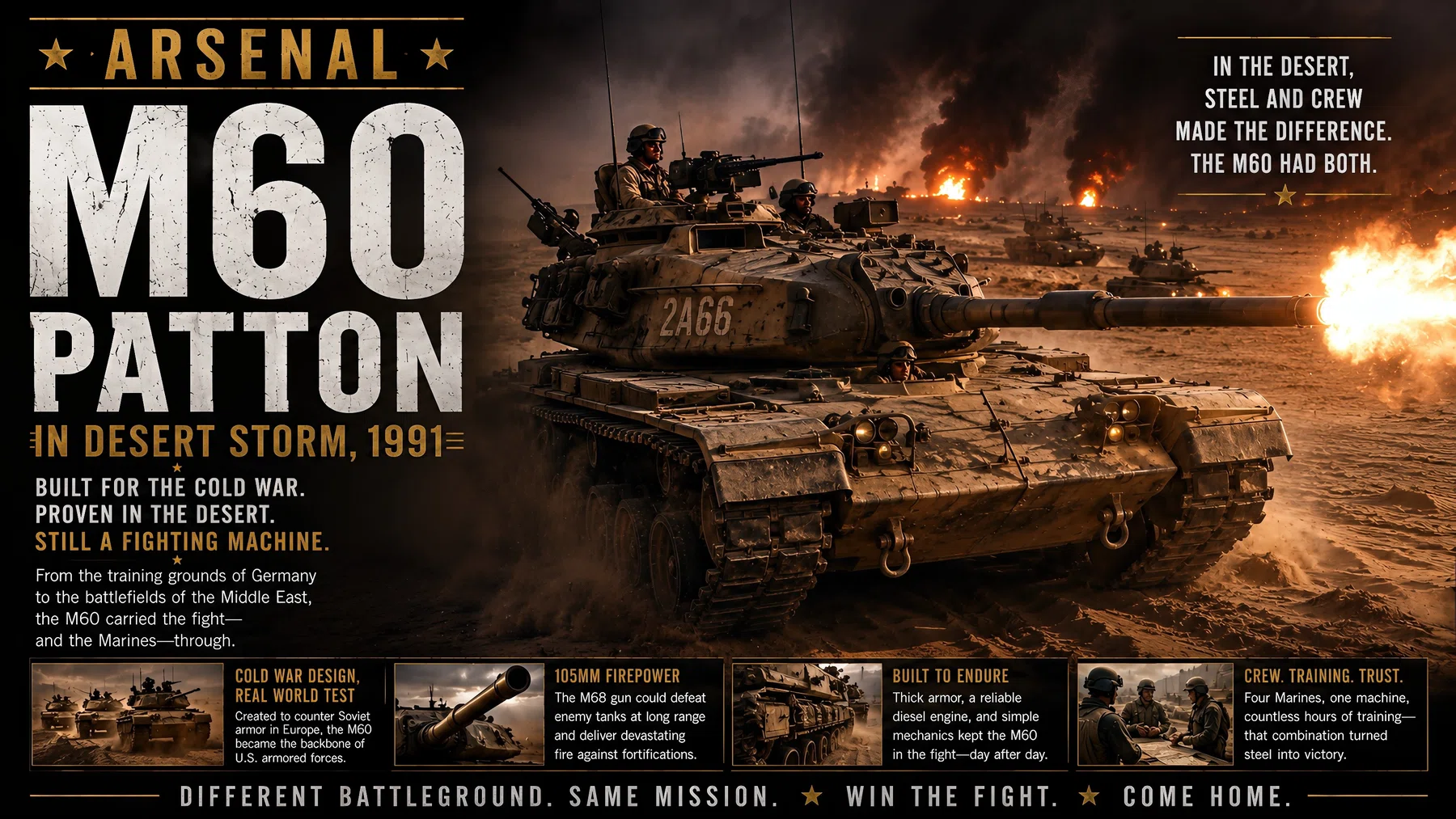
The desert night is lit by distant orange flickers from burning oil wells as a line of M60 Patton tanks waits on the Saudi–Kuwaiti border. Inside one Marine Corps tank, four men work in cramped silence, headsets hissing with radio traffic, the hull vibrating gently under the idling diesel. The gunner peers through his sight, turning handwheels in tiny, practiced movements, tracking a point of darkness where the battalion expects Iraqi positions to be. The commander stands half-crouched under his cupola, one hand on the turret controls, the other gripping a grease pencil and a map that already feels outdated.
When the order comes, the column surges forward. Sand whips past the periscopes as the driver steers by compass and faint markers, plunging toward a belt of trenches, mines, and bunkers laid out to stop exactly this kind of armored thrust. Ahead, the engineers have punched a breach, but everyone in the crew knows nothing about the next few minutes is guaranteed. Iraqi tanks and anti-tank gunners are somewhere beyond the berm, waiting in dug-in positions, confident the desert and fortifications will do half their work.
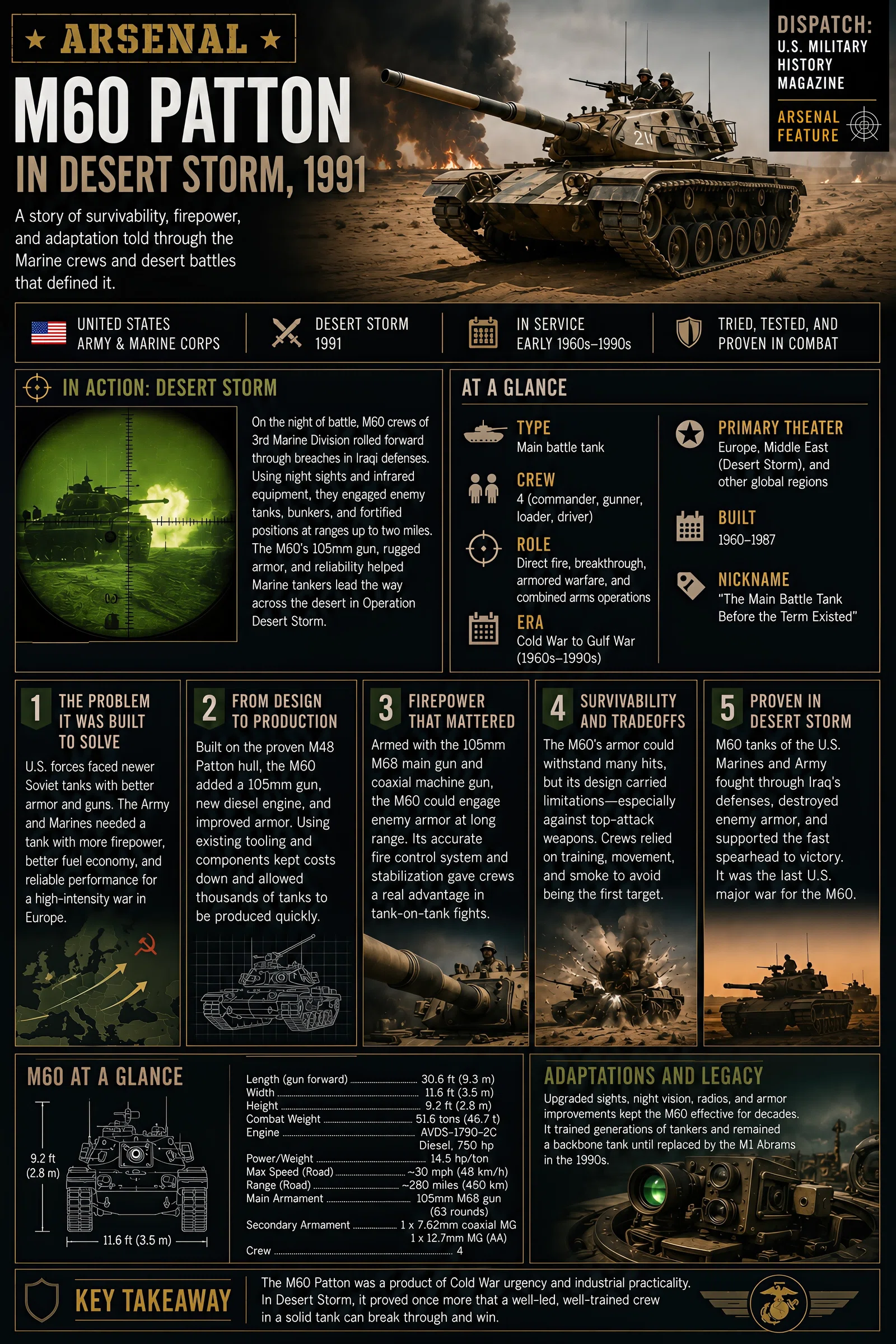
The loader braces as the first target call comes over the intercom, ramming a 105-millimeter round into the breech, slamming the heavy steel block shut by instinct. The gunner settles the reticle, the commander calls “on the way,” and the M60’s main gun hammers, filling the fighting compartment with sound, dust, and the sharp tang of propellant. Through the optics they see a distant shape bloom into sparks and smoke. It is one engagement in a campaign that will mark the M60’s last major war in United States service, and the culmination of decades of design choices aimed at solving a very specific Cold War problem.
The Problem It Was Built To Solve
The M60 did not begin its life in a desert of burning oil and dug-in bunkers. It was born in the anxious years of the late 1950s, when planners in the United States Army and Marine Corps expected the next big war to break out on the plains of Europe. Across the inner-German border, the Soviet Union and its allies were fielding newer generations of tanks with low silhouettes, sloped armor, and guns capable of killing American armor at long range. The existing Patton series, especially the M48, had been a step forward from World War Two designs, but it was clear that more range, more punch, and better fuel economy were needed if American armored units were to survive and fight through sustained battles on a nuclear-shadowed battlefield.
The problem was not just raw firepower. NATO doctrine envisioned outnumbered Western forces trying to delay or blunt massed waves of Warsaw Pact armor. Tanks would have to move quickly between firing positions, operate in all weather and light conditions, and keep running for days on end without constant refueling or major maintenance. At the same time, the United States needed a design that could be built in large numbers without crippling the defense budget, and that could be upgraded as new ammunition, sights, and protection schemes emerged.
Engineers were therefore asked to produce a main battle tank that combined a powerful new gun, better armor, and a fuel-efficient diesel engine, while still fitting within the practical limits of existing transport, bridges, and factories. The result would be the M60: the next step in the Patton line, intended to give American and allied crews a fighting chance against the best Soviet designs of the day. That decision, made in the tense calm of the Cold War, would eventually carry the M60 from European exercises to the deserts of the Middle East, where its strengths and compromises would be tested under real fire.
From Design Board To Production
The M60’s path from sketchpad to motor pool began not with a blank sheet of paper, but with a hard look at the existing M48 Patton. Designers knew that the basic layout worked: a four-man crew in a rear-mounted turret, a powerful gun, and a low enough profile to survive on a modern battlefield. What had to change was the punch of the main armament, the staying power of the powerplant, and the ability to accept new fire-control technology as it matured. The British had already shown the potential of the 105-millimeter L7 gun, and American planners wanted that level of long-range armor penetration on their own tanks. At the same time, the days of thirsty gasoline engines in front-line tanks were numbered.
Engineers and ordnance officers converged on an evolutionary approach. The new tank would use improved armor shaping and thickness, a more efficient diesel engine, and a locally produced version of the 105-millimeter gun, all while staying within the weight and size limits imposed by bridges, transporters, and ship holds. Budget concerns pushed them toward reusing as much existing industrial tooling as possible, rather than risking an entirely new and unproven configuration. Over successive refinements, the turret lines sharpened, the hull nose reshaped, and the internal arrangements tweaked to fit new ammunition stowage and optics.
At a glance, the M60 was a United States main battle tank, serving primarily with the Army and the Marine Corps from the early 1960s through the 1990s. It carried a crew of four, mounted a 105-millimeter M68 main gun with a coaxial machine gun, and could reach road speeds around thirty miles per hour with its diesel engine. Its range and fuel efficiency outclassed earlier Pattons, giving commanders more freedom to move and fight without constant refueling. Thousands would roll out of American factories, equipping United States armored units in Europe and elsewhere, and later being exported to allies across the Middle East, Mediterranean, and beyond. The basic design, solid if not revolutionary, was built with an eye toward upgrades that would arrive in later variants.
Inside The Weapon
From the outside, the M60 looked every bit the classic Cold War tank: a broad, sloped glacis plate, a tall but compact turret set back on the hull, and wide tracks wrapped around road wheels on torsion-bar suspension. The commander’s cupola, especially on earlier models, gave the tank a distinctive profile, with its own small machine gun and a ring of vision blocks. To a crewman walking up to it on a cold motor pool morning, the tank was a mass of steel and cast forms streaked with oil, dust, and the marks of field maintenance. Climbing onto the hull meant using grab handles, stowage racks, and whatever footholds experience had taught them to trust.
Inside, the layout was familiar to anyone trained on Western tanks of the era but still tight and unforgiving. The driver lay reclined in the front of the hull, feet to pedals, hands on tillers, looking out through periscopes that turned darkness, rain, or dust into a narrow tunnel of visibility. Behind him, under the turret, ammunition filled racks and wet stowage compartments, each shell heavy enough to remind the loader of the job’s physical demands. The turret itself housed the other three crew members: gunner on the right, loader on the left, commander perched above and behind the gunner with his own sighting and observation gear.
The gunner’s world centered on the main sight, rangefinding equipment, and turret controls. Over the years, simple optical systems gave way to more advanced rangefinders and thermal viewers, turning night or smoke into something the M60 could see through more effectively. The loader’s space was a narrow lane of motion, balancing speed with safety as he pulled rounds from racks, oriented them correctly, and slammed them into the open breech in rhythm with the commander’s fire orders. Above them, the commander scanned through his cupola, juggling radios, situational awareness, and target priorities. His view might be better, but he also bore the weight of decisions that could keep the crew alive or expose them to return fire.
The diesel engine in the rear filled the entire hull with vibration and a constant background roar when the tank was moving. Heat built up quickly, especially in hot climates, and noise made shouted words useless, forcing crews to rely on intercom systems and hand signals. Training ranges taught them how the tank should behave: how many seconds to reach a certain speed, how sharply it could pivot, how quickly the gun could settle on target after a short halt. In combat, crews discovered the gap between those expectations and reality. Mud, sand, and broken ground could sap speed and strain the drivetrain, while the stress of enemy fire turned routine drills into frantic, sweaty bursts of action. Yet many veterans came to trust the M60 as a known quantity: a machine with quirks and limitations, but one that would generally do what it was supposed to do if they treated it right and stayed within the envelope they had learned over long days in the field.
Baptism Of Fire
When the ground offensive of Operation Desert Storm finally began in February 1991, the M60’s long Cold War apprenticeship gave way to a brief, violent test under fire. Along the Saudi–Kuwaiti border, Marine tank battalions lined up in the darkness, their M60A1s shrouded in camouflage netting and dust, explosive reactive armor blocks bolted over the hull and turret. For months the Iraqis had watched coalition air strikes hammer their positions, but they still relied on belts of trenches, minefields, and dug-in tanks to break any armored thrust. The M60s would be among the first American tanks to drive straight into those defenses.
As Marine engineers blew lanes through the obstacles, M60s roared forward, following plumes of dust and the faint glow of chemical lights marking safe paths. The battalion advances were less about elegant maneuver and more about relentless pressure, rolling through prepared positions before defenders could recover from the shock of the breach. Iraqi T-55s and T-62s, and in some places newer Soviet-inspired designs, waited in revetments and hull-down scrapes, but they found themselves outranged and outmatched by well-trained gunners with good optics and decades of gunnery doctrine behind them. In many duels, the M60 crews saw their opponents first and fired first, a key advantage on a flat desert battlefield where silhouettes and thermal signatures stood out against the sand.
The same features that had been designed for Europe now paid off in the Gulf. The 105-millimeter gun could defeat the armor on most Iraqi tanks at typical engagement ranges, and the diesel engine gave the tanks enough endurance to keep pace with the rapid tempo of the offensive. Communication drills practiced in Germany and stateside ranges helped commanders coordinate fire, avoid fratricide, and keep the attack moving even in swirling smoke and dust. Yet the fighting was not one-sided. Mines disabled tracks, anti-tank weapons punished careless exposure, and the ever-present danger of misidentifying targets in poor visibility weighed on every commander’s mind.
By the time the ceasefire took hold, Marine M60 units had helped punch open the road to Kuwait City, destroying large numbers of Iraqi armored vehicles and strongpoints with surprisingly light losses of their own. For the United States, it was both a vindication of the M60’s underlying design and a sign that its time as a front-line tank was ending. Newer Abrams tanks had borne the brunt of the army’s deep armored thrusts, and everyone could see that digital fire control, heavier armor, and gas-turbine power represented the future. The M60’s baptism of fire in United States hands had come late, but it was decisive all the same.
Strengths And Weaknesses
Crews who lived with the M60 over years of training and deployments tended to remember it as a rugged, straightforward machine. They praised the 105-millimeter gun for its accuracy and flexibility, able to fire a range of ammunition types that covered armor, bunkers, and soft targets. The diesel engine, though noisy and far from gentle, was more economical and generally safer than gasoline powerplants, giving commanders greater operational reach and reducing the risk of catastrophic fires from fuel hits. Maintenance personnel learned the tank’s quirks and developed routines to keep them running, and many appreciated that the design left room to reach key components without completely tearing the vehicle apart.
Commanders liked the fact that the M60 could be upgraded. Over its life it received improved sights, stabilization, rangefinding gear, and in some cases thermal viewers and add-on armor. These enhancements allowed older hulls to keep pace, at least in part, with changing threats and doctrine. Export users and allied armies, particularly in the Middle East, valued the M60 as a solid foundation for their own modernization programs, combining American hulls with local optics, armor, and fire-control packages. In the Gulf War, Marine M60s with reactive armor demonstrated that, even in the age of more advanced main battle tanks, a well-handled upgraded design could still deliver decisive combat power.
Yet the tank had limitations that were obvious to those who faced the latest threats. Its tall silhouette made it easier to spot and hit than some lower-profile rivals, and the armor scheme, while respectable for its time, was not designed to withstand the newest long-rod penetrators or advanced anti-tank guided missiles. In high-intensity environments, crews had to rely on tactics, cover, and first-shot accuracy as much as on raw protection. The older suspension and drivetrain could feel strained in extreme conditions, especially when weighed down by extra armor and equipment. Compared with the Abrams, the M60 was noisier inside, more physically demanding for the loader, and less forgiving of driver errors.
Enemies who encountered the M60 form their own impressions. In Middle Eastern and Mediterranean conflicts, opposing forces learned to respect its gun and the skill of crews who could exploit terrain and visibility. At the same time, they looked for flanking shots, top-attack angles, and opportunities to channel tanks into kill zones where mines and missiles could do their work. The M60 was neither invincible monster nor fragile relic; it was a tough, capable second-generation tank whose success depended heavily on how well crews understood both its strengths and its vulnerabilities.
Variants And Evolution
The M60 family went through several distinct generations as technology and battlefield experience pushed designers to adapt the basic hull. The original M60 introduced the new 105-millimeter gun and diesel powerplant on a hull that still showed its ancestry in the Patton line. Soon, the M60A1 arrived with a redesigned turret offering better internal layout and improved ballistic shaping, giving crews more room and better armor protection in critical arcs. This version would become the backbone of United States service and many allied fleets through the 1970s and beyond.
Not all experiments were straightforward successes. The M60A2, sometimes nicknamed the “Starship,” tried to graft a low-profile turret and a gun-launcher system capable of firing missiles as well as conventional rounds onto the chassis. The concept promised long-range precision and lower silhouette, but the technology proved temperamental and complex in service. Many of these tanks were eventually converted to other roles. In contrast, the M60A3 represented a more practical step forward, adding improved fire-control systems, stabilization, and thermal imaging that significantly enhanced long-range and night fighting capabilities without completely altering the tank’s character.
Allied nations added their own layers of evolution. Israel’s Magach series, based on Patton and M60 hulls, saw heavy combat and received extensive upgrades in armor, electronics, and survivability features as a result. Turkey and other users commissioned modernization packages that brought digital fire-control computers, new engines, and heavier armor to older hulls, creating hybrids that bridged the gap between classic steel tanks and more modern designs. These variants show how a sound base design invited incremental improvement, allowing the M60’s core to remain relevant long after its original service life might have ended.
Through these changes, the M60 family charted the transition from early Cold War ideas about medium and heavy tanks toward the unified concept of the main battle tank: a single type expected to combine firepower, protection, and mobility in one package. Its variants form a visible timeline of shifting priorities, from exotic missile turrets to practical thermal sights, from simple cast armor to layered and reactive protection.
Legacy And Where To See It Today
By the time the Abrams had fully taken over United States front-line armored units, the M60 had already left deep marks on training, doctrine, and export relationships. Generations of tankers learned basic gunnery, crew coordination, and maintenance habits on M60s before transitioning to newer machines, carrying forward a culture of disciplined fire control and meticulous care for complex equipment. Overseas, the tank’s widespread distribution shaped the armored forces of several key allies, influencing how they thought about combined arms operations, reserve mobilization, and modernization cycles.
Technically, the M60’s legacy appears in many places. The emphasis on a powerful standardized gun, adaptable fire-control architecture, and efficient diesel power helped cement expectations for what a main battle tank should offer. Experiences with upgrades and field modifications informed later decisions about how to design vehicles with space, weight, and power margins for future improvements. Insights from real combat, whether in desert engagements or earlier conflicts involving export users, fed back into armor schemes, training practices, and survivability features on later designs.
Today, preserved M60s stand on display at armor museums, base gate entrances, and veterans’ memorial parks across the United States and allied countries. Visitors can walk around them, see the thickness of the armor, and imagine the confined spaces inside where crews spent long days and tense minutes in combat. Institutions such as armor collections, Marine museums, and regional military heritage sites often include M60s in their exhibits, sometimes alongside the Abrams and earlier Patton tanks to illustrate the family resemblance and the steps of development. Trackpads and related Dispatch projects have documented many of these vehicles in photographs and video, giving readers and listeners a closer look at the hardware behind the stories.
For readers who want to follow the human thread, companion features in Dispatch offer natural next steps: tales of armored units in Cold War standoffs, a Beyond the Call story where tank crews support desperate fights on exposed flanks, or Living History interviews with veterans and curators who worked with Patton-series tanks. Each of those stories underscores the central truth behind the M60’s history. Behind every piece of steel and every technical specification were crews and opponents whose lives turned on how well this tank performed when it mattered most.