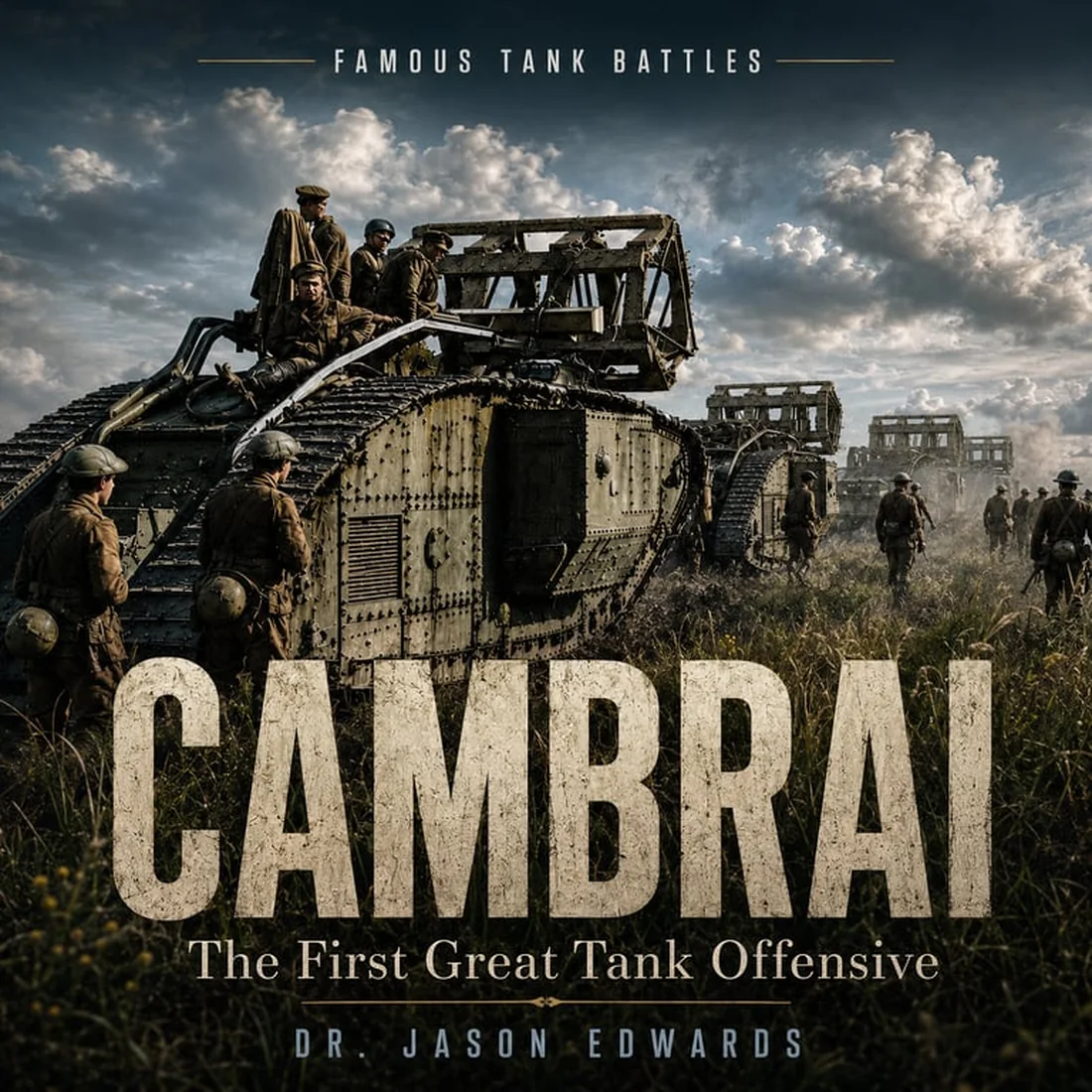
The Morning the Tanks Came
Before sunrise on November 20, 1917, the British attack began without the usual warning. There was no long preliminary bombardment to announce that an offensive was coming. No days of shellfire tearing the battlefield apart in advance. Instead, the opening movement at Cambrai depended on secrecy, timing, and the strange mechanical presence of hundreds of tanks moving toward the German line.
For the men waiting behind them, the tanks represented both hope and uncertainty. These were not sleek modern armored vehicles. They were slow, loud, hot, cramped machines, difficult to steer and prone to breakdown. Inside, crews worked in choking noise and fumes, surrounded by armor that could protect them from some dangers while trapping them inside others. Still, against wire, trenches, and machine-gun positions, the tank offered something infantry had desperately needed: a way through.
Cambrai’s first hours were unlike the familiar pattern of Western Front offensives. The British Army was not simply trying to batter its way forward with artillery and manpower. It was attempting to use tanks as part of a larger system: artillery firing by surprise, infantry advancing behind the machines, engineers ready to solve battlefield obstacles, aircraft watching from above, and cavalry waiting for the moment when a rupture might become a breakthrough.
That morning mattered because it briefly made the impossible seem possible. The Hindenburg Line, one of the strongest German defensive systems on the Western Front, had been built to resist exactly this kind of assault. Yet as the tanks moved forward and the infantry followed, Cambrai began as something more than another attack. It became a test of whether modern machines, careful planning, and surprise could break the pattern of trench warfare.
Why Cambrai Was Chosen
Cambrai was not selected by accident. By late Nineteen Seventeen, the Western Front had taught both sides a brutal lesson: courage alone could not solve trenches, barbed wire, artillery, and machine guns. Too many offensives had begun with massive bombardments that warned the enemy, shattered the ground, and left attacking infantry struggling through mud and shell craters before they even reached the real fight.
The ground around Cambrai offered a different possibility. Compared with the ruined mud of Flanders, it was firmer and better suited for tanks. That mattered because early tanks were still mechanically fragile. They needed ground they could cross, routes they could follow, and conditions that gave them at least a chance of reaching the enemy wire and trenches before breaking down or becoming trapped.
The target was also important. The German Hindenburg Line was not just another trench system. It was a deep, carefully prepared defensive belt built to absorb attacks and punish infantry as they advanced. If the British could crack it at Cambrai, the result would be more than a local success. It would suggest that tanks, surprise, and coordination might offer a new way to attack fortified positions.
Cambrai therefore became both a battlefield and a test case. The British Army wanted to know whether tanks could do what artillery and infantry had so often failed to do on their own. The answer would not be simple, but on the eve of the attack, the plan carried enormous promise: choose better ground, preserve surprise, mass the tanks, and try to rupture the German line before the defenders could react.
The Plan: Tanks, Artillery, Infantry, and Surprise
The British plan at Cambrai was built around a simple but ambitious idea: attack before the Germans realized what was coming. Earlier offensives often began with long artillery bombardments that tore up defenses but also warned the enemy to prepare. At Cambrai, the British hoped to preserve surprise by avoiding that familiar pattern. The guns would open suddenly, the tanks would move forward, and the infantry would follow before the defenders could fully react.
The tanks had a specific job. They were expected to crush barbed wire, cross trenches, suppress strongpoints, and create lanes for the infantry. This was one of the great promises of the Mark IV tank. It did not need roads in the way wheeled vehicles did, and it could move across obstacles that had stopped infantry again and again. In theory, tanks could turn the worst features of trench warfare into problems that could be crossed, crushed, or bypassed.
But Cambrai was never supposed to be a tank attack alone. Artillery had to strike German positions at the right moment. Infantry had to move close enough behind the tanks to take and hold ground. Engineers had to deal with obstacles, crossings, and battlefield repairs. Aircraft helped observe the fight from above. Cavalry waited behind the attack, ready to ride through if the German line truly broke open.
That last expectation showed both the ambition and the uncertainty of the plan. British commanders still imagined that a breakthrough might restore mobility to the battlefield. If the tanks opened the door, perhaps cavalry could pass through it and turn a local success into something much larger. Cambrai was therefore a strange mix of old and new: steel machines leading the way, mounted troops waiting in reserve, and an army trying to discover whether the Western Front could still be broken wide open.
Friction, Failure, and the German Counterattack
As the first day gave way to the days that followed, Cambrai became less a story of sudden breakthrough and more a story of battlefield friction. The tanks had done what many doubters thought they could not do, but early armored warfare was still fragile. Machines broke down, became stuck, ran out of momentum, or were knocked out. Crews fought inside brutal conditions, while infantry units struggled to keep pace, reorganize, and hold what had been gained.
The battlefield itself also began to resist the plan. Villages, ridges, trenches, roads, canals, and strongpoints turned the advance into a series of difficult local fights. Communication became harder as units moved forward. Commanders could not always see clearly what was happening. Success in one place did not automatically translate into success somewhere else. The clean lines of the plan gave way to the confusion of battle.
The Germans, meanwhile, recovered from the shock. Cambrai is important because it did not end with British tanks rolling triumphantly through the defensive system. German forces adapted, reinforced threatened areas, and prepared a counterattack. When it came, it showed that innovation on one side rarely goes unanswered. The defender studies, reacts, and looks for weaknesses.
The German counterattack turned Cambrai from a celebration into a warning. Ground that had been won at great effort could still be lost. Technology had opened a path, but it had not solved the larger problems of endurance, coordination, supply, reserves, and command. Cambrai proved that tanks could change the battlefield, but it also proved that the enemy still had a vote.
What Cambrai Really Proved
Cambrai did not prove that tanks could win battles by themselves. It proved something more important and more complicated: tanks could make a breakthrough possible, but they needed an entire battlefield system around them to turn that breakthrough into victory. Armor mattered, but so did infantry, artillery, engineers, communications, logistics, aircraft, reserves, and command decisions made under pressure.
That is why Cambrai still feels modern. The battle was not just about new machinery. It was about the challenge of integrating new technology into an old way of war. The British Army had found a weapon that could help overcome wire and trenches, but it had not yet mastered the full method needed to exploit success, sustain momentum, and defeat a determined enemy response.
The Germans learned as well. Their counterattack showed that no innovation remains one-sided for long. Surprise can open a battle, but adaptation shapes what happens next. Cambrai therefore became both a breakthrough and a cautionary tale: the tank had arrived, but the age of armored warfare was still being learned at terrible cost.
More than a century later, the Battle of Cambrai remains one of the clearest examples of war changing in real time. It was a battle of steel, mud, ambition, and hard lessons. It showed the future before armies fully understood how to use it, and that is why Cambrai remains essential to understanding the road from trench warfare to modern combined arms.
That story is at the heart of my new book and podcast on Cambrai: The First Great Tank Offensive. It is not only a story about machines crossing trenches. It is a story about soldiers, commanders, technology, risk, adaptation, and the difficult moment when the future of warfare first began to grind forward on tracks.