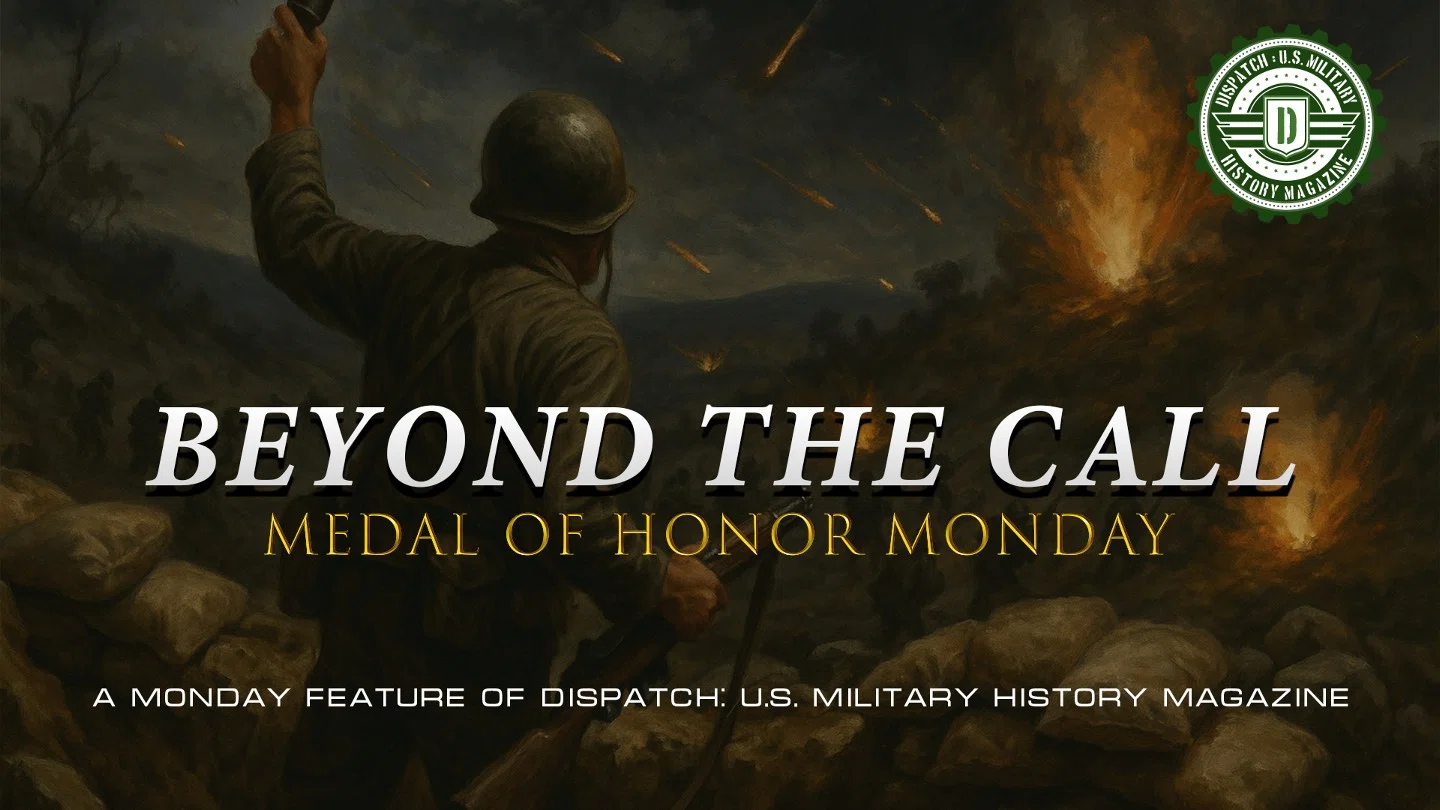
The Moment of Decision
In the dark, humid hours before dawn on Okinawa, the American line around Kakazu Ridge was little more than a jagged string of foxholes and shattered stone. Technical Sergeant Beauford “Andy” Anderson and the men of his weapons platoon had spent the night listening to the island—distant artillery rumbled, mortars coughed, and now and then a Japanese flare turned the terraced fields silver for a heartbeat before dropping them back into blackness. The men were exhausted, nerves stretched thin after days of fighting, but the order was simple and unforgiving: hold this ground.
Somewhere out in that darkness, a Japanese counterattack was forming. Anderson could feel it before he could see it. Snatches of movement on the left flank. A burst of machine-gun fire that came from the wrong direction. Then the night exploded—mortar rounds slamming in, automatic weapons raking the hillside, enemy soldiers shouting as they rushed forward, intent on rolling up the exposed side of the American position. If that flank folded, the company’s line would unravel, and the enemy would pour through the gap.
In the chaos, Anderson had seconds to decide. He could keep his men in their shallow positions and let them be swallowed by the oncoming wave, or pull them back and risk the enemy sweeping past them into the rear. Instead, he saw a third option. Just behind the line yawned the mouth of an old stone tomb carved into the hillside—thick walls, solid cover. Anderson ordered his men to crowd inside, out of the storm of fire, and then turned back toward the ridge. Alone now in the open, carbine in his hands and the enemy closing fast, he chose to stand and meet the attack himself.
The Road to That Day
Beauford Theodore Anderson was born on July 6, 1922, in the small town of Eagle, Wisconsin, and grew up amid the farms and wooded hills of the upper Midwest. His family later moved to nearby Soldiers Grove, a community where everyone knew everyone else and hard work was simply expected. The Great Depression shaped his generation; steady employment was precious, and responsibility came early. Those years gave Anderson a quiet toughness and the sense that when something needed doing, you stepped forward and did it.
When the United States went to war in 1941, young men from towns like Eagle and Soldiers Grove suddenly found the world’s map expanding. Anderson enlisted in the United States Army in 1942, trading Wisconsin winters for Army barracks and infantry training grounds. The Army discovered in him what his hometown already knew: he was steady, practical, and willing to take charge. As he learned the weapons of an infantry unit—rifles, machine guns, and the mortars that would later define his role—he also learned how to keep a squad moving when fear and fatigue tried to pin them in place.
By mid-1944 he was in the Southwest Pacific, part of the long, grinding push toward Japan. Serving with the 381st Infantry Regiment of the 96th Infantry Division, he fought on Leyte in the Philippines, where he earned the Bronze Star for heroic service. Jungle operations, rain-soaked foxholes, and sudden, close-range fights with a determined enemy hardened him and taught him how quickly a battlefield could turn. These were not lessons from a manual; they were bought with experience and loss.
By April 1945, Anderson was a technical sergeant leading elements of the weapons platoon in Company A, 1st Battalion, 381st Infantry. A weapons platoon carried the company’s heavier firepower—mortars and machine guns that could break up attacks or anchor a defense—so its leaders had to see the whole field, not just their own foxhole. On Okinawa, the regiment was tasked with clawing its way up against a layered Japanese defense centered on ridges and tomb-studded hillsides. Kakazu Ridge was one of those hard points. In the days leading up to the predawn attack, Anderson’s job was to position his guns, encourage tired men, and make sure that when the enemy came—as everyone knew they would—the company’s flank would not be the weak link.
Into the Fire
The Battle of Okinawa was already a brutal grind by the time Anderson’s regiment reached the approaches to Kakazu Ridge in April 1945. The ridge was part of a layered defensive belt where Japanese forces used caves, tunnels, and family tombs as ready-made bunkers. The 96th Infantry Division had been ordered to batter its way through this line, clearing one terrace at a time under artillery fire and well-placed machine guns. For Company A of the 381st Infantry Regiment, that meant holding a thin, exposed sector on the forward slope, with Anderson’s weapons platoon responsible for the vital firepower that could break up an enemy attack.
On the night of April 12–13, the company dug in as best it could along the hillside. The ground was rocky and uneven, pitted with shell holes and dotted with stone tombs built into the slopes. Anderson and his men wrestled with mortars and ammunition in the dark, trying to site their weapons so they could cover likely avenues of approach. Everyone knew a counterattack was coming; that was the pattern on Okinawa. American units pushed forward by day, and Japanese forces tried to throw them back under cover of darkness, relying on surprise, infiltration, and precise knowledge of the terrain.
In the predawn hours, the storm finally broke. Enemy artillery and mortars slammed into the company’s positions, walking explosions up and down the line. Small-arms fire followed, sweeping along the terraces as Japanese infantry closed in. The attack struck hardest at the company’s flank, where Anderson’s section found itself directly in the path of the assault. Shadows became rushing figures. Automatic weapons chattered from concealed firing points, and grenades arced in from the darkness. If that flank collapsed, Japanese troops could push past the company and drive into the rear areas, threatening the entire battalion’s position on the ridge.
Assessing the situation in moments, Anderson chose to move his men rather than keep them pinned in shallow foxholes that were rapidly being bracketed by fire. He ordered them to take cover in an old stone tomb behind the line, where thick walls and a narrow entrance offered a measure of protection. Once he was sure they were inside, he turned back toward the oncoming attack. Armed only with his carbine, he remained outside to face the assault alone, exposing himself deliberately so that his men could survive and the enemy would not break through unchecked.
As the first wave of attackers rushed his position, Anderson fired at point-blank range, emptying a full magazine into the nearest soldiers. The air was thick with smoke and dust, the hillside lit by muzzle flashes and exploding rounds. In the middle of this chaos, an enemy mortar shell landed nearby but failed to detonate, a dangerous dud lying amid the rocks. Anderson seized it, tore out the safety device, and hurled it back into the charging group. The shell exploded among them, tearing gaps in the advancing line and buying him a crucial few seconds.
Nearby lay a wooden box filled with additional mortar rounds. Recognizing a brutal opportunity, Anderson dragged it close, pulled the safety devices from the shells, and armed them by striking their bases against a rock. One after another, he hurled the live rounds like oversized grenades into the attackers, alternating this improvised bombardment with bursts from his carbine. The hillside became a deadly zone where each shell broke up another rush, shredding tightly packed groups and smashing enemy machine-gun and knee-mortar teams before they could fully establish their positions.
Shrapnel from an explosion tore into Anderson, inflicting a severe wound, but he refused to leave his post. Bleeding heavily, he continued to fight until the attackers finally began to fall back, their momentum broken and their numbers thinned. Only when the immediate threat had passed did he withdraw from the exposed position. Instead of seeking medical help, he made his way to the company command post to report exactly what had happened on the flank. His lone stand had accounted for around twenty-five enemy dead, destroyed several automatic weapons and mortars, and removed a serious danger to the company’s position on Kakazu Ridge.
The Citation, Decoded
The official Medal of Honor citation for Beauford T. Anderson begins by noting his “conspicuous gallantry and intrepidity above and beyond the call of duty.” In plain terms, that means he chose a course of action that was not required, not expected, and almost certainly fatal, in order to save others. Remaining outside the tomb while his men sheltered inside was that choice. He accepted a level of risk far beyond what his orders demanded, inviting enemy fire onto himself so the company’s flank would hold. The phrase captures that voluntary exposure to extreme danger when safer options were available.
The citation describes a “powerfully conducted predawn Japanese counterattack” striking his unit’s flank. Those words point to the timing and intensity of the assault. Attacking before dawn gave the enemy the advantages of darkness and surprise on ground they had long prepared. Hitting the flank meant aiming at the most vulnerable edge of the line, where a breakthrough could unravel the entire position. Against this pressure, Anderson’s actions—moving his men to cover, then engaging alone—turned a likely penetration into a failed assault. “Overwhelming odds” in the citation is not a figure of speech; it reflects one man standing in the open against dozens of attackers.
Later phrases speak of his conduct forcing the enemy to withdraw and removing “a serious threat to the company’s flank.” That language translates into concrete battlefield effects. By killing roughly twenty-five enemy soldiers and destroying multiple machine guns and knee mortars, he stripped the attacking force of much of its firepower. Those destroyed weapons represented bursts of fire that never raked the company’s foxholes, shells that never landed among stretcher teams or ammunition carriers. The closing lines of the citation, noting his refusal of evacuation until he had reported the situation, emphasize that even after the fighting, he placed the company’s needs over his own wound. The citation’s formal words, unpacked, tell the story of a technical sergeant who used every tool at hand—rifle, mortar shells, and sheer will—to hold a critical piece of ground when it mattered most.
Why It Mattered
On a map, Anderson’s stand at Kakazu Ridge might look like a small action on one corner of a much larger battlefield. On the ground, it was the difference between a company holding and a company being overrun. The Japanese counterattack was aimed squarely at the flank, the vulnerable edge where a breakthrough would allow enemy troops to slip behind the line, attack support elements, and collapse the position from the rear. By moving his men into the shelter of the tomb and staying outside alone, Anderson turned that exposed flank into a stubborn anchor point. Every enemy soldier he stopped, every machine gun or knee mortar he silenced, was one less threat bearing down on the men of Company A.
Tactically, his actions helped preserve the company’s foothold on a key piece of terrain in the larger defensive belt around Kakazu Ridge. If that sector had crumbled, the regiment might have been forced to fall back and fight for the same ground again at heavy cost. Instead, the position held, and the division could continue its slow advance through the ridge line. On Okinawa, where every yard of ground seemed to be paid for several times over, preventing a local collapse meant saving lives not only in his own unit but in neighboring companies and battalions that depended on that flank remaining secure.
There was also a powerful effect on morale. Soldiers knew when a comrade had done something extraordinary, even before any official recognition. Stories of a technical sergeant who hurled live mortar shells by hand and refused evacuation spread quickly through the unit. In a campaign marked by mud, exhaustion, and relentless resistance, that kind of example reminded weary riflemen that individual courage could still shape events. Anderson’s actions demonstrated that a single noncommissioned officer, thinking clearly under pressure and willing to risk everything, could blunt a carefully prepared enemy attack and keep a fragile line from shattering.
Leadership and Character
Anderson’s stand on Kakazu Ridge highlights several enduring themes of combat leadership. The first is responsibility for others. When the predawn attack smashed into the flank, he did not cling stubbornly to a failing position. Instead, he swiftly ordered his men into the relative safety of the tomb, prioritizing their survival over his own. That decision reflects a leader who sees his primary duty as protecting and preserving the fighting strength of his unit, even when doing so requires accepting greater personal danger. His choice to remain outside while they took cover transformed leadership from an abstract concept into a visible, concrete act.
Another theme is improvisation under extreme stress. Many soldiers are taught to use their issued weapons as designed; fewer are able to seize a dud mortar round, strip its safety device, and turn it into a hand-thrown explosive in the middle of a firefight. Anderson saw a box of mortar shells not only as ammunition for a tube, but as a set of tools he could adapt on the spot. Striking their bases on a rock to arm them, then throwing them like heavy grenades, required a clear understanding of how his equipment worked and a willingness to experiment when seconds mattered. It also required nerve, because each shell in his hand could kill him as easily as the enemy.
Finally, his conduct after the fight speaks to endurance and focus. Badly wounded, he did not make his own evacuation his first priority. Instead, he moved to the company command post to report in person, making sure leaders had an accurate picture of what had happened on the flank. That instinct—to think about the needs of the unit before his own pain—illustrates a quality that soldiers recognize immediately: the quiet, unshowy determination of a seasoned noncommissioned officer who sees the bigger picture. For readers and listeners today, those traits translate beyond the battlefield into any setting where people rely on a leader who stays calm, adapts to chaos, and accepts risk so that others can carry on.
Legacy and Memory
Beauford Anderson survived the war and returned to the quieter landscapes of home, carrying memories of Okinawa that never fully left him. Like many veterans of the Pacific, he moved from the life-or-death urgency of combat back into the steady rhythms of civilian work, family responsibilities, and community involvement. Over time he became known not only as a Medal of Honor recipient but as a neighbor, coworker, and citizen who had once faced terrible odds on a hillside far from Wisconsin. His wartime rank of technical sergeant became part of his story, but it did not define the whole of his life; he continued to serve in other ways, bringing the same steadiness and sense of duty to peacetime roles.
The Medal of Honor placed his name in the permanent roll of those whose actions the nation has chosen to remember. Ceremonies, newspaper articles, and local events marked that distinction, but the deeper legacy lay in how his story was told within families, veteran groups, and classrooms. When younger generations heard about the man who fought alone on the flank at Kakazu Ridge, they encountered not a myth but a real person who had grown up in small-town America before being thrust into one of the war’s hardest campaigns. His example offered a tangible link between homefront values and battlefield courage.
Today, Anderson’s name lives on in markers, memorials, and the records that preserve his award. His grave and any plaques or displays that tell his story give visitors a focal point for reflection on both the cost of Okinawa and the character it called forth. When we read about his actions or stand in front of such a memorial, we have the chance to see him as more than a figure in a citation: a young man who made a series of clear, costly choices on a dark ridge, and whose courage continues to speak across the years.