The Moment of Decision
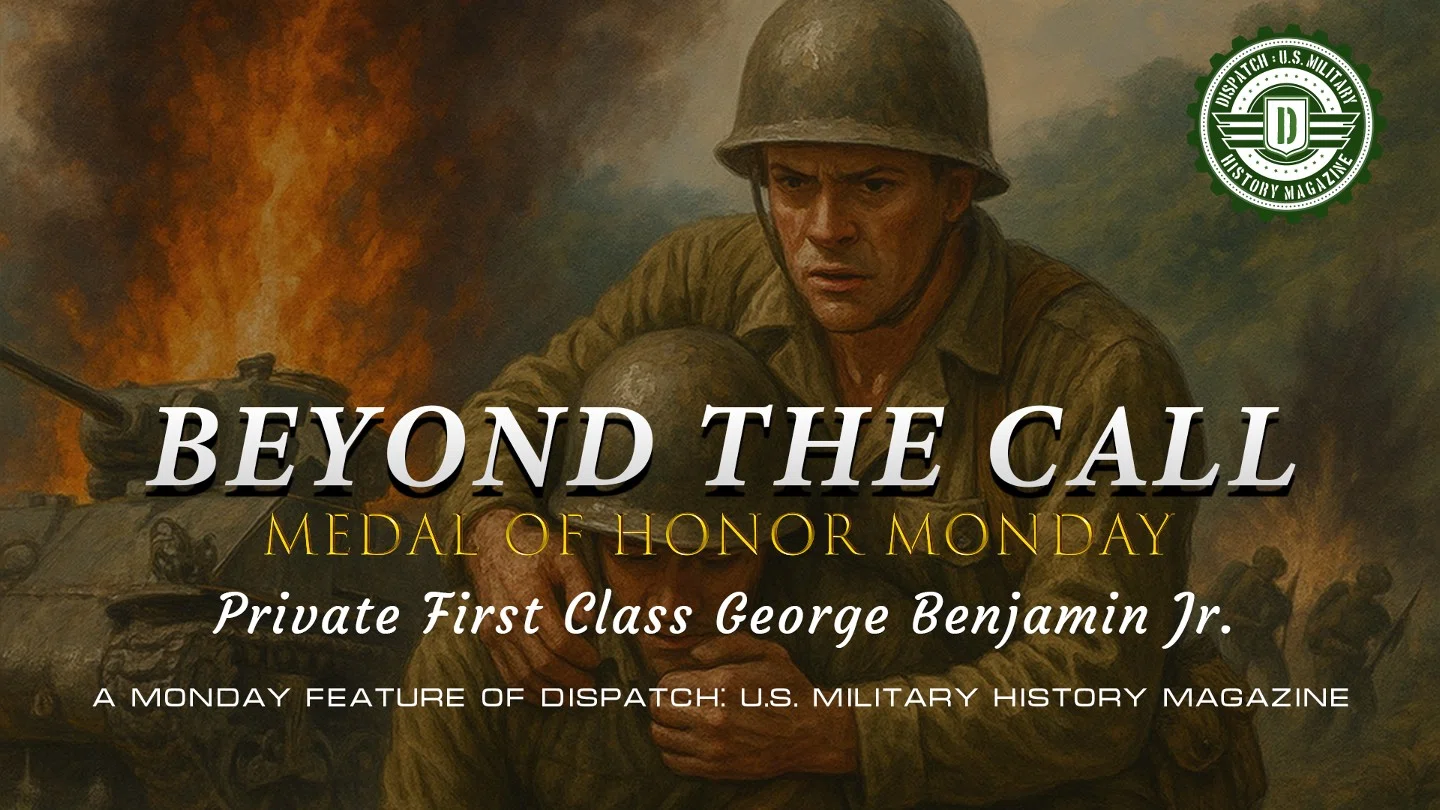
The rain-soaked hills of Leyte were already torn open by days of fighting when Company A of the 306th Infantry pushed forward against a Japanese strongpoint that refused to break. Machine guns were dug into the slopes, firing down narrow approaches that funneled every American movement into sheets of bullets. A light tank inched ahead, meant to crack the defenses, but the infantry platoon walking behind it stalled under the storm of fire. Men hugged the ground, pinned, the battalion’s advance frozen in place. In the relative shelter of the rear moved a young radio operator, Private First Class George Benjamin Jr., burdened with a heavy set and armed only with a pistol.
From where he was, Benjamin could have stayed low and waited for someone else to solve the problem on the ridge. Instead he saw the attack faltering and understood what it meant: if the strongpoint held, the battalion’s mission would fail and more men would die trying to approach it again. In that instant, he made his choice. Leaving his comparatively secure position, he rose to his feet in the bullet-whipped open ground, sprinting toward the hesitant tank, waving and shouting for the riflemen to follow. With the radio slamming against his back and enemy fire searching for him, he drove straight toward the guns that were stopping everyone else.
The Road to That Day
George Benjamin Jr. was born on April 24, 1919, in Philadelphia, Pennsylvania, and grew up in a working-class world shaped by the Great Depression. As a young man he moved across the river to New Jersey, graduating from Woodbury High School in Woodbury and putting down roots in nearby Carneys Point. Like many of his generation, the war in Europe and the Pacific turned from distant headlines into a personal call to serve. In August 1943, at twenty-four years old, he entered the United States Army from Carneys Point, trading civilian routines for barracks life, drill fields, and the hard discipline of infantry training.
The Army trained him not only as a rifleman but as a radio operator, a role that demanded both technical skill and calm under pressure. Carrying a radio meant more than extra weight; it meant being the link between scattered platoons and the officers trying to control a battle they could not always see. Assigned to Company A, 306th Infantry Regiment of the 77th Infantry Division, he joined a division that would fight its way across island battlefields where every ridge and tree line could hide an ambush.
By late 1944, Benjamin and his division were in the Philippines, committed to the campaign to retake Leyte from entrenched Japanese forces. The terrain was unforgiving—steep hills, ravines, and thick vegetation that turned every advance into a close-range fight. In his company, Benjamin had already earned trust as the man who kept the airwaves alive under fire, a steady presence with the radio that commanders depended upon. Marching toward the strongpoint that December morning, he could not have known the exact shape of the fight ahead, but everything in his training and experience had prepared him for a moment when hesitation could cost the battalion its chance to move at all. That moment was about to arrive on the slopes above Leyte’s scarred ground.
Into the Fire
The attack that morning on Leyte was part of the wider push to drive Japanese forces off the island’s central high ground and reopen vital roads through the mountains. The 77th Infantry Division had been grinding forward through steep, jungle-cloaked ridges, where every few dozen yards brought another hidden position dug into the slopes. Company A’s mission was simple on paper and brutal in practice: move up the narrow approach, knock out a fortified strongpoint, and open the way for the battalion behind it. A single light tank rumbled ahead as moving cover, its gun meant to blast apart machine-gun nests that infantry alone could not easily reach. The men behind it knew that if the tank stopped, the entire attack would stall, leaving them exposed in the open draws and terraces below.
As the column advanced, Japanese fire erupted from well-concealed emplacements overlooking the route. Machine guns stitched the ground in front of and behind the tank, seeking to isolate it from the infantry. Mortars began to fall, turning patches of hillside into sudden eruptions of earth and splinters. Under that fire, the attacking line faltered. Some soldiers dove for what little cover they could find; others hesitated, unwilling to press forward into what seemed like a killing zone. The tank slowed, its crew unsure how far forward they could move without infantry close by to protect them from enemy soldiers with grenades and satchel charges. Momentum, that fragile asset in any assault, was slipping away with every passing second.
In the rear of the company, George Benjamin felt all of this through the radio strapped to his back and the shouted fragments of orders that reached him. As the radio operator, he was the thread tying the forward elements to the company and battalion leadership, but he was also a trained infantryman who could see a stalled attack when it unfolded in front of him. He watched the men hunkering down, the tank creeping without direction, the invisible arc of enemy guns pinning his unit in place. In that moment he decided that his job was not only to carry messages but to help restore movement. Leaving what little cover he had, he sprinted forward toward the tank, waving his arms and calling out for the riflemen to follow.
Closing the distance under fire, Benjamin moved alongside the vehicle, exposing himself on ground that the enemy had already sighted in. With his pistol in hand and the heavy radio still strapped across his shoulders, he became a moving standard for the rest of the company. Seeing him rush forward next to the tank, other soldiers rose and pushed ahead in his wake, using the vehicle as a shield from some of the fire raking the approach. The tank crew, now aware that friendly infantry were with them again, resumed their advance up the slope. Together, tank and riflemen clawed their way toward the strongpoint, trading the relative safety of distance for the chance to close and silence the guns that were holding up the battalion.
Then the worst-case scenario arrived. Enemy fire found its mark and the tank was hit. In an instant, what had been the company’s spearhead became a burning steel trap. Flames licked across its exterior, and smoke began to pour from hatches and seams. Ammunition stored inside started to cook off, threatening to turn the whole vehicle into an erupting furnace. The crew was stunned and disoriented, struggling to escape as enemy guns stayed fixed on the crippled machine. Many men in Benjamin’s position might have sought cover and waited for the fire to burn itself out, assuming the tank was beyond saving. Instead, he saw something else: fellow soldiers trapped inside, seconds away from being killed in an explosion if no one reached them in time.
With no regard for the shells still landing nearby, Benjamin climbed onto the stricken tank. He forced open the hatches, helped drag the crew out, and got them moving toward a nearby ditch that offered at least a shallow measure of protection. Even after they were clear of the immediate flames, the danger did not end. The fire in the tank still burned, and the ammunition inside continued to heat. If the vehicle detonated, it would hurl fragments and blasts across the very ground where his company was trying to fight. The safe choice was to stay in cover, accept the loss of the tank, and hope the explosion did not shred the nearest infantry. Benjamin chose the opposite.
He turned back toward the burning machine. Knowing full well the risk, he climbed onto it again and went inside, trying to reach the ammunition or to smother the flames before they spread further. He was last seen entering the tank in a deliberate attempt to prevent the catastrophe he knew was coming. Moments later, the ammunition ignited in a violent explosion that killed him instantly and wrecked the vehicle beyond use. Yet his actions had already bought critical time and saved the crew who would otherwise have perished with their tank. In the shock that followed, the surviving infantry understood what he had chosen to do and why: to protect his comrades and preserve the attack, even at the cost of his own life.
The Citation, Decoded
The Medal of Honor citation for Private First Class George Benjamin Jr. speaks of “conspicuous gallantry and intrepidity” above and beyond the call of duty, phrases that can sound formal until they are tied back to the ground he died on. “Conspicuous gallantry” in this context meant that his courage was not only real but visible to those around him. When he rose under heavy fire, ran forward to the tank, and urged his comrades to follow, everyone in the company could see the risks he took. He was not acting in a quiet corner of the battlefield; he was out in the open, where enemy guns had every advantage and where hesitation by anyone else could have been forgiven.
“Intrepidity” is a word that tries to capture a particular kind of fearlessness, not the absence of fear but the refusal to let it dictate one’s actions. Benjamin’s decision to return to the burning tank after rescuing the crew shows this most clearly. By then he knew exactly how dangerous the situation was. The vehicle was aflame, ammunition was already cooking off, and the enemy continued to fire. Going back into that environment was not impulsive; it was a deliberate act to prevent a greater loss of life and possibly save the ground his company had just fought to gain. That is what the citation’s language is trying to convey.
The citation also emphasizes his “complete disregard for his own safety” and his devotion to duty. As a radio operator, his primary responsibility was to maintain communication, yet he chose to take on the roles of guide, rescuer, and shield when circumstances demanded it. Duty, in his case, stretched beyond the narrow description of his job to encompass the welfare of the men around him and the success of the mission. When we read those official words and translate them back into the scene on Leyte, they describe a young man who understood that leadership in combat is sometimes seized, not assigned, and that the highest form of service can come from those whose rank does not begin to reflect the weight of their choices.
Why It Mattered
On the tactical level, what happened on that hillside in Leyte was about more than one man and one burning tank. Company A had been tasked with cracking a strongpoint that dominated an approach route; if that position held, the battalion behind them would struggle to move forward without heavy casualties. Benjamin’s decision to rise under fire, rally the infantry, and keep the tank moving helped carry the attack closer to the enemy emplacements instead of allowing it to die in the open ground below. When he rescued the tank crew, he preserved not just lives but experience—men who knew their machine, their unit, and the terrain. Even when he turned back to fight the fire inside the tank, he was trying to prevent an explosion that could have torn into the very ranks he had just led forward.
Operationally, actions like his were part of the grinding process that made the Leyte campaign succeed. The island was not won by a single sweeping maneuver but by small units clawing their way up ridges and through passes, neutralizing strongpoints one by one. Each time a company broke through instead of being thrown back, it contributed to the larger effort to cut Japanese lines of communication and secure ground for airfields and supply routes. Had Company A failed, the battalion might have been forced to regroup under fire, delay its advance, and face the same or worse resistance on a later attempt. Benjamin’s sacrifice helped ensure that, at least on that sector of the front, the momentum stayed with the American troops and the enemy’s grip on the high ground weakened another notch.
Leadership and Character
George Benjamin’s story is often told in terms of bravery, but it also reveals a particular kind of leadership that does not depend on rank or formal authority. As a private first class and radio operator, he was not the one signing orders or briefing attack plans. Yet when the advance stalled, he recognized what was happening and acted in a way that gave others a clear example to follow. Running forward beside the tank, pistol in hand and radio on his back, he turned fear and confusion into movement. That is initiative in its most practical form: seeing a gap between what must be done and what is happening, and choosing to close it with personal action.
His conduct also shows a deep sense of responsibility for others. He could have considered his duty fulfilled once he had helped the tank crew out of the burning vehicle, but he saw the continuing danger and went back. That willingness to accept additional risk for the sake of his comrades is a form of moral courage as real as any physical act. It suggests a man who saw his safety as secondary to the welfare of those around him and the mission they shared. For leaders and service members today, his example underscores that character is revealed most clearly when there are no guarantees of success and no time to weigh rewards, only the immediate knowledge that someone must act if others are to live.
Legacy and Memory
After the explosion that claimed his life, George Benjamin’s story traveled from that remote hillside back to the families, towns, and units that had shaped him. He was posthumously awarded the Medal of Honor, a recognition that formally recorded what his comrades had already witnessed: that he placed the lives of others and the success of the mission above his own survival. News of the award reached New Jersey, where his hometown communities honored him as one of their own who had gone far from familiar streets to fight in a war that reshaped the world. In the years since, his name has appeared on plaques, rolls of honor, and memorial programs that keep alive the memory of local men who never returned.
Within the Army and among students of World War II, his actions at Leyte stand as one of many individual sacrifices that, together, broke the Japanese hold on the Philippines. His story is preserved in official records and in the living memory of those who study the campaign, not as an abstract citation but as a concrete example of what “above and beyond the call of duty” looked like on a rain-soaked battlefield. When we read his name today, we are invited to see more than a line in a list of recipients. We can picture a young radio operator, raised in ordinary American towns, who chose in a few brief minutes to risk everything for the men beside him and the mission they shared. Remembering him in that way keeps his legacy rooted in human choice and courage, not only in metal and marble.