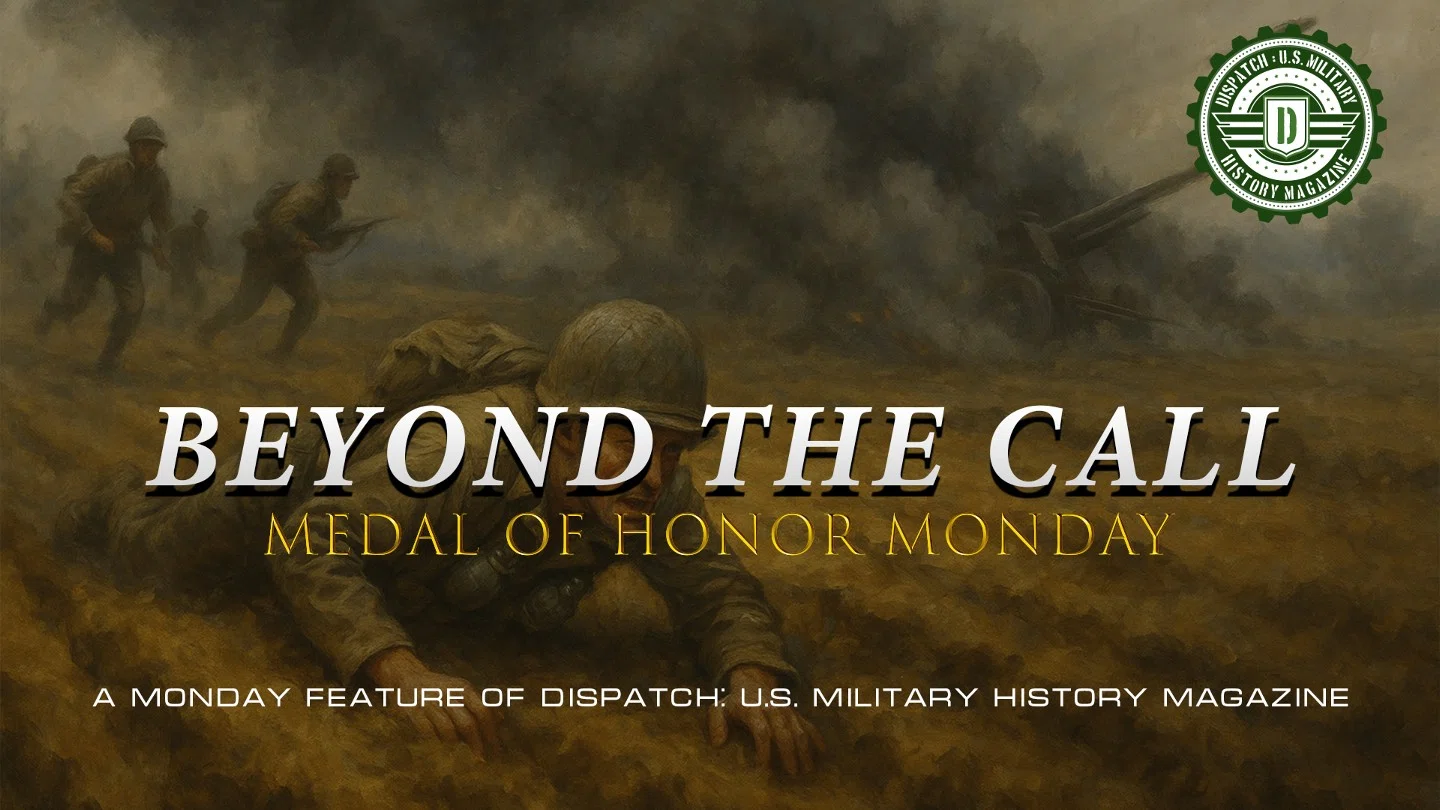
The Moment of Decision
The fields near Anzio were bare and unforgiving—flat, freshly plowed earth broken only by shallow furrows and a few low dikes. On a May morning in 1944, Staff Sergeant George John Hall lay pressed into that thin cover with the rest of his company, the dirt shaking under the hammering of German machine guns. Every time a man tried to crawl forward, grazing fire stitched the ground in front of him. Sniper rounds cracked overhead. The attack, meant to help break the stalemate around the beachhead, was dying in the open.
Hall could hear the shouted orders, the calls for medics, the dull thud of shells landing farther up the line. Somewhere ahead, three enemy machine-gun positions and scattered riflemen had perfect observation of the American advance. As long as those guns stayed in place, his company could not move without being cut down. The only cover between them and the enemy was a single plowed furrow that angled toward the German line.
He studied that furrow, feeling the weight of the grenades on his gear and the eyes of the men around him. No one ordered him to go. The safe choice was to hug the ground and wait for someone else to solve the problem—or for artillery to do it. Instead, Hall made a different calculation. If no one knocked out those guns, the men beside him would die where they lay.
He shifted his body into the furrow, took a breath, and began to crawl alone toward the German positions. In that instant, he stepped—quietly and deliberately—beyond the call of duty.
The Road to That Day
George John Hall’s path to that exposed Italian field began in Stoneham, Massachusetts, where he was born in January 1920. Growing up in a small New England town during the lean years of the Great Depression, he learned early what it meant to work hard and look out for family. Those lessons in responsibility and persistence would follow him into uniform when the United States entered World War II.
Like thousands of other young Americans, Hall left home to join the Army as the nation mobilized for a global war. He trained as an infantryman—learning how to move under fire, how to read the ground for any scrap of cover, and how to keep a squad working together when tired, wet, and afraid. Eventually he was assigned to Company B, 135th Infantry Regiment, part of the battle-tested 34th Infantry Division, an outfit that had already seen hard fighting across North Africa and Italy.
By 1944, Hall had risen to Staff Sergeant, leading men who had marched and fought with him through mud, cold, and mountain battles. He was not a distant figure; he shared their rations, their jokes, and the weary letters home to families who waited for news. What set him apart was a steady reliability under pressure. When orders came down, Hall was the kind of noncommissioned officer who made sure they were carried out, even when the plan looked grim from ground level.
As the Allies pushed up the Italian peninsula, Anzio became one of the most dangerous assignments on the front. The beachhead was ringed by German artillery and dominated by higher ground. Hall’s regiment was tasked with helping to punch through those defenses. On May 23, 1944, his company was ordered to attack across open farmland near the town, a maneuver every infantryman knew was risky. Hall went forward that morning as he always had—aware of the danger, responsible for his men, and ready to do what the situation demanded. Within minutes, the German guns would force him to make the decision that defined his name in Medal of Honor history.
Into the Fire
The attack that morning was part of a larger Allied push to break out of the Anzio beachhead and link up with forces driving north from the main Italian front. Hall’s company moved out across open farmland, the kind of ground infantrymen dread: long, gentle slopes, shallow furrows, and almost no cover. German forces had prepared well, digging in machine guns and rifle pits that overlooked likely avenues of advance. As the Americans stepped off, the first bursts of fire swept the field, driving men to the ground. Within minutes, the company was pinned, casualties already mounting, and the momentum of the attack threatened to stall.
From his place in the line, Hall saw that the enemy guns were not merely harassing them; they were locking the company in the open, making any movement deadly. The platoon leaders could not stand up to point out targets without drawing fire. Radio calls were difficult over the noise of automatic weapons and bursting shells. In that confusion, Hall focused on the single advantage in front of him: the plowed furrow that angled toward the German positions like a shallow trench. It was not much, but it was something, and he understood that if someone did not use it to get close, the company would be chewed apart where it lay.
He started forward alone, hugging the thin ribbon of disturbed earth as bullets snapped overhead and kicked up little geysers of dust on either side. The crawl was slow and exhausting, every foot gained under the threat of sudden death. Hall knew that his men were watching, and that some of them were already wounded, counting on someone to change the balance. When he reached a point close enough to the first machine-gun nest, he pulled the pin from a grenade, steadied himself, and rose just high enough to lob it over the lip of the enemy position. The explosion silenced the gun and its crew, giving the pinned Americans their first reprieve of the day.
There was no pause. The second machine gun opened up almost immediately, shifting its fire toward the new threat. Hall dropped back into the furrow and began crawling again, now under fire from enemies who knew someone was out there, closing the distance. He moved from one shallow dip in the ground to another, feeling the air tear above him as rounds passed close. When he judged himself within throwing distance, he repeated the dangerous sequence—pin, rise, throw—exposing himself just long enough to place another grenade where it needed to land. A second blast shattered that position, and another stream of deadly fire went quiet.
The third machine-gun nest was farther away and better placed. Its crew, now fully alert, poured fire into the field around the furrow, trying to catch the lone American who had already destroyed two positions. Hall pressed himself into the earth and inched forward anyway. At that point, the mission had moved beyond orders or expectation. He was acting on a simple calculation: every gun he silenced meant friends had a chance to live and move. As he closed with the final position and prepared to throw, a burst of fire struck him, shattering his right arm and leaving him grievously wounded.
In that instant, with pain surging through him and his primary arm useless, Hall still faced a live grenade in his hand and a machine gun that continued to fire on his company. Somehow he managed to keep hold of the grenade until he could shift it to his left hand and complete the throw. The weapon arced into the enemy nest and exploded, destroying the last of the three machine-gun positions that had dominated the field. The company, no longer pinned by overlapping streams of fire, could rise, reorganize, and move forward. Hall, bleeding heavily and now facing a lifetime changed by that wound, had broken the enemy line in front of his unit by sheer determination and courage under fire.
The Citation, Decoded
The official Medal of Honor citation for Staff Sergeant George John Hall describes “conspicuous gallantry and intrepidity” above and beyond the call of duty. In plain language, that phrase captures a soldier who knowingly moved into extreme danger, alone, to accomplish a task that most would consider impossible. The citation’s reference to repeated assaults against enemy machine-gun positions speaks to the deliberate nature of his actions. Hall did not act in a single flash of bravery and then return to cover; he kept crawling forward, gun after gun, until the threat to his company was reduced.
When the citation notes that he advanced over open terrain under heavy machine-gun, rifle, and sniper fire, it points to the tactical reality of the battlefield. There were no deep trenches or stone walls to protect him, only shallow furrows and small folds in the ground. Moving under those conditions meant staying as low as possible, controlling every motion, and accepting that each new yard forward brought him closer to weapons designed to sweep that ground clear of life. The repeated mention of enemy fire underscores that he did not catch the defenders off guard after the first attack; they knew he was coming and tried hard to stop him.
The citation also highlights the moment when Hall, already severely wounded and with his right arm shattered, continued the attack and completed the destruction of the final machine-gun position. This is where “intrepidity” becomes real. He was not just brave at the beginning of the action; he persisted when his body was breaking down, when the pain and shock of his wound could have justified staying in place or calling for help. By holding on to the grenade, shifting it to his remaining good hand, and making that last throw, he accepted personal loss—including the eventual amputation of his arm—to ensure that his comrades could survive and the mission could go on.
In the language of military awards, terms like “selfless devotion” and “above and beyond the call of duty” can sound formal. In Hall’s case, they translate into very specific acts: leaving cover when no one ordered him to, closing with enemy guns at grenade range three separate times, and finishing the job after a crippling wound. The citation preserves those facts in a few carefully chosen phrases. The field near Anzio, and the men whose lives were spared because of his actions, give those phrases their true weight.
Why It Mattered
On the ground that day near Anzio, the immediate effect of George Hall’s decision was simple and brutal: three enemy machine-gun positions that had locked down his company were destroyed. That changed everything for the soldiers lying pinned in the open. With the overlapping streams of fire silenced, they could rise, pull their wounded back to safety, and continue the advance instead of being slaughtered where they lay. The attack, once stalled and bleeding, regained momentum because one noncommissioned officer chose to move when movement seemed impossible.
The tactical impact rippled beyond that single field. The operation around Anzio depended on small infantry units punching holes in a carefully prepared German defense. Every strongpoint left intact could delay the advance and give the enemy time to counterattack. By eliminating those guns, Hall not only saved lives in his own company but also helped clear a path for the larger formation to press forward toward its objectives. In a campaign often remembered for stalemate and attrition, actions like his were the small hinges on which larger movements turned.
There was also a deeper moral weight to what happened. When soldiers see someone risk everything for them, it strengthens their belief that they are not facing danger alone. Hall’s decision under fire reinforced a culture of mutual responsibility inside his unit, the quiet understanding that no one would be abandoned to enemy guns if any chance remained to intervene. Without his assault on those positions, the company might have been forced to break off the attack or accept far higher casualties. With it, they proved that grit and initiative at the squad level could alter the course of a hard-fought day.
Leadership and Character
Hall’s actions at Anzio reveal a particular kind of leadership that does not depend on rank or speeches. As a Staff Sergeant, he was close enough to his men to share their fear and fatigue, yet senior enough to feel the weight of their survival. When the attack stalled, he did not wait for detailed instructions from above. He recognized what needed to be done and accepted that, in this case, the only way to do it was to go himself. That blend of initiative and responsibility sits at the heart of effective small-unit leadership.
His decision also shows moral courage, not just physical bravery. Crawling forward once under heavy fire is terrifying; choosing to continue, gun after gun, after the enemy has spotted you and after you are already wounded, demands an inner resolve that goes beyond instinct. Hall knew he was risking permanent injury or death. The fact that he kept moving forward, even after losing the use of his right arm, demonstrates a willingness to sacrifice his own future for the lives of the men behind him. It is leadership measured in actions, not words.
For today’s service members, veterans, and civilians, Hall’s example offers several lessons. Leaders at every level can see how clearly he understood his responsibility: he did not ask his men to do what he was unwilling to do himself. Those who work in teams, military or otherwise, can recognize the power of one person’s determination to break a deadlock and create options for everyone else. His story reminds us that character is often revealed when plans fall apart and someone has to step forward without promise of success.
Legacy and Memory
George John Hall did not leave Anzio unchanged. The wound that cost him his right arm marked him for the rest of his life, a constant physical reminder of that day in 1944. Like many combat veterans who returned home carrying visible and invisible scars, he faced the challenge of rebuilding a life that no longer matched the one he had imagined before the war. Yet his community and the Army recognized the significance of his actions, and the Medal of Honor placed his name among those whose courage shaped the course of the conflict.
Hall’s story has lived on in the records of his regiment, in the official roll of Medal of Honor recipients, and in the memories of those who served with the 34th Infantry Division. His citation is read and studied by later generations of soldiers learning what the highest standard of gallantry looks like in practice. Museum exhibits, regimental histories, and educational programs on the Italian campaign often include his example when they describe the grinding battles around Anzio and the human cost of breaking through fortified lines.
His grave and any local memorials tied to his name give family, friends, and townspeople a place to connect past and present. For most readers, though, Hall’s legacy is carried forward through stories like this one: accounts that restore the terrain, the decisions, and the faces behind the formal language of citations. When we remember him, we remember not only a decorated soldier but a young man from Massachusetts who, in the span of a few minutes on a plowed Italian field, chose to risk everything so that others might live. His name becomes more than a line in a record; it becomes a reminder of what ordinary people can do under extraordinary pressure.