The Moment of Decision
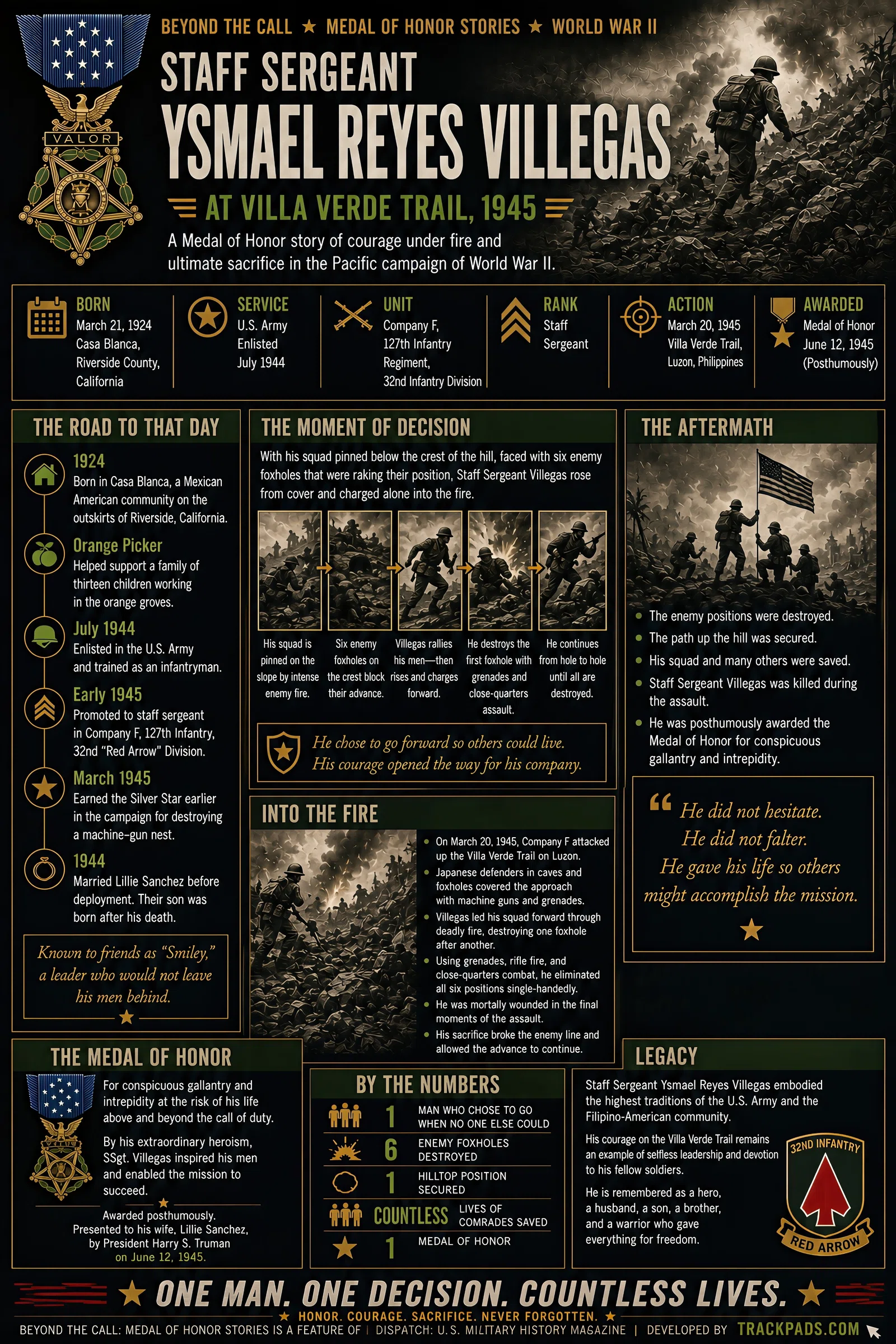
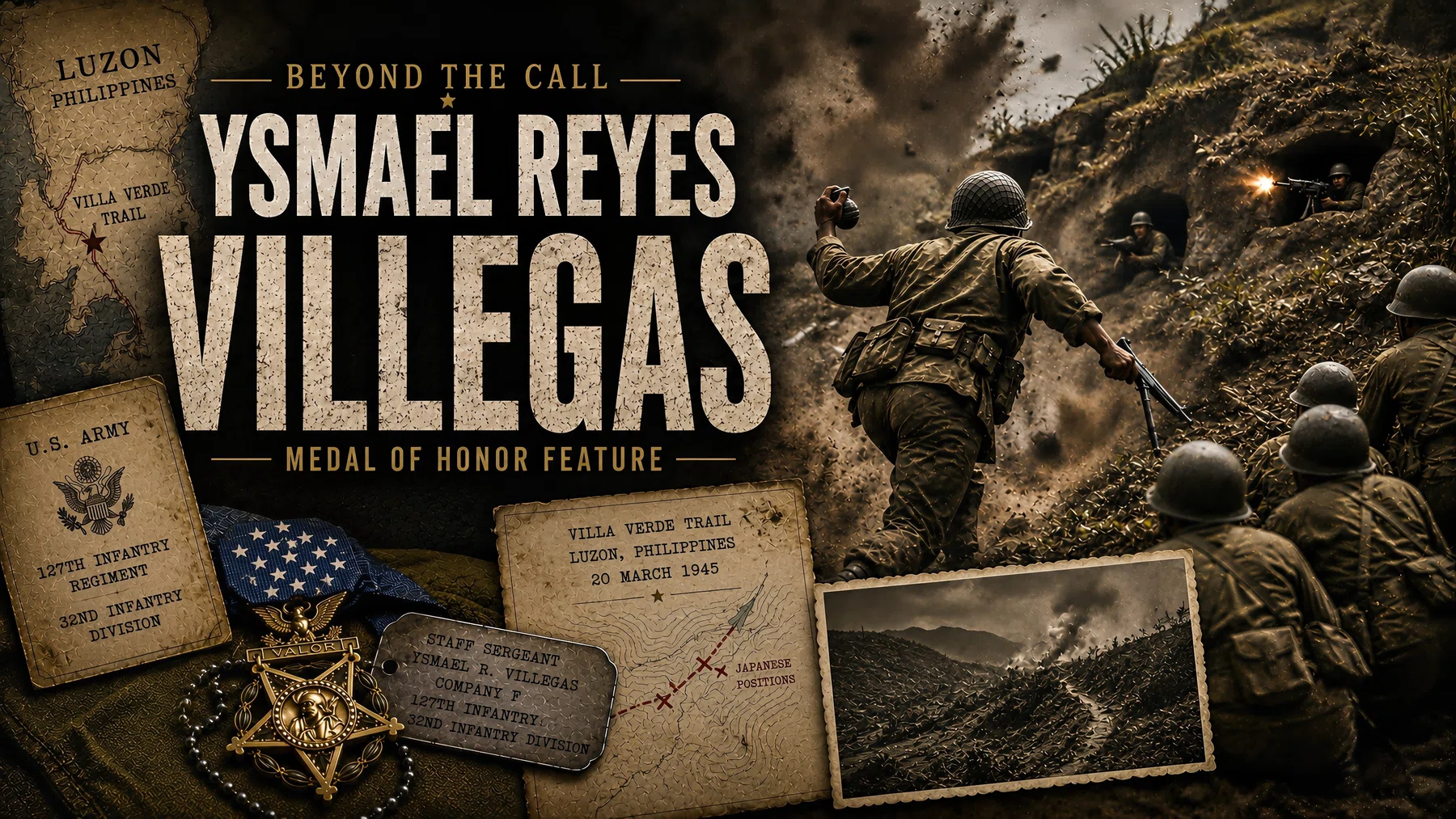
The air on the hillside is thick with blast smoke and dust, the ground under Staff Sergeant Ysmael Reyes Villegas shuddering with each detonation. It is March 20, 1945, along the Villa Verde Trail on Luzon, a narrow mountain road that has become a killing ground. His squad from Company F, 127th Infantry, 32nd Infantry Division is pinned on the slope below the crest, trading fire with Japanese soldiers dug into a chain of caves and foxholes on the commanding heights above.
Machine guns stitch the hillside, bullets snapping over helmets and chewing the earth around them. Grenades and demolition charges arc down from the unseen mouths of caves, exploding in bursts that shower rock and soil. Every few seconds a new blast throws fragments through the scrub, and the instinct is to hug the ground and stay there. Behind Villegas the rest of the company waits for his squad to break the deadlock; ahead of him, a cluster of enemy rifle pits guards the last stretch of ground to the top.
Ysmael moves from man to man, crawling, half crouched, checking on ammunition, clapping shoulders, shouting to be heard over the crack of rifles and the dull thump of explosions. Some of his soldiers are barely younger than he is, all of them exhausted from the endless climb along the trail. If they stay here, the enemy will pick them apart. If they pull back, the attack stalls and the hill remains an enemy strongpoint dominating the pass.
He studies the slope above—six foxholes, staggered and connected, spitting fire. There is no easy way around them, no fresh platoon coming up to take over. The choice, as he sees it, is brutal and simple: either someone goes up there and rips the heart out of that position, or the men around him die where they lie. With bullets kicking up the dirt at his feet, Staff Sergeant Villegas rises from cover, fixes his eyes on the nearest foxhole, and charges straight into the fire.
The Road to That Day
Two decades earlier and an ocean away, Ysmael Reyes Villegas was a boy in Casa Blanca, a predominantly Mexican American neighborhood on the edge of Riverside, California. He was born there on March 21, 1924, the eldest of thirteen children of Dario and Inez Villegas, who had come north from Mexico to build a life among the orange groves. Official records list his civilian occupation simply as “orange picker,” a few dry words that stand in for long days in the groves, climbing ladders and filling sacks under the sun to help support a large family.
Casa Blanca was close-knit and proud, but also marked by segregation and limited opportunities. For young Ysmael, responsibility came early. Being the oldest meant looking after younger brothers and sisters, taking whatever work he could find, and growing up quickly. Friends remembered him by a nickname that fit his easy, lopsided grin: “Smiley.” In the stories neighbors would tell years later, he was the kind of young man who could joke his way through hardship but never walk away from someone who needed a hand.
When war came, that sense of duty turned outward. In July 1944 he enlisted in the United States Army. After basic training he was assigned to Company F of the 127th Infantry Regiment, part of the 32nd “Red Arrow” Division, a unit that had already earned a reputation for grinding, close-quarters fighting in the Pacific. Villegas shipped out to join the division as it prepared for the campaign to drive Japanese forces from the Philippine Islands.
In the brief months before he left, life moved fast. He married Lillie Sanchez in 1944, just weeks before deployment. Their son would be born after Villegas was gone, a child he would know only from photographs and family stories. Overseas, his natural cheer and steady nerve translated into leadership. Promoted to staff sergeant, he took charge of a squad and quickly gained a reputation for leading from the front. Earlier in March 1945, during the same brutal struggle along the Villa Verde Trail, he had already earned the Silver Star for knocking out a machine-gun nest that threatened his men.
Now, as the division fought its way inch by inch up a treacherous mountain road lined with interlocking Japanese positions, that experience and that quiet authority brought him to the front of the column once again. The mission on March 20 was clear but deadly: lead his squad in the assault up a hill whose caves and foxholes controlled the trail. Every man on that slope understood the odds. Villegas shouldered them anyway—and then made a choice that would carry him, alone, toward the first enemy foxhole on the crest.
Into the Fire
By March 1945 the Villa Verde Trail had become a slow, grinding advance through the mountains of Luzon, where every ridge was a fortress and every bend in the road could draw fire from above. The mission for the infantry that day was simple in words and brutal in practice: seize the high ground that overlooked a stretch of the trail and clear the enemy out of the caves and foxholes that guarded it. Company F moved up the slope in short rushes, clinging to patches of cover as Japanese rifles and machine guns snapped from positions that were almost invisible among rocks and brush. Each yard of ground had to be taken under direct fire.
Staff Sergeant Villegas’s squad formed part of the leading element on that hillside. The route up was steep, broken by terraces and outcroppings that gave the defenders cover and clear fields of fire. As the Americans climbed, grenades and demolition charges began to tumble down from the mouths of caves, bursting among them and showering fragments across the thin line of men. Several times the squad was forced to hug the earth, pinned by the interlocking fire from foxholes on the crest. The instinct to stay down was strong. Anyone who stood up too long seemed likely to be cut down before taking three steps.
Villegas refused to let the attack die on the slope. He crawled and dashed from man to man, checking on ammunition, pointing out targets, and steadying those who were shaken or wounded. The official record notes that he moved boldly in the face of bursting grenades and heavy machine gun and rifle fire to bolster the spirit of his comrades, a dry phrase that only hints at the reality of standing upright while the air is filled with metal. Under his urging, the squad edged forward, using every fold in the ground for protection, gaining only a few yards at a time but refusing to break contact.
Inspired by his calm under fire, the men pushed toward the crest of the hill. At close range they used grenades and rifle fire to knock out individual firing points, while Villegas pointed them toward new bits of cover and shouted encouragement over the roar of explosions. The enemy clung stubbornly to their positions, ducking into caves between bursts, then reappearing to fire again. Each time the Americans thought they had silenced a gun, another opened up from a slightly different angle, sewing the slope with bullets and slowing the advance. The fight had become a test of will as much as of firepower.
It was at this moment that Villegas made the choice that would define his legacy. Realizing that his men could not move farther as long as the chain of foxholes above them remained intact, he shifted from leading the squad’s advance to attacking the strongpoint alone. With complete disregard for his own safety, he rose from cover and charged the nearest foxhole, closing the distance while bullets kicked up dirt at his feet. At point blank range he fired into the position and killed the defender, clearing that immediate source of fire that had held the squad down.
He did not stop there. Before the enemy could recover, Villegas turned and sprinted toward a second foxhole further along the crest. Shots cracked past him, close enough that the citation records bullets missing him by inches, yet he threw himself into the position and killed another defender. In rapid succession he charged a third and then a fourth foxhole, each time destroying the enemy within and reducing the volume of fire that lashed his squad. The hillside that had seemed to spit fire from every shadow now began to fall silent, one position at a time, under the assault of a single staff sergeant who refused to slow down.
Even as fire against him increased in intensity, he pressed on to a fifth foxhole, once more killing the occupants and breaking another link in the chain of defenses along the crest. By now his men could see clearly what he was doing and how exposed he was as he crossed the bare ground between positions. He had already turned the tide of the fight, yet he drove himself toward a sixth foxhole that still poured fire onto the slope. As he neared that last position, a burst of enemy fire struck him and he fell short of the lip of the hole he had set out to reach. His squad, shaken by the loss, picked up the attack he had begun, surged forward over the ground he had cleared, and swept the remaining defenders from the hill.
The Citation, Decoded
The formal Medal of Honor citation summarizes these events in phrases that are both precise and restrained. It speaks of an enemy “strongly entrenched in connected caves and foxholes on commanding ground,” language that describes not only the physical layout of the hill but the advantage the defenders held by occupying the top of a steep slope that controlled the trail below. To say that his unit “clashed” with that enemy is to compress hours of climbing, diving for cover, and fighting at close range into a single word. On such ground, every cave and foxhole commanded a patch of the hillside, and together they formed a barrier that could stop an entire company unless someone broke it apart.
The citation notes that Villegas “moved boldly from man to man” through grenades, demolition charges, and heavy fire to bolster the spirit of his comrades. In practice that meant standing or crouching upright where others hugged the ground, exposing himself so he could see the situation, give orders, and show by example that the attack would continue. The words “with complete disregard for his own safety” describe his decision to stand in clear view of enemy rifles and machine guns, not once but repeatedly, first to rally his squad and then to charge the foxholes alone. Each movement across open ground toward a firing position was a separate roll of the dice with his life at stake.
Conspicuous gallantry and intrepidity” is the official way of saying that he chose, again and again, to run directly at men who were trying to kill him, at ranges close enough for point blank fire. The citation lists the first, second, third, fourth, and fifth foxholes he attacked, each one a small fortress that had to be overcome before the squad could move. By the time he fell in front of the sixth position, he had almost single-handedly shattered the defensive line on the crest. The closing lines emphasize that, through his heroism and “indomitable fighting spirit,” he inspired his men to a determined attack in which they swept the enemy from the field. Those words capture the heart of the action: one man’s choice to go forward when everyone else was pinned made it possible for the whole unit to succeed.
Why It Mattered
On the map, the hill along the Villa Verde Trail was only one of many numbered heights that dotted the mountains of Luzon. On the ground, it was an anchor point in a carefully prepared Japanese defensive system, a place from which enemy machine guns could rake the road and the slopes where American infantry had to climb. By clearing the chain of caves and foxholes on that crest, Staff Sergeant Villegas and his squad removed a key strongpoint that had stopped the company’s advance and threatened to inflict heavy casualties on every unit that followed. Their success opened a path for the rest of the battalion to move forward.
The Villa Verde Trail campaign was a slow, costly push to break through successive ridgelines and reach the interior of northern Luzon. Every hill that held out meant more days of exposure under fire, more wounded carried back down narrow paths, and more strain on soldiers already exhausted by climate and terrain. The position Villegas attacked was part of that chain. If it had held, it could have served as a base for counterattacks, mortar fire, and repeated harassment of any movement along the trail.
His solo charge broke the tactical deadlock at a critical moment. Once his squad saw the foxholes fall one after another under his assault, they were able to rise from cover, rush the crest, and finish the fight. The enemy defenders lost their advantage of height and coordination, and the American line surged over the top instead of sliding back down the slope in defeat. In that sense, the Medal of Honor action was not an isolated gesture. It was the spark that allowed a larger force to gain the ground it needed to keep the campaign moving.
Leadership and Character
The official record describes “conspicuous gallantry and intrepidity,” but the men who watched him knew something more specific. In the days and hours before that final charge, Staff Sergeant Villegas had already shown the habits of a leader who put his squad first. He was the one moving under fire to check on ammunition, the one who exposed himself so he could see where the enemy guns were, the one who refused to let fear fix his men to the ground. That pattern of behavior made his last decision both astonishing and, in a way, entirely consistent with who he was.
His life before the Army helps explain that character. Growing up as the eldest of thirteen children in a working family meant constant responsibility. Long days as an orange picker in the groves around Riverside taught him persistence and toughness, while the close ties of the Casa Blanca neighborhood reinforced the idea that individuals survive and succeed together. In uniform, that background translated into a quiet, steady leadership style. He did not have rank for very long, but in combat he used it to shield younger soldiers, not to stand behind them.
For today’s readers in or out of uniform, his choices on the Villa Verde Trail illustrate several enduring lessons. Leadership can come from someone who is barely in his twenties and only months removed from civilian life, if that person is willing to accept risk and responsibility when circumstances demand it. Courage is not a single burst of emotion, but a series of decisions to move forward when every instinct says to freeze. Most of all, the story of Staff Sergeant Villegas shows how a leader’s willingness to act first can unlock the courage of others and change the outcome for an entire unit.
Legacy and Memory
Staff Sergeant Ysmael Reyes Villegas was killed in action on March 20, 1945, one day before his twenty first birthday. His Medal of Honor was awarded posthumously, presented to his family in recognition of the sacrifice he made on that hillside in Luzon. For his parents, his wife, and the son he would never meet, the decoration could not replace what they had lost, but it did affirm that the country understood the weight of his actions and the cost carried by his loved ones. His name joined the roll of those whose valor had shaped the course of the war.
In the years that followed, his memory became part of the identity of Riverside and the Casa Blanca community. Parks, community spaces, and local landmarks were named in his honor, making his story a visible part of everyday life in the neighborhood where he grew up. Young people playing on those fields or passing those buildings could see his name and learn that someone from their own streets had gone halfway around the world and given everything for the men at his side. Memory in this sense is not abstract, but built into the places where people live.
His grave today lies in a military cemetery in California, surrounded by fellow veterans of many wars. The inscription on his headstone is brief, but the story behind it stretches from the orange groves of his youth to the rocky ridges of Luzon and back to the community that still honors him. For students of military history, veterans, and families alike, remembering Staff Sergeant Villegas means seeing him as more than a name in a citation. It means understanding the life, the responsibility, and the final decision that lay behind that small block of carved stone.