The Moment of Decision
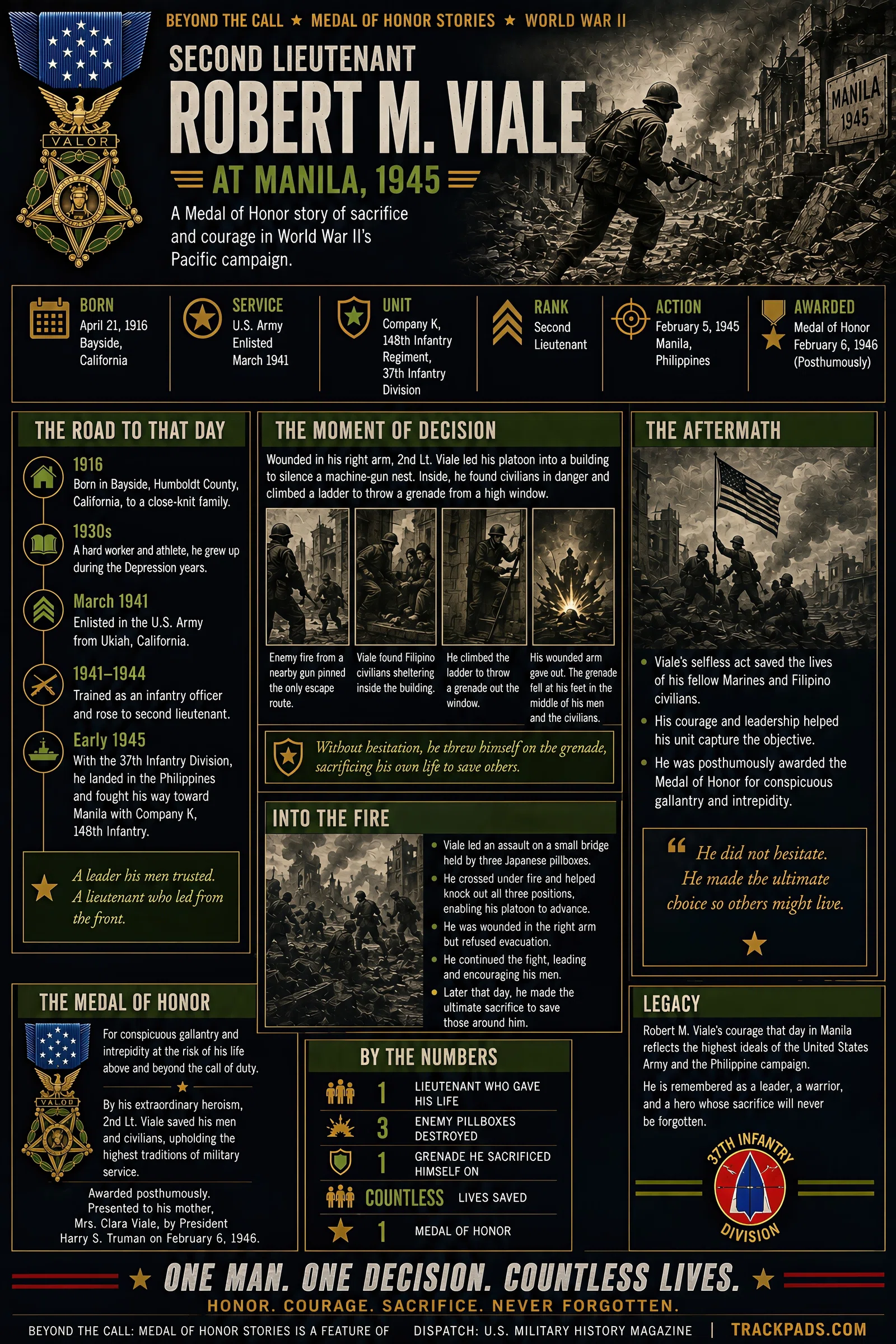
The stairwell reeked of smoke and dust as Second Lieutenant Robert M. Viale led his men into the shattered building. Outside, the thunder of artillery and the sharp, flat crack of machine guns bounced between the stone walls of Manila’s streets. A Japanese gun at a nearby corner had locked down the only escape route. Every time an American tried to cross the intersection, tracers stitched the pavement waist-high.
Inside, Viale moved room to room, searching for any way to silence that gun. In one darkened chamber he found Filipino civilians packed together, eyes wide, clutching children and a few bundles of belongings. In another, a narrow ladder rose to a small window high in the wall, looking out toward the enemy position.
Viale was already hurt, his right arm wounded from the brutal fight at a nearby bridge. But he was also left-handed, and he judged he could lob a grenade from that awkward window better than anyone else in the platoon. Cradling an armed grenade, he started up the ladder toward the small square of light.
Halfway up, his injured arm failed him. The grenade slipped, clattered to the floor, and began its brief, merciless countdown. Around him were his own soldiers and the civilians he had just discovered. There was no time to warn, no clear place to throw it where the blast would spare them. In that instant, Robert Viale made his decision and turned back toward the falling grenade.
The Road to That Day
Robert M. Viale was born on April 21, 1916, in Bayside, a small community in northern California’s Humboldt County. He grew up in a world of sawmills, coastal fog, and tight-knit towns scattered along the Pacific shore. Like many men of his generation, his early adulthood was shaped first by the hard years of the Great Depression and then by the gathering storms overseas.
By March 1941, with war already raging in Europe and Asia, Viale had joined the United States Army from Ukiah, California. The peacetime force he entered was rapidly expanding and transforming, preparing for a conflict that seemed more likely with each passing month. Training turned civilians into riflemen and small-unit leaders, and Viale proved capable enough to rise into the officer ranks. In his formal Army portrait, he appears steady and serious, the face of a young man trusted to lead others into danger.
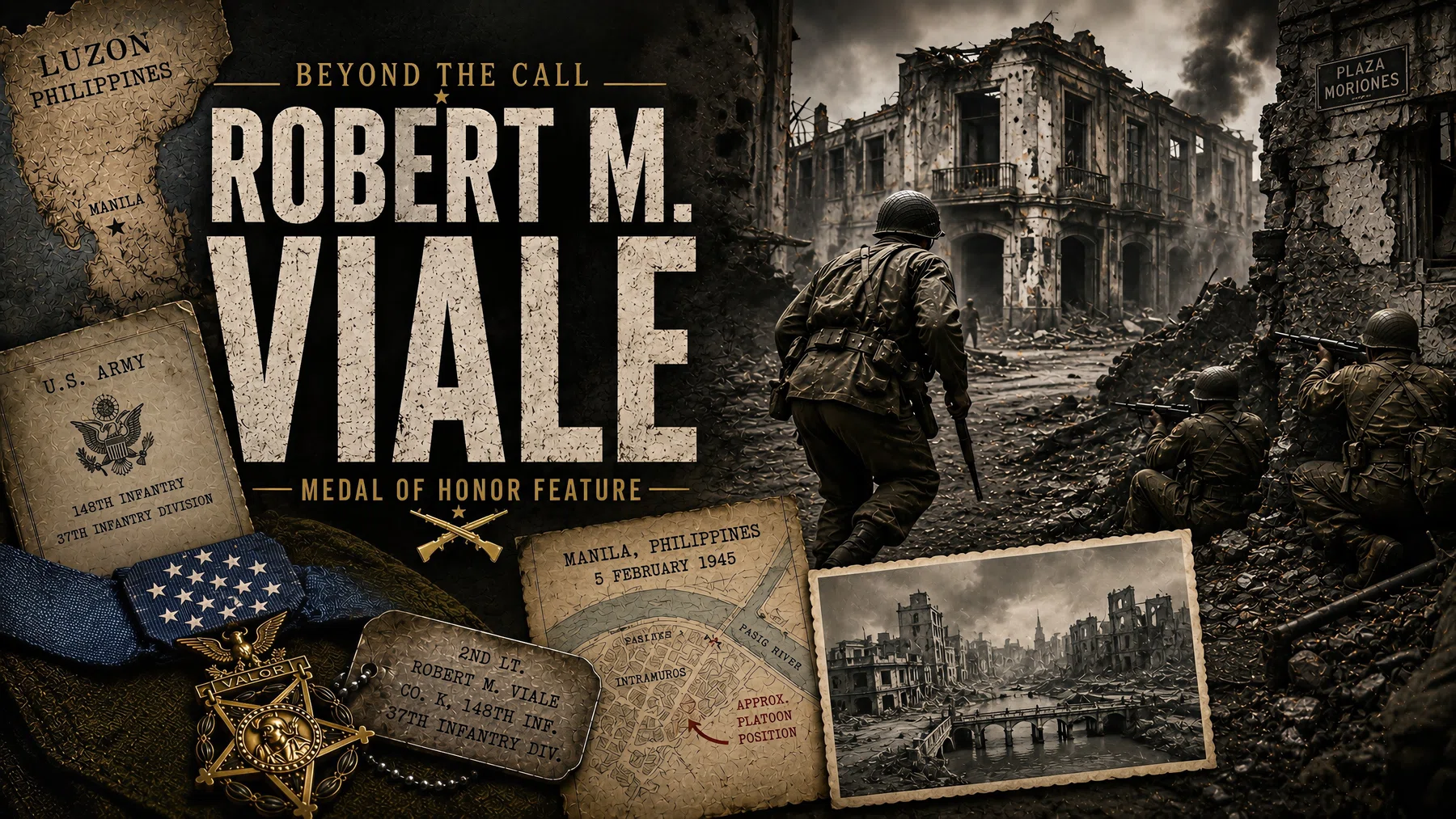
He was eventually assigned as a second lieutenant in Company K, 148th Infantry Regiment, part of the battle-tested 37th Infantry Division. By early 1945 that division had been fighting its way across the Pacific islands and was now committed to the liberation of Luzon in the Philippines. For officers like Viale, the campaign meant a relentless grind of patrols, street fighting, and close-quarters engagements against dug-in Japanese defenders.
At twenty-eight years old, Viale was old enough to carry responsibility for dozens of lives, yet still young by any peacetime measure. His job was to take a rifle platoon where it was ordered to go, often along streets and through buildings already shattered by shellfire. In the days leading up to February 5, 1945, Company K pushed deeper into Manila, closing on key bridges and intersections the enemy was determined to hold. That morning, Viale and his platoon were sent toward a small bridge—one more objective in a city full of them—without knowing that before the day was out, he would face a choice that no training schedule could prepare him for.
Into the Fire
The operation that brought Second Lieutenant Viale to that shattered stairwell began with a push toward a small bridge on a Manila side street. Enemy engineers had already blown sections of the road to canalize the American advance, turning likely paths into killing zones. Company K, 148th Infantry, was ordered to keep moving, because every stalled platoon slowed the liberation of the city and gave the defenders more time to dig in. Viale’s platoon took the lead, picking its way through rubble and shell craters as the sounds of other firefights echoed from nearby blocks. Progress was slow, but the bridge ahead was the only way forward for their part of the line, so they kept going.
As they neared the span, fire erupted from three concealed pillboxes covering the crossing. Concrete positions looked out over the bridge and the approaches, and the first men who tried to move into the open were driven back by machine gun bursts and grenades. Staying put was not an option, since the platoon was exposed in the street and any delay risked artillery or mortar concentrations. Viale decided they had to knock out the strongpoints from close range. He organized a small assault group and had the rest of the platoon lay down covering fire while smoke grenades were thrown to blind the enemy. Under that thin curtain of smoke, he and two men ran across the bridge toward the nearest pillbox.
At close quarters he led the attack, placing explosives and grenades where they would do the most damage. The first enemy position fell, silenced by his own actions at the embrasure. The remaining pillboxes were still dangerous, but the initiative had shifted. Working with a companion and a bazooka team he had summoned, Viale helped direct fire onto the other two positions until they were knocked out as well. During this fight he was hit in the right arm, a wound that was serious enough to cause significant pain and weakness, yet not enough to justify leaving the field when his men still needed him. He had the wound dressed as best the medics could manage under fire, then resumed his place at the front of the platoon.
With the bridge secure, Viale pushed his men ahead through streets raked by mortar bursts and framed by burning buildings. Flames from earlier demolitions and shelling licked at the sides of houses and shops, turning some blocks into narrow canyons of smoke and heat. The objective was to clear a route and reduce enemy positions that threatened other American units moving nearby. As they advanced, they came under fire again, this time from a machine gun emplaced at a street corner that dominated the only available path forward. The gun’s field of fire made the intersection a death trap. Any attempt to rush straight across would likely result in heavy casualties, and there was no easy way to flank without exposing the rest of the company.
Searching for another angle, Viale led his men into a nearby building that looked out toward the enemy gun. Inside, the darkness and dust contrasted sharply with the harsh daylight outside. The platoon moved carefully, checking rooms and windows, trying to find a vantage point from which they could suppress or destroy the machine gun. In one room they came across a group of Filipino civilians, huddled together and terrified, some clutching children, others gripping whatever belongings they had grabbed before fleeing the fighting. The soldiers now carried a responsibility that went beyond their own survival and the success of the mission. These civilians were trapped in the same killing zone, and any misstep could doom them.
In another part of the building, Viale found a small window high in a wall, accessible only by a ladder. From that vantage point, a well-thrown grenade might reach the machine gun position that dominated the street. One of his men had already tried and failed to make the throw, misjudging the distance and angle from the cramped perch. Taking stock of the situation, Viale considered the layout of the room, the position of the ladder and window, and his own abilities. He was left-handed, which he believed gave him a better chance of making the difficult throw through the restricted opening. Despite the pain and weakness in his wounded right arm, he decided that the risk was worth taking.
Cradling an armed grenade in his good hand, he started up the ladder toward the small square of light. The room below held both his own soldiers and the civilians he had just discovered. They waited in tense silence as he climbed, knowing that a successful throw might break the enemy’s hold on the intersection and open their path to safety. Halfway up, his injured arm failed him at a critical moment as he shifted his weight to balance and aim. The grenade slipped from his grasp and fell back to the floor, its fuse already burning down the last few seconds.
Viale dropped from the ladder and reached the grenade. Training and instinct might have driven another man to throw it as far as possible, even at the risk of exposing the people in the room to fragments. Instead, he looked for a place where the blast could be contained, some recess or corner that might spare those around him. There was no good option. Any throw toward a doorway or window would send shrapnel back into the crowded interior. In that compressed sliver of time, he made his final choice. Turning toward the wall, he pulled the grenade close against his body, bent over it, and absorbed the explosion himself. The blast killed him within minutes, but the soldiers of his platoon and the civilians in the building survived because of what he had done.
The Citation, Decoded
The official Medal of Honor citation for Robert Viale begins with the phrase “conspicuous gallantry and intrepidity above and beyond the call of duty.” In plain language, this means that his courage was not only visible to everyone around him but also far exceeded what could reasonably be required of any officer. Gallantry and intrepidity describe a willingness to face deadly risk with clear understanding of the danger. For Viale, this was not a single moment but a chain of decisions, from leading the charge across the bridge against pillboxes to continuing the advance despite his wound, and finally to using his own body to shield others from an exploding grenade.
The citation describes how enemy demolitions forced him to change his route through the city, then notes that he personally led the first platoon toward the bridge where heavy fire halted the unit. Those words capture a scene in which an officer does not stay back with the command group but instead takes the point and shares the same risks as his men. When it states that he crossed the bridge with two men behind a screen of grenade smoke, the citation condenses seconds of movement during which a few soldiers sprinted through a lethal zone where a single clear burst from a machine gun could have cut them down. His painful wound to the right arm, mentioned in the citation, underscores that he had every justification to fall back for treatment yet chose to continue leading.
The final portion of the citation focuses on the moment in the building, where civilians and soldiers were trapped together under the threat of an enemy machine gun and a falling grenade. Phrases about “finding no way to get rid of the grenade without exposing his own men or the civilians to injury or death” translate into a brutally simple arithmetic. He had perhaps five seconds to act. He could throw the grenade away and hope, or he could take the full force of the blast himself. When the citation concludes that he “held it close to his body and bent over it as it exploded,” it is describing a conscious decision to die so that others would live. In that explanation, the abstract words “above and beyond the call of duty” become something concrete: a single human being choosing to absorb an explosion with his own body in a small, smoky room in Manila.
Why It Mattered
Second Lieutenant Viale’s actions in Manila unfolded at the level of a single platoon, yet they carried weight far beyond one room in one burning building. At the tactical level, his leadership at the bridge allowed his company to break through a carefully prepared defensive line that could have halted movement along that vital route. Neutralizing three pillboxes with a small assault group opened the crossing for the rest of the battalion and reduced the threat to other units operating nearby. The city fight for Manila depended on dozens of such gains, each earned at close range under heavy fire.
Inside the building, the stakes were different but no less real. A single grenade detonation in a crowded, confined space could have killed or maimed multiple soldiers and civilians, stripping the platoon of leaders and experienced fighters while also taking innocent lives they had a duty to protect. By absorbing the explosion himself, Viale preserved the combat effectiveness of his unit at a moment when every rifleman mattered. He also ensured that the Filipino civilians trapped in that house survived to see liberation, which was the larger purpose of the campaign. If he had chosen to throw the grenade blindly or scramble for cover, the casualties might have been devastating, the mission delayed, and the moral cost far higher. Instead, his final act turned a likely disaster into a narrow escape and allowed his platoon to continue the push through Manila with their trust in one another strengthened rather than shattered.
Leadership and Character
Viale’s story highlights several enduring themes of military leadership that are as relevant today as they were in 1945. The first is personal responsibility for the mission and for the people under his charge. At the bridge, he did not delegate the most dangerous task to a junior soldier. He went himself, leading the assault across open ground to place explosives and grenades against hardened positions. That choice signaled to his platoon that their officer would not ask of them what he was unwilling to do personally, which builds a kind of trust that cannot be manufactured in training alone. His decision to continue leading after being wounded, when he could have withdrawn for treatment, reinforces the same pattern of responsibility carried into pain and fatigue.
A second theme is initiative under conditions of uncertainty. The demolitions and blocked streets forced Viale to improvise, selecting new routes, finding new angles of attack, and adapting quickly as the situation shifted. When a direct approach to the enemy machine gun was suicidal, he moved his men into the building, searched for the civilians, and then identified the narrow opportunity offered by the high window and ladder. These actions reflect an officer who could read terrain, think in three dimensions, and make decisions rather than waiting passively for perfect orders. Finally, there is the moral courage that drove his last act. In the seconds after the grenade fell, he made a choice that prioritized the lives of his men and the civilians over his own survival, not as an abstract idea but as a physical reality. That willingness to accept absolute personal risk for the sake of others is at the heart of what the Medal of Honor recognizes, and it speaks to a character formed long before that day in Manila.
Legacy and Memory
Robert M. Viale did not live to see the liberation of Manila completed or to return to northern California. He died within minutes of the explosion, and his body was later laid to rest back in his home region, far from the shattered streets where he fell. His Medal of Honor was awarded posthumously, recognizing not only the final moment in the building but the full chain of actions he took during that day’s fighting. For his family and community, the decoration served as both a tribute and a reminder of the cost paid by one young officer who never reached his thirtieth birthday. Over time, his name found its way into unit histories, regimental rolls of honor, and the broader story of the 37th Infantry Division’s campaign in the Philippines.
Beyond written records, Viale’s legacy also lives in the ways the Army and the country choose to remember him. A transport ship bearing his name once carried service members and supplies across the oceans, turning his story into a part of the daily life of those who served aboard. At military memorials and cemeteries, his name appears among many others who received the nation’s highest award for valor, each with a story anchored in a specific time and place. For students of military history, his example illuminates the realities of urban combat and the burden of command in close quarters among civilians. For veterans and those still serving, it offers a concrete image of leadership that protects the vulnerable even when there is no safe choice. Remembering Robert M. Viale means seeing more than a citation on paper and recognizing the human being who made a final decision in a smoke filled room so that others could live.