The Moment of Decision
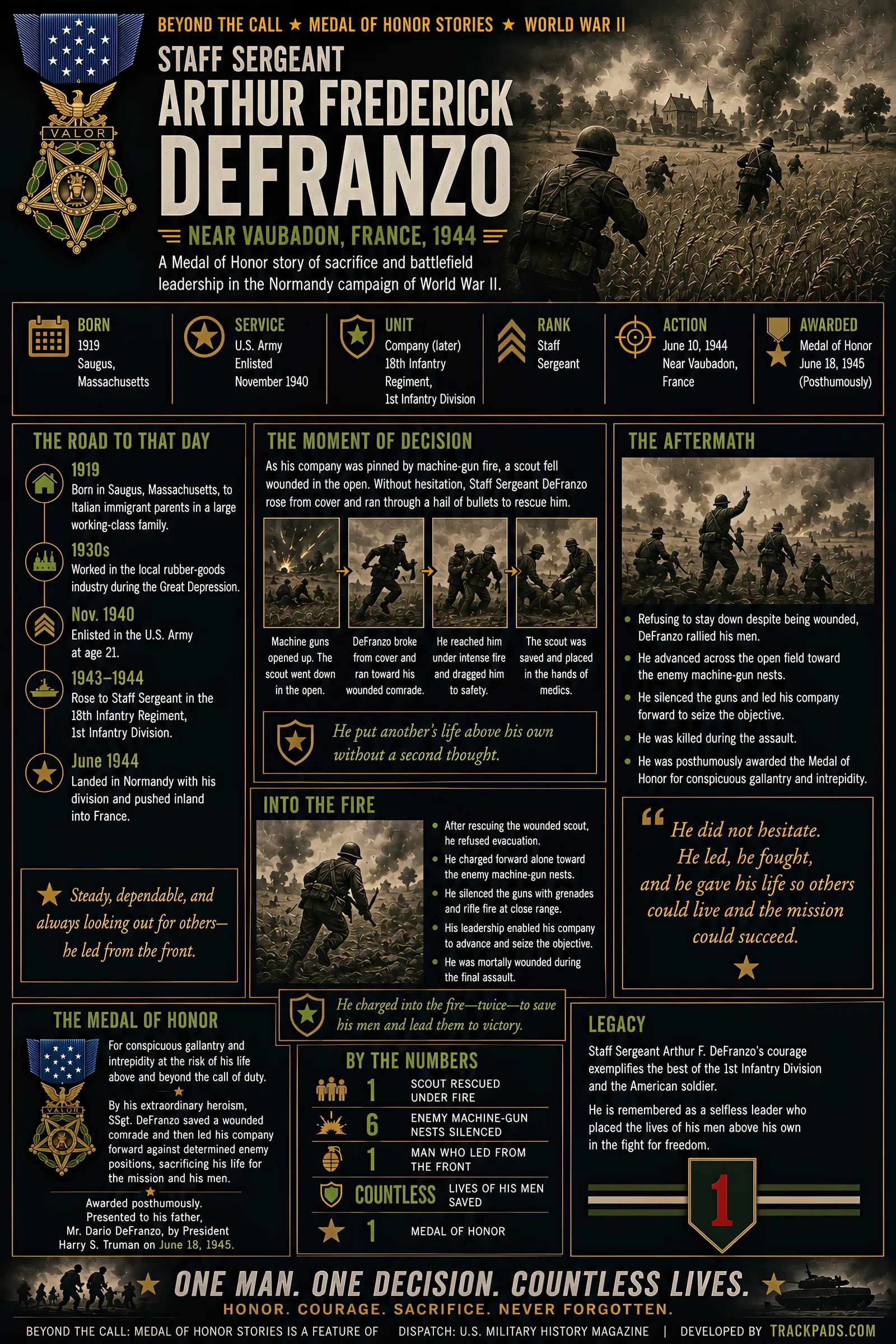
The wheat in the Norman field barely reached a man’s knees, and that was part of the problem. There was nowhere to hide. On 10 June 1944, just days after the landings in Normandy, the men of an infantry company stepped off from the cover of a hedgerow and into open ground near the village of Vaubadon. Their mission was simple to state and hard to survive: cross that field, find the German positions, and keep pushing inland.
A pair of scouts moved out front, silhouettes against the low rise ahead. The morning felt close and heavy, the only sounds the crunch of boots through the stalks and the distant thump of artillery. Then the German machine guns opened up. The flat crack of automatic fire swept the field, chewing into the earth. One of the scouts pitched forward and stayed down, motionless in the grain.
In seconds, the company was pinned. Men dove for what little cover there was—a shallow fold in the ground, a lone cart track—anything to get below the storm of bullets. The wounded scout lay between the lines, in full view of the enemy guns. Anyone who tried to reach him would have to sprint straight into that fire.
Staff Sergeant Arthur Frederick DeFranzo could see his man out there, just yards beyond where the rest of the company had frozen. The air was alive with tracer rounds, snapping overhead and striking sparks from the stone. He knew what every instinct screamed: stay down, wait for smoke, call for supporting fire. But the scout was bleeding into the soil of a country they had come to liberate, and time was running out. In that moment, DeFranzo made his choice. He rose from cover and stepped into the open, running toward the wounded man.
The Road to That Day
Arthur Frederick DeFranzo’s path to that Normandy field began thousands of miles away in Saugus, Massachusetts. Born in 1919 to Italian immigrant parents, he grew up in a large working-class family where paychecks were stretched and every pair of hands mattered. Sharing a small home with many siblings meant chores came early and privacy was rare; responsibility and looking out for one another were not abstract ideas but part of daily life.
He came of age during the Great Depression, finishing four years of high school before stepping into the world of adult work. Like many young men north of Boston, he found employment in the local rubber-goods industry, putting in long hours on factory floors where discipline and endurance were survival skills. Friends and family remembered him as steady more than flashy, the kind of person others gravitated toward when something heavy needed lifting or a job needed doing without complaint.
In November 1940, with war already raging overseas and his own country still officially at peace, DeFranzo enlisted in the United States Army. He was twenty-one—old enough to understand what he was signing up for, young enough to believe he could handle whatever came. Training turned the factory worker into an infantryman, and in time into a noncommissioned officer. As he rose to the rank of staff sergeant in the 18th Infantry Regiment of the 1st Infantry Division, he became the man at the front of the squad, responsible for leading younger soldiers who would look to him in the worst moments of their lives.
By the time his division sailed for Europe, it was a hardened outfit, seasoned by brutal fighting in earlier campaigns. The invasion of Normandy would be another test, and DeFranzo’s company would be in the thick of it—landing on the French coast, clawing its way inland through hedgerows, villages, and ambushes. On June 10, near Vaubadon, his unit stepped off on yet another advance across open ground. It was the kind of movement they had done many times before. This time, the enemy waited with carefully sited machine guns, and DeFranzo would be asked for everything he had learned and everything he was.
Into the Fire
When DeFranzo broke from cover, the field that had seemed merely exposed now felt like the center of every German sight. Machine gun bursts stitched the ground around him, throwing up fountains of dirt and torn wheat. He ran anyway, rifle slung, eyes fixed on the crumpled figure of the scout. A round caught him as he moved, punching into his body and driving the breath from his lungs. For a moment the world narrowed to pain and the metallic taste of blood. Then he was at the scout’s side, dragging the wounded man back toward the shallow folds of ground where the rest of the company hugged the earth. Somehow, under that curtain of fire, he brought the scout into relative safety and into the hands of the medics.
Medics and fellow soldiers tried to pull him fully into cover and urged him to stay down. The wound was serious and the normal expectation was clear: he had done his part, and others would carry the fight forward. DeFranzo refused. Looking down the line, he could see the company strung out along the hedgerow and prone in the field, every man pinned by the intersecting arcs of enemy fire. Remaining in place meant giving the German gunners all the time they needed to adjust, correct, and finish the job. Falling back across that same open ground would be worse. The only real path to survival for his men lay ahead, through the guns that were trying to kill them.
He rose again, this time not to rescue a single man but to pull an entire company forward. Moving back into the open, he advanced directly toward the unseen machine gun nests dug in along the far hedgerows. He fired as he went, short, controlled bursts from his rifle, shifting from muzzle flash to muzzle flash. The enemy answered with what the citation later called “unrelenting” machine gun fire, at least two guns working together so that no moment was truly safe. Yet his continued movement, upright and aggressive, tore at the paralysis that had gripped the rest of the company. If the staff sergeant was willing to walk into it, the younger riflemen could not justify staying flat in the dirt.
DeFranzo was hit again as he pressed forward, another impact that would have sent most men to the ground for good. He staggered, dropped to a knee, then pushed himself up and continued to close the distance. The field that had seemed endless now shrank yard by yard, each rush buying a little more space, each shot silencing another burst or at least forcing enemy gunners to duck. When he fell once more, he did not curl in on himself. Witnesses recalled him propped on an elbow, firing his rifle and using his free hand to motion his men forward, urging them to use the narrow window his reckless advance had opened.
The company responded. Seeing their leader out in front, bloodied but still pressing the attack, men began to rise and move in bounds from patch to patch of thin cover. As they did, much of the enemy fire focused on DeFranzo, who had become the most immediate threat in the eyes of the German gunners. In bearing the brunt of that fire, he turned himself into a kind of moving shield, buying seconds for his soldiers to close the gap. By the time they reached the middle of the field, the staff sergeant had pushed on until he was within about one hundred yards of the main enemy position, a distance comparable to the length of a football field with nothing solid between him and the guns.
Even then, as he fell yet again, he kept his weapon working and his arm moving, signaling the company not to stop. When they finally drew up behind him, preparing for the final push into the enemy line, DeFranzo somehow found the strength to rise once more and take the lead. It was not enough for him that the men had reached his position; he insisted on being the one in front. In those final moments he closed the last stretch, hurled grenades into the machine gun nest that had been tearing into his company, and destroyed the position outright. The price was his life. The result was a shattered enemy defense and an American company able to complete its advance with far fewer dead and wounded than the terrain and firepower should have claimed.
The Citation, Decoded
The official Medal of Honor citation for Arthur Frederick DeFranzo begins with the familiar but weighty phrase “conspicuous gallantry and intrepidity at the risk of his life above and beyond the call of duty.” In plain terms, “conspicuous” means that his courage was not hidden or known only through later reports. It was visible to everyone in that field, from the pinned riflemen to the enemy machine gunners who could not ignore the single figure walking toward them. “Intrepidity” is a formal word for a kind of stubborn fearlessness, not the absence of fear but the decision to act in spite of it. In DeFranzo’s case, that meant leaving cover again and again even after serious wounds, each time fully aware that he might not return.
The citation notes that as scouts were moving across an open field, enemy machine guns struck down one of the men. This is the moment readers met at the start of the article, a slice of time in which the situation could still have unfolded in many different ways. By moving into the open to reach the wounded scout, DeFranzo accepted near certain exposure to those same guns. Being hit and yet still dragging the scout to safety is what the citation compresses into “courageously moved out in the open” and “brought the man to safety.” Each phrase covers seconds of crawling, lifting, and pulling under fire, work that feels much longer than the neat sentence suggests.
Later lines describe him reentering the field, leading the advance while “at least two machine guns” poured “unrelenting fire” on him. That wording points to more than a single burst or lucky dash; it tells us he stayed upright long enough for enemy gunners to track him continually. The detail that he pushed on until he was within one hundred yards of the enemy position gives a sense of scale, a nearly full field of fire crossed under constant threat. Finally, the citation records his “final gesture of indomitable courage” as he rose despite multiple wounds to throw grenades and destroy the machine gun that had dominated the field. Those formal words try to encompass a harsh reality: a noncommissioned officer choosing, again and again, to risk and then to give his life so that the men behind him could live and the mission could succeed.
Why It Mattered
On the scale of a map, the field near Vaubadon was only one of many small objectives assigned to infantry companies after the Normandy landings. On the ground, it was life or death. The German machine gun positions that caught DeFranzo’s company in the open were placed to stop exactly this kind of advance, to pin attacking troops in the wheat and force them to fall back, broken and disorganized. By drawing fire onto himself and then destroying a key machine gun nest at close range, he cracked open a position that could have bled the company white. His men were able to push through the killing zone, carry the attack forward, and secure ground that otherwise might have taken many more lives to seize.
Tactically, his actions turned a stalled assault into a successful advance. Instead of an exposed withdrawal across the same open field, the company moved forward and forced the enemy to yield. That advance helped maintain the momentum of the broader push inland from the beaches, the grinding series of small fights that together expanded the fragile bridgehead in Normandy. In a campaign where every hedgerow and crossroad had to be fought for, DeFranzo’s decision meant one less strongpoint for later units to reduce and one more link in the chain of progress away from the coast. The men who lived because he took the lead carried that memory with them long after the field itself faded from the headlines.
Leadership and Character
Arthur DeFranzo’s conduct on 10 June reveals a particular kind of leadership that is common in descriptions of the best noncommissioned officers. It is the combination of professional skill, personal courage, and an almost instinctive willingness to accept risk for the sake of others. As a staff sergeant, his authority did not come from rank alone but from the trust his soldiers placed in him. When he went back into the open after being wounded, he was not just performing an isolated brave act. He was showing his men that their lives and the mission came first, even before his own safety. That kind of example cannot be ordered into existence; it is earned over months and years of steady conduct.
His decisions in that field also show a clear understanding of responsibility. He did not treat the pinned company as someone else’s problem or wait for instructions that could not reach him in time. Instead, he assessed that staying in place meant destruction, and that someone had to move first if anyone was to survive. Modern service members and civilians can see in this a lesson about initiative under pressure: there are moments when waiting for perfect solutions is not an option, and imperfect but courageous action can change the outcome for many. His refusal to stop, even when gravely wounded, also speaks to endurance and a sense of duty that went deeper than fear or pain. It is a demanding standard, but one that continues to resonate with those who lead others in dangerous or uncertain work.
Legacy and Memory
Staff Sergeant Arthur Frederick DeFranzo did not live to see the end of the war he helped to win. He died on that French field, far from the streets of Saugus where he had grown up and from the factory floors where he had worked before the Army. News of his death and the story of his actions traveled home in the form of official notifications and the quieter, more personal letters sent by comrades and commanders. In time, his nation recognized what he had done with its highest award for valor, presenting the Medal of Honor to his family in his stead. The medal itself became a tangible link between a grieving household in Massachusetts and a faraway battlefield in Normandy.
His legacy did not end with the formal words of the citation or the ceremony that followed. In his hometown, his name became part of the local landscape, remembered in community spaces, memorials, and stories passed down through generations. For the Army, he remained an example of what a noncommissioned officer can be at the sharpest edge of combat. For students of military history, his story offers a window into the brutal close combat of the hedgerow country and the human qualities that allowed small units to prevail under appalling fire. Today, visitors who pause at memorials that bear his name, or who read his citation and the accounts of that day, are invited to see him not just as a figure in uniform but as a son, brother, worker, and leader who gave everything he had for the men beside him and the cause he served.