The Moment of Decision
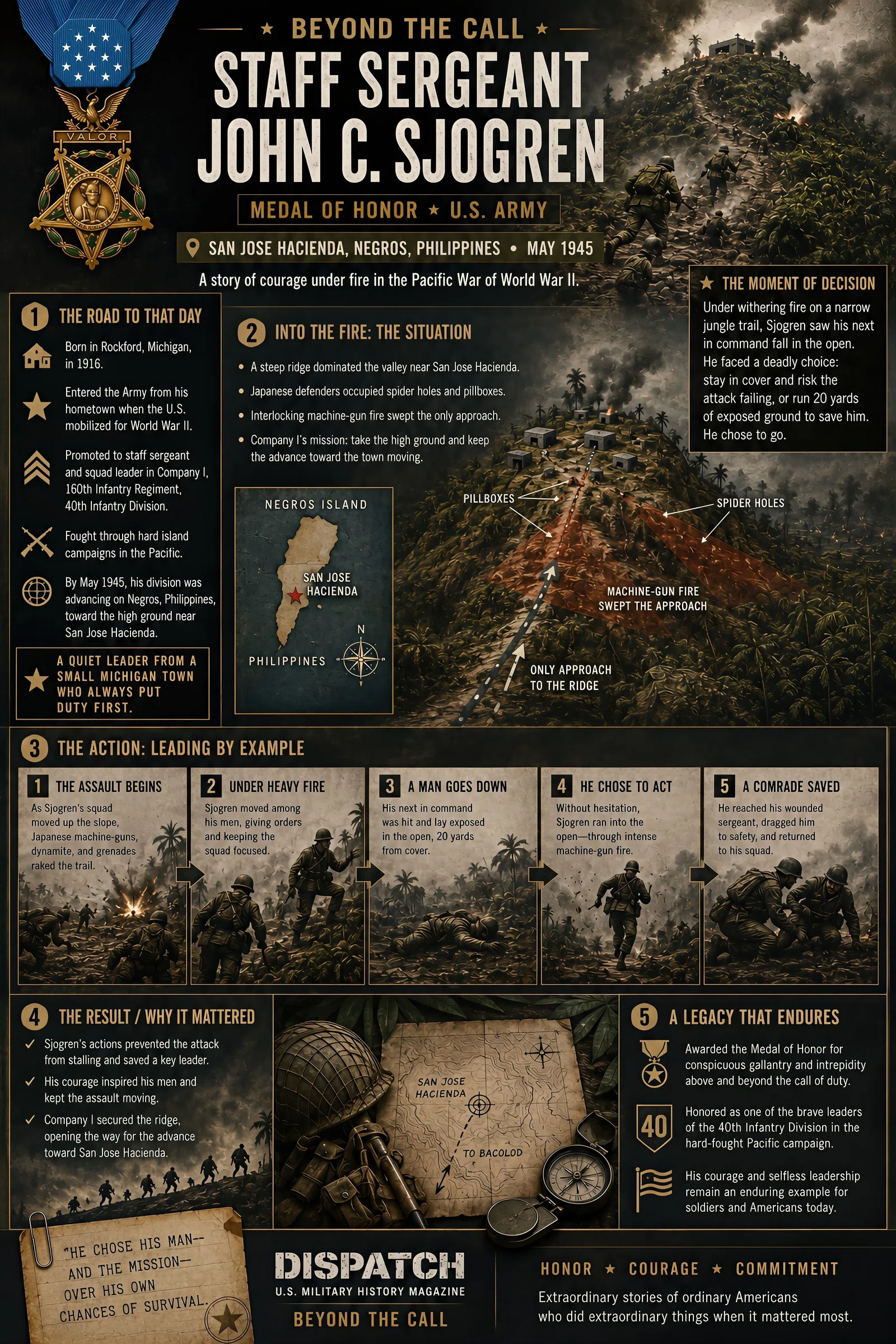
The ridge near San Jose Hacienda rose steep and stubborn out of the jungle, a wall of earth and rock that dominated the valley floor. Somewhere up there, hidden in spider holes—small, camouflaged fighting pits—and pillboxes, Japanese soldiers waited behind interlocking bands of machine-gun fire. To reach the crest, Company I of the 160th Infantry Regiment had only one narrow approach, a trail that funneled men into a killing zone. Staff Sergeant John C. Sjogren, leading the first squad, knew that if his element failed, the entire company’s attack would stall under the guns above.
The first bursts cracked out as his men began to climb, bullets whipping branches and kicking dirt from the slope. Explosions from thrown dynamite charges showered them with soil and splinters. Sjogren moved among his soldiers, shouting orders over the roar, pausing only long enough to pull the pin on another grenade and send it arching toward an unseen firing position. Then he saw one of his key men, the next in command on the far flank, suddenly crumple and lie still in the open. The only way to him was twenty yards of bare ground raked by fire.
In that instant, Sjogren faced an impossible choice: stay under what little cover the ridge offered and preserve the attack, or break from safety to reach his wounded sergeant and almost certainly draw every weapon on the hillside. He did not signal for a volunteer, and he did not wait for orders. He simply rose, stepped into the open, and ran straight into the storm, choosing his man—and the mission—over his own chances of survival.
The Road to That Day
John Carleton Sjogren was a product of small-town America in the early twentieth century. Born in Rockford, Michigan, in 1916, he grew up in a community where everyone knew everyone else and where the hardships of the Great Depression demanded steady work and quiet endurance from families like his. Those who remembered him later recalled an unassuming man more interested in doing his job than in drawing attention to himself, traits that fit easily into the culture of the citizen-soldiers who would soon be called to war.
When the United States mobilized for World War II, Sjogren entered the Army from his hometown, trading Michigan’s fields and small factories for training grounds crowded with new recruits. Infantry training was demanding and often monotonous—long marches, weapons drills, and endless repetitions of small-unit tactics—but it was there that he learned how to move a squad across open ground, how to read terrain, and how to keep frightened men focused under pressure. Over time, his reliability and calm under stress brought him promotion to staff sergeant and leadership of a squad in Company I, 160th Infantry Regiment, part of the 40th Infantry Division fighting its way across the Pacific.
The formal portrait on page 1 of the wartime citation packet shows a square-shouldered soldier in dress uniform, ribbons neat on his chest and a level, steady gaze that suggests more resolve than swagger. It is the face of a man his neighbors in Rockford would have recognized from church or the corner store, not from a recruiting poster. After serving through hard island campaigns, Sjogren and his division were sent to the Philippines, tasked with driving entrenched Japanese forces from rugged ground on islands like Negros. By May 1945, his company was pushing toward the high ground near San Jose Hacienda. The ridge ahead, crowned with pillboxes and spider holes, would test every lesson he had learned since leaving Michigan—and demand more of him than any training field ever could.
Into the Fire
At San Jose Hacienda on Negros, the ridge that blocked Company I’s path was more than just a rise in the ground. It was a fortified spine of earth studded with spider holes and pillboxes, each position placed so its fire overlapped the next and swept the only usable approach. The company’s mission was simple to describe and deadly to execute: take that high ground so the larger advance toward the town could continue. Only one squad at a time could move up the narrow slope without bunching into a single, vulnerable mass. Staff Sergeant John C. Sjogren’s squad would go first, feeling out the defenses and opening a path for the men behind him.
The opening moments of the assault were all noise and confusion. As Sjogren deployed his men along the lower slope, a hidden pillbox on a knoll opened fire, its machine gun stitching the trail with bursts that sent soldiers diving for what little cover they could find. Grenades and improvised dynamite charges hurled from the heights burst in the scrub, showering them with dirt, splinters, and rock. Communication was reduced to shouted fragments—orders to shift left, to keep moving, to stay low and watch the flanks. For the squad leader, every few seconds brought a new decision: where to crawl next, which man to push forward, when to risk one more sprint uphill before the enemy corrected their aim.
Then came the moment when the attack nearly collapsed. On the opposite flank, Sjogren’s next in command was hit hard and lay exposed in the open, closer to the enemy than to safety. Any instinct for self-preservation argued against moving toward him; the twenty yards of bare slope between them were already under direct fire. Yet Sjogren did not pass the problem along or wait for the fire to slacken. He rose from cover, ran straight into the beaten zone, and dragged the wounded man back to a fold in the ground. Only after administering first aid and ensuring his sergeant was shielded from the worst of the fire did he turn back toward the crest and the task that still remained.
With his squad pinned and the pillbox still dominating the slope, Sjogren began to change the shape of the fight one position at a time. He crawled forward alone, using shallow depressions and brush where he could, sometimes simply flattening himself against the hillside as bursts swept overhead. Ahead of him lay a line of spider holes—individual fighting pits that guarded the final approach to the main strongpoint. From each came sporadic rifle shots and the flash of grenades rolling downhill. Taking the initiative, he closed with them, pulling the pin on his own grenades and dropping them into the concealed pits before the defenders could adjust. By the time he had finished working along that line, eight Japanese soldiers lay dead and the route to the pillbox was suddenly far less defended.
Reaching the last stretch of ground before the pillbox required yet another change in tactics. Sjogren crawled to within a few feet of the emplacement, hugging the earth while his men concentrated every available rifle on the firing slit above him. With the enemy’s attention fixed outward, he began the dangerous work of feeding grenades directly into the narrow opening. Each time he tossed one in, there was a desperate scramble inside the position, and sometimes the grenade came spinning back out to explode on the slope. Fragments from one blast tore into his hand and back, but he refused to break contact. Instead, he increased the tempo, sending grenades through the slit faster than the defenders could react, until the machine gun fell silent and the pillbox was finally dead ground instead of a living threat.
Wounded and short of breath, Sjogren might have pulled his squad back to regroup. Instead, he used the success against the first pillbox as a springboard. Calling his men forward, he organized them into a moving line of fire and maneuver that worked methodically along the ridge. Each remaining strongpoint received the same treatment: suppressing fire from the squad, then a personal approach and the final blow delivered at close range with hand grenades. At one position, the enemy tried to keep their machine gun blazing as he neared, only to have Sjogren seize the weapon by its barrel and wrench it out through the embrasure before blasting the occupants. The ridge that had seemed untouchable minutes before was taken apart pillbox by pillbox.
By the time the shooting stopped, Sjogren had single-handedly destroyed nine pillboxes and killed forty-three enemy soldiers, all while directing his squad’s advance and absorbing his own wounds. The path up the precipitous ridge, once under complete enemy control, now lay open for the rest of Company I to follow. With the key defensive line broken, the company could push over the crest and continue the larger advance toward San Jose Hacienda. On that narrow slope in May 1945, the outcome of a company attack—and the safety of dozens of American soldiers—turned on the actions of one staff sergeant who refused to halt until every gun on the ridge was silent.
The Citation, Decoded
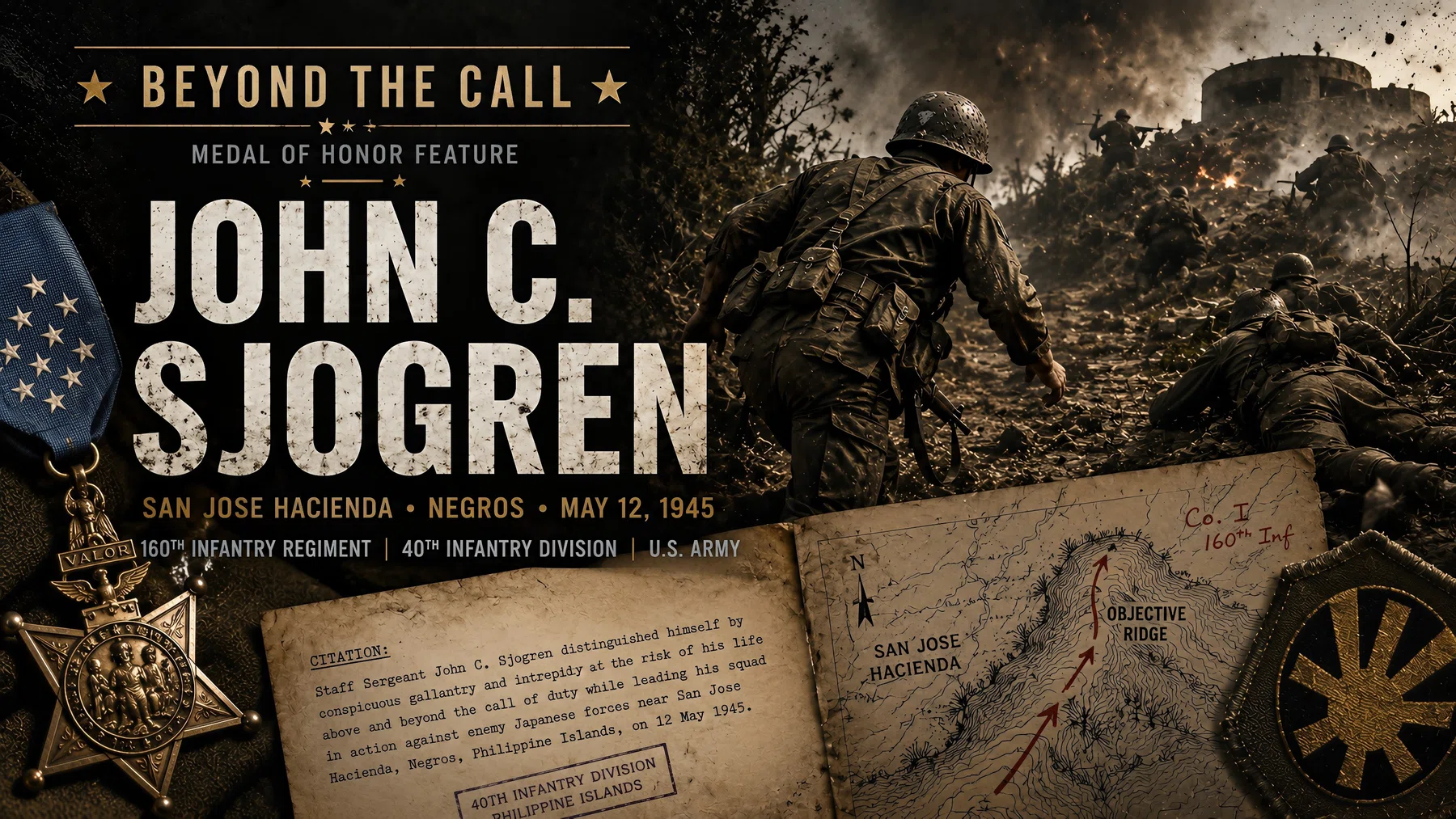
The official Medal of Honor citation for John C. Sjogren compresses this brutal climb into a single, densely written paragraph, beginning with the image of “a high precipitous ridge defended by a company of enemy riflemen” in spider holes and pillboxes. That phrase marks the scale of what his squad faced: not a stray outpost, but a full company’s worth of defenders whose weapons overlapped to leave no safe line of approach. When the citation notes that “only one squad could advance at a time,” it reflects the narrow, funneled terrain that prevented the company from massing its strength. For Sjogren, leading the first squad meant accepting that his men would endure the full weight of that defense while others could only watch from below.
The citation’s account of him crossing “20 yards of exposed terrain” to reach his wounded second-in-command captures only part of the risk involved. On that slope, there was no trench, wall, or rock to break the fire; those steps were taken in full view of the pillbox and every rifleman nearby. Moving a casualty under such conditions required not just courage, but a clear sense of responsibility—refusing to abandon a key leader and the man behind the rank, even when the mission still demanded his presence at the front. Later, when the citation describes him “advancing directly into the enemy fire” and killing eight men in spider holes, it is marking the deliberate choice to close with each small position rather than seek a safer, indirect solution.
Terms like “heroic bravery, aggressiveness, and skill as a soldier” can sound formulaic on the page, but in this case they point to specific, concrete behaviors. His aggressiveness lay in the way he kept pressing the attack despite wounds and repeated close calls with exploding grenades. His skill showed in the way he coordinated his squad’s suppressive fire while personally delivering the grenades that destroyed each pillbox, turning textbook small-unit tactics into lived action under extreme pressure. The final lines, crediting him with single-handedly killing forty-three enemy soldiers and destroying nine pillboxes, underscore not a tally for its own sake but the reality that one noncommissioned officer’s decisions cleared the way for an entire company to survive and move forward. In that sense, “conspicuous gallantry” on the citation equates to lives saved on the ground.
Why It Mattered
On that ridge above San Jose Hacienda, the stakes were bigger than one squad’s survival. The Japanese company dug in along the crest had turned the heights into a hinge of their local defense, able to sweep the only practical approach route with machine-gun and rifle fire. As long as those pillboxes held, Company I’s attack would stall on the lower slope, leaving the rest of the regiment exposed and the advance toward the town behind schedule. By clearing the spider holes and destroying the main strongpoint, Staff Sergeant John C. Sjogren did more than win a personal fight; he opened the door for his company to get over the top and push the line forward.
Tactically, his actions broke the backbone of a carefully prepared position. The defenders had planned to force repeated, bloody assaults against the same narrow trail, counting on steep ground and overlapping fire to grind down any attack. When Sjogren killed the gunners in the pillboxes and silenced the machine guns, that plan unraveled in minutes. The company could move up in depth instead of one squad at a time, redistribute its firepower, and seize the rest of the ridge before the enemy could regroup. Positions that had dominated the valley moments earlier became footholds for American soldiers, and the “impregnable” hill turned into a liability for its former owners.
Operationally, the ridge fight was one small piece of a larger effort to clear the central highlands of Negros and secure the southern Philippines. Japanese forces on the island had retreated into rugged interior terrain, hoping to slow the American advance and stretch the war out month after month. Every captured hilltop and ridgeline reduced their ability to stage counterattacks, observe movement, or control local roads and trails feeding the coastal areas. By leading his squad in a successful assault on this key feature, Sjogren helped maintain the momentum of a campaign that aimed to break that interior defensive belt and free the surrounding communities from occupation.
There is also the quieter impact on the men watching from below. Soldiers in Company I saw one of their own run through exposed fire to save a wounded sergeant, then keep attacking uphill despite being wounded himself. That kind of act changes how a unit judges what is possible. If the assault had failed, the company might have spent days pinned under the same guns, losing men in piecemeal attacks against the same ridgeline. Instead, they went forward behind a cleared path, carrying with them the knowledge that one noncommissioned officer’s refusal to stop had turned a deadlock into a breakthrough.
Leadership and Character
The story of John Sjogren on the ridge is, at its heart, a story about how character expresses itself under pressure. One recurring theme is responsibility. When his second-in-command went down on the bare slope, Sjogren could have reasoned that the mission demanded he stay under cover and push the rest of the squad forward. Instead, he treated the wounded man as both a person and a leader whose loss would hurt the squad, and he crossed those deadly twenty yards himself. That decision reveals a leader who puts his people first without losing sight of the task at hand, accepting personal risk to preserve both a life and the integrity of his small unit.
Another theme is persistence in the face of repeated setbacks. The grenade duels at the pillbox were not a single clean exchange; several charges came spinning back out or exploded close enough to send fragments into his body. In each case he adjusted, closed the distance, and tried again rather than breaking off and waiting for someone else to solve the problem. That willingness to keep moving toward the source of danger, once a decision had been made, is a form of courage distinct from the first impulse to act. It is the disciplined follow-through that turns a brave idea into a completed task, even when the cost becomes clear along the way.
His path to that hillside also shows a kind of quiet determination that predates the firefight itself. Before the war, Sjogren had been classified as physically unfit for service because of spinal issues, only later persuading the Army to accept him for combat duty. After World War II he would serve again in the Michigan National Guard and be called to Korea, continuing to wear the uniform when he could easily have retired to civilian life. Taken together, these choices sketch a man who did not view service as a temporary interruption but as a responsibility he actively sought out.
For today’s leaders—military or civilian—the lessons in his story are tangible rather than abstract. Leadership at the small-unit level is often about making fast choices when none of the options are safe or clean, and about accepting risk personally instead of pushing it onto others. It is about knowing your people well enough that their losses are not just numbers on a report, and about nurturing the professional skill that allows bold decisions to succeed. Sjogren’s actions on the ridge show how training, persistence, and a deep sense of responsibility can combine in a single afternoon to change the outcome for many others.
Legacy and Memory
After the war in the Pacific, John Sjogren did not step away from service. He joined the Michigan National Guard and rose to the rank of first lieutenant, later deploying again when his unit was called to duty during the Korean War. When he finally retired from the Guard in the early 1950s, he returned to Rockford, living a comparatively quiet life in the same community that had sent him to war. Those who heard him speak at public events remembered a man reluctant to claim special glory, emphasizing instead that the greatest honor belonged to those who had not come home.
He died of cancer in 1987, decades removed from the ridge fight but still carrying the memories that came with it. In the years since, his hometown and state have taken steps to keep his story visible. His Medal of Honor and uniforms have been displayed in local institutions, allowing visitors to see not just the famous decoration but the everyday items of a citizen-soldier who returned to build a life after war. Exhibits at museums dedicated to Michigan’s military history preserve artifacts connected to his service, placing him alongside others from the state who answered the call in times of crisis.
Perhaps the most striking tribute stands in Rockford itself. In 2016, a life-sized statue of Sjogren was dedicated outside the Rockford Area Museum, the result of years of local effort to honor the town’s only Medal of Honor recipient. The figure, rendered in bronze, captures him not in a moment of ceremony but as a soldier—helmeted, equipped, and moving forward. It serves as a focal point for remembrance, giving shape to a name that might otherwise be just another line in a long roster. For residents and visitors alike, it offers a quiet reminder that the man who once charged a ridge on the far side of the world began and ended his life in this small Michigan community.