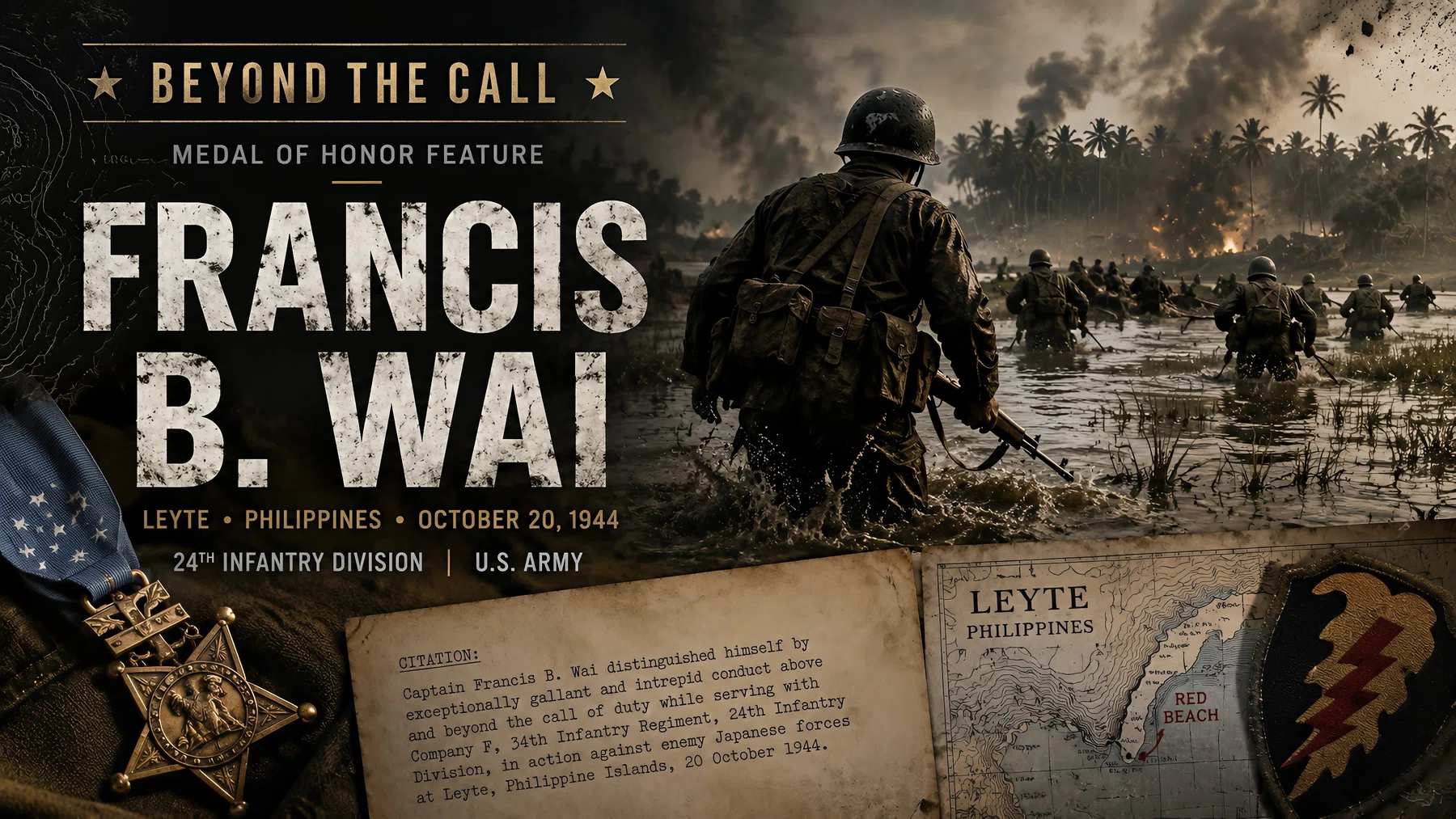
The Moment of Decision
The ramps drop into waist-deep surf and chaos. It is the morning of October 20, 1944, on a stretch of shoreline the maps call Red Beach. Ahead lies a narrow band of sand, beyond it a low palm grove and flooded rice paddies. Somewhere in that green fringe, Japanese guns have the approaches bracketed. As the first waves of soldiers tried to cross, the beach turned into a killing ground.
By the time Captain Francis B. Wai steps off his landing craft in a later wave, bodies and equipment already litter the sand. Men are hugging the thin line of the beach, pinned flat by machine-gun bursts that stitch the water and smack into the palm trunks behind them. Smoke drifts low. Orders are shouted, then swallowed by the crack of rifles and the whine of incoming fire.
Wai takes in the scene quickly: company commanders down, units mixed together, no one sure who is in charge. The flooded paddies beyond the sand offer almost no cover, just mud and water reflecting the muzzle flashes from the tree line. Staying put means more men will die in place; pulling back into the surf risks losing the landing altogether.
He stands up on the exposed sand where others are hugging the ground, calm and direct, gathering soldiers with his voice and his presence. Then, with deliberate steps into the open rice paddies—into the fire everyone else has been trying to escape—he leads the way inland, choosing in that instant to act far beyond the call of duty.
The Road to That Day
Years earlier, Francis Brown Wai had learned to read waves instead of bullet trails. Growing up in Honolulu, the son of a Chinese immigrant father and a Native Hawaiian mother, he spent his free hours in the Pacific surf and on playing fields. Classmates remembered a lean, fast athlete who seemed equally at home on a board, a track, a football field, or a baseball diamond. At Punahou School he earned letters in multiple sports, and on the mainland he continued that life of competition at Sacramento Junior College and then at UCLA, where he played football alongside his brothers.
Off the field he was just as serious. Wai finished college with a degree in banking and finance, with every expectation that he would return to Hawaii and join his father in real estate and business. The world, and his plans, changed as war clouds gathered. In 1940 he enlisted in the Hawaii National Guard. Within a year he had completed Officer Candidate School at Fort Benning and earned a commission as a second lieutenant at a time when few Asian Americans were given the chance to lead combat troops.
Assigned to the 34th Infantry Regiment of the 24th Infantry Division, he drilled on Oahu through the shock of Pearl Harbor, then shipped west as the division moved into the Pacific war for real. Training in Australia, fighting through the jungles and airfields of New Guinea, Wai built a reputation as a fit, unflappable officer who led from the front and knew how to keep men moving under fire. Those campaigns taught him how to read terrain, how to keep scattered units focused, and how to stay calm when everything went wrong. By October 1944, as the division prepared to help spearhead the return to the Philippines at Leyte, Captain Wai was a seasoned combat leader stepping into yet another landing craft—this time bound for Red Beach.
Into the Fire
On the morning of the Leyte landings, Red Beach was meant to be a straightforward objective. Naval gunfire had pounded the shoreline, and planners expected scattered resistance that could be pushed aside as the 24th Infantry Division moved inland. Instead, Japanese defenders had dug machine-gun and rifle positions into a palm grove behind the sand, using the flooded rice paddies as a moat of mud and water between themselves and the surf. When the first waves of assault troops tried to cross that open ground, they were met by precise, concentrated fire that stopped them cold. Officers fell, units lost cohesion, and men pressed themselves into the thin strip of sand, unable to move forward and unwilling to pull back into the sea.
Captain Francis B. Wai came ashore in the fifth wave, stepping from his landing craft into water already clouded by sand, smoke, and debris. He quickly realized that what should have been a steady push inland had stalled into confusion. Rifle companies were mixed together, some leaders were down, and the battered survivors of earlier waves were looking for direction as Japanese fire hammered the beach. Wai’s role on paper was that of an intelligence officer, but on that strip of Leyte he saw something more basic was needed: someone to stand up, take charge, and give the scattered soldiers a way off the killing ground.
Moving along the beach, he spoke directly to small groups of men, asking who they belonged to, pointing out landmarks inland, and turning a jumble of individuals into a fighting line. His calm under fire mattered as much as his orders. He stood where others crawled, using his own posture to signal that the only way out was forward. Once he had gathered enough soldiers to form a rough assault group, Wai did not stay at the rear to coordinate. He stepped into the paddies himself, wading through water and mud with a rifle and a Browning Automatic Rifle team close behind him, heading straight toward the invisible gun positions beyond the palm trees.
The ground he crossed offered almost nothing in the way of protection. The flooded fields were broken only by low dikes and narrow causeways; any man who rose above a crouch was instantly visible. Wai used that fact deliberately. Time after time, he exposed himself to enemy fire, standing or moving in the open so that hidden guns would reveal their positions by firing at him. Each burst that cracked past him or tore into the water around him told his men where to aim and where to maneuver. Behind him, soldiers who had been pinned down only minutes before now pushed forward by short rushes, using his movement as a guide and his courage as a shield.
As the improvised assault group advanced, they began knocking out Japanese strongpoints one by one. Some were shallow rifle pits; others were better-built bunkers cut into the tree line. The fighting was close and brutal, using grenades and automatic fire to clear each position. Wai kept pressing ahead, shifting his men to avoid the worst beaten zones and pointing out covered approaches where any existed, however slight. The palm grove that had seemed impregnable from the water slowly yielded, strongpoint after strongpoint falling as the American soldiers closed in. The momentum on that sector of Red Beach began to change. What had been a static, deadly stalemate was now a series of aggressive pushes inland.
Near the edge of the grove, the Japanese defense coalesced around a final pillbox that continued to rake the paddies with fire. Its low silhouette and careful siting made it hard to approach. Wai could have waited for heavier weapons or tried to call fire from offshore, but every minute under that gun’s sights cost lives and threatened to halt the hard-won advance. Gathering a small group around him, he moved again into the open, drawing the pillbox’s attention and allowing other soldiers to work closer along the dikes and depressions. In the last rush toward that position, he led from the very front. It was there, in that final assault, that he was shot and killed.
The men he had rallied did not stop when he fell. The same determination he had modeled in the paddies carried them the last few yards. They closed with the pillbox, silenced it, and then pushed past the grove to secure the inland edge of Red Beach. In the space of one savage advance, a leaderless, pinned-down landing zone had been turned into a viable beachhead. Later assessments of the day’s fighting noted that the speed with which that sector was secured owed much to the example and aggressive leadership of Captain Francis Wai in those crucial minutes after he came ashore.
The Citation, Decoded
The official Medal of Honor citation for Francis Wai opens with the familiar but heavy phrase “above and beyond the call of duty.” In plain terms, it recognizes that what he did on Red Beach went far beyond what could reasonably be asked of any officer. The citation describes how he landed in the face of “accurate, concentrated enemy fire” from gun positions in the palm grove. That is a formal way of saying that every step he took off the sand and into the paddies was under the sights of prepared machine-gun crews who had already proven they could stop entire assault waves.
When the citation notes that he found the first waves “leaderless, disorganized, and pinned down,” it captures the reality that combat units without commanders can quickly become clusters of frightened individuals. Wai’s decision to “immediately assume command” did not come with a formal order; it was a choice made on the spot, recognized only after the fact by the men who followed him and by those who later studied the battle. The words “clear and concise orders” reflect the way he cut through confusion, telling mixed groups of soldiers where to go and giving them a simple, achievable task: get off the beach and move on the enemy.
Another key phrase speaks of Wai “deliberately exposing himself to draw their fire.” That language carries more weight when you picture the scene: a man standing or moving upright in an open rice paddy, knowing that machine-gun crews are waiting for exactly that movement. By making himself the target, he turned the enemy’s advantage into a vulnerability, allowing others to identify and attack the hidden positions. Finally, the citation closes by stating that his “courageous, aggressive leadership” inspired the men, even after his death, and that his efforts were a major reason the beachhead was secured so quickly. Behind those formal words lies the simple, stark truth that one captain’s refusal to stay down helped turn a stalled landing into a foothold that opened the way for the liberation of the Philippines.
Why It Mattered
On the narrow scale of a single beach, Francis Wai’s actions changed the geometry of the fight. Before he arrived in the fifth wave, Red Beach had become a shallow grave: assault waves stalled on the sand, leaders down, and Japanese gun positions in the palm grove pouring fire into the stuck landing. By standing up, taking charge of mixed remnants, and personally leading the attack across the flooded paddies, he turned that static line into a moving front. Once the strongpoints began to fall and the last pillbox was silenced, the beach was no longer just a strip of sand under fire; it was the forward edge of a secure foothold. That meant additional troops, supplies, radios, and heavy weapons could come ashore without facing the same deadly bottleneck.
At the operational level, the stakes were far larger than one company’s advance. The landings at Leyte were the opening move in the campaign to liberate the Philippines, a campaign that would cut Japan off from vital resources and fulfill the long-promised return to Filipino soil. Each division’s beachhead was a link in that larger chain. If a sector like Red Beach had been delayed or thrown back, the tempo of the landing could have faltered, inviting counterattacks and complicating the push toward key airfields and road networks inland. Instead, the 24th Infantry Division was able to push forward from the shore, helping to anchor the broader lodgment on Leyte.
There was also a quieter kind of impact. Wai, a Chinese Hawaiian officer, embodied the reality that Americans of many backgrounds were fighting and dying to reclaim the Philippines. His example, known at first only to the men who watched him stride into the paddies, later became part of a wider story about courage and belonging. The beachhead he helped secure was physical ground; the story of how he secured it would become a piece of moral ground for later generations looking back on the war.
Leadership and Character
The citation’s formal language points to a handful of traits, but it is the details of that morning that reveal the person behind the words. Wai’s first instinct when he saw the chaos on Red Beach was not to look for his own headquarters or wait for a senior officer to appear. He simply began acting as the leader the situation needed, gathering scattered soldiers by name, gesture, and voice. That kind of initiative grows from years of being the person teammates rely on, whether on a football field in Honolulu and Los Angeles or in training grounds with the division. His athletic background had taught him to read a field quickly, move with purpose, and accept responsibility for the outcome.
Calm under fire is another theme that stands out. Witnesses remembered him walking upright across ground that others believed was impossible to cross, not with rash bravado but with a steady, matter-of-fact bearing. By deliberately exposing himself to draw enemy fire, he was not making a show; he was using his own risk to give his men information and an opening. That is moral courage as much as physical: a conscious choice to accept danger in order to give others a chance to live. His willingness to step beyond the role of an intelligence officer and command whichever soldiers would follow him speaks to a sense of duty anchored more in obligation to his men than in the boundaries of his assignment.
Modern leaders, military or civilian, can see in Wai’s example a model for leading from the front without losing sight of the people following. He did not berate frightened soldiers or wait until conditions were perfect. He gave clear, simple directions, showed what he asked others to do by doing it first, and kept moving toward the objective even as he knew the odds. His character shines through not in a single dramatic gesture but in the way his choices on that muddy field lined up with the habits of a lifetime: disciplined preparation, quiet confidence, and an unshakable sense that when something needed doing, he would not ask someone else to go first.
Legacy and Memory
Francis Wai did not live to see Leyte secured or the Philippines liberated. He fell in front of the last pillbox he helped silence, on the same day he came ashore. His body was eventually laid to rest at the National Memorial Cemetery of the Pacific, the Punchbowl, in Honolulu, bringing him home to the islands where he had grown up. For his actions in 1944 he was originally awarded the Distinguished Service Cross, a high decoration that still did not fully reflect what his comrades knew he had done on Red Beach. Decades later, a wider review of Asian American service in the Second World War took a fresh look at cases like his.
In 2000, his Distinguished Service Cross was upgraded to the Medal of Honor, and a White House ceremony presented the medal to his family. Among the group of upgraded awards, Wai stood out as the only Chinese American soldier ever to receive the Medal of Honor. That fact has made his story a touchstone in accounts of Asian American service, showing how courage in combat often outpaced the recognition granted at the time. His name appears not only on the roll of Medal of Honor recipients but also in discussions of how the nation has learned, slowly, to honor all of its heroes.
Today his memory is preserved in several ways. His grave in the Punchbowl offers a quiet place where visitors can pause and connect the sweeping histories of the Pacific war to a single, specific life. In Hawaii and on the mainland, schools and universities highlight him among their wartime alumni. Military history works on the Leyte campaign often pause to describe the stand on Red Beach and the captain who turned a pinned-down landing into a successful assault. Above all, his story invites readers to remember him not only as a name in a citation but as a son, brother, athlete, and officer whose last walk across a muddy field helped open the road back into the Philippines.
