The Moment of Decision
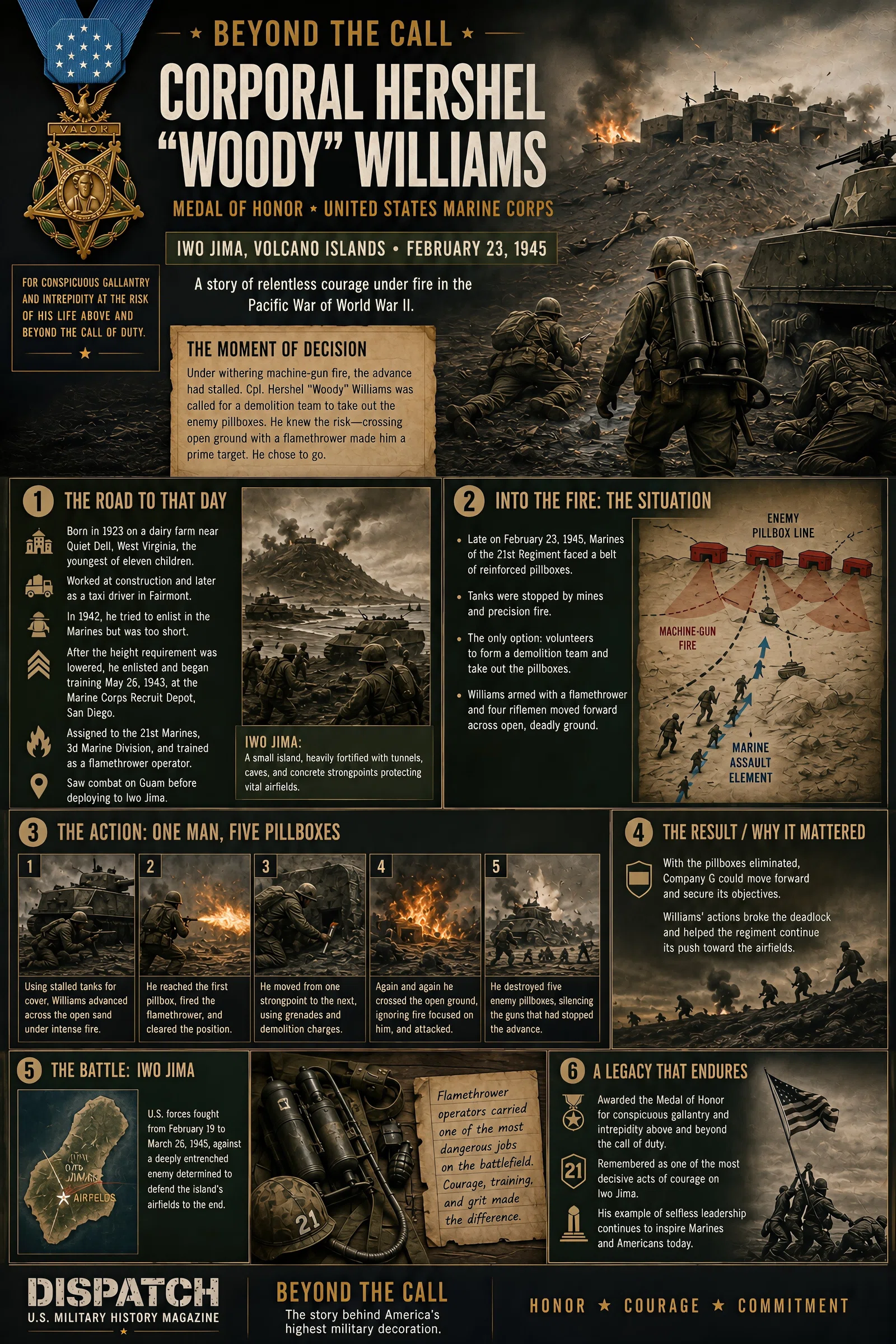
The black volcanic sand of Iwo Jima offered no cover, only shallow shell holes and the hulks of stalled tanks. Late on February 23, 1945, Marines of the 21st Regiment lay pinned down, staring across a short stretch of open ground that felt a mile wide. Ahead of them, a maze of reinforced concrete pillboxes spat machine-gun fire in crossing patterns, every burst chewing fresh craters into the sand. Tanks had tried to push forward, only to be stopped by buried mines and precision fire that found every exposed weak point.
Cpl. Hershel “Woody” Williams pressed his body into the grit behind one of the tanks, feeling the heat of its idling engine at his back and the heavier weight of the flamethrower tank on his own shoulders. Each time a Marine tried to move up, the pillboxes came alive, slamming them back to the ground. The advance had stalled; the attack might fail here, bleeding away in front of invisible guns tunneled into the island. Somewhere beyond those guns waited the company’s objective and, further still, the airfields that were the reason they were on Iwo Jima at all.
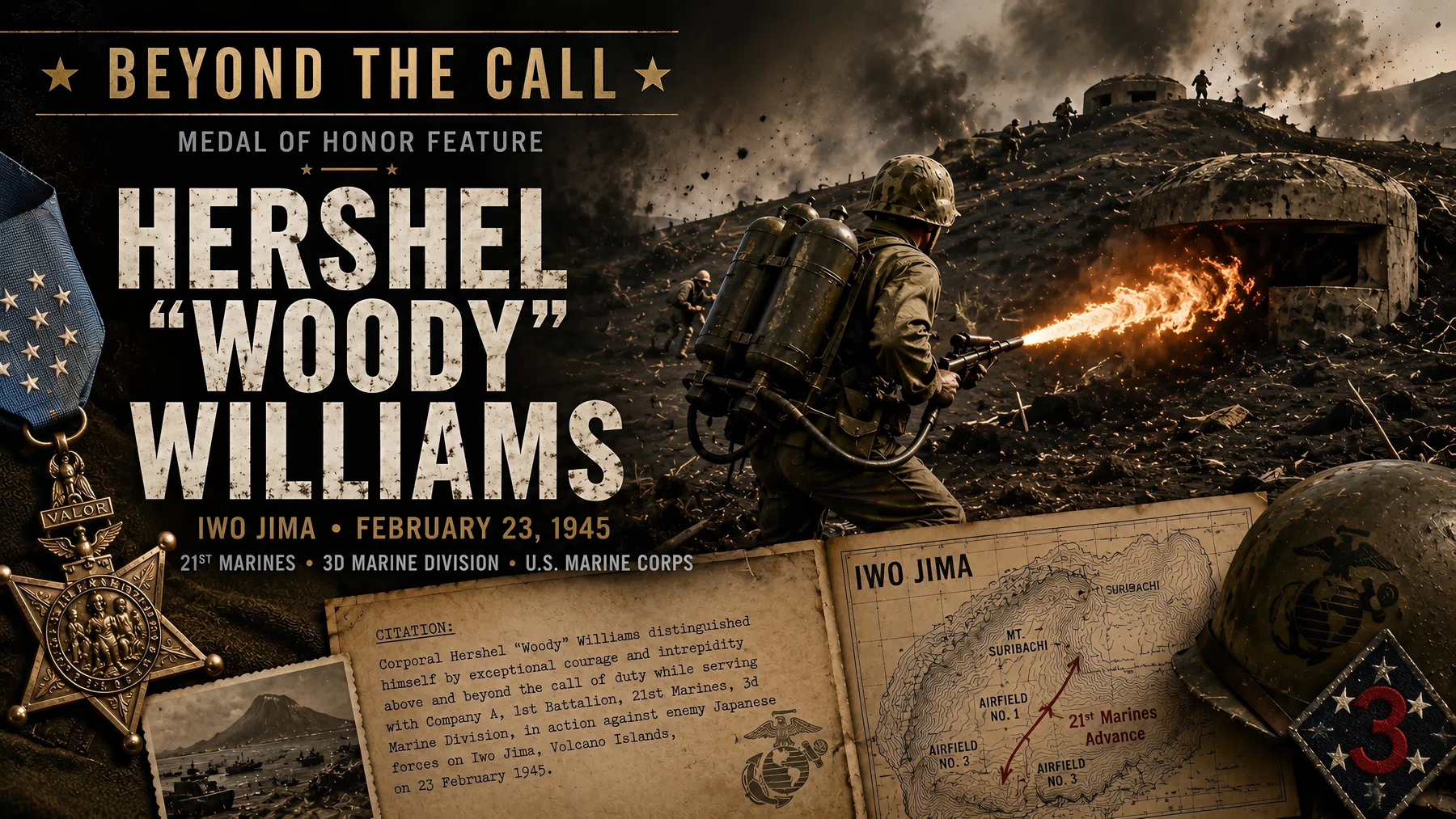
Someone needed to get those pillboxes. Volunteers were called for a demolition team to go forward. Williams, a compact West Virginian who had spent months training with the flamethrower, understood exactly what it meant: crossing that open sand with only a few riflemen for cover, carrying a weapon that marked him as a priority target. He looked at the men around him, heard the flat, unending crack of enemy fire, and made his choice. He rose from the sand and moved toward the first pillbox.
The Road to That Day
Hershel Woodrow Williams’ path to that stretch of sand began far from the Pacific, on a dairy farm near Quiet Dell in Marion County, West Virginia. The youngest of eleven children, he entered the world in 1923 weighing barely three and a half pounds, small enough that his survival was in doubt. His mother named him after the doctor who delivered him, and from his earliest days he was surrounded by the hard routines of farm work and the fragility of life: his father died of a heart attack when Woody was still a boy, and several siblings were lost to illness.
Growing up in the Depression, Williams learned responsibility early. Before and after school there were cows to milk, chores to finish, and whatever work a wiry, determined teenager could find. As he grew older he drove trucks for a construction company, then worked as a taxi driver around Fairmont, learning local roads and the quiet art of reading people from the driver’s seat. When the attack on Pearl Harbor shocked the nation, he was in Montana with the Civilian Conservation Corps, part of a program that put young men to work on public lands. The war suddenly felt close, even on distant western plains.
Williams tried to enlist in the Marine Corps in 1942 but was turned away for being too short under the standards of the time. When the height requirement was lowered the following year, he went back and was accepted, beginning recruit training at the Marine Corps Recruit Depot in San Diego on May 26, 1943. From there he joined the 21st Marines of the 3d Marine Division, eventually becoming a flamethrower operator—a dangerous specialty that demanded physical stamina, calm under fire, and meticulous attention to equipment that could fail catastrophically if mishandled. He saw combat on Guam before sailing toward a small, heavily fortified island called Iwo Jima, where the division would be tasked with fighting through a defense built on tunnels, caves, and concrete strongpoints. As the assault unfolded in February 1945, those skills and that quiet persistence would place Corporal Williams at the center of a crisis only one man could resolve.
Into the Fire
The assault on Iwo Jima had already cost the Marines dearly by the time Williams’ regiment moved against the center of the island. The 3d Marine Division was pushing inland to break through layered defenses that guarded the critical airfields, while Mount Suribachi loomed behind them and fresh enemy positions waited ahead. Their immediate problem was brutally simple: a network of concrete pillboxes and buried emplacements blocked the advance of the 1st Battalion, 21st Marines, raking every attempt to move across the open sand. Tanks and infantry were supposed to work together to crack the line, but the tanks could not maneuver through mines and hidden obstacles, and infantry alone could not cross ground swept by interlocking machine-gun fire.
Williams’ company commander asked for someone to go forward with a flamethrower and demolition charges, working with a small escort to clear a path for the stalled armor. It was not a formal order so much as a call for a volunteer to step into a role that might last only a few minutes. Williams stepped up and was assigned four riflemen to cover him as best they could. He strapped on the heavy flamethrower, felt the weight settle into his shoulders and lower back, and moved out from behind the partial safety of the tanks. Each step across the loose sand was slow, sinking, and exposed. Every time he rose from a shallow depression or tank track, enemy gunners searched for him, hammering the area with bullets and fragments.
Working from one stalled tank as a starting point, Williams used the armored hull as a moving shield. The tank would edge forward a short distance, drawing fire, while he and his escorts crouched close behind its rear. When they were as near as they dared, he would dash ahead on his own toward a specific firing point, closing the last stretch of open ground at a run. The four riflemen tried to keep enemy heads down, firing at slits and firing ports, but the Japanese defenders were fighting from reinforced concrete boxes connected to tunnels, with alternate exits and firing positions that were hard to see until they came alive.
Reaching the first pillbox, Williams crawled along its flank, seeking any weakness in the thick walls. The front was a jagged slit barely wide enough for the gun, set behind layers of sandbags and broken rock. The real vulnerability was out of sight: a vent that allowed air into the enclosed chamber. Finding it meant working his way across the top of the fortification, fully exposed. He climbed up, feeling the coarse concrete under his hands and knees, and jammed the flamethrower’s nozzle into the opening. When he triggered the weapon, a sheet of fire roared into the confined space, instantly silencing the gun that had been cutting the Marines to pieces.
That first success did not mean the work was finished. The Japanese defenses were arranged in depth, with one position backing another. Williams had only so much fuel in the tank on his back, and each attack burned through it quickly. Again and again, he was forced to pull back through the same deadly corridor to his own lines, where other Marines helped him refill the flamethrower or swap it for a serviced one and prepare fresh demolition charges. Each return trip meant shouldering the heavy load, rising from cover, and stepping into fire that had not slackened. The four Marines assigned to protect him shifted positions, firing steadily, but they could not erase the danger that followed him every yard.
Over the next several hours, Williams methodically attacked one strongpoint after another. Some pillboxes he approached from the rear, working his way behind them through shallow folds in the ash-dark ground while his escorts created distractions at the front. Others he assaulted from the side, hugging the ground so closely that bullets snapped just inches overhead. In one encounter, enemy soldiers emerged from a covered trench to rush him with explosives and bayonets, hoping to kill the man whose weapon threatened their entire position. Instead of retreating, he turned directly toward them and fired, the blast of flame breaking the attack and leaving the path to the pillbox suddenly, eerily clear.
The pattern repeated: crawl, rush, fire, pull back for more fuel, then go forward again. Marines on the line watched this small figure move in and out of the storm, bending under the flamethrower yet somehow always finding his way back to the front. The action lasted for roughly four hours, an eternity measured not in minutes but in trips across ground that had already claimed so many. As each enemy position fell silent, the volume of fire against the American line eased slightly. What had been an impenetrable wall of guns and explosives began to fracture into isolated points of resistance.
By the time Williams and his escorts had finished, one of the most stubborn clusters of strongpoints in that sector had been neutralized. Tanks could finally thread a route through the wreckage, and infantry squads could advance without being shredded from multiple angles. The battalion still faced hard fighting ahead, but the deadlock in front of this particular company was broken. The cost of that breakthrough had been shouldered by a handful of men, with one flamethrower operator at their center, moving again and again into a space where survival was never guaranteed and retreat was always an option he refused to take.
The Citation, Decoded
The Medal of Honor citation for Williams begins by describing “gallantry and intrepidity at the risk of his life above and beyond the call of duty.” In plain terms, that phrase captures behavior that goes far past what any commander can reasonably demand. Every Marine on Iwo Jima was expected to face danger and obey orders under fire. Williams’ actions differed in scale and persistence: he volunteered for a mission almost certain to draw concentrated enemy fire, then repeated that mission over and over when most would have been justified in stopping after a single attempt. The words “above and beyond” point to that sustained choice to keep going back into the killing ground.
The citation notes that he stepped forward when tanks were “maneuvering vainly to open a lane for the infantry through the network of reinforced concrete pillboxes, buried mines, and black volcanic sands.” Behind that single line lies the reality of Iwo Jima’s terrain. The volcanic ash swallowed boots and tracks, making movement slow. Mines and obstacles trapped armored vehicles in predictable paths, which defenders had already registered with their guns. The pillboxes were not isolated bunkers but nodes in an underground system, each supporting the others. Williams’ job was not just to destroy one or two firing points; it was to carve a usable corridor through this interconnected system so that the attack could resume.
Another key phrase describes him as “covered only by four riflemen” while he “fought desperately for four hours under terrific enemy small-arms fire” and repeatedly returned for more charges and fuel. Those words translate into a series of short, violent journeys in which the margin for error was razor thin. Four Marines with rifles could suppress some enemy apertures, but they could not eliminate fire from all angles or protect him from hidden trenches or tunnels. Each trip back to friendly lines meant turning his back on the enemy while carrying equipment that limited his speed and agility. The four-hour span is not just a measure of time; it marks a prolonged test of endurance, nerve, and judgment.
The citation highlights two vivid moments: climbing onto a pillbox to fire through an air vent, and charging enemy riflemen who tried to stop him with bayonets. In both instances, the language points to closing distance rather than keeping it. Climbing onto a fortification meant giving up even the small protection of the ground, while rushing armed opponents with a flamethrower required moving into the very zone where they were most dangerous. Finally, the citation concludes that his “unyielding determination and extraordinary heroism” were “directly instrumental” in neutralizing one of the most strongly defended positions and enabling his company to reach its objective. In other words, his individual decisions did not just inspire others; they physically changed the battlefield, turning an impossible advance into one that could continue.
Why It Mattered
On the map, the ground in front of Williams’ company was only a small slice of Iwo Jima’s central defenses. In reality, that cluster of pillboxes and buried positions functioned like a locked hinge in the Japanese line. As long as those guns held, the tanks could not push through, and as long as the tanks were pinned, the infantry remained exposed in shallow shell holes with no real cover. Every hour under that fire meant more casualties and more momentum slipping away from the attack. By knocking out one strongpoint after another, Williams turned a static killing zone into a passable corridor through which armor and riflemen could move.
The tactical impact rippled outward. Once the immediate threat was reduced, the company could advance and link up with neighboring units, tightening the grip on the central part of the island. That, in turn, helped secure the airfields that were the ultimate objective of the entire operation, airstrips that would later serve as emergency landing sites for damaged bombers returning to the Marianas. Had the breakthrough failed, the battalion might have been forced to pull back and regroup, ceding precious ground and giving the defenders more time to repair and reinforce their positions. Instead, an action that began with a single Marine stepping forward helped keep the offensive moving and shortened the brutal work of clearing Iwo Jima, day by exhausting day.
Leadership and Character
Williams’ actions on Iwo Jima highlight several qualities that go beyond technical skill with a flamethrower. The first is initiative: he did not wait to be ordered into a role everyone knew could be fatal but chose it when others hesitated, understanding both the risk and the necessity. The second is endurance, not just in the physical sense of hauling heavy equipment across loose volcanic ash but in the mental sense of returning again and again to the same deadly stretch of ground after each trip for more fuel. Many acts of bravery last a few seconds; his played out over hours.
Equally important was his focus on the Marines around him. Accounts emphasize that he was keenly aware of the men pinned down by the pillboxes and the tanks stuck behind him, and that awareness shaped his decisions. He was not trying to build a legend; he was trying to open a path so that his company could survive and succeed. After the war, that same sense of responsibility carried into civilian life as he worked with fellow veterans, listened to their struggles, and used his own experience to help them navigate life after combat. For today’s readers and service members, his story speaks to a kind of leadership rooted in quiet competence, persistence under pressure, and a willingness to shoulder danger so that others might live.
Legacy and Memory
In the years after World War II, Hershel “Woody” Williams returned to West Virginia and built a life that balanced family, work, and service. He married, raised children, and spent decades assisting veterans and their families, becoming a familiar figure in his community not just as a Medal of Honor recipient but as someone who showed up when others needed help. He remained connected to the Marines, serving in the reserve and attending commemorations where he preferred to talk about the men who did not come home rather than dwell on his own deeds. The battlefield courage that defined his youth became, in older age, a steady commitment to remembrance and care.
His country honored that commitment in tangible ways. A United States Navy ship, an expeditionary sea base, was named in his honor, carrying his name across the world’s oceans as a reminder of service that began on a small, volcanic island in the Pacific. Statues and memorials in West Virginia and beyond tell his story to new generations, and his grave, like those of so many Marines of his era, has become a quiet place of reflection for those who visit. In museums and public displays that recount the struggle for Iwo Jima, his image often appears not as a distant icon but as a representative of all who faced that black sand and did not turn away. Remembering Hershel “Woody” Williams in full—farm boy, Marine, veteran, mentor—means remembering that history’s great moments are carried on the shoulders of individuals whose choices, in a few terrible hours, echo long after the gunfire has faded.