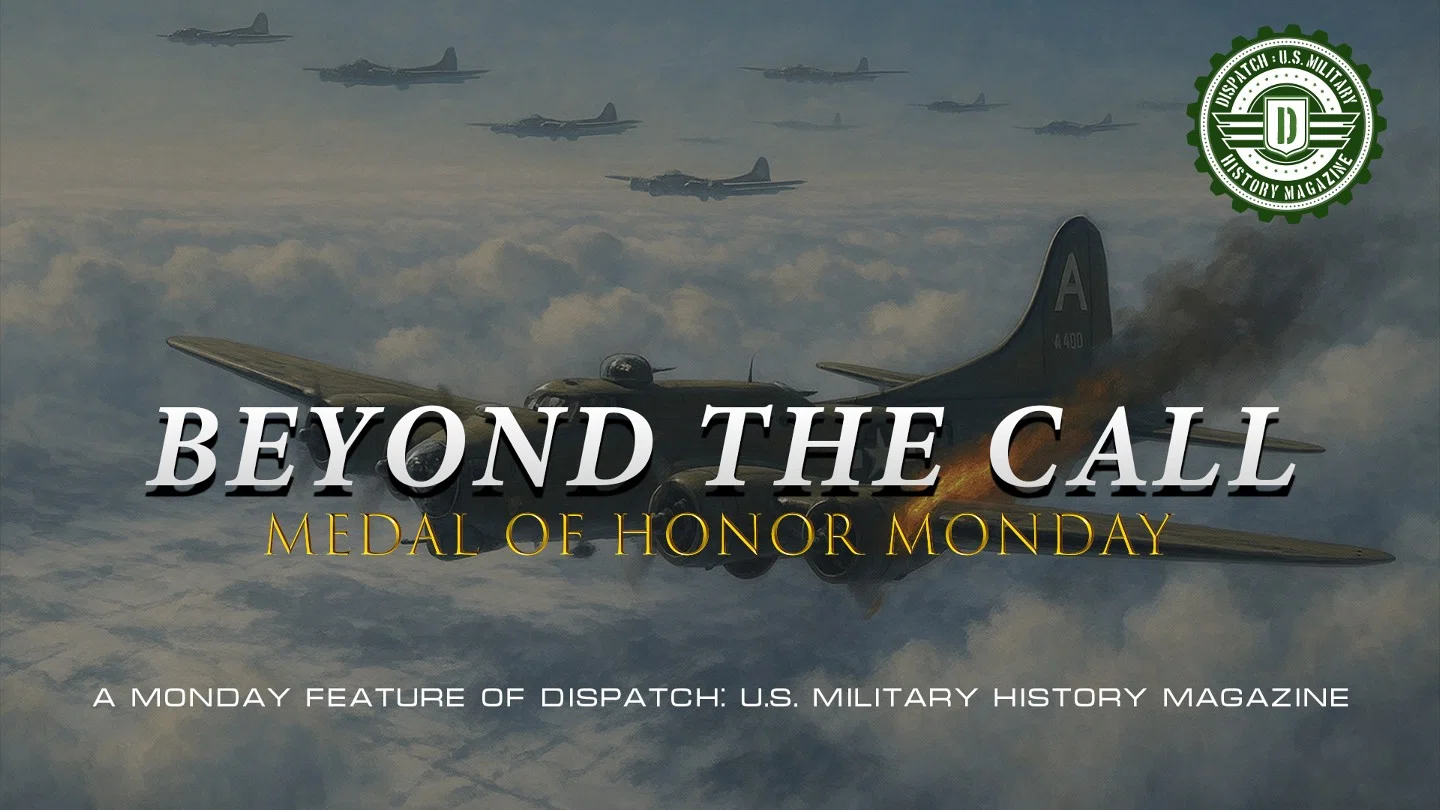
The Moment of Decision
High over Europe on Christmas Eve 1944, the sky is crowded with contrails. Hundreds upon hundreds of heavy bombers push east toward German airfields, the engines’ steady thunder mixing with clipped radio calls. At their head is a single Flying Fortress, the air commander’s ship, where Brigadier General Frederick Walker Castle studies the instruments and the grey cloud deck below. Somewhere under that blanket of weather are Allied soldiers fighting for their lives in the Battle of the Bulge—and the Luftwaffe fields that threaten them.
Then one of Castle’s engines coughs and dies.
Instantly his bomber begins to lose speed. The formation, depending on precise timing and tight spacing for mutual protection, starts to stream past. Procedure says the air commander should turn out of the way, jettison his bombs to lighten the aircraft, and race to rejoin from behind. Doing that here would mean dropping a full bomb load blindly through the clouds, with friendly troops and towns directly beneath the bomber stream’s path.
Castle weighs the choice in seconds. Keep the bombs and fall behind, becoming an easy target. Or obey the book, save his own crew’s chances, and risk the men on the ground he has come to support. He keeps the bombs. As his aircraft drifts out of formation and the first enemy fighters begin to nose in toward the lagging Fortress, Castle leans forward in his seat, fully aware that he has just chosen the harder, more dangerous road—for himself.
The Road to That Day
Frederick Walker Castle’s path to that cockpit began half a world away. He was born in 1908 at an American Army post in the Philippine Islands, the son of a young lieutenant and part of a community where uniforms and duty were everyday sights. One of his early godfathers was a fellow officer named Henry “Hap” Arnold, a hint of how closely the boy’s life would be tied to the emerging world of military aviation. After the First World War, the Castle family settled in Mountain Lakes, New Jersey, where Frederick grew into a serious, academically gifted student.
Determined to follow his father’s path, he joined the New Jersey National Guard as a teenager to prepare for the entrance exams to the United States Military Academy. He not only earned an appointment to West Point but graduated near the top of his class in 1930. Initially commissioned in the Corps of Engineers, he soon transferred to the air arm, completed flight training, and earned his wings as a pilot. In the early 1930s he flew pursuit aircraft—what today would be called fighters—learning the demanding craft of military flying in open cockpits over fields in Texas and Michigan.
Like many young officers in the lean years between wars, Castle eventually left active duty for a promising civilian career, working in industry while remaining in the Air Corps Reserve. He built a life in New Jersey, commuting to the city, raising a young family, and staying quietly involved with flying. Colleagues remembered him as methodical and modest, more interested in doing the work well than in being noticed for it. When global war erupted again, that reputation and his combination of business and aviation experience brought him back to uniform. By 1944 he was a general officer in England, helping manage the immense bomber forces of the Eighth Air Force—and insisting, whenever he could, on flying with his crews. That insistence is what put him on the lead ship of the Christmas Eve mission toward Germany.
Into the Fire
The Christmas Eve mission formed up over England in darkness, a vast armada of heavy bombers climbing toward the continent with their navigation lights dark and their engines beating a steady rhythm in the cold air. At its head flew the air commander’s ship, the Flying Fortress carrying Brigadier General Frederick Walker Castle and the crew he had chosen to lead from the front. Their task was to shepherd more than two thousand bombers toward German airfields, striking the Luftwaffe on the ground so that Allied soldiers fighting in the Ardennes would not face swarms of enemy aircraft overhead. As the sun rose and the formation crossed the Channel, thin winter light picked out the silver wings stretched in tight boxes, every crew member trusting the lead aircraft to hold course and timing. For Castle, it was another step in a long campaign of strategic bombing, but the weather, the distance, and the urgency of the ground battle made this mission feel different. Everyone understood how much was riding on it.
Somewhere over the continent, as the bomber stream pressed on toward Germany, trouble struck Castle’s aircraft. One of the four engines began to fail, coughing and losing power until the big Fortress could no longer keep pace. In a formation where protection depended on overlapping fields of fire and tight spacing, slowing down meant danger not just for one crew but for any ship forced to maneuver around them. The accepted answer was straightforward: the ailing lead should pull out, jettison its bombs to lighten the load, and try to regain position from behind. Castle knew exactly what the checklist said and what his crew expected. Yet below the cloud deck lay friendly troops and towns, scattered through the Ardennes at the height of the winter fighting. Dropping a full bomb load blindly into that murk would be gambling with their lives. He chose instead to hold on to the bombs and nurse the crippled aircraft along, even as the rest of the formation edged ahead.
As the distance widened, the bomber that had been the best-protected machine in the sky became one of the most vulnerable. Out on the flank and lagging, Castle’s ship lost the shielding mass of guns and metal that had discouraged enemy fighters earlier in the mission. German pilots scanning the bomber stream for stragglers saw their chance. Fighters clawed upward and began to converge on the solitary Fortress, attacking in swift passes that raked the fuselage and wings. Cannon shells tore into the left wing, smashing through metal and fuel lines, and punched into the oxygen system that kept the crew alive at altitude. Flames flickered where oxygen met hot fragments, and inside the aircraft two crewmen were wounded as shards and smoke filled their compartments. The general’s ship, already underpowered, now carried fire as well as bombs.
The attacks kept coming. With each pass, more metal peeled away and more systems failed, until fires burned in two engines and the aircraft shuddered with every change in power. The Fortress was no longer just damaged; it was a potential airborne bomb, heavy with fuel and ordnance, one spark away from catastrophic explosion. Inside, Castle and his pilots fought to keep the wings level and the nose steady, working controls that responded sluggishly or not at all. The interphone carried fragments of reports—fires, smoke, wounded men, ammunition running low. Over the roar of wind and engines, the general understood that they could not stay in the air much longer. The mission to Germany was effectively over for his crew. Another decision, as stark as the one about the bombs, now waited for him.
Realizing that the aircraft might break apart at any moment, the order went out to bail out. In the cramped spaces of a heavy bomber, parachuting to safety was never simple, but it was the only remaining chance for survival. One by one, crewmen moved to escape hatches, clipped on parachutes, and prepared to jump into the freezing air above Belgium. Castle knew that if he left his seat too soon, the crippled bomber could roll, spin, or erupt before the others reached the exits. He stayed at the controls, fighting a dying aircraft, buying seconds at a time so that each man could scramble clear. Down the length of the fuselage, men tumbled into the sky, trusting their pilot and their general to hold the ship steady long enough for their chutes to open.
Only when most of the crew had escaped was Castle alone in the cockpit, still wrestling a machine that wanted to fall. Enemy fighters had not finished with the lagging bomber. Another attack struck the right wing where gasoline tanks, already strained by battle damage, now took direct hits. The resulting explosion tore through the airframe, overwhelming what little control remained. The big aircraft rolled and plunged toward the ground, trailing fire, beyond the reach of any further human effort. It came down in the Belgian countryside near Liège, scattering wreckage across fields and hedgerows. Some of the men who had jumped survived to tell the story. Frederick Walker Castle did not. His final minutes had been spent not trying to save himself, but holding a burning bomber in the sky long enough for others to live.
The Citation, Decoded
The official Medal of Honor citation for Brigadier General Castle opens by naming him as air commander and leader of more than two thousand heavy bombers on that Christmas Eve strike. Behind those simple words lies the scale of responsibility he carried: not just his own crew, but the timing, direction, and confidence of an entire bomber force depending on his leadership. When the citation notes that an engine failure forced him from his place at the head of the formation, it describes more than a mechanical problem. It marks the moment when his authority and his vulnerability both increased—he was no longer shielded by the mass of aircraft, yet every crew behind him would learn from the choice he made about the bombs. His refusal to jettison them to gain speed was not stubbornness; it was a deliberate decision to protect unknown soldiers and civilians below, even at the cost of leaving his own aircraft exposed.
Later, the citation describes how his lagging, unescorted bomber became the target of numerous enemy fighters. In practice, this meant that a single heavy aircraft, already struggling with engine trouble, had to face concentrated attacks designed to pick off stragglers. Cannon rounds that tore into the left wing and ignited the oxygen system brought fire, choking fumes, and shrapnel into the crew compartments, wounding men who could no longer perform their duties fully. When the citation speaks of repeated attacks that started fires in two engines and left the Flying Fortress in imminent danger of exploding, it is summarizing a brutal sequence of passes that steadily stripped away Castle’s options. What had been a flying command post became a crippled, burning mass that could disintegrate at any moment, turning his cockpit into one of the most dangerous places in the sky.
The final lines of the citation are often quoted: Castle, realizing the hopelessness of the situation, gave the bail-out order, remained alone at the controls so others could escape, and died when another explosion hurled the bomber earthward. Words like “gallantly,” “intrepidity,” and “willing sacrifice of his life” can sound formal, but in this context they have concrete meaning. Intrepidity is the steady refusal to be ruled by fear when every sense warns of imminent death. Gallantry is choosing to stay at the controls of a doomed aircraft not because there is hope for oneself, but because each extra second of control may open one more parachute behind. The citation’s closing claim that his conduct was in keeping with the highest traditions of the military service is not a flourish; it is an attempt to measure a decision that placed duty to others above survival, in a cockpit lit by fire on a winter morning over Belgium.
Why It Mattered
On one level, the events of that Christmas Eve could be described in technical terms: a lead aircraft fell out of formation, was attacked, and lost. Yet the consequences of Frederick Castle’s decisions reached far beyond a single bomber. By refusing to jettison his bombs blindly through cloud, he accepted a slower, more vulnerable climb so that the mission would not endanger the very soldiers and civilians it was meant to protect. In the chaos of the Battle of the Bulge, when towns and road junctions shifted hands rapidly and front lines were anything but clear, that restraint mattered. It reflected an awareness that airpower, however powerful, had to be wielded with care. At the same time, his choice to remain at the controls while his men bailed out altered the tally of lives lost and saved on that winter morning.
Tactically, the bomber force he helped lead still carried out its blows against German airfields, contributing to the broader effort to keep enemy fighters away from the Ardennes. Castle’s own aircraft never reached the target, but his earlier work in organizing and commanding bomber operations helped shape missions whose effects rippled across the campaign. Operationally, the Christmas Eve raids were one piece of a larger air effort that gradually strangled German mobility and airpower during the Bulge. His loss was keenly felt by colleagues, yet his conduct became an immediate example within the Eighth Air Force. Commanders and crews alike could point to a general who had literally shared their risks and, in his final minutes, placed their survival ahead of his own. In that sense, the impact of his actions cannot be measured only in bombs dropped or targets destroyed, but in the standard of duty he left behind.
Leadership and Character
Frederick Castle’s leadership style combined technical competence with a quiet sense of responsibility. He was not known as a flamboyant figure; those who worked with him remembered a reserved officer who preferred meticulous planning to dramatic speeches. That background makes his final flight all the more striking. The same methodical mind that understood formation tactics, engine performance, and fuel calculations also understood the human consequences of dropping ordnance through cloud over friendly territory. When the engine failed and procedure pointed toward jettisoning bombs, Castle’s decision to hold them was not impulsive heroism. It was the act of a leader who saw the ground battle as clearly as his own instruments and refused to trade unknown lives for his personal safety.
Another thread in his character emerged in the way he handled command. As a general responsible for thousands of aircrew, he could have remained on the ground and directed operations from a headquarters. Instead, he insisted on flying missions, learning what his crews faced at altitude. That habit built credibility long before his final flight. On the day his aircraft was crippled and under attack, the order to bail out came from someone whose men knew he did not ask them to accept risks he would not share. His choice to remain at the controls until others had escaped was a natural extension of that approach. He did not frame his actions in dramatic language; he simply stayed where he was needed most. For service members and civilians who study his story today, the lesson is less about a single moment of sacrifice and more about a pattern of leadership: mastering the details, accepting responsibility for others, and making the hardest choices at one’s own expense.
Legacy and Memory
Frederick Walker Castle did not live to see the end of the war he helped fight. His death on Christmas Eve 1944 left a young family without a husband and father, and an air force without one of its most capable planner-commanders. In the months that followed, he was posthumously awarded the Medal of Honor, formal recognition of a sacrifice already deeply felt by the bomber crews who had flown under his direction. He was laid to rest with military honor, joining thousands of other Americans who had crossed the Atlantic a final time. For his family, the decoration and ceremonies could not replace his presence, but they affirmed that his last decisions had meaning far beyond one aircraft.
In the years after the war, his name was woven into the physical landscape of the Air Force he had served. A major base in California was renamed in his honor, a daily reminder to generations of airmen that the installation’s history was rooted in the courage of a single wartime leader. Streets, buildings, and plaques carried his name at various posts, while memorials near the crash site in Belgium marked the spot where his aircraft came down. Visitors walking among rows of white crosses or through base museums encounter his photograph and his story, often presented alongside the larger narrative of the air war over Europe. These reminders invite people to see him not only as a figure in a citation, but as a man who made difficult, costly choices at a critical moment. When readers pause over his name today, they are invited to remember both the lives he saved in the sky and the example he left for those who follow.