The Moment of Decision
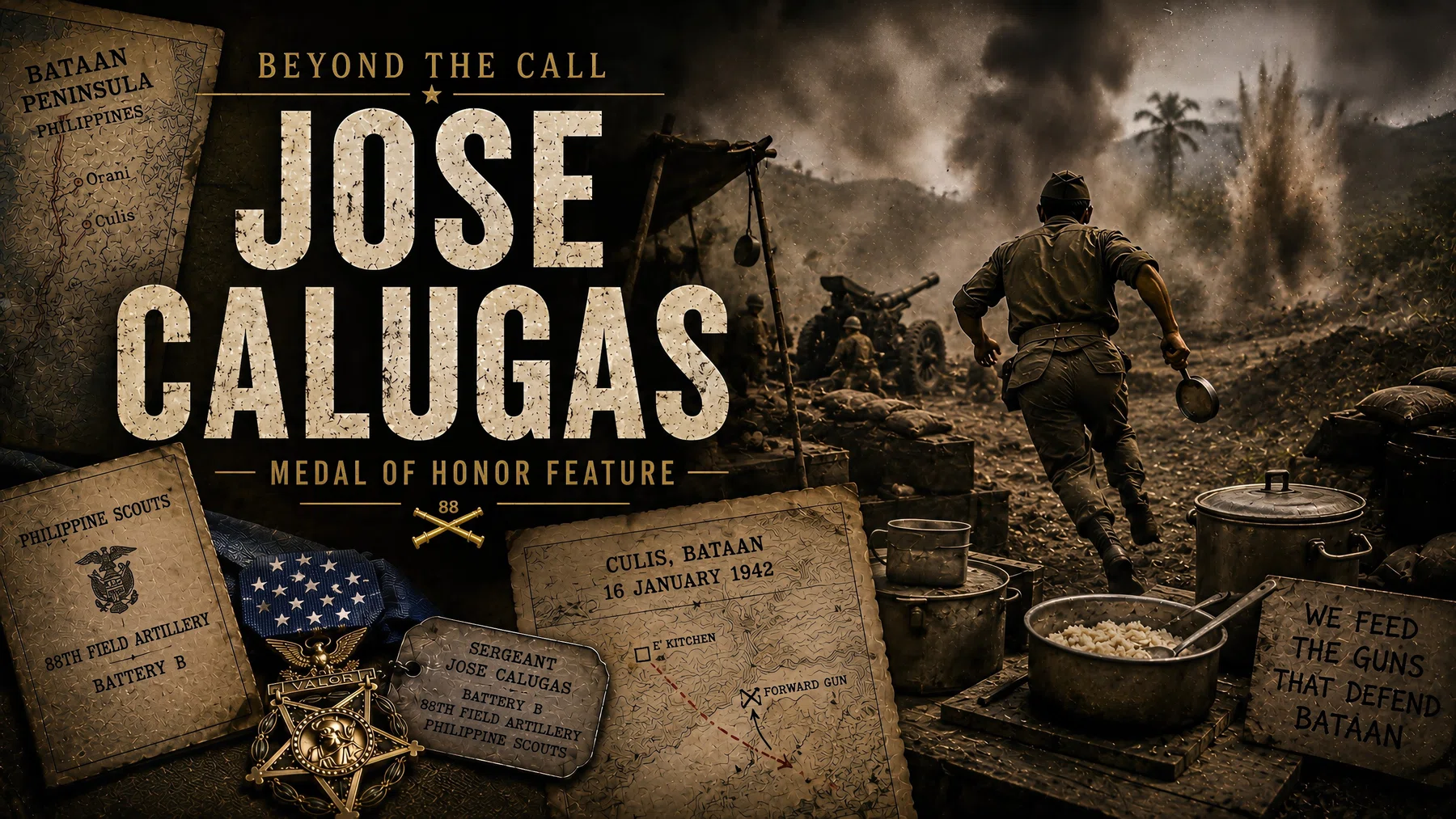
The sky over Bataan was already smoky and gray when the shelling crept closer to the little field kitchen near the village of Culis. It was midafternoon on January 16, 1942, and the thin peninsula had become a last refuge for exhausted American and Filipino troops falling back before the Japanese advance. In the distance, artillery cracked and boomed; closer in, explosions walked steadily toward the position of Battery B, 88th Field Artillery, Philippine Scouts. The ground shuddered, mess tins rattled, and the smell of dust and cordite mixed with boiling rice.
Sergeant Jose Calugas, the battery’s mess sergeant, moved quickly among his men, trying to get one hot meal into them before the enemy found their range. He had spent years as an artilleryman before being assigned to the kitchen, and he knew the rhythm of a barrage as well as any gunner. As he glanced toward the tree line, something felt wrong. One of the forward guns—part of another battery anchoring the defense—had gone silent. No muzzle flashes, no answering thunder, just a gap in the line where there should have been steel.
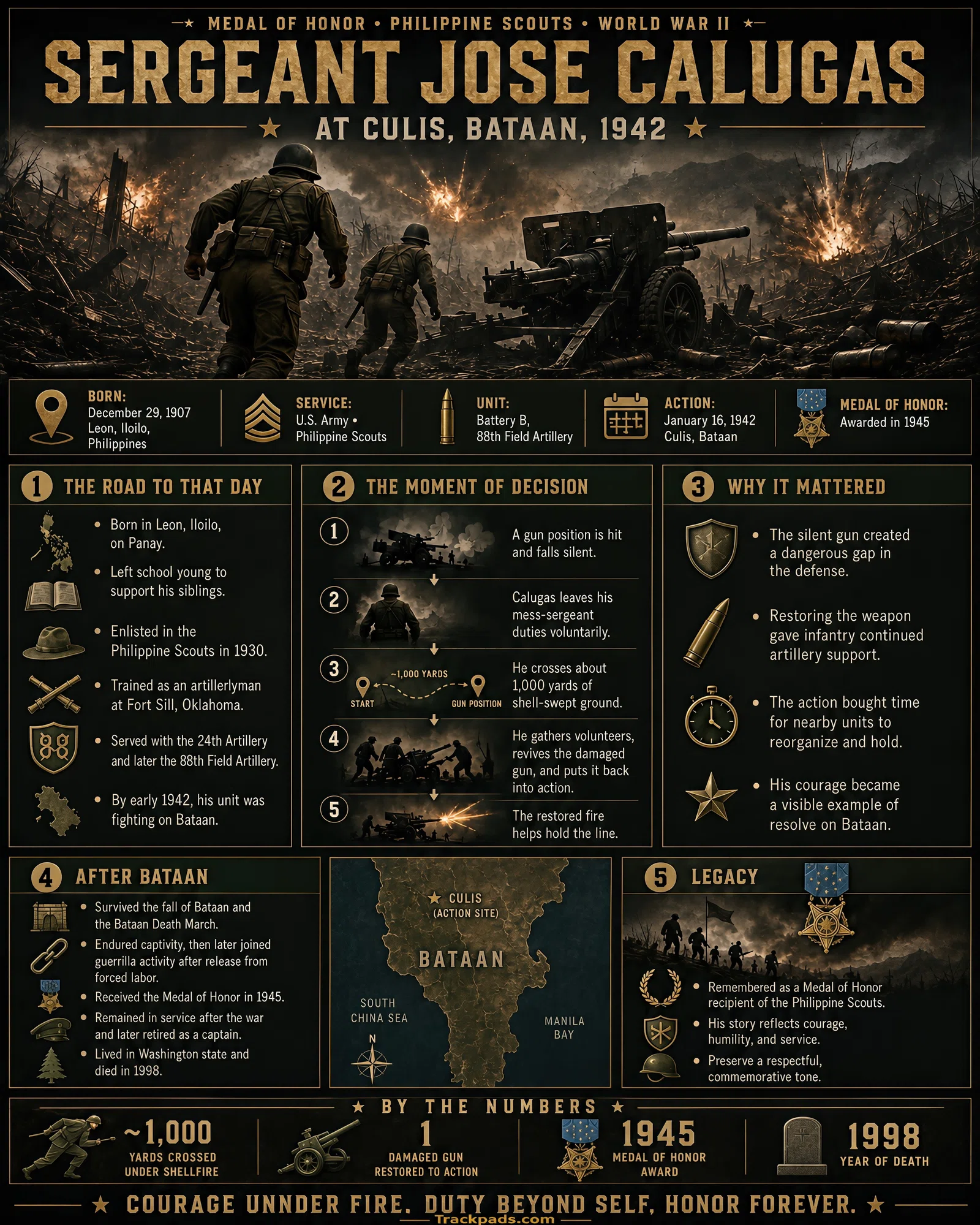
Reports filtered back in fragments: the position had been bombed and shelled; the cannoneers were down. Between Calugas and that gun lay roughly a thousand yards of open, shell-swept ground, already being plowed up by enemy fire. Staying put meant doing the job he’d been assigned—feeding the battery. Crossing that ground meant almost certain death. As another salvo slammed in nearby, he made his choice. Jose Calugas put down the ladle, stepped out from what little cover he had, and began to run toward the silent gun.
The Road to That Day
The man sprinting across that ravaged field had grown up far from Bataan’s dry ridges and jungle gullies. Jose Cabalfin Calugas was born on December 29, 1907, in the farming village of Leon, Iloilo, on the island of Panay. His family worked the land, and money was scarce. When his mother died while he was still a boy, he left high school to help support his younger siblings. Hard work in the fields and in odd jobs taught him to endure long days, carry heavy loads, and shoulder responsibility early—traits that would later matter when lives, not crops, depended on him.
In 1930, looking for steadier pay and a wider world, the 23-year-old enlisted in the Philippine Scouts, a professional force of Filipino soldiers serving under the United States Army. Sent to Fort Sill in Oklahoma, he learned the trade of the artilleryman—how to range a target, serve a gun, and keep complex equipment working in mud, heat, or rain. After training he returned home, posted to the 24th Artillery Regiment at Fort Stotsenburg north of Manila, and later to the 88th Field Artillery. Years of peacetime drills, long marches, and live-fire exercises honed him into a skilled noncommissioned officer who could move from the gun pit to the kitchen without ever ceasing to lead.
Life in uniform also brought quieter joys. He married, started a family, and settled into the rhythms of garrison life—raising children, saving what he could, and taking pride in looking after the men of his battery as carefully as he looked after his own household. By late 1941, however, the world around them was changing fast. Japan’s ambitions in Asia loomed over the islands, and the Scouts drilled harder, moved more often, and kept their equipment ready to go at a moment’s notice. When Japanese forces struck the Philippines in December, the 88th Field Artillery fell back with the rest of U.S. Army Forces in the Far East onto the Bataan peninsula, tasked with covering the withdrawal and holding the line as long as possible. Early on January 16, 1942, Battery B set its guns and its field kitchen near Culis—unaware that, by afternoon, one quiet mess sergeant would be tested in a way no training schedule could predict.
Into the Fire
By mid January 1942, the defense of the Philippines had narrowed to the Bataan peninsula, a rough triangle of jungle ridges, ravines, and dusty roads jutting into Manila Bay. American and Filipino forces, grouped under United States Army Forces Far East, were trying to slow the Japanese advance long enough for some hope of relief that would never come. Along one sector near the small village of Culis, the 1st Battalion of the 88th Field Artillery, Philippine Scouts, supported infantry from the 26th Cavalry and the 31st Infantry Regiment. Their mission was simple to describe and hard to survive: hold the road, cover the withdrawal, and keep the enemy from breaking through to the south.
The day of January 16 began like many on Bataan, with humid heat and the constant threat of air attack. Before dawn the battalion’s 75 millimeter guns had already spoken, firing counterbattery missions and harassing fire as Japanese artillery and aircraft searched for their positions. The gun pits were scraped into the dry earth, sandbags and logs piled high, camouflage nets stretched where they could. Behind the firing line, a short distance away, the field kitchen tried to work through the concussion of nearby blasts. Men moved between the positions, carrying shell crates, water cans, and messages, trying to pretend that the storm building around them was just another day’s work.
As the morning wore on, Japanese gunners began to walk their fire closer to one particular battery supporting the sector. Their shells chewed up the trees and tore at the revetments, each impact throwing dust and splinters through the air. Then the aim tightened. One of the guns took a direct hit. Another blast landed in the crew’s ready area. When the smoke cleared, the 75 millimeter piece that had been anchoring part of the line was silent. Its cannoneers were dead or badly wounded, the trail of the gun split, and the position still under heavy shellfire. On that side of the road, there was now a hole where steady, practiced fire had been answering Japanese guns only minutes before.
At the Battery B kitchen, Sergeant Jose Calugas heard the change before anyone had time to explain it. Years around artillery had tuned his ear to the pattern of outgoing and incoming fire, and the quiet where that gun should have been was like a missing note in a drill he knew by heart. When word reached him that the position had been hit and its crew put out of action, he did not wait for orders. Drawing on his reputation and earlier service as a gunner, he called out for volunteers. About a squad’s worth of men stepped forward, some from kitchen duty, some from nearby positions, all of them knowing they were about to cross nearly a thousand yards of open, shell-swept ground.
The run to the crippled gun was a test of nerve as much as muscle. The route offered only scattered clumps of brush and shallow folds in the ground, far from the deep foxholes that might stop shrapnel. Japanese observers, already registered on the position, continued to adjust their fire. Shells burst ahead of the little group, then behind them, throwing soil into their faces and peppering them with fragments. Some of the volunteers had to turn back or were pinned down short of the objective. Calugas kept going, legs pumping, gear rattling against his body, fully exposed each time he passed through a bare stretch of ground. By the time he reached the gun pit, he was among the few who had made it all the way.
The scene around the damaged gun was grim. Bodies lay where they had fallen, and wounded men still cried out over the boom of enemy fire. Calugas and the survivors first dragged the injured to what little cover they could find and shouted for stretcher bearers. Then he turned his full attention to the weapon itself. The gun’s carriage and shield were scarred, but the breech still worked. With the instincts of an experienced artilleryman, he checked for damage, had the volunteers clear debris, and quickly reestablished a crew. Ammunition had to be manhandled into place, fuses set by men who moments earlier had been cooks or drivers, not trained gunners.
Soon the 75 millimeter gun was back in the fight. Under Calugas’s direction, the ad hoc crew laid the piece on Japanese positions that had been battering the line all afternoon. Each round they fired brought more answering fire from the enemy, who clearly understood that an American gun had come back to life. Shrapnel hammered the parapet, and the air filled with dust and acrid smoke, but the scratch crew kept the weapon working. Their fire helped suppress enemy batteries, buying time for other units to deepen foxholes, shift men, and set up alternate positions. That steady, stubborn stream of shells also signaled to nearby infantry that the artillery was still with them and that the line, however battered, remained unbroken.
Only late in the afternoon, when the Japanese barrage eased and the tempo of the battle slackened, did Calugas finally leave the gun. He had been in action for hours, exposed to direct fire and the constant risk of another hit that could have finished the entire position. Yet when he made his way back across the same dangerous ground, he returned not as a man seeking rest but as a mess sergeant who still had a job to do. He stepped back into the kitchen and resumed preparing what food he could for exhausted, hungry soldiers. The day’s work had ranged from cooking rice to commanding a gun under heavy fire, and he had treated both responsibilities as part of the same duty to his comrades.
The Citation, Decoded
The official Medal of Honor citation for Jose Calugas compresses that long, brutal afternoon into a few spare lines. It notes that a battery gun position was bombed and shelled until one gun was out of action and all its cannoneers were killed or wounded. It goes on to say that Sergeant Calugas, a mess sergeant of another battery, “voluntarily and without orders” ran one thousand yards across a shell-swept area to the gun position, organized a volunteer squad, placed the gun back in commission, and fired effectively while under constant and heavy Japanese artillery fire. Each phrase in that short text speaks to layers of risk and responsibility that the brief language only hints at.
Voluntarily and without orders” sounds almost routine on the page, but in combat it marks a decisive break from the minimum expected of any soldier. As a mess sergeant, Calugas could have stayed with his assigned task, feeding the men who depended on him for their only hot meal of the day. Instead, seeing a gap in the line and knowing that no one had told him to fill it, he chose to act anyway. That choice meant leaving what little cover he had, stepping into a proven killing ground, and trusting his own judgment about what the situation required. The citation’s language about “conspicuous gallantry” is the formal way of acknowledging that he deliberately placed himself where death was most likely in order to help others survive.
The distance he covered, “one thousand yards across the shell-swept area,” is not just a figure. It represents nearly a half mile of ground already registered by enemy guns, a zone where incoming shells were landing at irregular but frequent intervals. Running that far while under observed artillery fire meant remaining exposed not for a single burst or two, but for minutes at a time, any one of which could have ended in a lethal fragment. The phrase “shell-swept” sums up explosions that tore at the soil, filled the air with shards of metal and rock, and left no guarantee that even a man at full sprint could make it through.
Finally, the citation’s closing line, that he “placed the gun back in commission and fired effectively against the enemy,” speaks to both technical skill and endurance. Bringing a damaged weapon back into service required inspecting the gun, rallying shaken men, organizing ammunition supply, and restoring fire control while still under attack. Firing effectively meant more than just pulling a lanyard. It meant choosing targets, adjusting aim, and keeping up a rate of fire that supported the overall defense even as Japanese artillery continued to pound the position. When the citation sums all of this up as “intrepidity at the risk of his life above and beyond the call of duty,” it is capturing a day in which one noncommissioned officer turned a silent, shattered gun into a living shield for his comrades and held it there long enough to make a difference.
Why It Mattered
On a map of Bataan, the fight near Culis looks like just one small sector of a collapsing front. On the ground in January 1942, it was a narrow lifeline for exhausted units trying to hold back a relentless advance. The artillery supporting that sector gave the infantry a shield they could not do without. When the gun near Calugas went silent, the gap in fire left a slice of the line exposed to enemy pressure and probing attacks. By restoring that weapon and directing its fire under heavy shelling, he helped close a hole that could easily have widened into a breakthrough.
The gun he brought back into action bought time as well as protection. Under its renewed fire, other soldiers had minutes they badly needed to deepen fighting positions, move ammunition, and shift men into better cover. Infantry who might have been forced to fall back too quickly instead felt the reassurance that artillery was still covering them. That meant the local defense could stiffen rather than crumble.
His action also had meaning beyond that day’s firing tables and casualty reports. The Bataan campaign was already marked by hunger, disease, and the knowledge that promised reinforcements were not coming. In that climate, one noncommissioned officer’s willingness to risk his life to keep a single gun firing sent a message about resolve that others could see and feel. Had that position stayed silent and the defense around it been rolled up, the withdrawal on Bataan might have turned even more chaotic, and more men might have been lost before the peninsula finally fell.
Leadership and Character
The story of Jose Calugas at Culis is often told as a tale of physical bravery, but it also reveals a particular kind of leadership. He was not a commander issuing orders from a map table. He was a mess sergeant whose daily work centered on feeding his battery, making sure pots were clean, rations stretched, and men had one steady comfort in a hard campaign. When he saw a gap in the line, he did not wait for someone else to claim responsibility. He stepped into a role no one had assigned him because he believed the situation demanded it. That quiet assumption of responsibility is one of the clearest marks of character in his story.
Another theme is how he used his skills for others rather than for recognition. Years spent learning the craft of artillery could have stayed buried once he moved to kitchen duty. Instead, he drew on that knowledge in the worst possible conditions, turning an improvised group of volunteers into a functioning gun crew. He did not stop there. Once the immediate crisis passed, he did not linger at the recovered gun to bask in praise. He returned to his mess line, back to ladles and cook fires, because hungry, shaken men needed to eat.
For leaders and service members today, that pattern is instructive. Calugas did not confuse status with service. He brought his full ability to whatever task was in front of him, whether it was cooking or commanding a gun, and he changed roles quickly when the mission required it. His example suggests that leadership is less about title and more about seeing what must be done, taking the first step toward it, and then staying with the team until the work is finished.
Legacy and Memory
The artillery duel at Culis was only the beginning of the hardship Jose Calugas endured. When Bataan fell in April 1942, he joined tens of thousands of American and Filipino soldiers on the brutal Bataan Death March, then suffered months of malnourishment, disease, and abuse as a prisoner of war. Even in captivity, he tried to protect the men around him, hiding the news of his award to avoid retaliation from guards. Released to work at a rice mill, he slipped into the underground, serving with guerrilla forces that kept up the fight until the Philippines were liberated in 1945.
Only after surviving those years did he finally receive the Medal of Honor, in a ceremony at Camp Olivas in Pampanga Province in 1945. He stayed in uniform, serving with Philippine Scout units in the postwar occupation of Okinawa. When the opportunity came, he accepted United States citizenship and a direct commission, eventually moving with his family to Washington state. There he retired from the Army as a captain, earned a business degree, worked in industry, and stayed active in veterans organizations, living a life that combined quiet dignity with steady service. He died in Tacoma in 1998 and was laid to rest at Mountain View Memorial Park, far from his birthplace but close to the community that had become his home.
His name lives on in more than just the roll of Medal of Honor recipients. Memorials on Bataan recall the first, desperate battles of 1942 and the Scouts who stood in the way of the advance. Housing and community projects in Washington state have been named in his honor, and his Medal of Honor is preserved in a museum collection so future generations can see the decoration he so rarely spoke about. For many, though, his deepest legacy is the image of a man setting down his cooking gear, running into a storm of fire to restore a fallen gun, and then quietly returning to feed the soldiers whose lives he had just helped save. It is a reminder that courage and humility can live side by side in the same person.