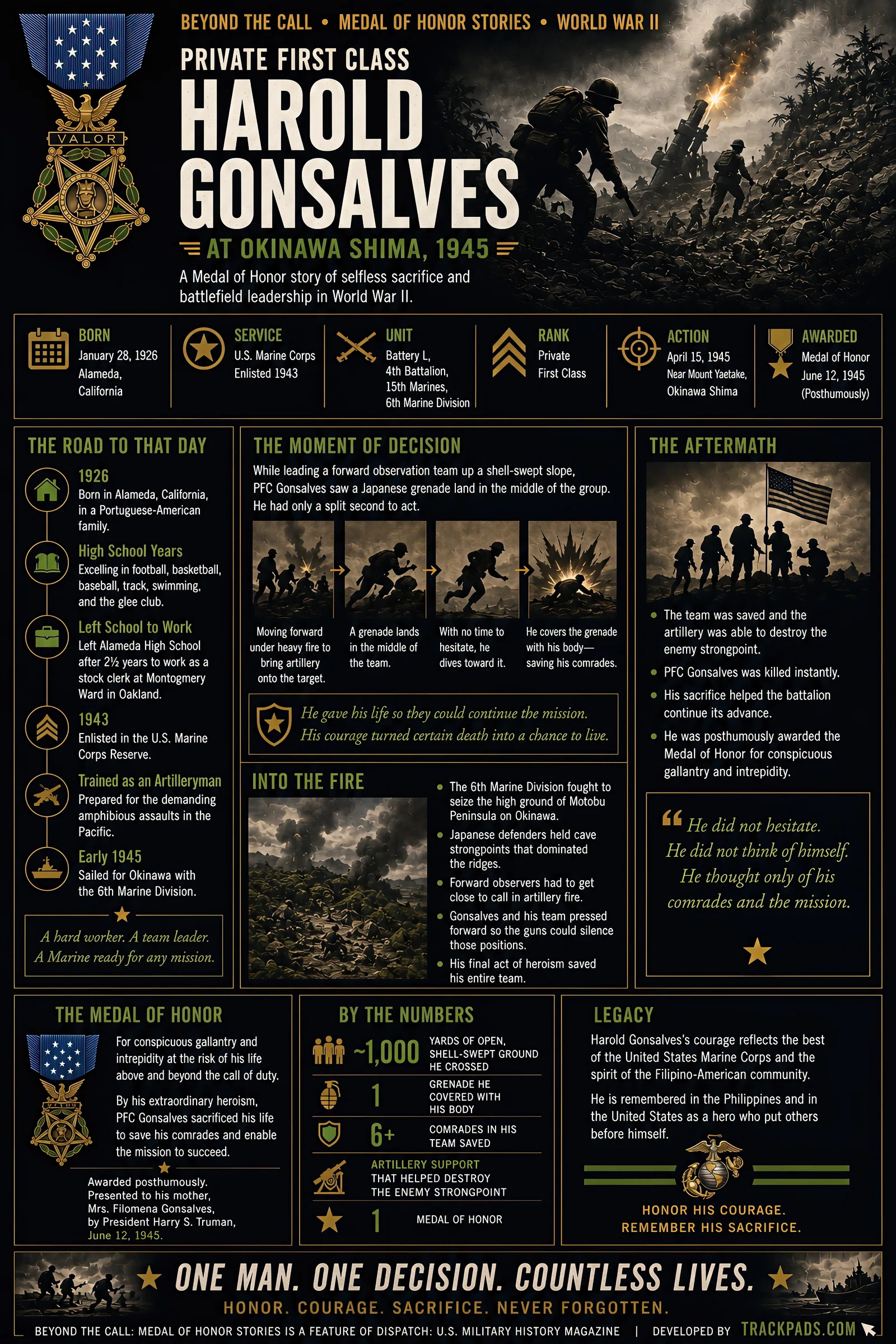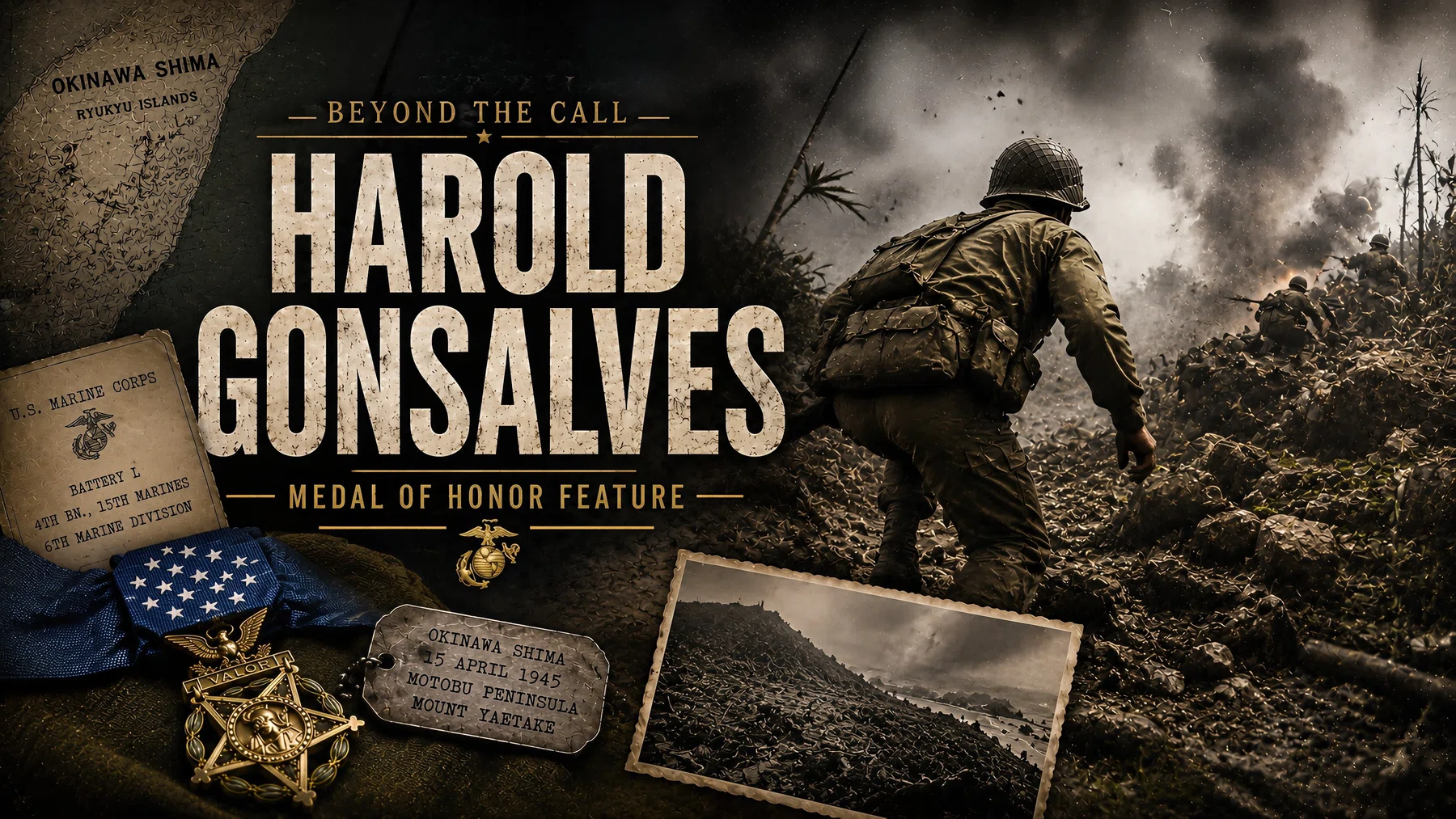
The Moment of Decision
Mid-April 1945. The Battle of Okinawa is only days old, and the Marines of the 6th Marine Division are fighting their way up the tangled ridges of the Motobu Peninsula. The air is thick with the crack of rifles and the hollow whump of mortars. Somewhere ahead, dug into the maze of rocks and jungle around Mount Yaetake, Japanese defenders have turned the heights into a fortress.
Private First Class Harold Gonsalves moves with a small forward observation team, a handful of Marines whose job is to bring artillery fire down on those hidden guns. Though only a PFC, he is acting as the scout sergeant for the team, helping guide them up the slope so their officer can see the enemy positions clearly enough to adjust the guns behind them. Every few yards they have to hit the dirt as shells tear the ground and splinters of coral whistle past.
They press forward anyway, scrambling uphill through brush and broken stone, closing the distance so the artillery can be walked right onto the enemy stronghold. As they near the front line, the fire grows even more intense—rifle flashes from cave mouths, mortars thumping from somewhere they still can’t quite spot. Then, without warning, a Japanese grenade arcs into the middle of the tight-knit group and lands almost at their feet.
In that instant there is no time to think, no time to shout a warning or scatter. Gonsalves has only a split second to decide whether to dive away or toward the small, hissing object that will explode in the next heartbeat. He chooses to move toward it.
The Road to That Day
Harold Gonsalves’s path to that Okinawan hillside began far from the Pacific war, in the working-class neighborhoods of Alameda, California. Born on January 28, 1926, he grew up in a Portuguese-American family rooted in the Bay Area’s immigrant community, where relatives and neighbors alike expected the next generation to work hard and look out for one another. His father labored in factories and on the road, his mother kept the household together, and Harold and his younger sister learned early what it meant to shoulder responsibility.
At Alameda High School he threw himself into every sport he could reach—football, basketball, baseball, track, and swimming. He also sang tenor in the school glee club, proof that he was as comfortable under stage lights as under stadium lights. Teachers and teammates saw a lean, energetic teenager who might not always be the biggest player on the field, but who could always be counted on to show up, take a hit, and keep going.
Like many young Americans coming of age during the war, Gonsalves did not finish high school. After two and a half years he left to work as a stock clerk at a Montgomery Ward store in nearby Oakland, helping support his family while the world beyond California’s shores caught fire. Before long, the pull of service proved stronger than the promise of a steady paycheck. He enlisted in the United States Marine Corps Reserve, traded store aisles for drill fields, and learned the skills of an artilleryman.
Assigned to Battery L, 4th Battalion, 15th Marines, part of the newly formed 6th Marine Division, Gonsalves trained for the kind of demanding amphibious assaults that had already scarred names like Tarawa and Saipan into the public mind. Quietly, the stock clerk from Alameda became a forward observer’s right hand—steady under pressure, willing to push a little farther forward so the guns could do their work. That growing reputation would follow him into the largest and bloodiest battle of the Pacific war, as his division sailed toward Okinawa and the ridges of Motobu Peninsula where his final test awaited.
Into the Fire
By the spring of 1945 the United States forces had carried the Pacific war to Okinawa, the last and bloodiest stepping stone before the Japanese home islands. On the northern part of the island, the 6th Marine Division drove onto the Motobu Peninsula, a rugged finger of land cut by ravines, coral ridges, and thick vegetation. Japanese forces had turned the high ground around Mount Yaetake into a defensive web of caves, bunkers, and interlocking fields of fire that could tear apart any exposed advance. Each step forward demanded close coordination between the infantry attacking uphill and the artillery batteries behind them that tried to smash open those hidden positions.
Private First Class Harold Gonsalves served with Battery L of the 4th Battalion, 15th Marines, the divisional artillery regiment that supported that push. Forward observer teams from the regiment accompanied the infantry, moving with small groups of riflemen and machine gunners, scanning the slopes for flashes of enemy guns and the outlines of caves. Their job was to call back precise corrections so that the big guns to the rear could shift fire just yards ahead of friendly lines. It was dangerous work in any battle, but on Motobu it was especially deadly, because the only way to see the enemy positions clearly was to get very close to them.
On 15 April, as one Marine infantry battalion attacked a strong point near Mount Yaetake, Gonsalves was serving as the acting scout sergeant for a forward observation team attached to that assault. The terrain ahead of them rose sharply, broken by boulders and scrub that gave cover to defenders who knew every fold of the hillside. The Japanese had endured weeks of bombardment and still held their ground, answering each Marine movement with mortar shells and bursts of rifle fire that seemed to come from nowhere. Under those conditions, the team inched forward, choosing each bit of cover carefully and using brief lulls to raise their binoculars and radios.
As the battalion closed with the main defensive line, the need for precise artillery fire became urgent. Mortar rounds were already falling among the advancing Marines, and pockets of resistance were firing from caves that earlier barrages had missed. The artillery officer with Gonsalves knew that to adjust the guns with enough accuracy, he had to see the enemy positions from the actual front line instead of from the partial viewpoints they had used so far. That meant stepping out beyond their current cover and climbing to a point where the enemy could see and shoot at them just as clearly.
According to the citation, when the officer decided to move closer, Gonsalves did not hang back or suggest a safer way. He moved with the officer and another Marine, advancing uphill through what was described as a slashing barrage of enemy mortar and rifle fire. The three men scrambled over exposed rock and low shrubs, feeling the concussions of near misses and the hiss of fragments cutting the air. Behind them, the rest of the team and the infantrymen they were supporting hugged the ground, waiting for the artillery observers to find a vantage point that could turn the tide against the stronghold above.
At last they reached a shallow fold in the ground near the front lines, close enough that the Japanese were only yards away in their dug in positions. The officer began to study the slope and caves ahead so that he could call adjustments to the guns behind them. In that tense moment, when everyone was focused on picking out the next target and no one could afford to relax, a Japanese soldier hurled a grenade that arced down into the tiny space where the three Marines were clustered. The grenade landed close among them, too near for a simple shout or a quick scramble to guarantee escape.
The official account records what happened in the next heartbeat in plain, stark language. Instantly, Gonsalves threw himself onto the grenade, using his own body to smother the blast and shield the officer and the other Marine. The explosion that followed killed him, but the two men beside him survived to continue the work he had been helping them do. The forward observer team remained in action, the infantry assault continued, and the fight for the stronghold on that section of the Motobu Peninsula pressed on, carried by Marines who now knew that one of their own had given up his life so they could keep moving.
The Citation, Decoded
The Medal of Honor citation for Harold Gonsalves opens with the familiar legal phrase that he distinguished himself by conspicuous gallantry and intrepidity at the risk of his life above and beyond the call of duty. In plain language, this means that his courage was not simply what any Marine was expected to show under fire. He performed an act that went far beyond the already demanding standard of the service. Gallantry speaks to visible courage in the face of the enemy, while intrepidity means a kind of fearless resolve, a refusal to be driven back by danger that would cause most people to seek cover. The citation anchors those words to a specific moment on a specific hillside rather than leaving them as abstractions.
It goes on to describe how he repeatedly braved the terrific enemy bombardment to help his forward observation team direct well placed artillery fire. Terrific, in this context, does not mean impressive but terrifying and overwhelming. The shells that fell around the team were meant to break up the Marine advance and kill whoever tried to guide it forward. Each time Gonsalves moved or raised his head to help spot a target, he exposed himself to that danger. When the commanding officer decided to move into the front lines to obtain a more effective bombardment, the citation notes that Gonsalves unhesitatingly advanced uphill with the officer and another Marine despite the slashing barrage of enemy mortar and rifle fire. Those words capture the sense that there was no pause, no argument, and no effort to seek a safer job in the rear.
The key sentence in the citation describes the final act. As they reached the front and a Japanese grenade fell close within the group, it states, instantly Pfc. Gonsalves dived on the deadly missile, absorbing the exploding charge in his own body and thereby protecting the others from serious and perhaps fatal wounds. The phrase deadly missile is a formal way of naming a small object that, in that context, meant certain mutilation or death for whoever was nearest. To dive on it required not only physical speed but a conscious acceptance that he was exchanging his survival for theirs. The final lines of the citation, which speak of his cool decision, prompt action, and valiant spirit of self sacrifice in the face of certain death, try to sum up that reality. They underline that his choice was made in full awareness of the cost and that it allowed his fellow Marines to carry on the relentless battle against a determined enemy.
Why It Mattered
On the ground near Mount Yaetake, the immediate impact of Harold Gonsalves’s decision was stark and simple. Two Marines who would almost certainly have been killed or badly wounded survived because his body absorbed the blast meant for all three. One of them was the artillery officer responsible for bringing fire onto the Japanese strongpoint ahead. The other was a Marine who shared the same exposed patch of hillside. Their survival meant that the forward observation team could remain effective in the critical minutes and hours that followed, guiding the guns that supported the infantry battalion clawing its way up the ridge.
Artillery was often the only tool that could crack open the caves and bunkers that protected Japanese defenders on Okinawa. If the observers had been killed or incapacitated at that moment, the infantry attack might have stalled under unanswered mortar and rifle fire. Every pause on that slope cost lives, as assault squads were caught in the open or pinned against bare rock with nowhere to go. By sacrificing himself, Gonsalves kept the chain between the front line and the batteries behind intact, giving the Marines on the ridge a better chance to reach and destroy the enemy position.
Beyond the immediate tactical effect, his act also carried a powerful message about the kind of trust that held small units together in brutal fighting. Word of such sacrifices traveled quickly through companies and battalions. Marines heard that one of their own had given up his life to shield the men beside him from the blast of a grenade. In a campaign already known for its ferocity, that story became part of the moral strength that kept others moving forward when fear and exhaustion might have urged them to stop.
Leadership and Character
Harold Gonsalves held the rank of private first class, yet the responsibility on his shoulders that day went far beyond the title of a junior enlisted Marine. Serving as the acting scout sergeant for a forward observation team meant that he was trusted to read terrain, to stay steady under intense fire, and to guide others to positions where they could do their jobs. That trust did not appear overnight. It grew from months of training, field exercises, and earlier operations where he showed that he could be relied on when conditions were rough and the mission was unclear.
One of the most striking themes in his story is initiative. When the artillery officer chose to move closer to the front lines to gain a better view, Gonsalves did not wait for precise instructions or weigh his personal safety against the order. He moved alongside the officer and another Marine because that was where he was needed. Initiative here did not mean acting alone. It meant stepping forward without hesitation when the mission demanded it, even when the route ahead was swept by fire from hidden positions.
Another theme is responsibility for others. The final choice to dive on the grenade was an extreme expression of a habit already visible in the way he carried out his duties. His job as a scout was to help protect the Marines around him by ensuring that enemy guns were found and destroyed as quickly as possible. In the last instant of his life, he extended that protective instinct to the two men beside him, making a conscious decision that their chance to live and continue the fight mattered more than his own. For leaders, service members, and civilians today, his example underscores that real leadership is not limited to rank. It lives in the willingness to accept risk for the sake of others.
Legacy and Memory
In the months after the Battle of Okinawa, the story of what happened on that hillside traveled far beyond the Motobu Peninsula. The Marine Corps recommended Harold Gonsalves for the nation’s highest award for valor, and the Medal of Honor was approved and presented posthumously. His parents and sister received the decoration that he would never wear in person, a small piece of metal and ribbon that could never fully capture the cost of his absence at their table. For them, the formal language of the citation rested on memories of a son and brother who had once raced across school playing fields and sung in the glee club back in Alameda.
The Marine Corps and the wider sea services also carried his name forward. A United States Navy ship bore his name, carrying Marines and sailors on new missions over distant oceans in the years after the war. On board, his story joined the long tradition of ship names that honor those who fell in earlier battles, a reminder to each new crew of the sacrifices made by those who came before. His name appears on rolls of honor, memorial plaques, and unit histories that mark the dead of Okinawa.
Today, his grave and the records of his service remain places where his story can be encountered by anyone willing to pause and read. For Marines studying the Pacific campaign, for local residents in his hometown, and for visitors moving quietly past the Medal of Honor displays in museums, he stands as more than a line in a book. He is a nineteen year old artilleryman who made a choice in a single heartbeat that saved others and helped carry a hard fight forward. Remembering him in that way keeps the human meaning of the citation alive.