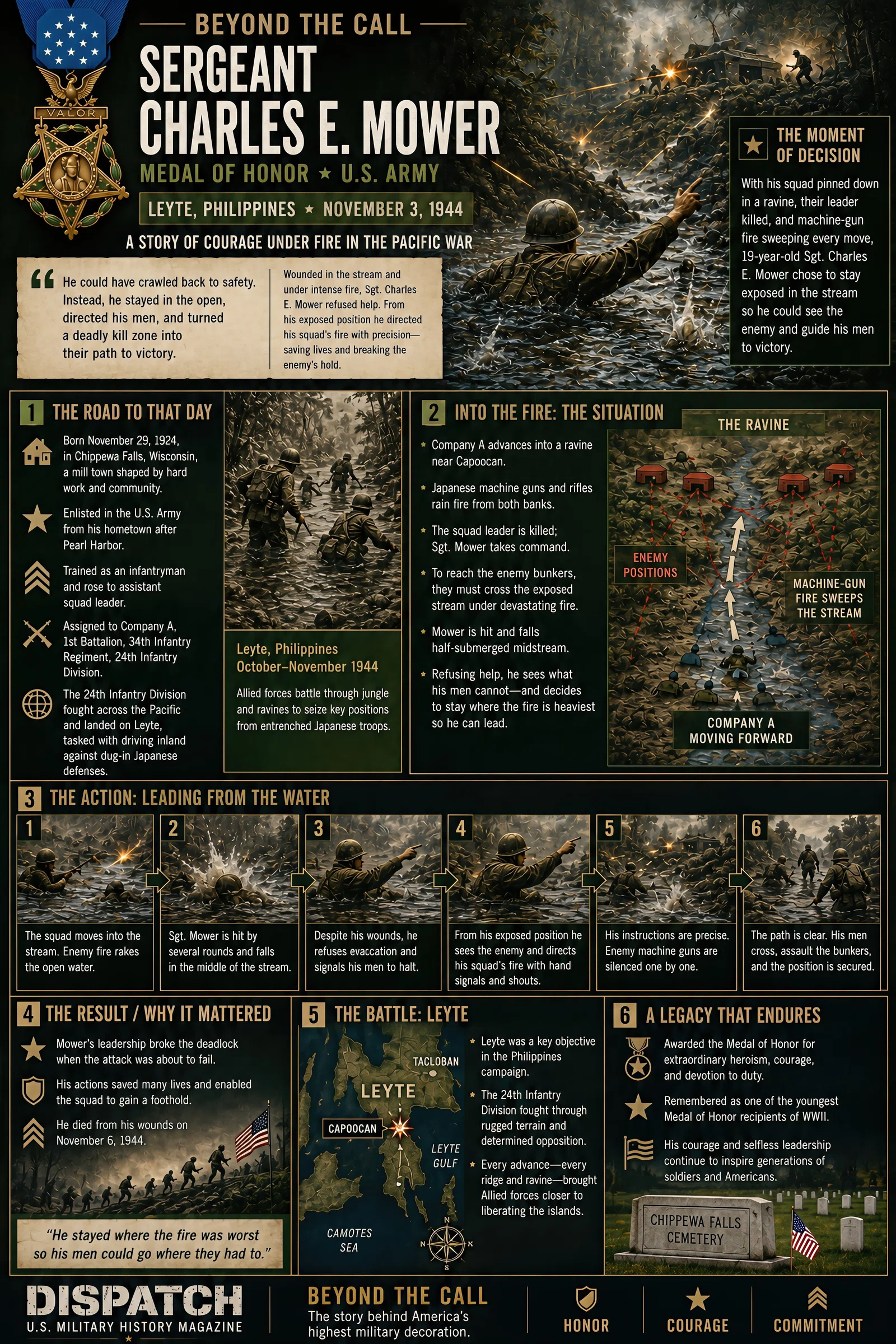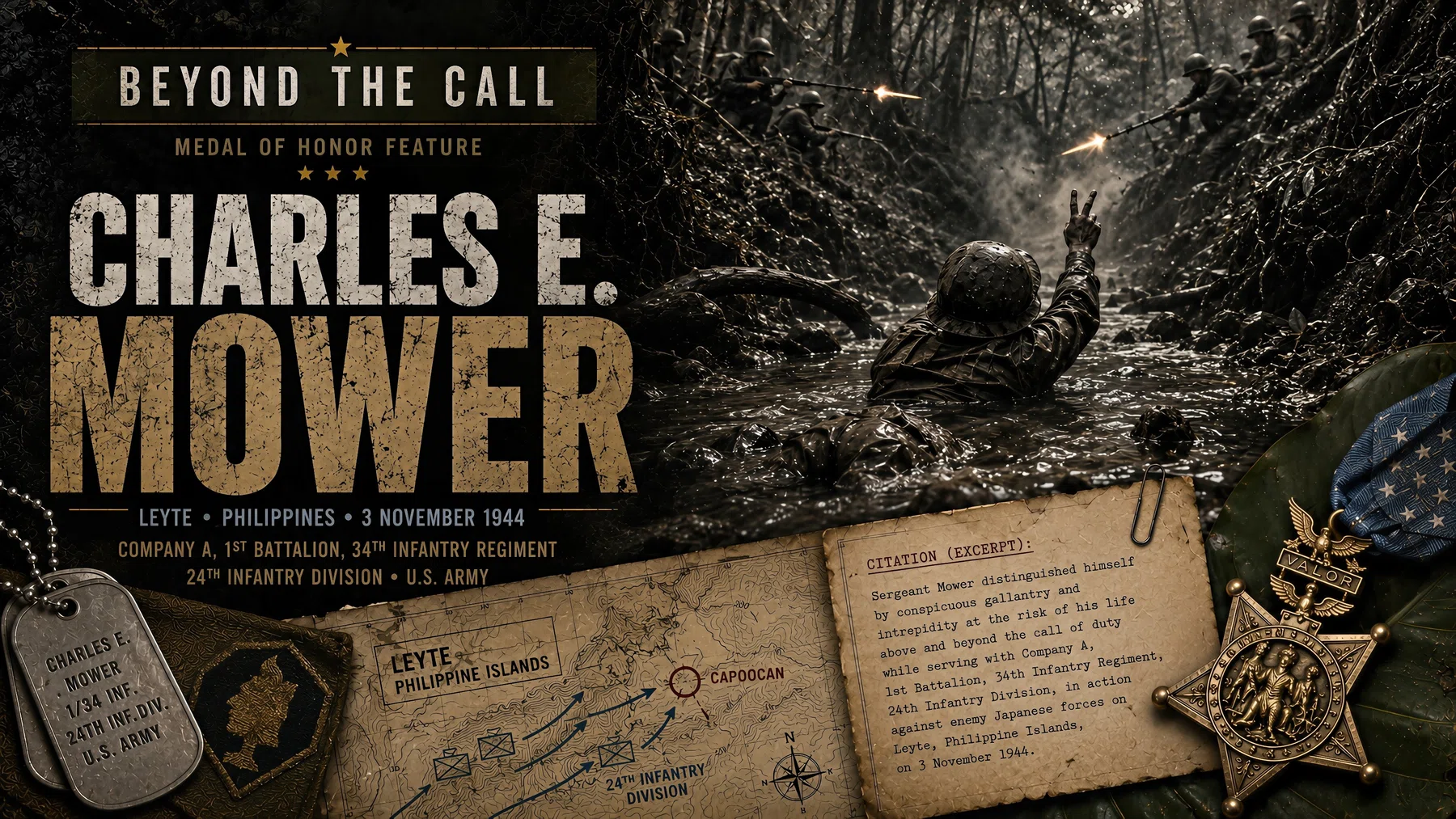
The Moment of Decision
The jungle ravine near Capoocan, on the island of Leyte, funneled sound like a drum. Machine guns hammered from the slopes, echoing off the trees. A thin stream cut the bottom of the gulch, its surface slapped into white splashes as bullets stitched across the water. Sergeant Charles E. Mower, just nineteen years old, stood in that stream with his squad of Company A, 34th Infantry Regiment, advancing into the teeth of a Japanese defense on a November day in 1944.
Moments earlier, the squad leader had fallen, cut down as the men tried to push forward. Mower, the assistant squad leader, stepped up without ceremony. To reach the enemy bunkers hidden in the foliage beyond the far bank, he led his soldiers into the water, where every splash and ripple drew fire. Somewhere midstream, rounds tore into him, dropping him half-submerged in the current.
He could have crawled back to the near bank, out of the direct line of fire, and no one would have questioned it. Instead, lying exposed in the churning stream, Mower saw what his men could not: from this low, open vantage point he could watch the muzzle flashes on both banks and guide their fire with precision. He signaled the squad to halt and held his ground in the water. Gravely wounded, refusing help, he began shouting orders and hand signals, turning that kill zone into his command post. In that instant—choosing to remain in the open, to stay where the fire was heaviest so his men could live—Charles Mower went beyond the call.
The Road to That Day
Charles Edward Mower was born on November 29, 1924, in the mill town of Chippewa Falls, Wisconsin. He grew up in the shadow of the Great Depression, in a community where hard work and looking out for neighbors were not abstractions but daily habits. By his late teens, war had spread across the world, and the attack on Pearl Harbor turned distant headlines into a personal summons. From that same hometown, he enlisted in the United States Army, trading the familiar streets of Chippewa Falls for the rigid lines of barracks and the long days of infantry training.
The formal portrait on page one of his Medal of Honor record shows a young man whose face still carries traces of boyhood—dark hair neatly parted, uniform crisp, expression steady rather than stern. There is no swagger in the photograph, only a quiet seriousness that fits the role he would soon play. In training he learned the fundamentals that would matter on Leyte: how to move a squad under fire, how to read ground at a glance, how to keep frightened men focused on their fields of fire rather than on their fear.
Assigned to Company A, 1st Battalion, 34th Infantry Regiment, 24th Infantry Division, Mower rose to assistant squad leader while still in his teens, an indication of how his superiors viewed his reliability and calm under pressure. The division had already been blooded in Pacific fighting and now was driving into the Philippine island of Leyte, a key step in cutting Japan’s grip on its southern resources. In early November 1944, as American forces pushed inland through jungle-cloaked ridges and ravines, Company A received orders to clear a series of dug-in Japanese positions straddling a narrow stream near Capoocan. Mower and his squad would be among the first across the water.
Into the Fire
On the morning of November 3, 1944, Company A picked its way into a wooded ravine near Capoocan, Leyte, with orders to root out Japanese positions that blocked the advance. The ground forced them into a narrow approach: steep, jungle-covered slopes on both sides and a shallow stream cutting the bottom like a trench. Hidden along those banks, Japanese machine guns and riflemen waited until the Americans were exposed in the open bed of the gulch, then opened fire with sudden, overlapping bursts. The first man to fall was the squad leader at the front of the column, leaving the squad momentarily stunned in the lethal crossfire.
Charles Mower did not let that pause stretch into disaster. As assistant squad leader, he stepped into command, shouting for the men to keep moving and firing as they went. To get accurate fire on the enemy positions, the squad had to cross the stream and climb toward the concealed guns, and that meant walking straight into the impact zone. Mower waded forward, leading from the front, water splashing around his legs as bullets slashed the surface. The enemy gunners quickly zeroed in on the movement in the stream, turning it into a churning lane of fire that cut branches, threw up mud, and struck men as they tried to follow.
Before Mower could reach the far bank, several rounds tore into him. The shock of the impact drove him down into the water, leaving him half submerged in the center of the stream where the fire was fiercest. For a moment his men tried to pull him back toward cover on the near side, but he waved them off. From that low, exposed vantage point, he could see flashes from both banks, judge where the enemy guns were sited, and understand how his squad’s fire needed to shift. He made a quick calculation that would cost him his life: he was more valuable to his men in that dangerous spot than he would be behind a boulder or a tree trunk.
Mower signaled the squad to halt in positions where they had at least some cover, then began turning himself into a living forward observation post. Propped against the current and ignoring his wounds, he shouted corrections to their fire, pointed with his arm, and used hand signals to direct individual men to new firing angles. Under his guidance, the squad focused on one machine gun nest at a time, pouring concentrated fire into the patches of foliage he indicated. Gradually, the volume of enemy fire from one side of the stream faltered as the gun crew was hit and their weapon silenced. The men could feel the pressure on that flank ease, a direct result of their sergeant’s instructions from the water.
Even as blood mixed with the stream around him, Mower refused any effort to pull him out. He continued to call out targets and encourage the squad, his voice cutting through the din of gunfire and ricochets. When a second machine gun that had been sweeping the approaches revealed its position through a burst of tracers, Mower caught it and shifted his squad’s fire, directing them to break its line of sight. Again, their shots, guided by his vantage point, found the hidden emplacement and reduced its fire to scattered, panicked bursts before falling silent altogether. With both major guns knocked out and several riflemen down, the Japanese grip on the ravine began to loosen.
The enemy quickly understood where the real threat lay. While the squad on the banks fired from partial concealment, the gravely wounded sergeant in the stream was fully exposed, yet still clearly in control of the fight. Recognizing that this single figure was directing the attack that was dismantling their defense, the remaining Japanese gunners and riflemen concentrated their fire on him. Bullets struck the water around his torso and head in dense clusters, but he kept urging his men forward, insisting they hold their positions and finish the job. Only when a final, deadly burst hit him did his voice fall silent. By then, his squad had broken the core of the enemy resistance in the ravine and could press on to complete their mission. The stream that had nearly become their graveyard instead became the place where their nineteen-year-old sergeant turned certain defeat into a hard-won advance.
The Citation, Decoded
The official Medal of Honor citation for Sergeant Charles E. Mower begins with a simple description: he was an assistant squad leader attacking strongly defended positions on both sides of a stream in a wooded gulch. Behind those few words lies a deadly tactical problem. The “strongly defended positions” were machine guns and rifle pits sited to command the only practical crossing in that ravine, and the “wooded gulch” meant the enemy could remain almost invisible while firing. To assault such a position, an infantry squad had to expose itself in the open watercourse while its opponents fired from concealment, a situation where attackers usually paid a terrible price.
The citation then notes that when the squad leader was killed, Mower took command and started to lead his men across the stream, only to be “severely wounded before reaching the opposite bank.” Those lines encompass the moment we saw earlier, when he chose to move forward rather than stay behind the men and when his leadership shifted from title to action. The key phrase that follows explains his extraordinary choice: realizing his exposed position was the best place to direct the attack, “he stood fast,” half submerged, refusing to seek shelter or accept aid. In practical terms, that meant choosing to remain at the exact point where enemy fire was most intense so that his men would have the benefit of his eyes and judgment.
The citation credits him with directing the destruction of two machine guns and numerous riflemen, while the remaining Japanese, recognizing his influence, concentrated their full firepower on him until he was killed. Each of those phrases reflects a chain of cause and effect: from his vantage point, he identified threats, shifted his squad’s fire, and methodically removed the weapons that were pinning them down. Words like “gallant initiative,” “heroic determination,” and “magnificent leadership” might sound formal, but in this context they point to something concrete. Initiative meant stepping into command the instant the squad leader fell. Determination meant staying in the stream when every instinct screamed to crawl to safety. Leadership meant that even as he died, his orders and example carried his men forward to complete their mission. The citation’s careful language, when unpacked, reveals a young sergeant who used his last moments not to save himself, but to make sure his squad survived and the attack succeeded.
Why It Mattered
On paper, the firefight in that Leyte ravine was a small action in a vast campaign. A single squad, a narrow stream, a handful of enemy machine guns: it did not decide the war. But in close combat, the difference between a squad that breaks through and a squad that is destroyed can shape the tempo of an entire battalion’s advance. Mower’s choice to remain exposed in the stream allowed his men to silence the weapons that were holding up the attack. By directing their fire with a clear view of both banks, he turned chaos into a coordinated effort, and the squad was able to push past what could easily have become a dead end.
The larger campaign on Leyte depended on momentum. American forces needed to break through successive defensive lines, secure road networks, and drive the Japanese from positions that threatened supply routes and landing areas. A single stubborn strongpoint in a ravine, if left intact, could delay or divert units, costing precious time and lives. By helping to break the resistance at that crossing, Mower contributed to keeping the advance moving forward through northern Leyte. The men who survived that gulch carried their rifles and their experience into the next ridge and the next village, adding weight to the overall push.
There is also the human dimension. Had Mower accepted evacuation or crawled behind cover, his squad would likely have suffered heavier casualties trying to locate and suppress the enemy guns on their own. Some of the men who went home after the war owed their lives, in part, to a nineteen-year-old sergeant who chose to make himself a target so they would not be. That is what the Medal of Honor is meant to recognize: not only a tactical success, but a conscious decision to accept near-certain death in order to give others a chance to live and the mission a chance to succeed.
Leadership and Character
Leadership in combat is often described in broad words—courage, sacrifice, devotion to duty—but in Mower’s case those words point to very specific choices. When his squad leader fell, he did not hesitate or look over his shoulder for higher authority; he stepped into the role because the squad needed someone to turn to immediately. That kind of initiative does not appear suddenly in a single moment. It reflects training, trust built with his men, and a sense of responsibility that had been growing since he first pinned on his sergeant’s stripes. His soldiers were not abstractions to him; they were faces he knew, voices he recognized, and it was their survival he weighed against his own.
His decision to remain in the stream after being hit reveals another quality: a clear, almost cold assessment of where he could do the most good. Wounded, he recognized that his ability to move was limited, but his vantage point was excellent. Rather than accepting help and moving to safety, he chose to stay where his presence mattered most, even as the risk increased with every second. That balance of selflessness and tactical judgment is at the heart of the citation’s language about “gallant initiative” and “heroic determination.” He was not simply being reckless; he was making a calculated sacrifice so his men would have a chance to survive and the squad would have a chance to win.
For leaders today—whether in uniform or in civilian life—Mower’s example offers a stark lesson about ownership and responsibility. He did not delegate the hardest duty to someone else; he accepted it himself. He put himself where the situation was most dangerous and most confusing, then used his voice and judgment to bring order to it. His story reminds us that leadership is not about rank alone, but about where we choose to stand when everything depends on clear decisions made under pressure.
Legacy and Memory
Sergeant Charles E. Mower did not live to see the end of the war he helped to win. He was killed there in the ravine on November 3, 1944, his body carried away from the stream after the fight ended. The following year, he was posthumously awarded the Medal of Honor, the nation’s highest decoration for valor. For his family in Chippewa Falls, the medal came with the knowledge that their son’s last moments were spent protecting the men around him. For his comrades, the award put into official words what they already knew: that their survival and their success in that gulch were tied directly to his decision to stay in the water and keep leading.
In the years that followed, his name did not vanish into the long lists of the fallen. A military transport ship bore his name, carrying soldiers across oceans under the banner of Sergeant Charles E. Mower. Memorials and markers in his hometown and in veteran communities recall his story, keeping his photograph and citation within reach of new generations. His grave in a national cemetery offers a place where visitors can stand, read his name, and connect the quiet rows of headstones to the violent, decisive moments they represent.
For students of military history, his story offers a vivid case study in small-unit combat and individual courage. For families of veterans and service members, it stands as a reminder that acts of extraordinary heroism can come from very young shoulders. Above all, his legacy invites us to remember that behind every line in a citation is a person who made a choice under fire. Mower’s choice in that Leyte ravine turned a deadly trap into a path forward. When we speak his name, we honor not only what he did, but the lives his actions allowed to continue.