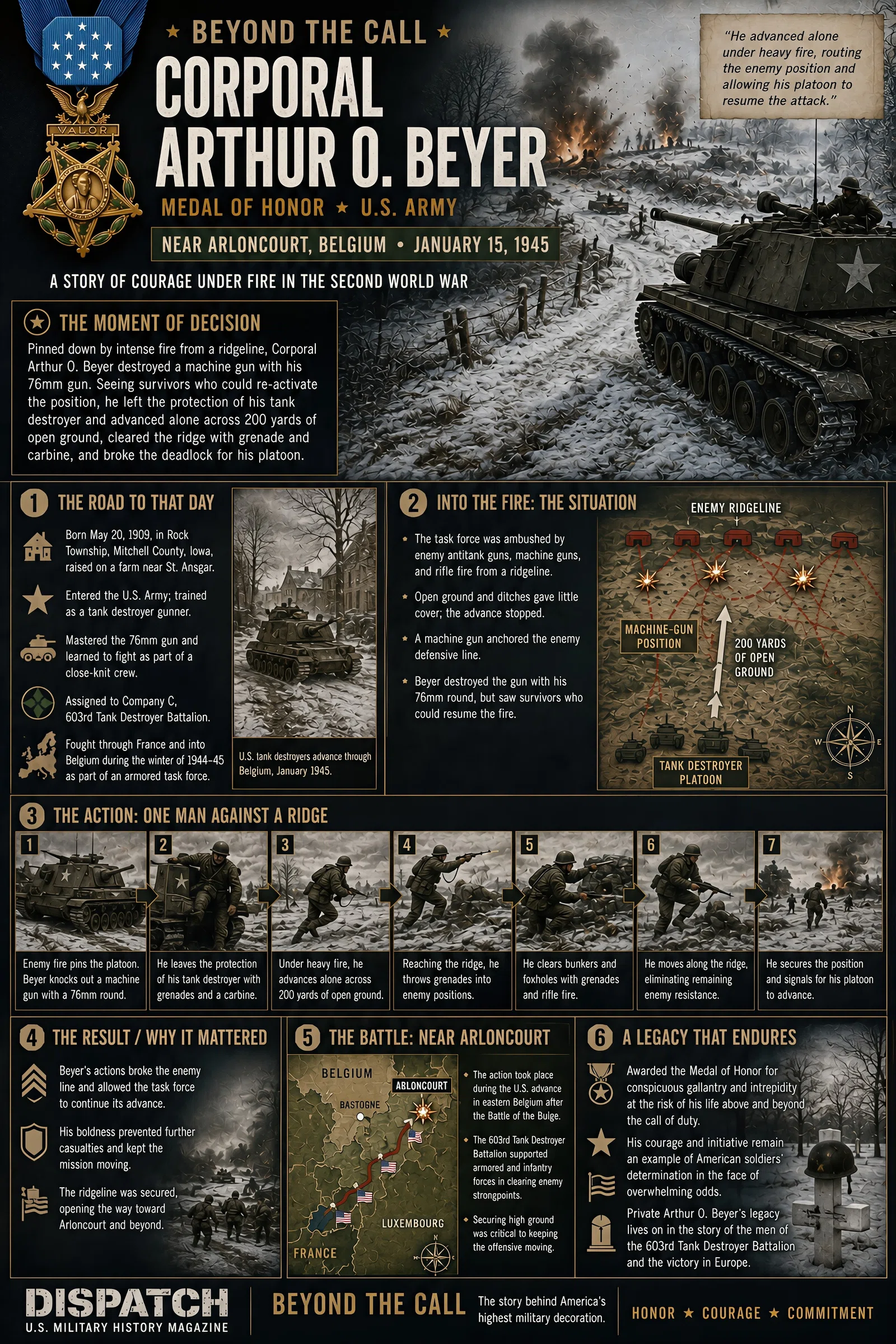
The Moment of Decision
The January sky over eastern Belgium is the color of steel, low clouds pressing down on snow-covered fields. An American armored task force eases forward along a narrow road when the world ahead of it suddenly erupts. Antitank rounds smash into the frozen earth, machine guns rake the ditches, and rifle fire lashes out from a ridgeline roughly two hundred yards in front of the column. Inside one of the lead tank destroyers, Corporal Arthur O. Beyer peers through his gunsight at the source of the fire, feeling the hull shudder under enemy impact.
His platoon’s advance has been stopped cold. Somewhere beyond the ridge lies the next step in the offensive against German forces still clinging to ground after the Battle of the Bulge. Here, though, the entire effort risks stalling. The enemy has dug into a defensive line along the crest, weapons carefully sited to sweep the open approaches. If the column turns back, it gives the Germans time to regroup. If it waits, more fire will find its mark.
Beyer spots one of the machine guns and swings his seventy-six millimeter gun onto the position. The round crashes into the emplacement, silencing the gun and sending its crew sprawling. Through the drifting smoke he can see movement: survivors, shocked but still alive, men who could drag another weapon into place or turn the position into a stubborn strongpoint. The platoon around him is pinned; no one is in a position to rush the ridge.
The obvious choice is to stay behind armor and keep firing, to wait for infantry to work their way forward. Instead, Beyer makes a different decision. He climbs down from the relative shelter of his vehicle, steps out into the open snow under full enemy observation, and starts toward the ridge alone, carbine and grenades in hand. In that instant, he chooses to risk everything to break the line that holds up his comrades.
The Road to That Day
Arthur O. Beyer’s path to that frozen Belgian ridgeline began far from the sound of artillery. He was born on May 20, 1909, in Rock Township, Mitchell County, Iowa, a rural landscape of fields, gravel roads, and close-knit farming communities. In towns like nearby St. Ansgar, life revolved around church, family, and work that started early and finished late. Growing up there meant learning endurance as much as anything else, the kind of steady toughness that rarely makes headlines but carries people through hard times.
By the time global war arrived, Beyer was in his early thirties, older than many of the young men who would eventually serve under or alongside him. When he entered the United States Army, he brought with him not only physical strength honed by years of labor but also the perspective of someone who had already seen lean years and responsibility. The Army channeled those qualities into a specialized role: tank destroyer gunner, part of the new force built to counter enemy armor with fast, hard-hitting vehicles.
Training turned Beyer into a master of his seventy-six millimeter gun. He learned how to read terrain at a glance, how to judge distance under pressure, and how to coordinate with his crew as the turret swung from one threat to another. The work demanded calm, quick thinking, and trust; every man inside the vehicle depended on the others. In wartime portraits associated with his Medal of Honor story, Beyer appears in uniform with corporal chevrons on his sleeve and the tank destroyer patch on his shoulder, his expression more relaxed than dramatic, hinting at quiet confidence rather than swagger.
As the war in Europe ground on, his unit—Company C of the 603rd Tank Destroyer Battalion—found itself moving with armored task forces through France and into the bitter winter battles along the German border. By mid-January 1945, they were fighting in the cold, broken countryside near small Belgian villages, part of the effort to push German forces back after their failed offensive. On the morning of January 15, near a village called Arloncourt, Beyer took his place behind the gun of his tank destroyer, unaware that the day’s mission to clear a ridgeline would demand not just his gunnery skills, but a solitary advance on foot that would change the course of the fight—and his own life—forever.
Into the Fire
By mid-January 1945, the German winter offensive in the Ardennes had been checked, but the fighting was far from over. American armored and infantry units were still pushing against stubborn defenses, trying to clear villages and ridgelines that controlled the narrow roads of eastern Belgium. Near the small village of Arloncourt, an armored task force that included Company C, 603rd Tank Destroyer Battalion, moved out along a snow-fringed road toward a low rise that dominated the surrounding ground. Corporal Arthur O. Beyer, serving as a gunner in one of the lead tank destroyers, watched the ridge ahead, searching for anything out of place among the hedges, thickets, and patches of bare earth.
The ambush, when it came, was sudden and violent. Antitank guns opened from concealed positions along the crest, their shells striking near the head of the column and sending geysers of snow and dirt into the air. Machine guns stitched the ditches along the road, and rifle fire flared from shallow foxholes the Americans had not seen until the muzzles flashed. Vehicles ground to a halt, some slewing toward the roadside for cover as crews tried to nose into defilade, the dead ground where enemy guns could not bear. Men bailed out to the sides, throwing themselves into the thin protection of the ditches while they tried to understand exactly where the worst of the fire was coming from.
From his position behind the 76-millimeter gun, Beyer quickly picked out one of the main offenders: a machine-gun nest dug into the defensive line along the crest, about two hundred yards to the front. Working the turret with practiced speed, he laid the main gun directly onto the narrow slice of ground where the weapon was chattering. The first round smashed into the emplacement, killing one member of the crew and silencing the gun. It was a solid hit, the sort of shot that could easily have been the end of his role in the engagement. But through the smoke and flying snow, Beyer saw movement—two more enemy soldiers still alive in the wrecked position, scrambling for cover and, potentially, for another weapon.
The platoon’s advance was still pinned down, and no friendly infantry was in position to rush the ridge. Rather than wait, Beyer chose to act alone. He climbed down from the comparative safety of his tank destroyer, knowing that every eye on the crest could now pick him out against the snow. Under direct observation and within range of rifles and machine guns, he stepped off into the open field separating the road from the enemy line. Snow clutched at his boots as he moved, and each yard carried the risk that a single well-aimed burst would cut him down. Yet he pushed forward, angling toward the damaged machine-gun nest that had just survived his first salvo.
Reaching the smashed emplacement, Beyer closed on the stunned survivors before they could recover. With his carbine and sheer force of will, he captured the two men and removed their ability to rejoin the fight. At that moment he could have slipped back toward his own lines, having already done more than anyone could have demanded. Instead, while he was still exposed on the enemy’s side of the killing ground, he became aware of a second machine gun roughly 250 yards to his left that was still tearing into the American column. Its tracers carved bright paths across the gray air, and every burst meant more danger for the immobilized vehicles and men below the ridge.
Beyer turned toward this new threat and advanced again, now moving laterally along the crest, closer to the heart of the German position. The fire grew heavier as he neared the second machine-gun nest, bullets cutting through the brush and whipping past him at close range. Using what little cover the ground offered—shallow depressions, clumps of frozen grass, the low walls of abandoned foxholes—he worked his way close enough to end the duel at hand-grenade distance. A well-placed grenade into the emplacement killed one crew member outright. Beyer rushed the position before the others could recover, capturing the two remaining soldiers and silencing yet another key weapon that had been raking his comrades.
What followed went beyond any direct order. Rather than retrace his steps back to the American lines, Beyer continued along the ridge on what his citation would later describe as a self-imposed mission. For roughly a quarter of a mile he moved from foxhole to foxhole, attacking German soldiers in their individual pits and small clusters. Sometimes he fired his carbine at close range; other times he used grenades to break the will of defenders who had chosen their ground and believed they owned the high ground. Each short rush between bits of cover meant fresh exposure to small-arms fire from enemies who now understood that a lone American was inside their line.
By the time he finally worked his way back toward his own force, the character of the battlefield had changed. Beyer had personally destroyed two machine-gun positions, killed eight enemy soldiers, and captured 18 more, including two bazooka teams who had been poised to threaten American armor at close range. The German defense line along the ridge, once a carefully prepared belt of fire, had been gutted by a single determined man. With the machine guns down, key positions cleared, and prisoners being led away, the task force could move again. What had been a deadly bottleneck turned into a breached line, and the American advance near Arloncourt regained its momentum.
The Citation, Decoded
The Medal of Honor citation for Corporal Beyer is written in the formal language of military tradition, but every phrase points back to very real moments on that Belgian ridge. It begins by stating that he “displayed conspicuous gallantry in action,” a phrase that means his courage did not blend into the background chaos of battle. It stood out—conspicuous—because other soldiers could see him leave his armored vehicle, cross open snow under fire, and keep moving forward when there was no protection but his own determination and skill. The words mark a difference between simply doing one’s duty and stepping far beyond it.
The citation notes that his platoon was held up by antitank, machine-gun, and rifle fire from troops dug in along a ridge. In plain terms, that means his comrades were stuck in the worst possible place: caught on exposed ground below a prepared defensive line. When it describes him dismounting and crossing open ground under direct enemy observation, it emphasizes that there was nothing accidental about his risk. He knew the defenders could see him and adjust their aim as he moved, yet he chose that path because remaining behind armor would not remove the threat to the task force.
Later, the citation speaks of Beyer advancing “through withering fire” and undertaking a “self-imposed mission” along the ridge. Withering fire is more than scattered shots; it is sustained, accurate small-arms fire that can strip the life out of an attack if men hesitate. A self-imposed mission means no one ordered him to clear that quarter mile of foxholes. He recognized that as long as German soldiers remained dug in with weapons and the will to use them, the larger force was in danger. His decision to keep going, armed only with a carbine and grenades, transformed him from a gunner at his station into a roving assault force.
Finally, the citation states that his actions “eliminated the German defense line and enabled his task force to gain its objective.” In practice, this means the destruction of key weapons, the killing of eight enemy soldiers, and the capture of 18 more—including bazooka teams—broke the backbone of the position. The ridge that had stalled the advance became ground secured by American hands. The formal words “close with and destroy the enemy” translate into a series of deliberate, perilous steps: one man climbing down from armor, walking into the storm of fire, and refusing to stop until the line that threatened his comrades no longer existed.
Why It Mattered
In immediate tactical terms, Corporal Arthur O. Beyer’s assault along the ridge near Arloncourt turned a stalled advance into a moving offensive. The armored task force had been pinned in a textbook deadly zone: vehicles halted on open ground, crews unable to maneuver freely, and infantry in shallow cover under machine-gun and antitank fire. By destroying two key machine-gun positions and removing bazooka teams that threatened the vehicles at close range, Beyer cut out the anchors of the German defense. The line that had been designed to stop armor cold was suddenly full of gaps, its most dangerous weapons silent or in American hands.
That change in the local fight fed directly into the broader winter campaign. January 1945 in Belgium was a moment when every cleared village, road, and ridgeline helped push German forces back from their last major offensive in the West. A single tank destroyer company could not decide the outcome of the war, but it could decide whether a route remained open for follow-on units, whether pressure on the enemy stayed constant, and whether the initiative remained in American hands. Beyer’s actions ensured that, at that time and place, the momentum stayed with the attackers rather than shifting back to the defenders.
There was also a human dimension to why it mattered. The men in that column knew exactly how exposed they were and how dangerous the enemy fire had become. Seeing a comrade leave cover, cross the snow alone, and systematically tear apart the positions holding them down did more than change the map; it changed morale. Acts of visible courage can steady a unit, turning fear into determination. Had Beyer remained behind armor and no one else been able to break the line, the task force might have been forced to fall back, reorganize under fire, and accept more casualties. Instead, one man’s choice allowed the entire formation to keep moving toward its objective.
Leadership and Character
Arthur Beyer did not hold a high rank or command a large formation, yet his actions from that Belgian ridgeline show several enduring themes of battlefield leadership. The first is initiative. No one needed to explain to him that the task force could not remain pinned indefinitely under enemy fire. When he saw an opportunity to strike directly at the source of the danger, he did not wait for detailed orders that could not easily be given in the chaos. He translated understanding into action, a hallmark of small-unit leadership in combat.
A second theme is responsibility that extends beyond formal duty. As a tank destroyer gunner, Beyer’s job was to fight from inside his vehicle, working the main gun and destroying enemy targets from under armor. He had already fulfilled that duty when he smashed the first machine-gun nest with his gun. Choosing to dismount and advance alone across the snow was not required by his role; it was something he took upon himself because he understood that the safety of his comrades and the success of the mission demanded more. That willingness to assume risk for others is at the core of the Medal of Honor tradition.
The third theme is determination under sustained danger. Beyer’s courage was not a single momentary surge. After reaching the first position and capturing survivors, he could have justified withdrawing. Instead, he pressed on to the second machine gun, then still farther along the ridge, clearing foxholes over a long stretch. That persistence, step after step under fire, speaks to a character shaped by years of hard work, training, and a deeply ingrained sense of duty. For leaders and service members today, his story underscores that leadership is often expressed not with speeches or titles, but through quiet, repeated decisions to confront danger so others do not have to.
Legacy and Memory
In the years that followed the war, Arthur O. Beyer’s name became part of the record of American valor in Europe. His Medal of Honor recognized not only the destruction of enemy positions and the capture of numerous soldiers, but also the example he set for those who served with him and those who would study the conflict later. Like many decorated veterans, he carried the experiences of that winter day in Belgium back into civilian life, returning to the same Midwestern world that had shaped him before the war. His story stands alongside thousands of others who went overseas, did extraordinary things in extraordinary circumstances, and then came home to resume ordinary lives marked forever by those experiences.
The memory of his actions lives on in more than a framed citation or an entry in a roster of recipients. It appears wherever the story is told: in unit histories of the 603rd Tank Destroyer Battalion, in community remembrances from his home region, and in the larger narrative of the Battle of the Bulge and its aftermath. When visitors walk through museums, read summaries of the winter campaign, or explore lists of Medal of Honor recipients, Beyer’s name is there as a reminder that large battles are shaped by individual choices made in seconds on ridgelines and roadsides.
Gravesites, hometown markers, and the quiet mentions of his name at commemorations all serve the same purpose: to ensure that he is remembered as a person, not just as a line in an official document. His legacy includes not only the tactical success he won near Arloncourt, but the enduring lesson his story offers about courage, initiative, and responsibility under fire. When we pause to consider his actions, we honor not only one man, but all those whose unrecorded courage helped turn the course of that hard winter in Europe.