The Moment of Decision
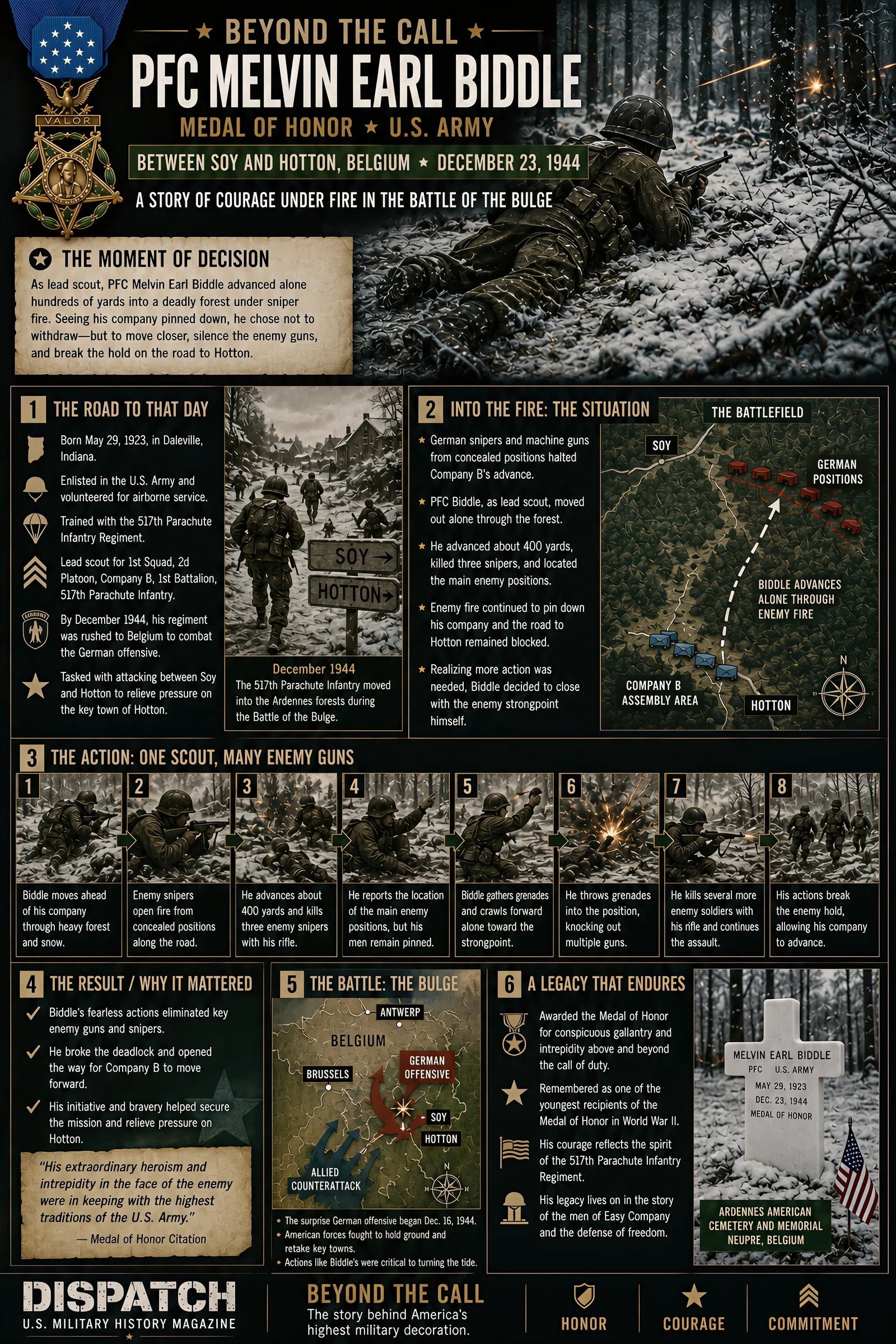
Snow hangs heavy in the Ardennes forest, muting sound until a rifle cracks and splinters bark from a nearby tree. Private First Class Melvin Earl Biddle lies pressed into the freezing ground, the lead scout for an American parachute infantry company feeling every heartbeat echo in the stock of his rifle. Somewhere ahead, beyond the dark trunks and tangled undergrowth, German snipers have halted his company’s advance on the road between the villages of Soy and Hotton. Behind him, an entire battalion is depending on someone to find a way through the fire and break the grip of the enemy on a key approach to the town.
Biddle has already edged forward hundreds of yards, alone, testing each step in the snow before shifting his weight. The enemy’s first shots were wild, flashes in the gloom, but the next ones are deliberate, cutting twigs inches above his head. He can feel the temptation to stop, to let someone else take the next risk. The orders are clear—push through, relieve the pressure on Hotton—but no order can tell a man to move his body toward bullets that have already found men he knows.
He studies the pattern of the fire, catches a glimpse of a helmet, and realizes that if he can reach a better angle, he can silence the threat that’s pinning the company down. It means leaving the relative shelter of a shallow fold in the ground and crawling closer to the muzzle flashes with only a few grenades and his rifle. In that instant, Biddle decides. Instead of pulling back, he eases forward into the killing zone, committing himself to a path that will carry him far beyond what anyone could reasonably ask of a private first class.
The Road to That Day
Two decades earlier, Melvin Earl Biddle’s world was a small Indiana town surrounded by fields and two-lane roads. Born in Daleville in 1923, he grew up in the lean years of the Great Depression, where work was expected early and nobody wasted much time boasting. Family, school, and chores filled his days; the rhythms of planting seasons and high school ball games mattered more than anything happening an ocean away. That kind of upbringing tended to produce quiet, steady young men who measured themselves by whether they did their share, not by whether anyone noticed.
When the United States went to war, Biddle was part of a generation suddenly asked to trade those familiar routines for uniforms and rifles. The idea of airborne troops—paratroopers who would drop behind enemy lines and fight as light infantry—was still new and dangerous, but it appealed to men willing to shoulder extra risk for extra responsibility. Biddle trained hard, learned to trust a parachute and a small group of fellow soldiers, and earned his place in a regiment that prided itself on toughness and initiative.
By December 1944, Private First Class Biddle was the lead scout for 1st Squad, 2d Platoon, Company B, 1st Battalion, 517th Parachute Infantry Regiment of the United States Army. His job was simple to describe and hard to perform: move in front of everyone else, read the ground, sense danger before it struck, and give his company a chance to survive its first contact with the enemy. Comrades knew him as the man who would be out front, slipping from tree to tree with an alert, unhurried stride that suggested he trusted his training more than luck.
As winter closed in and the German surprise offensive in the Ardennes exploded into being, the regiment was rushed north into Belgium. Their mission was to help plug the gaps torn in the Allied lines and to pry key towns out of German hands. When orders came to attack between Soy and Hotton—villages now caught up in the desperate struggle known as the Battle of the Bulge—Biddle once again shouldered his pack and stepped to the head of the column, ready to feel the forest close around him.
Into the Fire
On the morning of December twenty-three, 1944, the woods between Soy and Hotton were a maze of snow, trees, and enemy fire. The German offensive in the Ardennes had torn gaps in Allied lines, and the town of Hotton lay under enemy pressure, its roads threatened by armored thrusts. Biddle’s battalion received the mission to attack through the forest and break that grip, a task that meant pushing straight into positions the enemy had spent days preparing. As lead scout for his company, Biddle moved out first, feeling the brittle crust of snow under his boots and seeing only a few yards ahead through the trunks and underbrush. Somewhere in that gray distance, German riflemen waited. The success of the whole attack depended on whether the scouts could find and survive the first contact long enough for the rest of the company to move.
Soon the forest answered. A sudden crack of rifles and the whine of bullets through branches announced the unseen enemy. Biddle pushed forward anyway, probing carefully until he had advanced roughly four hundred yards into the woods. There, within about twenty yards of German positions, he caught glimpses of snipers using the trees as cover and began the deliberate work of hunting them down. Working from one patch of concealment to another, he used his rifle with calm precision, killing three snipers and easing the pressure on the men behind him. The snow, the distance from his own lines, and the constant threat of enemy fire gave each movement weight, yet he kept moving, measuring each shot and each shift of position in seconds.
Most soldiers might have paused there, content to have broken the first ring of resistance. Biddle chose to keep going. He pressed ahead another two hundred yards through the dense timber, closing on a machine-gun position that had been raking the approach routes. Once he located it, he fired until both enemy gunners were down, then scanned for the next threat. The woods were now a patchwork of dead ground and danger zones, but his work had opened lanes for his company and for the following troops. Every enemy position he silenced was one less muzzle waiting for the Americans who would pass through that clearing later.
Still alone out front, Biddle identified the likely location of another, better-concealed machine-gun nest. Crawling through snow and brush, he inched forward until he was close enough to throw hand grenades. The blasts tore into the position, killing two Germans and wounding a third, and for the first time in hours, that slice of the forest fell quiet. Only then did he signal back, using his limited cover to gesture his company forward. When the line surged up to his position, Biddle did not fall back to rest. Instead, he rejoined the fight in the rifle line, shifting to meet new threats as they appeared. Under continued fire he changed positions coolly, picking off three more enemy soldiers whose weapons had been chewing at the American advance.
The battle did not end with daylight. As evening settled over the Ardennes, the front lines remained tangled and uncertain, and commanders needed fresh information about the enemy’s movements. Biddle volunteered to go forward once more, this time prowling the darkened woods alone for several hours. Listening for engines, watching for the glint of metal, he gathered details on enemy positions and the strength of their armor. When he returned, the information he brought back allowed American infantry and tanks to plan a coordinated attack against the German armor that threatened the town. While most soldiers from either side sought shelter from the cold and the guns, he spent the night between the lines, trading comfort and safety for knowledge that could save lives.
At first light on December twenty-fourth, Biddle was again at the front of the advance. The attack resumed, and as the company pushed forward, its flanking elements ran into yet another hostile machine-gun position that pinned them down. Biddle once more moved out ahead, closing the distance alone across open ground broken only by snow and scattered cover. From about fifty yards away, he used his rifle to kill the machine-gun crew, breaking the spell of their fire. Deprived of their automatic weapons and shaken by the sudden loss, the remaining German riflemen abandoned their positions and fled in confusion. Over the span of roughly twenty hours, Biddle’s repeated solo advances, accurate fire, and refusal to stop underlined one simple fact: without his actions, his battalion might well have been stalled in the forest with far heavier losses. Instead, they pried open the road network and helped free Hotton from the pressure of enemy guns.
The Citation, Decoded
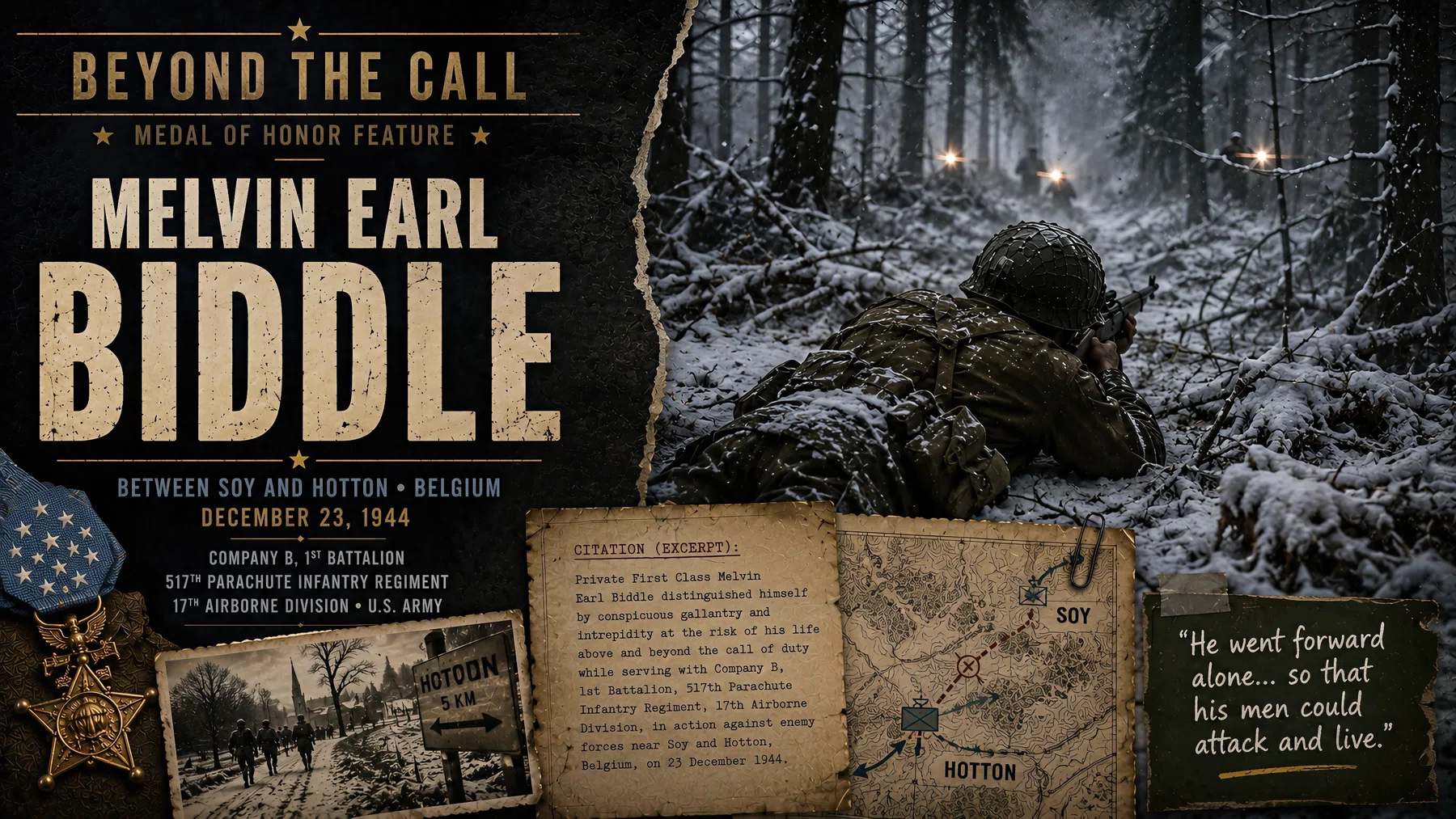
The official Medal of Honor citation for Private First Class Melvin Earl Biddle speaks of “conspicuous gallantry and intrepidity” near Soy, Belgium, on December twenty-three and twenty-four, 1944. In plain terms, that phrase covers hour after hour of a single scout repeatedly stepping into the most dangerous ground in front of his battalion. When the citation notes that he “aggressively penetrated a densely wooded area” and advanced four hundred yards, it describes a man leaving all friendly support behind, moving so far in front that the nearest help was several football fields away through snow-choked timber. Killing three snipers at twenty yards meant he had allowed himself to get close enough that a single missed move could have ended his life.
The citation’s mention of a hostile machine-gun position and a well-concealed machine-gun nest captures just how much firepower Biddle faced alone. A machine gun in the Ardennes could dominate an entire stretch of approach ground, and most infantry units were trained to bring several weapons and multiple soldiers against such a threat. Biddle instead crawled close enough to use grenades, exposing himself to any surviving rifleman or automatic weapon, and then charged the damaged position with his last grenade and his rifle. When the citation says he “entered a determined line of enemy defense, coolly and deliberately shifted his position, and shot three more enemy soldiers,” it highlights not just courage but control—moving under fire in a way that protected his own men while steadily reducing the volume of enemy fire.
Finally, the citation’s closing lines emphasize both endurance and effect. It notes that he patrolled alone for hours at night, bringing back information that enabled American infantry and armor to destroy enemy tanks, and that at daybreak he again led the advance, killing a machine-gun crew from fifty yards. The phrase “his intrepid courage and superb daring during his twenty-hour action enabled his battalion to break the enemy grasp on Hotton with a minimum of casualties” is not an exaggeration; it is a summary of how one private’s decisions reshaped a small but critical corner of a much larger battle. In those woods between Soy and Hotton, the words of the citation translate into a long, cold, and lethal patrol carried out by a single soldier who kept choosing to step forward when nearly every instinct must have urged him to stop.
Why It Mattered
In the confusion of the Battle of the Bulge, the ground between Soy and Hotton was more than just another patch of forest; it was a doorway. If German forces kept control of the roads and high ground around Hotton, they could continue to push deeper into the Allied rear, threaten supply lines, and prolong their offensive in Belgium. Biddle’s battalion had been given a difficult assignment: drive the enemy from positions that commanded those routes and relieve the town before the situation deteriorated further. The forest favored the defenders. Concealed machine guns and snipers could stop an attack long before it reached the edge of the trees, turning every approach into a killing ground and grinding the advance to a halt.
By moving alone far ahead of his company, Biddle changed that equation. Each sniper he found and killed, each machine-gun nest he silenced, opened a narrow but crucial gap in the German defenses. Instead of a company stumbling blind into overlapping fields of fire, Biddle’s deliberate work meant the main body could move forward with fewer surprises and fewer casualties. His nighttime patrol, conducted in bitter cold with no certainty of return, gave commanders the information they needed to match infantry and armor against enemy tanks at first light, rather than blundering into them. The destruction and scattering of enemy crews on the second day broke the coherence of the defense at a critical moment.
Had he hesitated or failed, the battalion’s attack might have stalled short of its objectives. A stalled attack in that forest would have meant more time for German armor to maneuver, more lives lost pressing the same ground again, and greater risk that Hotton would remain under threat. Instead, the road network opened, the enemy grip on the town loosened, and a local success contributed to blunting a much larger offensive. In a campaign measured in miles and days, one private’s decisions helped shift the balance on a small but important piece of the front.
Leadership and Character
Although Biddle wore the chevrons of a private first class rather than the bars or stripes of a formal leader, his actions between Soy and Hotton demonstrate the essence of combat leadership. Leadership in that setting is not about rank; it is about who moves first when everyone understands the danger. As lead scout, he was already expected to take on risk, but the way he did so—repeatedly pushing beyond the distance most would consider reasonable—showed an unusual level of initiative. No one ordered him to crawl hundreds of yards ahead, alone, to hunt snipers at close range or to stalk well-concealed machine guns with grenades. He recognized what the situation demanded and accepted responsibility for doing it, even when it meant being out of sight and out of easy reach of help.
His conduct also reveals a steady, disciplined courage rather than a single burst of reckless daring. The citation’s account of him coolly shifting positions under fire, picking his shots, and returning again and again to the most dangerous ground suggests a man who controlled his fear and used his training to guide his movements. That kind of calm under pressure is what soldiers look for in the person they must follow, whether or not that person has formal authority. In Biddle’s case, his willingness to go forward made it possible for others to advance at all.
There is also a deeper thread of care for others in his decisions. Each enemy weapon he silenced meant fewer rounds tearing into the ranks of men he knew by name. Volunteering for the night patrol meant accepting personal hardship so that his battalion would not walk blind into the range of enemy armor. For modern readers—whether service members, veterans, or civilians—Biddle’s story underscores that character is often revealed when no one is watching closely, when the choice to step forward or hold back belongs to the individual alone. His courage, initiative, and quiet sense of duty offer a model of leadership grounded not in orders, but in conviction.
Legacy and Memory
After the guns fell silent and the war in Europe ended, Melvin Earl Biddle returned to Indiana and to the quieter responsibilities of civilian life. Like many combat veterans, he carried memories of those frozen woods that he rarely shared in full, choosing instead to focus on family, work, and community. The Medal of Honor placed him in a select company, but by all accounts he remained the same modest man who had left Daleville as a young paratrooper. When he did speak about his experiences, he often emphasized the men he served alongside and the sacrifices of those who did not come home, rather than his own role in the battle.
Over the years, his story became part of the broader memory of the Battle of the Bulge and of airborne operations in Europe. His name appears in unit histories, local memorials, and tributes in his home state, where his service is remembered alongside that of other Hoosiers who fought in the Second World War. His grave in Indiana gives veterans, historians, and neighbors a tangible place to honor the quiet man behind the medal, a reminder that extraordinary courage can come from very ordinary beginnings.
Today, the fields and forests between Soy and Hotton are peaceful, but his actions there continue to be studied by students of military history and leadership. For those who walk the ground, visit museum exhibits, or read accounts of the battle, Biddle’s story serves as a bridge between the statistics of a major campaign and the choices of a single soldier on a cold December night. It invites us to remember him not just as a figure in a citation, but as a young American who repeatedly chose to step into danger so that others could live.