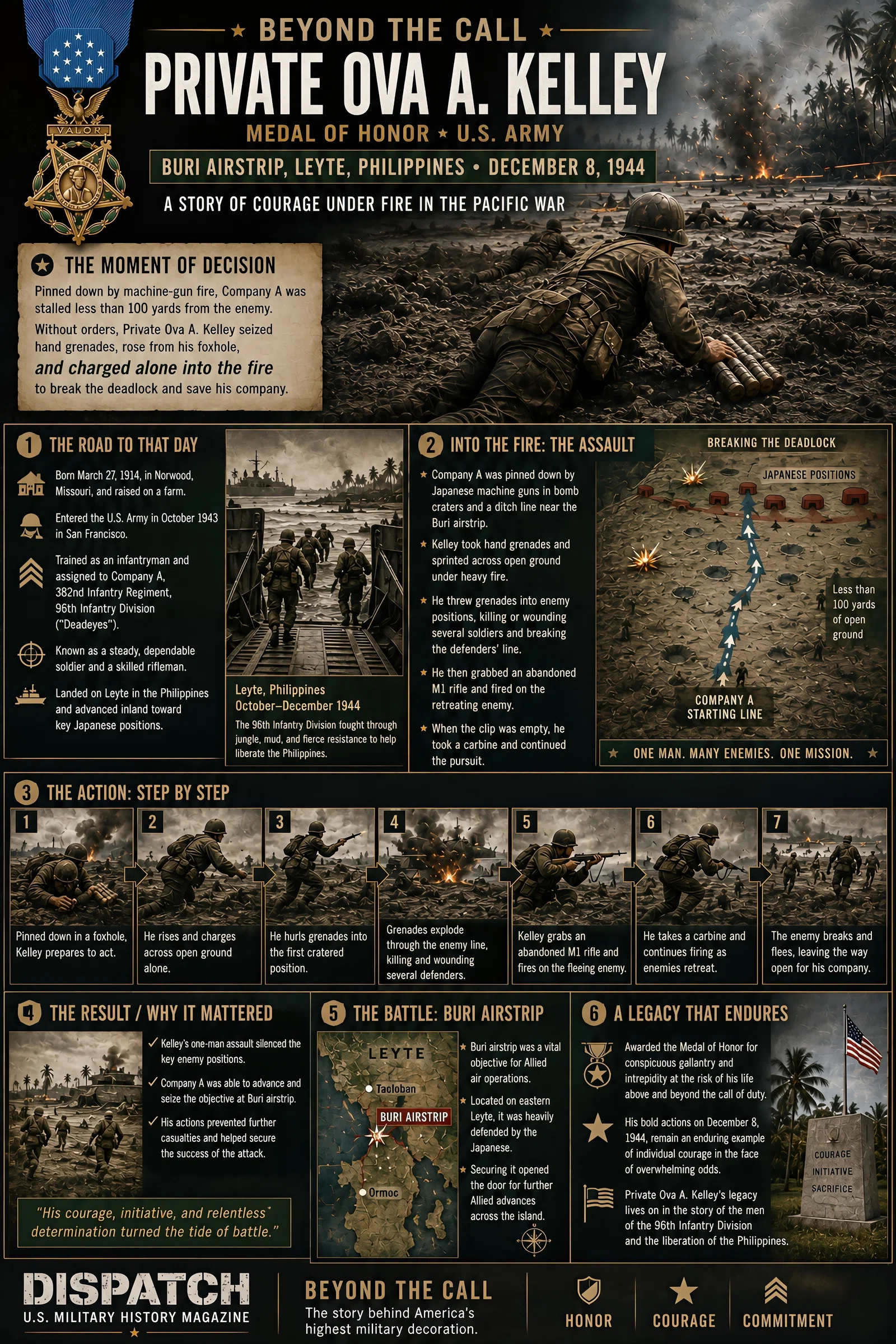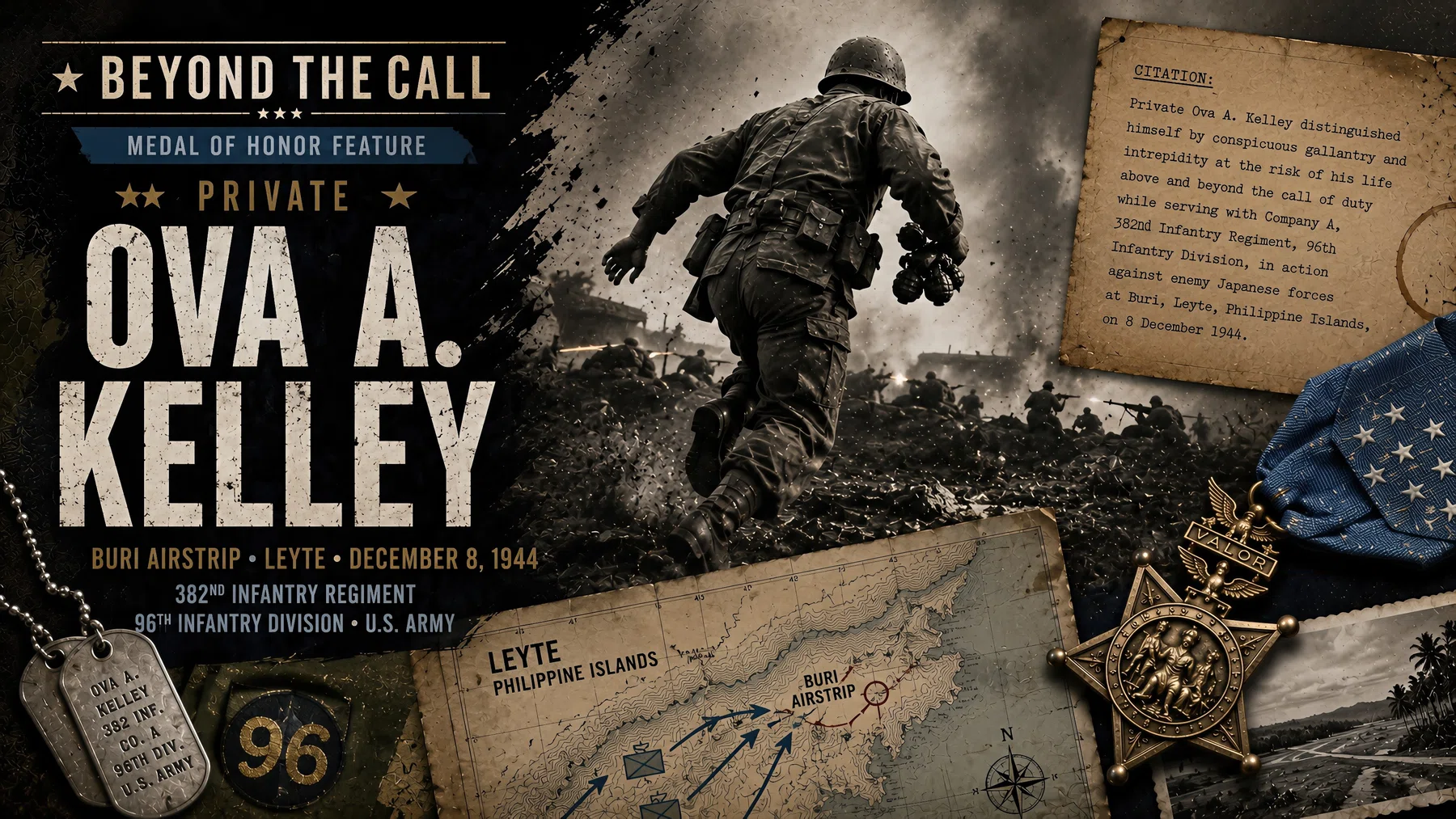
The Moment of Decision
Before dawn on Leyte, the world was reduced to shadows, muzzle flashes, and the flat crack of Japanese rifles. Company A of the 382nd Infantry had clawed its way to the edge of the enemy‑held Buri airstrip, then stalled. Out in front, less than a hundred yards away, Japanese soldiers were dug into bomb craters and a drainage ditch, their machine guns perfectly sighted on every patch of open ground. Anyone who tried to move was met with bursts of fire that snapped past at chest height. Men hugged shallow foxholes, listening to bullets smack the earth and the desperate calls for a medic.
A mortar concentration silenced one of the enemy guns, but it did not change the basic fact: the company was pinned in place, exposed, and going nowhere. Without a breakthrough, the attack would fail and daylight would only make them easier targets on the open ground leading to the runway. Private Ova Kelley lay in his own scrape of dirt, feeling the concussions of nearby rounds and the helpless tension that grips an infantry line when every option seems lethal.
Then something shifted—not in the enemy positions, but inside one soldier. Kelley reached for a stack of hand grenades, cradling them against his chest. Without orders, he rose from the scant cover that had been his protection and started forward alone into the fire, intent on breaking the deadlock himself.
The Road to That Day
Ova Arthur Kelley was born on March 27, 1914, in the small town of Norwood, in the rolling hill country of southern Missouri. It was a place of farms, two‑lane roads, and close‑knit families where everyone knew who you were and where you came from. Growing up between the First World War and the Great Depression meant learning early about hard work, shared sacrifices, and making do with what you had. Those traits would follow him into uniform.
As a young man, Kelley eventually found his way west. By the fall of 1943 he was in San Francisco, one of thousands of Americans watching the war surge across oceans on maps and newsreels. In October he entered the United States Army, trading civilian clothes for the olive drab of a wartime recruit. Training transformed him from small‑town Missourian into an infantryman, teaching him how to handle an M1 rifle, move under fire, and trust the men to his left and right. A wartime portrait shows him in dress uniform and cap, face still youthful but eyes steady, the look of a man who understands the seriousness of what lies ahead.
Kelley was assigned to Company A, 382nd Infantry Regiment, part of the 96th Infantry Division—an outfit that would earn the nickname “Deadeyes” for its marksmanship and toughness in the Pacific campaigns. After months of preparation, the division shipped out across the Pacific and landed on Leyte in the Philippines, tasked with seizing ground vital to the larger effort to liberate the islands. As the regiment pushed inland through mud, jungle, and shattered villages, its companies were sent to pry the Japanese loose from key positions. Early on the morning of December 8, 1944, that mission brought Kelley and his comrades to the blood‑slicked edge of Buri airstrip, where their advance abruptly ground to a halt and one private faced the decision that would define his life.
Into the Fire
When Kelley rose from his foxhole with grenades pressed against his chest, the men around him shouted warnings that were swallowed by the gunfire. The nearest Japanese positions lay in a shallow depression and along a ditch line, no more than the length of a football field away but guarded by interlocking machine guns. Between Kelley and that line of fire stretched open ground broken only by shell holes and tufts of grass. As he moved, enemy tracers cracked past him, tearing into the soil and kicking up little fountains of dirt. Instead of diving for cover, he kept going, loping forward in a crouch, pulling the pin on a grenade and hurling it into the first crater. The blast punched the air out of his lungs, but when he saw figures slumped and still, he knew he had at least shaken the defenders.
Kelley did not stop there. He zigzagged from one shallow depression to another, keeping just low enough that hurried shots went high. With each grenade he chose his target carefully, throwing into a crater mouth or along the lip of the ditch where helmets bobbed up and down. Explosions tossed dirt and smoke into the air, turning the Japanese line into a torn strip of earth where nothing looked solid or safe anymore. In the confusion, some of the defenders tried to scramble back, only to be caught in the open as Kelley closed the distance. By the time his last grenade went off, at least a handful of enemy soldiers were dead or wounded, and the rest were breaking away from carefully prepared positions, no longer an anchored line but a disorganized knot of men trying to escape.
Now exposed on the enemy side of no-man’s-land, Kelley grabbed an abandoned M1 rifle lying near a shell hole. Ahead of him, Japanese soldiers were running for the rear, some glancing over their shoulders in disbelief at the lone American in their midst. Kelley snapped the rifle to his shoulder and fired methodically, the weapon’s sharp report cutting through the rumble of the fight. Several of the fleeing soldiers fell, the rest scattering toward a low rise near the airstrip. When the rifle’s clip pinged empty and flew free, he let the weapon drop and snatched up a carbine from another body, the shorter weapon better suited for rapid fire as he continued to pick targets. More enemy troops went down, their attempted withdrawal collapsing into chaos under his aim.
Back at the American line, Kelley’s company had watched this one-man assault unfold with a mix of horror and awe. The sight of a single private charging the entrenched enemy, surviving each burst of fire, and then standing upright to shoot into the retreating column broke the paralysis that had gripped them. Officers and noncommissioned officers shouted for the men to move. With a sudden surge, they poured out of their foxholes and advanced, rifles and automatic weapons firing into the crumbling Japanese position. What had been a killing zone for the attackers only minutes before became a ground of opportunity as the company crossed it in a rush, following the trail Kelley had blasted open. In the short, violent clash that followed, they overran the enemy force, leaving dozens of dead and capturing several heavy and light machine guns that had pinned them down at dawn.
The momentum did not stop at the ditch line. Kelley, still at the front, pressed on toward the airstrip itself, intent on exploiting the breakthrough before the enemy could reorganize. The runway and its surroundings were vital terrain; holding it meant denying the Japanese a base and securing another piece of Leyte for the wider campaign. As the charging soldiers crested a small rise and spilled onto the fringes of the airfield, scattered enemy survivors fired from hidden positions. One sniper’s bullet struck Kelley, tearing into him with a wound so severe that he collapsed even as the company swept past. His comrades pushed on to secure the objective, but when they later carried him to the rear, it was clear his injuries were grave. Two days after his assault broke the back of the enemy defense at Buri airstrip, Ova Kelley died of his wounds, never seeing how his courage had turned a stalled attack into a decisive success.
The Citation, Decoded
The official Medal of Honor citation for Private Kelley reads like a compressed history of that morning at Buri airstrip, packed with phrases that carry more weight when unfolded. It speaks of a company “immobilized by heavy, accurate rifle and machine-gun fire” from troops in bomb craters and a ditch, which on the ground meant men flattened against the soil, unable to move without drawing fire from positions less than a hundred yards away. The commander’s call for a mortar concentration, and the destruction of a single machine gun, shows that standard solutions had been tried and found wanting. What changed the battle was the next line: Kelley, “on his own initiative,” leaving his shallow foxhole with an armload of grenades and beginning a one-man assault. Those words capture a decision to act without orders, accepting that the open ground ahead might be fatal but deciding that staying put would doom even more men.
The citation then traces his advance in simple, stark terms: moving forward under fire, throwing grenades with such accuracy that he killed or wounded several defenders and forced the remainder into a “disorganized rout.” Each of those phrases reflects seconds in which he had to judge distances, throw cleanly, and keep going while bursts of fire hunted for him. His shift from grenades to an M1 rifle, and then to a carbine, shows how quickly he adapted as the fight changed from breaking bunkers to cutting down fleeing soldiers. When it notes that his comrades, “inspired by his example,” followed him in a charge that destroyed an enemy force of officers and enlisted men and captured multiple machine guns, the citation is describing how one soldier’s action unlocked the courage and aggression of an entire company. The final lines, recording that he continued the attack until a sniper’s bullet inflicted the wound that killed him, underline the cost of that initiative. Terms like “outstanding courage, aggressiveness, and initiative” are not abstractions here; they point directly to a single infantryman who chose to move when everyone else was pinned, and in doing so changed the course of a small but fiercely contested piece of ground on Leyte.
Why It Mattered
On the most immediate level, Kelley’s charge broke a deadlock that was bleeding his company white. An entire American rifle company lay pinned in shallow holes, unable to advance or withdraw without crossing ground swept by Japanese machine guns. By taking his grenades forward alone, then turning captured ground into a firing point with first an M1 rifle and then a carbine, he shattered the cohesion of the defending force. In the space of a few minutes, dozens of enemy soldiers were killed or scattered, and three machine guns that had dominated the field were captured instead of firing. His company surged through the gap he created and overran what had been a strongpoint, transforming a likely repulse into a clear tactical victory.
The fight at Buri airstrip was only one episode in the long and bitter struggle for Leyte, yet actions like this were how the larger campaign moved forward. The Japanese defense relied on small, well-placed positions anchoring key terrain—the edges of airstrips, road junctions, and ridgelines from which they could harass American advances and protect their own routes of withdrawal. By ripping out one of those anchors in a single violent burst of initiative, Kelley helped his regiment secure ground that denied the enemy both a firing platform and a rally point. Clearing the approaches to the airstrip also meant that American units could continue pushing inland, adding weight to the broader effort to liberate the Philippines and cut Japan’s access to vital resources and sea lanes.
There was also an important moral dimension. Soldiers in that pinned company saw one of their own refuse the logic of staying down, and then watched the enemy positions crumble under the pressure he created. The official recognition that followed, in the form of the Medal of Honor, underscored that this was not merely a lucky break in a firefight but a moment when individual courage altered the outcome of a mission. The citation’s closing line—that his courage and initiative led directly to the success of the attack—captures what many veterans understand instinctively: battles often turn on the actions of a single person who moves when everyone else is stuck.
Leadership and Character
Kelley held no formal command; he was a private in the rifle ranks, a citizen-soldier who had been in the Army barely more than a year. Yet everything about his decision at Buri reflects core traits of battlefield leadership. First was initiative: he did not wait for new orders or a different fire plan when it was clear that the existing tactics were failing. From his shallow foxhole he could see the same facts everyone else saw—immobilized comrades, well-sited enemy guns—but he chose a different response, taking personal responsibility for changing the situation rather than accepting it.
Second was a kind of quiet calculation under extreme stress. His assault was not a blind rush; the citation makes clear that he threw grenades with “great accuracy,” moved forward deliberately, and shifted weapons as the fight changed from destroying entrenched positions to stopping a retreating enemy force. That ability to adapt in seconds, selecting tools that matched each phase of the fight, points to a soldier who had absorbed his training and was thinking clearly in the midst of chaos. It also shows a concern for the men behind him: by breaking the enemy’s line rather than simply trading shots, he was opening a path for his company to advance with fewer losses.
Finally, Kelley’s character shows in the way his actions affected others. The citation emphasizes that his comrades were “inspired by his example” and rose to charge after him, an effect many officers strive for but do not always achieve. Leadership in combat often comes down to who moves first and how convincingly they commit to that movement. Kelley’s willingness to stand, run, and keep pushing even after exhausting his own grenades and his first rifle created a living argument that the position could be taken. That kind of moral courage—the choice to expose oneself for the sake of others—is as central to leadership as any rank insignia, and it is why his story still resonates with service members learning what real responsibility looks like under fire.
Legacy and Memory
Kelley did not survive to see the end of the Leyte campaign. The sniper’s bullet that struck him near the airstrip inflicted wounds from which he died two days later, on December 10, 1944, at the age of thirty. His body was returned to Missouri after the war and buried at Oak Grove Cemetery near his hometown of Norwood, bringing him back to the hills and fields where his life had begun. For friends and family there, the grave is not only a marker of loss but also a reminder that a man from their small community stood at the center of a crucial fight on the far side of the world.
The nation’s formal recognition came the following year. In October 1945 the Medal of Honor was awarded posthumously in his name, and in February 1946 a ceremony at Norwood High School brought the decoration home. There, before neighbors and classmates who knew him simply as “Art,” the medal was presented to his young son Jerry by a brigadier general, a moment that linked national gratitude with the intimate grief of a single family. The official citation entered his name on the enduring roll of Medal of Honor recipients, but events like that hometown presentation made the story tangible for those who had watched him grow up.
Today Kelley’s legacy lives in several layers. On paper, he appears in unit histories, on lists of Medal of Honor recipients, and in summaries of the Leyte campaign, where his actions are cited as a classic example of individual initiative breaking a strong defensive position. In stone and soil, his grave in Missouri gives a place for reflection, tying world events back to a local churchyard and a family name carved in granite. In memory, especially among infantry soldiers studying past battles, his story serves as a case study in what it means to go beyond the call—not in pursuit of glory, but to give trapped comrades a fighting chance. Remembering him as a man with a hometown, a family, and a final decision under fire keeps him from becoming just another line in a long list of wartime heroes.