The Moment of Decision
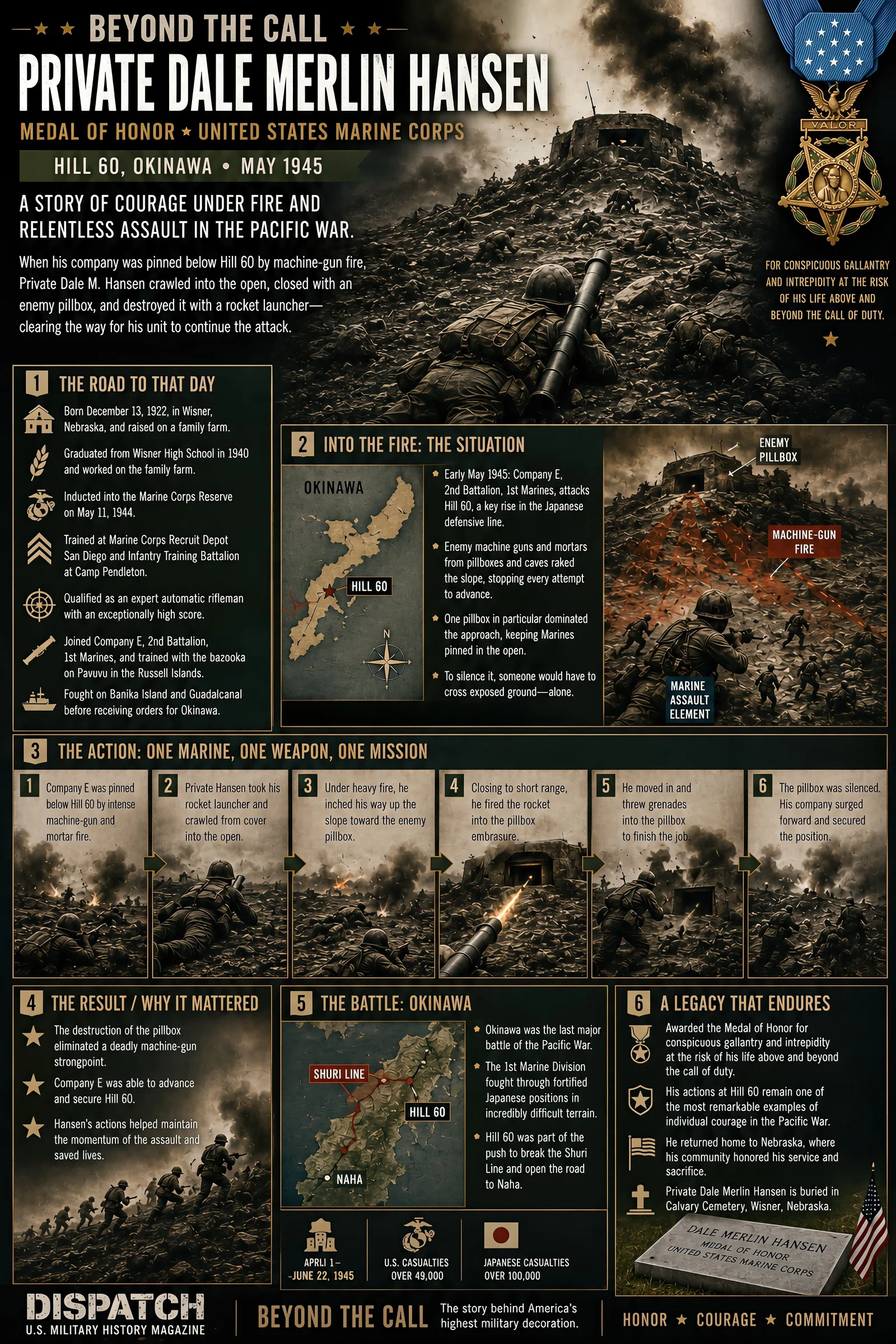
The ridge ahead looked less like a battlefield and more like a shattered hillside of rock, clay, and smoke. It was early May 1945 on Okinawa, and the Marines of Company E had stalled below Hill 60. Japanese machine guns chattered from hidden bunkers. Mortar rounds crashed into the slope, showering the men with dirt and splinters of coral. Every attempt to move up the ridge drew a fresh burst of fire that pinned them flat.
Private Dale Merlin Hansen hugged the ground behind a low rise, close enough to hear the snap of bullets overhead. Somewhere above, an enemy pillbox anchored the whole defense, its field of fire sweeping the narrow approach. Marines were stuck in craters and behind boulders, unable to move forward, yet unable to fall back without leaving wounded men behind. The company’s momentum—carefully built through hours of fighting—was draining away with every minute they stayed pinned.
Beside Hansen lay a rocket launcher, the clumsy, tube-shaped weapon the Marines were still learning to trust. Using it meant crawling into the open, across ground the enemy already owned. There would be no cover, no one to share the risk. Hansen could feel the weight of the decision settle on him: stay prone and safe while the attack failed around him, or rise into that storm of fire and take the fight to the pillbox alone.
He chose. Gripping the launcher, Private Hansen slipped from cover and began crawling uphill toward the enemy strongpoint, one man against a ridgeline bristling with guns.
The Road to That Day
Long before he faced that ridge on Okinawa, Dale Hansen had learned what it meant to work until a job was done. He was born on December 13, 1922, in Wisner, a small town in Cuming County, Nebraska. Growing up on the family farm, he spent his days handling chores, tending animals, and helping bring in the crops. After finishing high school in Wisner in 1940, he stayed on the farm full-time, trading classrooms for long hours in the fields and barns.
People who knew him remembered a straightforward, steady young man. Farm life left little room for drama; what mattered was whether you showed up, did the work, and could be trusted when things got hard. Those habits—quiet endurance, practical skill, and a willingness to shoulder responsibility—would follow him into uniform.
On May 11, 1944, Hansen was inducted into the Marine Corps Reserve. He traveled west to California for recruit training at the Marine Corps Recruit Depot in San Diego, swapping Nebraska’s open plains for crowded barracks and drill fields. From there he went to the Infantry Training Battalion at Camp Pendleton, where he learned the tools of his new trade: rifle marksmanship, small-unit tactics, and the harsh conditioning needed for Pacific island fighting. Given a Browning Automatic Rifle, he proved a natural, qualifying as an expert automatic rifleman with an exceptionally high score.
By November 1944 he was bound for war. Hansen sailed for the Pacific theater as part of a replacement draft and soon joined Company E, 2nd Battalion, 1st Marines, on Pavuvu in the Russell Islands. There, he and other Marines trained intensively with the shoulder-fired rocket launcher they called the bazooka—an awkward-looking weapon that could punch through bunkers and armor if handled well. In early 1945 the 1st Marine Division moved through maneuvers on Banika Island and Guadalcanal, sharpening their edge for the next assault. When they finally received orders for Okinawa, Hansen went with them, a young private from Nebraska now serving in a veteran division headed for one of the bloodiest battles of the Pacific war.
Into the Fire
By early May 1945 the battle for Okinawa had become a grinding contest for every ridge and ravine anchoring the island’s southern defenses. Hill 60 was one of those pieces of ground, a blunt rise of coral and earth that overlooked approaches to the Japanese lines and had been honeycombed with firing positions. Company E of the 2nd Battalion, 1st Marines, moved against it under a sky streaked with tracer fire and arcing mortar rounds. Each time the Marines tried to climb, guns hidden in caves and pillboxes cut loose and drove them back down the slope. The hill was more than a spot on the map; it was a key to unlocking the next stretch of the Shuri Line, and the cost of every yard was already measured in casualties.
Private Dale Hansen fought forward with his platoon through this chaos, the air thick with dust and the sharp smell of explosives. Somewhere above them a pillbox sat at just the right angle to rake their line of advance, its machine gun stitching the slope whenever a helmet or shoulder showed. Hansen understood that as long as that bunker remained, the company would stay pinned, bleeding men into the rocky soil. With a rocket launcher at his side—an awkward, tube-shaped weapon that many Marines still regarded with suspicion—he saw a way to change the fight. The route to a firing position was exposed and broken, offering only shallow shell holes and scattered rocks for cover, but it was the only path that would give him a clear shot at the bunker’s firing slit.
He began to move. Hansen crawled upslope alone, dragging the launcher and its ammunition, feeling the terrain through his elbows and knees as he searched for dips that might shield him from view. Enemy gunners spotted the movement and raked the area, bullets chewing into the ground around him, but he kept going, inch by inch. When he finally reached a rise that offered a glimpse of the pillbox, he braced the launcher, aimed as steadily as the pounding in his chest allowed, and fired. The rocket streaked out, slammed into the structure, and detonated in a blast of flame and shattered concrete, suddenly silencing the gun that had held up the company for so long.
The victory was brief. Enemy fire quickly found his position and wrecked the rocket launcher, leaving Hansen exposed on the slope with the main weapon of his mission reduced to twisted metal. Instead of dropping back, he seized a rifle and pressed on, turning his one-man demolition run into a direct assault. Reaching the crest of the ridge, he vaulted across into another patch of cover and found himself nearly face-to-face with a group of six Japanese soldiers. At close range his first bursts of fire cut down four of them before his rifle jammed, leaving him with a useless weapon and two enemies rushing him over the rocks. He met them with the only tool left in his hands, smashing them back with the butt of the rifle in a brutal, desperate struggle fought at arm’s length.
Instead of remaining on the crest after beating off the attack, Hansen pulled back down the slope, not to escape but to rearm. He returned to his comrades, grabbed another weapon and a supply of grenades, and headed up the hill once more. The climb was no easier the second time. Mortar shells still fell around him, and scattered enemy riflemen probed for any sign of movement. Working his way toward another crucial position, he located a strong mortar emplacement that had been dropping rounds onto the Marines’ line of advance. Moving from fragment of cover to fragment of cover, he closed the distance, then unleashed his grenades and fire, destroying the position and killing the enemy crew. By the time he finished, at least eight more enemy soldiers lay dead, and another piece of the hill’s defensive network had been torn out.
Hansen did not step back after these assaults. Accounts describe him remaining at the forefront as the company pressed the attack, his example helping to drag the line forward through the bitter, close-quarters fighting that defined the struggle for Hill 60. Every bunker he silenced and every position he overran reduced the fire pouring onto his fellow Marines and opened gaps in the defense that others could exploit. In a battle where progress was usually measured in a few yards taken at terrible cost, one private’s determination and willingness to attack alone shifted the balance on a key rise of ground. As evening closed over Okinawa’s torn ridges, the story of what he had done on that slope was already beginning to pass from man to man in the company.
The Citation, Decoded
Later, the official Medal of Honor citation would describe Hansen’s actions in the formal language reserved for the country’s highest award. It spoke of “gallantry” and “intrepidity” at the risk of his life “above and beyond the call of duty,” phrases that can sound distant until they are tied back to the decisions he made on that slope. In practical terms, those words meant voluntarily leaving what little shelter he had, twice, to advance alone into zones already proven deadly for entire squads. The “critical stage of the action” mentioned in the citation was the moment when Company E’s attack had stalled under concentrated fire, and failure would have left wounded men stranded and the hill still firmly in enemy hands.
The citation’s reference to taking the initiative captures another essential part of the story. No officer ordered Hansen to make a one-man crawl with a rocket launcher or to return with more weapons after his first assault. Initiative in this context meant recognizing that the normal pattern of attack had broken down and that someone had to do something extraordinary to break the deadlock. Terms like “complete disregard of all personal danger” and “bold tactics” are the citation’s way of summing up his choice to move straight toward key enemy positions instead of staying with the relative safety of the line. Each step he took under fire converted abstract courage into concrete results: a pillbox silenced, a mortar destroyed, and enemy soldiers removed from the fight.
Finally, when the citation credits Hansen with contributing “essentially to the success of his company’s mission and to the ultimate capture of this fiercely defended outpost,” it is acknowledging how decisive a single Marine’s actions can be in a battle built from countless small engagements. The outpost in question was not just a bunker or a trench; it was part of the fortified system guarding the southern approaches on Okinawa, and its fall helped open the way for continued advances by the division. Hansen would be killed by enemy sniper fire just three days after this action, never seeing the full recognition that would follow. Yet the language closing the citation, noting that his valor reflected the highest credit on himself and the naval service, marks his story as one in which individual courage altered the course of a hard-fought engagement and left a legacy far beyond that scarred hillside.
Why It Mattered
Tactically, Hill 60 was more than just another pockmarked rise on Okinawa; it was a firing platform that controlled the approaches to a broader stretch of the Japanese line. As long as its bunkers and mortars remained intact, every attempt by the Marines to move forward would be shredded on the slope. By knocking out the pillbox that anchored the defense and then destroying a key mortar position, Private Dale Hansen stripped away much of the hill’s killing power. That opened a path for his company to regain momentum, close with the remaining defenders, and finally seize the crest rather than remain pinned in the rocks below. In an assault where gains were often counted in a few yards, his actions unlocked a critical piece of ground.
There was also a wider impact beyond that single hill. The battle for Okinawa depended on wearing down a deeply entrenched defensive system, ridge by ridge, bunker by bunker. When Marines took positions like Hill 60, they forced the enemy to expend precious manpower and munitions and yielded jump-off points for the next day’s attacks. Hansen’s assault helped break one of those nodes in the defensive web, contributing to the gradual unravelling of the line protecting the southern part of the island. At the level of his platoon, the effect was immediate and personal: Marines who might have been cut down in a renewed attempt against intact positions lived to fight on because one of their own had already crawled forward and silenced those guns. Had he hesitated, the company might have been forced to withdraw, leaving wounded men under fire and giving the defenders time to reinforce a position that had already cost the unit dearly.
Leadership and Character
Dale Hansen wore the chevrons of no high rank, yet his story is, at its core, a study in battlefield leadership. Leadership in that moment did not come from a radioed order or a written plan; it came from a private deciding that the situation required more than staying in cover and trading fire. The qualities that shaped his choice on Hill 60 had been formed long before Okinawa: the farm-bred habit of seeing work through, the discipline of Marine training, and the trust of comrades who knew him as a reliable automatic rifleman. When the company faltered under the hill’s defenses, he did not wait for someone else to volunteer for the most dangerous job. He picked up the rocket launcher and moved into the open because he understood that the attack could not succeed otherwise.
His actions also reveal a particular kind of courage that goes beyond a single burst of bravery. Hansen’s decision was not a one-time dash; it was a series of deliberate returns to danger. After crawling through fire to destroy the pillbox and fighting off a close-range counterattack, he could have stayed with the line and still been counted brave. Instead, he went back down, rearmed, and climbed again to neutralize the mortar that continued to threaten his company. That persistence underlines a character rooted in responsibility rather than impulse. Modern readers—whether they wear a uniform or not—can see in his story the kind of leadership that comes from action, not title: noticing what must be done, accepting that no one else may be available to do it, and stepping forward despite the personal cost.
Legacy and Memory
Hansen did not live to see the full impact of his courage. Only a few days after the assault on Hill 60, he was killed by enemy sniper fire during continued fighting on Okinawa. He was twenty-two years old, a young man who had left a Nebraska farm less than a year before to join the Marine Corps and who would never return to the fields and family he had known. The Medal of Honor that recognized his actions at Hill 60 was awarded after his death, presented to his loved ones in his place. For them, the nation’s highest decoration was both an honor and a reminder of a son’s absence that could never be filled by metal and ribbon.
Yet his name did not fade with the generation that knew him. Within the Marine Corps, his citation became part of the long roll of stories that instructors and leaders use to illustrate what “above and beyond the call of duty” looks like in real terrain and real fear. In his home state, the boy from Wisner is remembered not only as a farmhand who went to war, but as a Marine whose actions on a distant hill saved comrades and helped carry an assault forward. For visitors who encounter his grave or see his name on memorials, the brief inscription of rank, unit, and dates hints at a much larger story. Remembering Private Dale Merlin Hansen as more than a line on a monument means holding onto that story: the quiet young man who faced a fortress alone so others could live and the attack could go on.