The Moment of Decision
The jungle pressed in on both sides of the Ormoc Road, a narrow ribbon of mud and broken pavement cutting through the hills near Limon on the island of Leyte. December rain had turned the ditches into brown pools. American infantrymen crouched behind a hasty roadblock of felled trees, sandbags, and wrecked vehicles, listening to the grinding approach of steel. The distant clatter of treads grew louder, joined by the sharp crack of tank guns and the angry buzz of machine-gun fire sweeping the road ahead.
For the soldiers at the roadblock, the math was brutally simple. Their rifles and light machine guns could sting, but they could not stop armored vehicles from smashing through and rolling over their position. If the enemy tanks broke past them, they would threaten the battalion’s thin line farther to the rear, where supply trucks and wounded men lay almost defenseless.
Private First Class Dirk John Cornelius Vlug stared down that road and saw the problem clearly. Somewhere beyond the curve, five enemy tanks were feeling their way forward, trying to punch a hole in the American defenses. The air around him filled with splinters and the whine of incoming shells. Staying in cover meant waiting to be overrun. Running meant leaving comrades to face the armor alone.
He picked up a rocket launcher, slung a handful of rounds over his shoulder, and stepped out from the safety of the roadblock. Alone, under the muzzles of advancing tanks, he chose to walk toward the fire rather than away from it, determined to stop them by himself if he had to.
The Road to That Day
Dirk Vlug’s journey to that jungle road began far from the Philippines, in the farm and small-town country of the American Midwest. Born in Maple Lake, Minnesota, in 1916, he grew up in a generation shaped by the hardship of the Great Depression and the steady routines of work, school, and church. By the time war clouds gathered overseas, he was living in Grand Rapids, Michigan, part of a community that was watching the headlines from Europe and Asia with growing unease.
In April 1941, months before the attack on Pearl Harbor, Vlug went to the local recruiting office and joined the United States Army. Training transformed him from a civilian into an infantryman—learning to march in step, to care for his rifle, to trust the man in the next foxhole. Eventually he was assigned to the 126th Infantry Regiment of the 32nd Infantry Division, a formation built largely from National Guard units in Michigan and Wisconsin. The division would become one of the workhorses of the Pacific war, fighting in harsh, disease-ridden jungles where the enemy and the environment were equally deadly.
By late 1944, Vlug served with Headquarters Company, 1st Battalion, 126th Infantry. Years of campaigning had taught the division how to move, fight, and survive in the Pacific—crossing rivers choked with mud, hacking through foliage, and digging in on rain-soaked ridges while artillery shook the ground. Like many veterans by then, he knew the feel of exhaustion that never quite faded and the quiet worry for friends who did not make it back from patrol.
Those experiences forged a soldier who was steady rather than showy, a man who understood both the risks of combat and the importance of holding a line when ordered. When the 32nd Division was committed to Leyte, tasked with pushing up the Ormoc corridor to cut Japanese supply routes, Vlug went with his battalion into the island’s steep, tangled interior. As they dug in along the crucial Ormoc Road near Limon, he could not yet know that a coming enemy tank attack would focus the entire weight of that campaign, for a few minutes, on one soldier with a rocket launcher and six rounds of ammunition.
Into the Fire
By mid-December 1944, the campaign to liberate Leyte had settled into a brutal push up the Ormoc corridor. Japanese forces clung to the hilltops and ridges overlooking the twisting road, using every fold of terrain to slow the American advance. For the 32nd Infantry Division, that meant inching forward through jungle and rain, clearing one position after another while supply lines strained behind them. Near the small town of Limon, the Ormoc Road narrowed and curved, making it an ideal place for an enemy counterattack. To guard this vulnerable stretch, American troops threw up a roadblock and dug in to hold whatever came.
When the tanks appeared, they announced themselves first with sound. The grind of treads and the sharp clank of steel carried through the trees, followed by the thunder of main-gun rounds slamming into the roadblock area. Machine-gun bursts stitched the earth and trees, showering dirt and splinters over the men in cover. Japanese infantry moved with the tanks, using the armor as moving shields as they probed for a gap. The roadblock’s small arms fire rattled back, but everyone knew that rifles and light machine guns could not stop armor for long. If the tanks forced their way through this point, they could roll up the battalion’s line and cut deep into the American rear.
Private First Class Dirk Vlug understood that the roadblock was more than just one position on a map. Behind it were ammunition and rations, radio sets and medical stations, and soldiers who were counting on the forward units to hold. He also knew that the American force had only limited means of dealing with tanks in that tight, jungle-lined road. One of those means lay close at hand: a shoulder-fired rocket launcher, powerful enough at short range to pierce armor, but awkward to use and dangerous to operate alone. Normally the launcher was a two-man weapon, one to fire and one to load, because each reload under fire cost precious seconds.
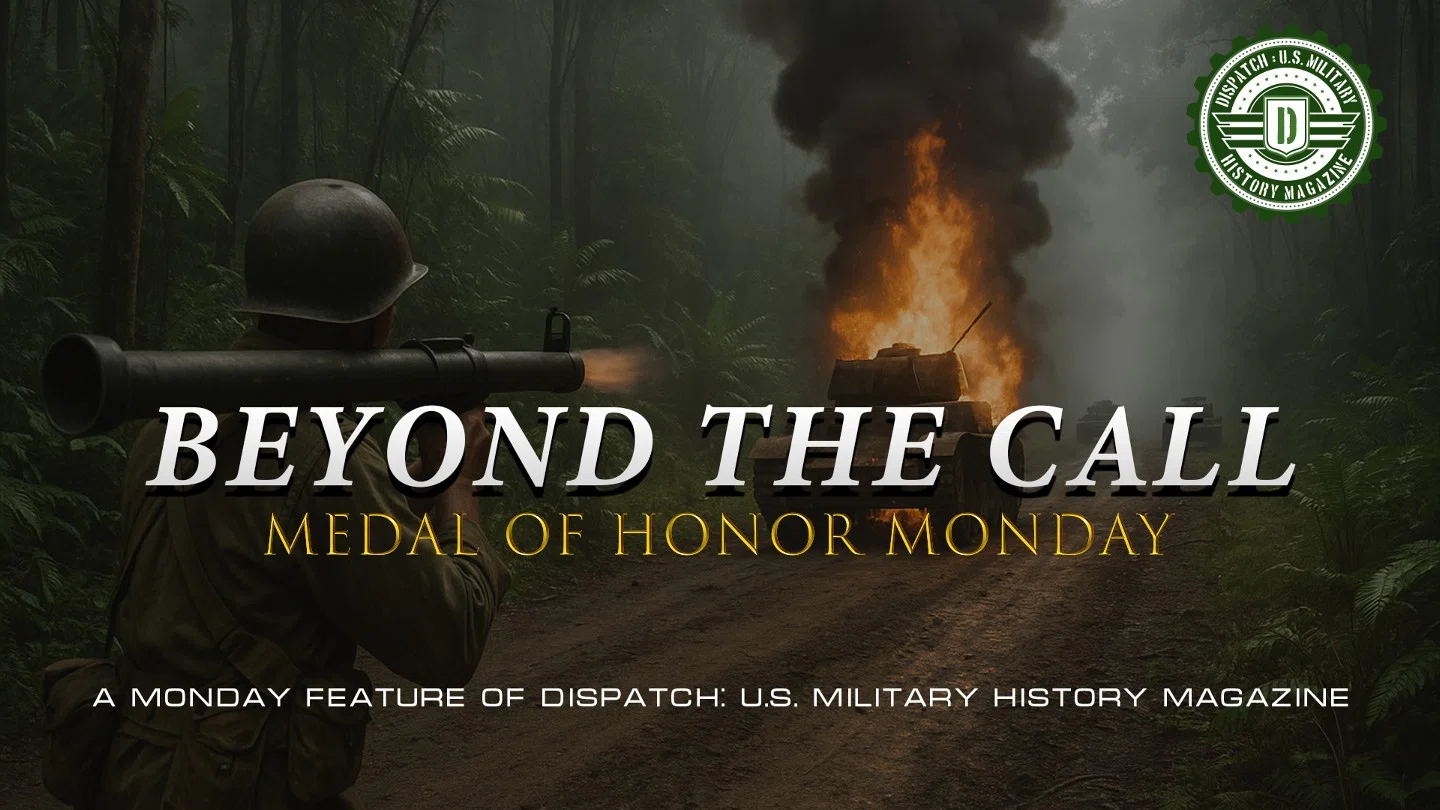
As the enemy tanks closed in, Vlug made his choice. Leaving the relative safety of the covered position, he picked up the launcher, slung six rockets over his shoulder, and stepped onto the exposed roadway. Every movement now took place within sight of enemy gunners watching from armored turrets. He advanced toward the leading tank, the noise of its engine growing louder with each step, the air alive with machine-gun fire that reached for him along the road. When he judged the distance close enough for a killing shot, he braced himself, aimed, and fired. The rocket streaked out, struck the front tank, and turned it into a burning obstacle, its crew killed before they could bring their weapons fully to bear.
The second tank lurched forward, its crew dismounting to attack the lone American who had just destroyed their lead vehicle. Vlug dropped the empty launcher long enough to draw his pistol and engage them at close range, killing one and forcing the others to scramble back into their tank for protection. Seizing that brief moment of confusion, he reloaded the launcher by himself, swung it back into position, and sent another rocket into the second vehicle, destroying it as well. Two tanks were now burning on the road, clogging the narrow route and startling the enemy infantry who had expected an easy breakthrough.
Three more tanks rumbled up, trying to recover momentum and smash through the wreckage. Vlug did not wait for them to bring all their weapons to bear. Using the limited concealment offered by the roadside ditches and vegetation, he worked his way along the flank of the tank column, getting off the main line of fire. From this new angle he could strike the next tank where its armor was more vulnerable. Another well-placed rocket turned that vehicle into a wreck, further blocking the road and trapping the remaining tanks in a column of smoke and confusion.
Still under heavy fire, Vlug pressed his advantage. With only a few rockets left and no one to help him reload, he continued to advance, closing distance to make every shot count. A fourth tank fell to his fire, knocked out as it tried to maneuver around the growing pile of burning steel. The last tank attempted to push past the chaos, perhaps hoping speed would carry it through. With his final rocket, Vlug fired again, striking the vehicle and sending it careening off the road and down a steep embankment.
In the space of a few minutes, one soldier with a rocket launcher had turned a dangerous armored thrust into a trail of wrecked tanks. The roadblock still stood, the American battalion’s line remained intact, and the enemy’s attempt to break through at that point had been shattered. The men who watched from the roadblock saw more than just explosions; they saw a single infantryman, exposed on the road and in the ditches, deliberately drawing the attention of enemy armor so that his comrades and the mission could survive.
The Citation, Decoded
The official Medal of Honor citation for Dirk Vlug begins by noting his “conspicuous gallantry and intrepidity above and beyond the call of duty.” Those words can sound ceremonial, but on the ground near Limon they meant stepping away from cover and moving toward five armored vehicles that were firing in his direction. “Above and beyond the call of duty” recognizes that no order compelled him to go out alone with a rocket launcher. A reasonable soldier could have remained behind the roadblock, doing his part with a rifle and waiting for heavier weapons. Vlug chose instead to accept a level of personal risk far greater than what the situation required.
The citation explains that he “advanced alone under intense machine-gun and thirty-seven millimeter fire.” The tank’s main gun threw high-explosive shells designed to smash fortifications and tear apart infantry positions. Its machine guns could sweep the road and the ditches with streams of bullets. Advancing alone meant there was no one to share that fire, no partner to draw part of the enemy’s attention. Each time Vlug paused to aim and fire, he had to stand still for a heartbeat or two, presenting a clear target to gunners who were searching for any sign of movement.
Another key phrase notes that he “singlehandedly destroyed five enemy tanks.” In practical terms, that meant not just firing the weapon but also loading it, carrying the rockets, and shifting position between shots while under fire. Every reload required him to handle heavy rounds, orient them correctly, and seat them in the launcher with calm hands, even as explosions and machine-gun bursts shook the air around him. The mention that he used his pistol to engage dismounted enemy soldiers underscores how close the fight became and how quickly he had to adapt when tank crewmen tried to attack him on foot.
Finally, the citation states that his actions “greatly facilitated successful accomplishment of his battalion’s mission.” The destruction of the tank group did more than earn individual recognition. By blocking the Ormoc Road with wrecked armor and breaking the momentum of the counterattack, Vlug helped ensure that the battalion’s positions were not overrun and that the advance up the corridor could continue. The citation’s formal language captures this by linking his courage directly to the larger objective. In the measured words of the award, one can see the reality of a single soldier’s decision echoing outward through a company, a battalion, and a hard-fought campaign.
Why It Mattered
On the ground near Limon, the destruction of five tanks in a narrow stretch of road meant the difference between a localized crisis and a cascading disaster. The roadblock that Vlug helped protect was not just a pile of obstacles; it was the front door to the battalion’s rear areas, supply lines, and medical support. If the tanks had smashed through, they could have torn into artillery positions, ammunition dumps, and aid stations that were never designed to withstand armored assault. The sudden loss of those assets in the middle of a jungle campaign would have forced a hurried withdrawal and given the enemy time to regroup along the Ormoc corridor.
Instead, the wrecked tanks became a barricade in their own right, physically blocking the Ormoc Road and breaking the momentum of the counterattack. American commanders did not have to shift precious reserves to plug a gap or abandon hard-won positions in the surrounding hills. The advance toward Ormoc, already slowed by terrain and weather, could continue without the shock of a major breakthrough in the lines. Even at the small-unit level, every rifle squad and weapons team along that sector knew that a serious threat had just been neutralized.
There was also a powerful psychological effect. Soldiers who watched a lone infantryman stride out under fire and stop a column of armor saw proof that initiative and courage still mattered in a war increasingly dominated by machines. For the enemy, losing five tanks in rapid succession along a confined road sent a clear message that American defenses were alert and aggressive. Tactically, Vlug’s action preserved the battalion’s position and helped secure a critical route on Leyte; morally, it reinforced the belief that determined individuals could still shape the outcome of a much larger campaign.
Leadership and Character
Dirk Vlug did not hold high rank, command a company, or plan operations on a map. His leadership expressed itself in a different way: through action, taken at the moment when hesitation would have been understandable. One clear theme in his story is initiative. No one needed to prod him to pick up the rocket launcher or to leave the safety of the roadblock. He saw the tanks coming, understood the danger, and chose to move toward it. That kind of initiative under fire often distinguishes those who change the course of a fight from those who simply endure it.
Another theme is responsibility that runs deeper than formal orders. Vlug’s decision to engage the tanks alone reflected an understanding that the men behind him—comrades in the battalion, wounded in aid stations, and support personnel along the Ormoc Road—were counting on the forward elements to hold. When he stepped into the open, he carried not just a weapon but the weight of that responsibility. His willingness to face machine-gun fire and tank guns at close range showed a level of personal commitment that went beyond self-preservation.
A third theme is calm under extreme pressure. The action required more than one brave rush; it demanded repeated reloading, careful aiming, and quick adaptation when dismounted enemy soldiers suddenly appeared. Switching from rocket launcher to pistol and back again, shifting position to attack from a flank, and making each shot count with limited ammunition all speak to a focused mind in chaos. For leaders and service members today, his example underscores that character is not only about dramatic gestures. It is about preparation, steady skill, and the readiness to shoulder risk on behalf of others when the situation leaves little time to think.
Legacy and Memory
After the fighting on Leyte and the long grind of the Pacific war, Dirk John Cornelius Vlug returned home from overseas service. Like many veterans of the campaign, he carried with him memories of jungle heat, sudden danger, and comrades who did not come back. He also carried the nation’s highest decoration for valor, presented in recognition of what he had done on that narrow road near Limon. In the years that followed, he built a civilian life in Michigan, becoming part of the quiet generation that went from foxholes and rain-soaked hillsides back to neighborhoods, families, and work.
His Medal of Honor did not separate him from those around him so much as connect him to them. Community events, veterans’ gatherings, and commemorations offered chances to tell the story of the 32nd Infantry Division and the men who served in it. Younger soldiers and students of military history could look to his experience as a concrete example of what courage under fire can achieve. His name appears on rolls of honor and in collections that preserve the stories of Medal of Honor recipients, ensuring that his actions on Leyte remain part of the broader narrative of the Pacific war.
In death, as in life, his memory rests close to the communities that shaped him. He is remembered in his home state, in the lineage of the unit that fought with him, and in the larger circle of those who study and teach the history of the war. When readers encounter his name in a citation, it can be easy to see only formal phrases on a page. Behind those phrases stands a real person, an infantryman from the Midwest who walked alone toward advancing tanks so that others might live. Remembering him as a son, neighbor, and fellow soldier—rather than just as a line in an official document—is one way to honor that choice.