In Action
The morning haze over North Vietnam is already streaked with contrails when the Phantom crews cross the coast. Down below, the Red River delta is a patchwork of flooded fields and small villages. Up here, two F-4s ride shotgun on a strike package of bomb-laden jets headed toward a bridge that has been hit, patched, and hit again. In the front seat, the pilot scans the sky and the instruments; in the back, the radar intercept officer rides the scope, watching for the first flicker of threats.
The radio is busy with call signs, altitude checks, and tanker updates when the warning hits. A flat, urgent call: enemy fighters lifting near Hanoi. Almost at the same moment, another voice shouts a different danger – surface-to-air missile launch, high and fast. The crews shift from escort to survival in a heartbeat. Phantoms roll and dive, climbing and jinking to spoil the missile’s guidance, while the radar intercept officer calls out bearings and closing speeds.
A blip on the scope hardens into a hostile aircraft angling in behind the formation. The pilot hauls the F-4 into a turn, trading altitude for position while the backseater locks the radar and counts down ranges. A missile leaves the rail with a hard shove, and the crew never sees the impact – only a disappearing trace on the screen and a curt confirmation from another jet. The strike group presses on, shaken but intact. For the Phantom crews, it is just one sortie in a long campaign, but moments like this reveal why this hard-edged, smoke-trailing jet became a symbol of the Vietnam air war and the design choices that shaped it.
The Problem It Was Built To Solve
The F-4 Phantom II was born years before Vietnam, in a world worried less about jungle trails and more about ocean horizons. The United States Navy needed an aircraft that could stand between its carrier battle groups and waves of high-speed enemy bombers armed with nuclear weapons or heavy anti-ship missiles. Existing fighters could not combine the speed, altitude, radar reach, and missile load needed to defend the fleet in all weather and at long range. The Navy wanted a two-seat, twin-engine fighter that could launch from carriers, hunt far out from the task force, and destroy attackers before they ever saw the ships.
At the same time, the United States Air Force faced its own set of challenges. Jet bombers and reconnaissance aircraft were flying higher and faster, and air defenses were growing more sophisticated. The Air Force needed fighters that could escort strike aircraft, patrol contested airspace, and, if required, dive into ground-attack roles. Budgets and timelines pushed both services toward common solutions where they could find them. A large, powerful fighter with a flexible radar and a heavy missile armament seemed like an answer, even if it meant accepting size and complexity that would have been unthinkable a decade earlier.
When the Vietnam War escalated, this interceptor-turned-multirole fighter suddenly found itself over dense jungle and heavily defended industrial targets instead of open ocean. The same radar and missile systems intended to stop bomber raids were now used to pick out small enemy fighters and support strike packages clawing their way through belts of guns and missiles. The Phantom’s ability to carry a wide mix of ordnance, survive punishment, and adapt to new tactics made it invaluable, even as its limitations drove urgent changes in training and equipment. The decision to adopt this machine had set in motion a story that would play out over years of hard flying in Southeast Asia.
From Design Board To Production
The Phantom’s story began on the drawing boards at McDonnell in the mid nineteen fifties, when the United States Navy wanted a new fleet defense fighter. Earlier carrier fighters did some jobs well, but none could combine long range, high speed, powerful radar, and a heavy missile load in one airframe. McDonnell’s team started with ideas drawn from its earlier Demon fighter, then pushed every parameter outward: more thrust, more fuel, more radar, more weapons. The result was a big twin-engine design with a two-person crew, intended to hunt enemy bombers far from the carrier group in any weather.
Early prototypes showed that the concept worked. The aircraft that would become the F-4 could climb hard, hold high supersonic speeds, and carry radar-guided missiles that promised to destroy attackers before they reached the fleet. The Navy accepted the tradeoffs that came with this power: a large, heavy airframe, demanding carrier landings, and complex maintenance. As test flights racked up records, the United States Air Force took a hard look and decided that the same qualities could serve its own needs. With modifications to suit land-based operations and different avionics fits, the Phantom crossed service lines and became a shared workhorse.
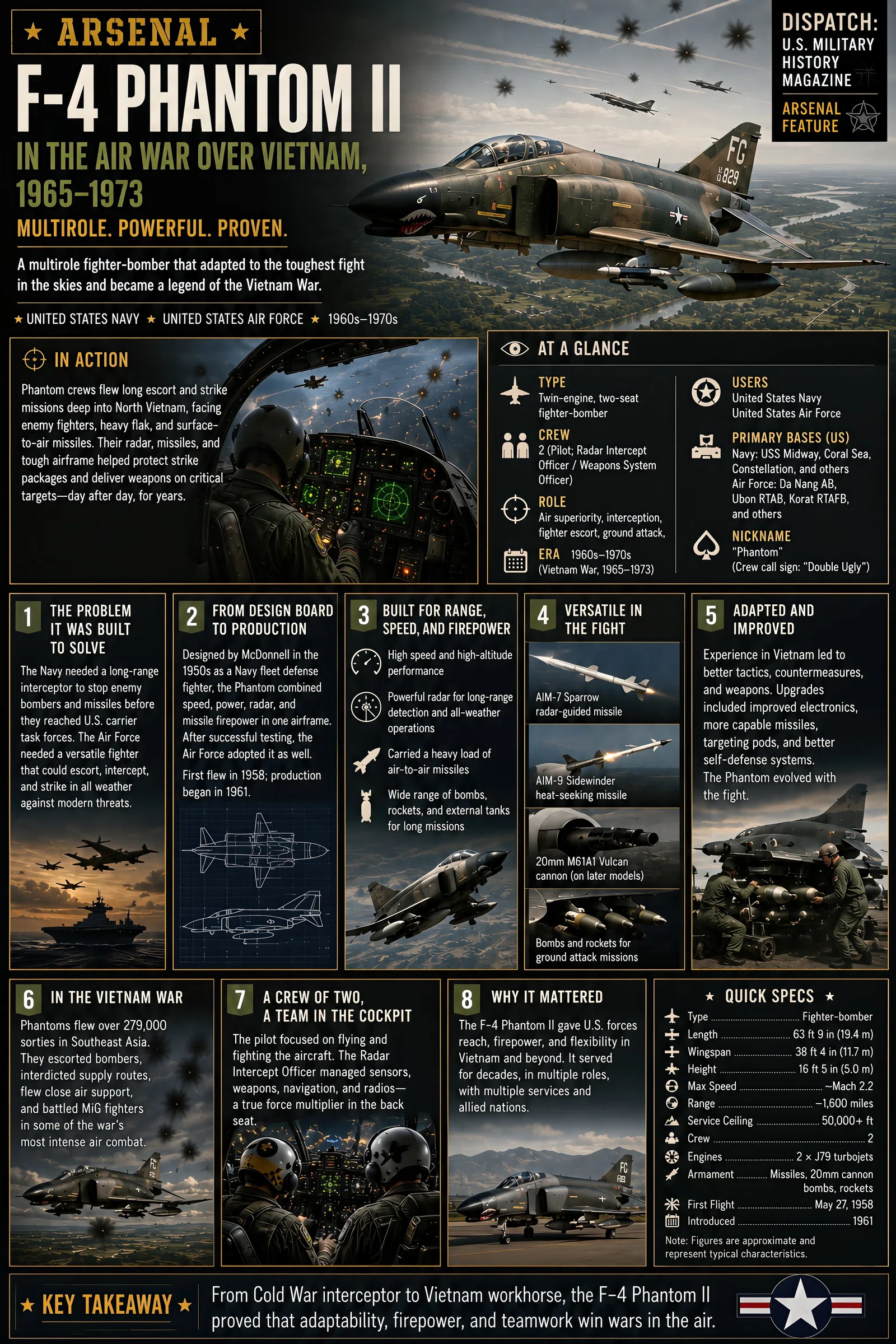
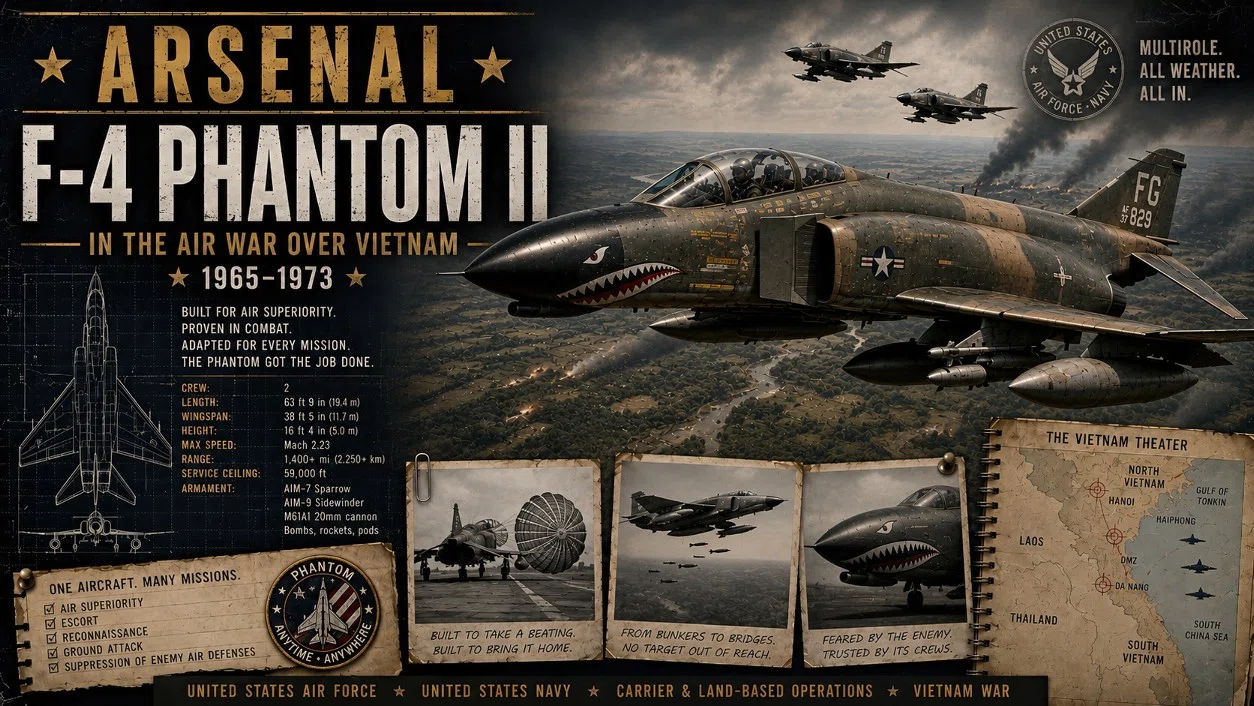
At a glance, the F-4 Phantom II was a twin-engine, two-seat, all-weather fighter-bomber built in the United States for both Navy carriers and land-based Air Force units during the Cold War and the Vietnam era. Typical crews paired a pilot up front with a radar intercept officer or weapons system officer in the rear cockpit. The aircraft’s primary armament centered on radar-guided and heat-seeking air-to-air missiles, later joined by an internal cannon on some versions, along with a wide range of bombs and rockets for ground attack. Headline performance figures included speeds above Mach two at altitude, strong climb rates, and the ability to haul heavy loads of ordnance over substantial distances.
Production ramped up at McDonnell’s St. Louis plant as orders arrived not only from the Navy and Air Force, but later from allies overseas. Variants were tuned for different missions: carrier defense, tactical fighter-bomber, reconnaissance, and eventually specialized roles such as air defense interception in Europe and the Middle East. Each new block made small adjustments to radar, electronics, engines, and structure as crews and maintainers reported what worked and what failed in hard use. By the time Phantoms were flying daily missions over Vietnam, the aircraft had evolved from a pure interceptor concept into a true multirole platform, equally at home escorting bombers, sweeping for enemy fighters, or dropping ordnance on targets deep in hostile territory.
Inside The Weapon
From the outside, the F-4 Phantom II looked every bit as serious as its missions. A long, pointed nose housed the radar, feeding information to both cockpits. The intakes along the sides gulped air for two powerful turbojet engines, whose exhaust gave the Phantom its famous trail of dark smoke when not using afterburner. The wings had a noticeable sweep and a complex shape, with drooping ailerons and flaps, and the tailplanes were canted downward, giving the jet a distinctive stance. On carrier-capable versions, the wings folded upward at the tips and a strong hook under the tail waited to catch arresting wires on pitching decks.
Inside, the front cockpit belonged to the pilot, surrounded by a forest of analog gauges, switches, and warning lights. A large head-up view over the nose and canopy framing gave good forward visibility, but the aircraft’s size and long nose meant that looking down and back was more difficult, especially in tight turns. The pilot managed the engines, flight controls, basic navigation, and weapon release, working heavy control forces at low speed and during carrier operations. Behind, on a slightly raised platform, sat the radar intercept officer or weapons system officer, with radar scopes, communication panels, and navigation aids spread across a busy instrument panel and side consoles.
The division of labor defined how the Phantom fought. In air-to-air missions, the backseater searched the radar display for distant returns, sorted targets, and guided the pilot onto the right heading and altitude while tracking closure rates. The pilot flew the intercept and handled the final visual maneuvering, but missile selection, radar modes, and timing often depended on a practiced dialogue between the two. In ground-attack roles, the pilot focused on flying low, fast profiles into and out of target areas, while the backseater helped manage navigation fixes, radio calls, and weapon settings under intense time pressure.
Major subsystems shaped daily life in the jet. The radar could reach far out in front, but in Southeast Asia’s cluttered skies it demanded constant tuning and interpretation. The engines delivered impressive thrust, especially in afterburner, yet they also produced the heat signature and smoke that keen-eyed opponents learned to exploit. Fuel systems, hydraulic lines, and avionics bays filled much of the fuselage, leaving the crew in tight but functional cockpits protected by armor plates and backed up by ejection seats for escape if everything went wrong. Communication gear linked the aircraft to controllers on the ground, other fighters in the formation, and the bombers or strike aircraft they were covering.
In training, the Phantom came across as a powerful but demanding machine: fast, heavy, and less nimble than some smaller fighters, but able to carry more weapons higher and farther. In combat over Vietnam, crews discovered just how much those characteristics mattered. They valued the thrust and toughness that helped them bring damaged jets home, yet they also felt the weight and drag in turning fights where enemy aircraft could sometimes outmaneuver them. The reality of flying and fighting inside the F-4 blended cockpit workloads, subsystem quirks, and the constant need for teamwork into a daily test that left deep impressions on the men who strapped into it.
Baptism Of Fire
The engagement over the Red River was part of a much larger struggle. As Rolling Thunder gathered pace in the mid nineteen sixties, Phantoms from the United States Navy, Marine Corps, and Air Force rotated through bases in Thailand, South Vietnam, and carriers on Yankee Station. They flew fighter cover for strike packages heading toward bridges, power plants, airfields, and rail lines threaded through some of the most heavily defended airspace on earth. North Vietnamese gunners filled the sky with bursts of flak, while radar-guided missiles rose on bright plumes from camouflaged sites along the approach routes.
In the early months, Phantom crews learned hard lessons. Rules of engagement often forced them to identify enemy aircraft visually before firing radar-guided missiles, erasing the beyond-visual-range advantage their designers had counted on. Missile reliability was uneven, and dogfights quickly dropped to subsonic speeds where nimble MiG-17s and MiG-21s could turn inside the big American jet. The lack of an internal gun on early variants, a deliberate design choice in an age that believed missiles would do all the work, left many crews wishing for a weapon that could fire the moment a fleeting opportunity appeared in close.
Over time, tactics and training adapted. One of the best-known examples was Operation Bolo in early nineteen sixty seven, when Air Force F-4s deliberately mimicked the radio callsigns, routes, and formations of bomb-laden strike aircraft to lure MiG-21s into a trap. When the North Vietnamese fighters rose to pounce on what they thought were vulnerable targets, they found themselves facing ready Phantoms configured for air combat. In a brief, violent series of engagements, American crews claimed multiple victories without loss, proving that with the right plan and coordination, the Phantom could dictate the terms of a fight rather than react to it.
As the war shifted into the Linebacker campaigns later in the conflict, the Phantom’s roles multiplied again. It escorted B-52 strikes, flew armed reconnaissance over the Ho Chi Minh Trail, delivered precision-guided munitions as new weapons came online, and supported Wild Weasel missions that hunted enemy surface-to-air missile sites. In each setting, the aircraft’s blend of speed, payload, and sensor reach gave commanders options, even as every sortie meant running the gauntlet of guns, missiles, and enemy fighters that defined the Vietnam air war.
Strengths And Weaknesses
Ask Phantom crews what they valued most and they often begin with raw power. Twin engines gave the F-4 a thrust-to-weight ratio that could haul the aircraft and its heavy load of missiles, bombs, and fuel into the fight quickly, and sometimes claw it back out of trouble when damage or a bad situation demanded brute force. The jet’s rugged structure and systems absorbed punishment that might have destroyed lighter aircraft, and many stories circulate of Phantoms limping home with large chunks of tail, wing, or fuselage damage that would have seemed unsurvivable on paper. The two-person crew also gave the aircraft a cognitive edge, letting pilot and backseater share the workload of radar operation, navigation, communications, and weapon employment when the sky turned chaotic.
At the same time, the F-4 carried real drawbacks. Its size, weight, and high wing loading meant it could not match the instantaneous or sustained turning performance of smaller opponents when fights slowed down and tightened up. Engines that produced impressive thrust also left dark trails of smoke at many power settings, making the aircraft easier to spot at a distance. Early lack of an internal gun, combined with rules that limited missile shots, left crews in close-range turning battles with tools that were not always suited to the moment. Maintenance demands were heavy, especially in tropical climates and on busy carrier decks, where salt, heat, and high sortie rates punished every system on the jet.
Enemy pilots and controllers learned to exploit those weaknesses. They tried to drag Phantoms into vertical maneuvers and tight horizontal turns, where the smaller MiGs could gain position. Ground defenses adjusted their patterns of fire to catch predictable ingress and egress routes, forcing Phantom crews to vary their tactics constantly. Yet the aircraft’s strengths remained decisive when used well: it could arrive fast, deliver heavy ordnance, and still fight its way clear, provided crews understood its limits and played to its advantages. That balance between power and constraint defined its reputation among all who flew, maintained, or faced it.
Variants And Evolution
Combat over Southeast Asia pushed the Phantom along a rapid evolutionary path. The earliest Navy and Marine Corps aircraft, known as F-4B models, carried the core combination of radar, missiles, and twin engines that defined the type. Upgrades to avionics, structure, and systems produced later naval variants like the F-4J, which offered improved radar performance and better handling for carrier operations. On the Air Force side, the initial F-4C adaptation gave land-based tactical units a powerful new fighter-bomber, followed by the F-4D with refined radar and expanded ground-attack capability.
The most visible change for many crews came with the F-4E, which added an internal cannon in the nose. This modification responded directly to Vietnam combat experience, where external gun pods had proved less accurate and more drag-inducing than hoped. The F-4E also gained leading-edge slats on its wings in later production blocks, improving low-speed handling and turning performance. These changes did not transform the Phantom into a pure dogfighter, but they narrowed the gap in close-in maneuvering and gave pilots more confidence when fights inevitably closed inside missile range.
Specialized variants spun off as different missions emerged. The RF-4C reconnaissance Phantom traded missiles for cameras and sensors in a recontoured nose, flying high-risk photo runs over targets that needed detailed imagery before and after strikes. Wild Weasel conversions carried electronic warfare equipment and anti-radiation missiles to find and suppress surface-to-air missile sites, often drawing enemy fire so other aircraft could survive. Export versions, license-built or modified for allies in Europe, the Middle East, and Asia, extended the basic design into new environments and doctrines while still reflecting the hard-won lessons of Vietnam.
By the end of the war, the Phantom family included a spectrum of models that shared a common silhouette but differed significantly in capability and role. Each new version represented another step in adapting an interceptor concept to real-world combat requirements, blending radar, weapons, structure, and crew stations into configurations that could handle the messy, unpredictable demands of modern air warfare.
Legacy And Where To See It Today
The F-4 Phantom II left a deep imprint on both technology and training long after the last Vietnam sorties ended. It forced air arms to confront the gap between prewar expectations of long-range missile duels and the reality of close, turning engagements under strict identification rules. In response, fighter schools refined air combat maneuvering instruction, dissimilar air combat training programs grew, and future designs such as the F-15 and F-16 were shaped by a desire to combine Phantom-like power and avionics with improved agility. Naval aviation followed parallel paths, with aircraft like the F-14 and F/A-18 carrying forward multi-role flexibility and advanced sensors while learning from the Phantom’s strengths and limitations.
The aircraft’s combat record in Vietnam and later conflicts also cemented its status as a Cold War icon. It served in air defense, ground attack, reconnaissance, and suppression of enemy air defenses roles for the United States well into the nineteen eighties and nineteen nineties, and for several allied air forces beyond that. In many nations it formed the backbone of tactical aviation for a generation, becoming as familiar on flight lines and ramp ceremonies as earlier propeller-driven legends had been in the Second World War.
Today, preserved Phantoms stand guard outside bases, sit on museum ramps, and occupy pride of place in indoor galleries. Visitors can walk under their long noses and broad wings at institutions such as large national air museums, naval aviation collections, and regional military history centers, seeing up close the size and complexity that photos only hint at. Many carry the markings of Vietnam-era squadrons, with mission tallies and tail codes that echo the stories of their crews. Photo archives and video collections, including those highlighted through Dispatch and Trackpads, help connect these static airframes to the moving, noisy world they once inhabited in combat.
For readers who want to follow the thread further, Phantom stories pair naturally with Beyond the Call features that trace individual pilots and backseaters through intense air battles, and with Living History interviews where veterans describe life in and around jets of this era. Companion Arsenal pieces on the aircraft that flew alongside the F-4, or opposed it, round out the picture of a complex, evolving air war. Behind every Phantom on display, and behind every radar scope and control stick in those cramped cockpits, stand crews and opponents whose lives turned on how well this machine performed when it mattered most. You can also hear narrated versions of Arsenal features as part of the Trackpads podcast feeds and Dispatch audio editions.