In Action
In the gray light of a Pacific morning, a Zumwalt-class destroyer does not look like the destroyers that came before it. There are no familiar stepped decks, no forest of exposed antennas, and no traditional silhouette bristling with the visual language of twentieth-century naval power. Instead, the ship rises from the water like a dark wedge, its tumblehome hull sloping inward as it climbs, its angular deckhouse shaped to scatter radar energy rather than invite it. From a distance, it can seem less like a conventional warship than a moving shadow.
Inside, the pressure is different from the battleship gunlines and destroyer screens of earlier wars, but it is pressure all the same. Sailors manage combat systems, propulsion loads, sensors, communications, and weapons from spaces built around automation and integrated control. The enemy in this world may be a missile battery ashore, a distant surface combatant, an aircraft searching for a targeting track, or a command network trying to find the ship before the ship can strike first. The crew’s task is to remain hard to detect, hard to classify, and hard to kill while carrying weapons powerful enough to matter across long distances.
That is the Zumwalt-class story in miniature. It is not only a story about a destroyer. It is a story about what the United States Navy thought the future fight might demand.
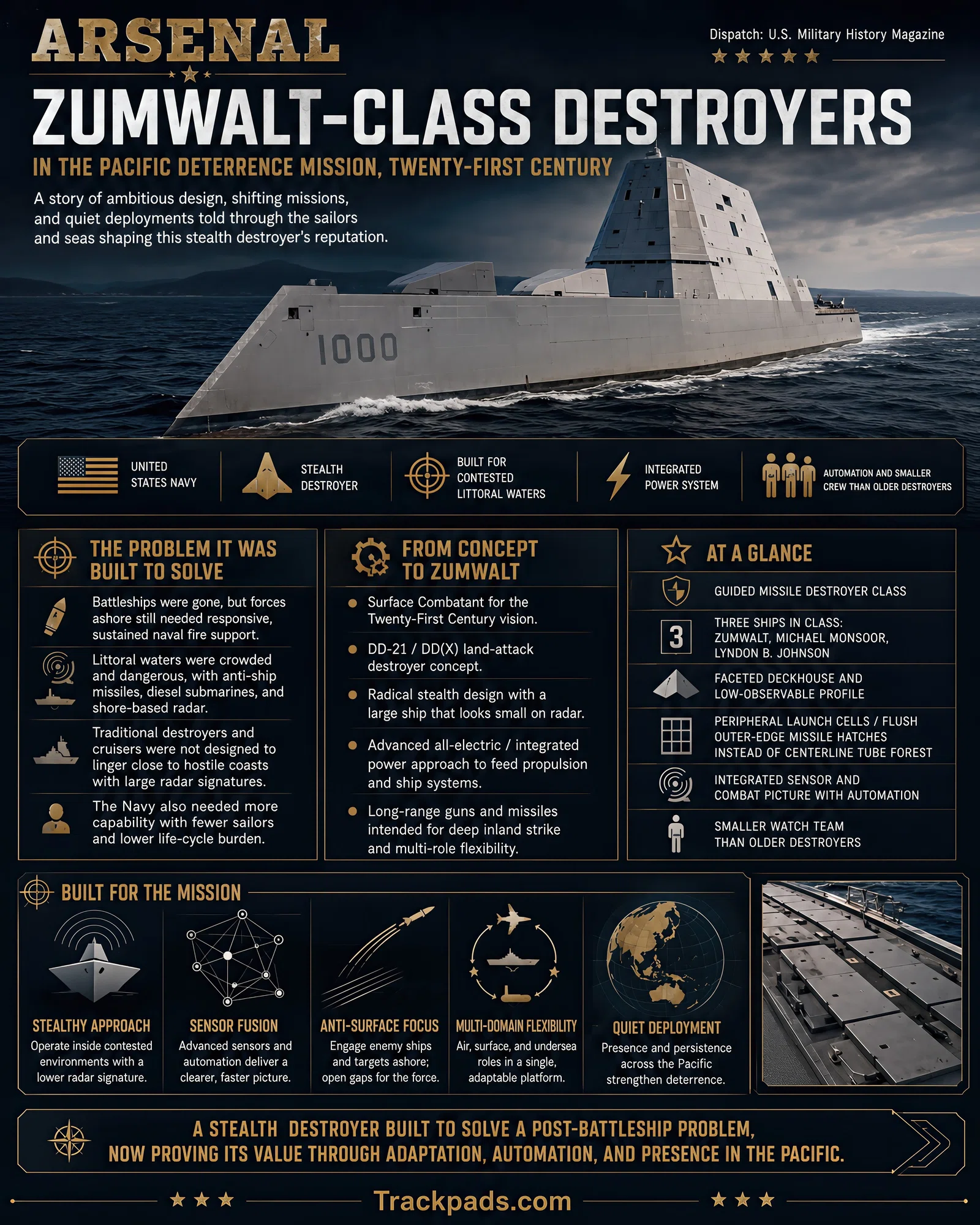
The Problem It Was Built To Solve
The Zumwalt class grew out of a difficult question facing the United States Navy after the Cold War. For decades, American surface combatants had been shaped by the need to escort carrier groups, defend against aircraft and missiles, hunt submarines, and fight Soviet warships across the open ocean. The Arleigh Burke-class destroyer became the workhorse of that world: capable, heavily armed, and built around the Aegis combat system. But the post-Cold War Navy also faced missions closer to shore, where land attack, naval gunfire support, stealth, and survivability in crowded littoral waters seemed increasingly important.
The Navy wanted a surface combatant that could approach defended coastlines, reduce its radar signature, support forces ashore, and deliver precision fire without relying entirely on aircraft or submarines. Marines and soldiers operating near the coast needed timely fires. Commanders wanted a ship that could influence events inland from the sea. Planners also wanted room for future electrical power demands, because sensors, weapons, and shipboard systems were becoming more energy-hungry with every generation.
Existing destroyers could perform many missions well, but they were not designed around this specific combination of low observability, high electrical generation, automated operations, and land-attack firepower. The answer became a radical new destroyer: larger than many cruisers, shaped for stealth, powered by an integrated electric system, and originally centered on advanced guns intended to strike targets far inland. The result would be one of the boldest naval design experiments of the modern era, and one of the most debated warship programs in United States Navy history.
From Design Board To Production
The Zumwalt class began as part of a larger effort to rethink the Navy’s surface fleet for the twenty-first century. The original idea was not simply to build another destroyer with newer equipment. The Navy wanted a ship that could combine land attack, survivability, reduced radar visibility, advanced sensors, and a level of electrical power that older mechanical arrangements could not easily provide. The program that eventually produced the class was shaped by the belief that future warships would need to carry more demanding radars, more automated systems, and weapons that might require far more power than conventional guns and missiles.
That ambition pushed designers toward a hull and superstructure that looked radically different from the Arleigh Burke class. The tumblehome hull, with sides that slope inward above the waterline, was chosen in part to reduce the ship’s radar signature. The large angular deckhouse served the same purpose. The ship’s overall form tried to make a vessel more than six hundred feet long appear far smaller to radar than its actual size suggested. In naval design terms, that was a bold tradeoff: stealth, internal volume, and advanced integration were prioritized over familiarity and proven convention.
The class also embraced integrated electric propulsion. Instead of using mechanical drive systems in the traditional way, the ship’s gas turbines generate electricity that can be distributed to propulsion and ship systems. This promised flexibility. Power could be routed where needed, and future energy-intensive weapons or sensors could be easier to support. But the same ambition also made the ship complex, expensive, and difficult to bring from concept to operational reality.
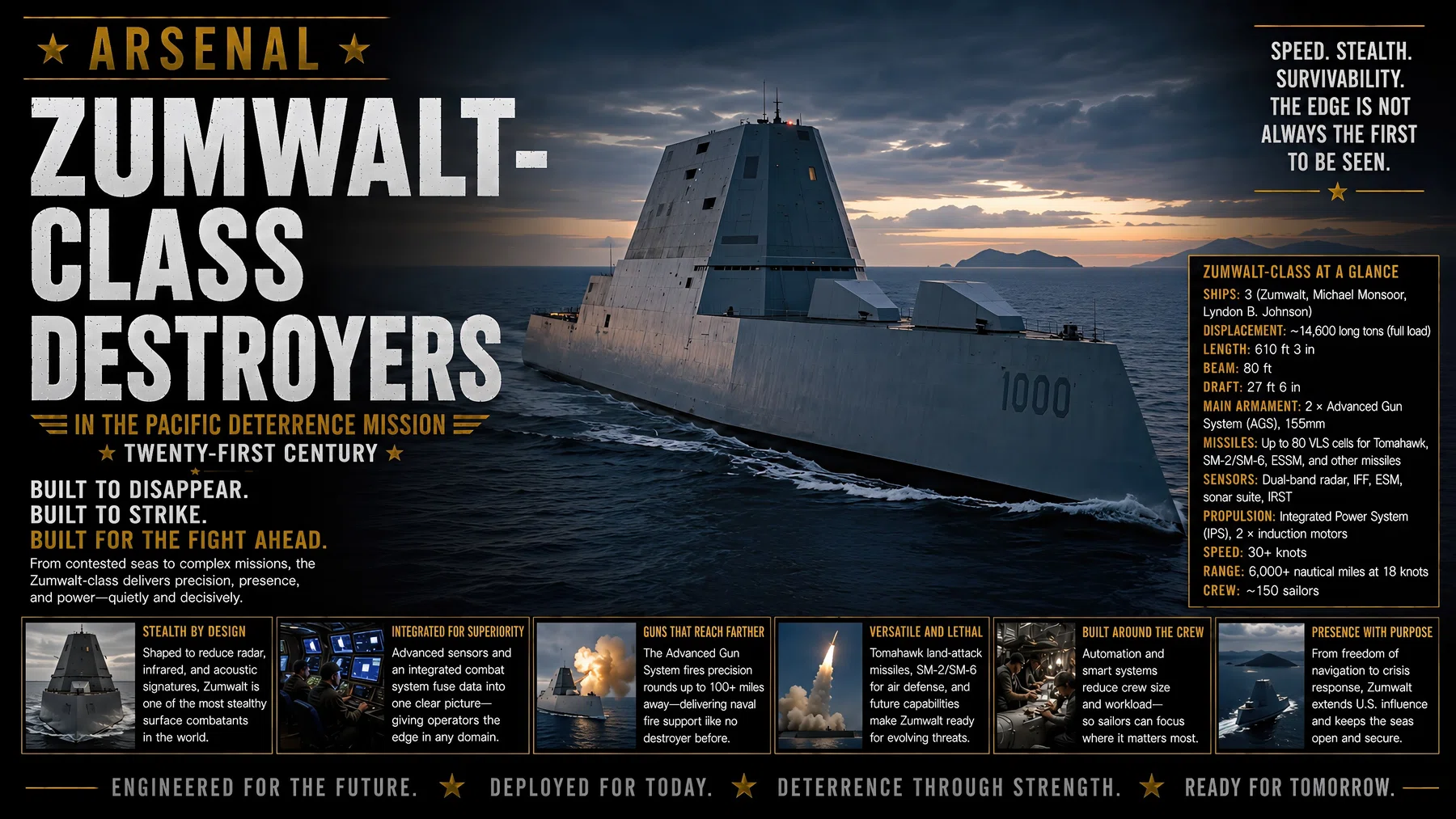
At a glance, the Zumwalt class is a United States Navy guided missile destroyer built for the modern era, though its size is closer to that of a cruiser than many earlier destroyers. It carries a relatively small crew for a ship of its size because automation was central to the design. Its original concept centered on stealth, land attack, advanced guns, missiles, powerful sensors, and high electrical generation. Three ships were ultimately built: Zumwalt, Michael Monsoor, and Lyndon B. Johnson.
The production story became inseparable from cost and changing requirements. The Navy first imagined a much larger class, but as expenses rose and missions shifted, the number of ships fell dramatically. The Advanced Gun System, originally one of the class’s defining features, became a central example of the problem. The guns were designed to fire long-range precision projectiles in support of forces ashore, but the ammunition became too costly and was not fielded as originally intended. A destroyer built around revolutionary naval gunfire support entered service without the practical ammunition that had justified much of that role.
Inside The Weapon
Walking around a Zumwalt-class destroyer begins with its shape. The ship’s bow, hull sides, and deckhouse are all part of a deliberate attempt to reduce radar reflection. The usual clutter of exposed masts, antennas, ladders, and deck fittings is minimized or hidden where possible. Even before looking inside, the ship tells the viewer what problem it was trying to solve: detection. It was built to be seen late, understood slowly, and targeted with difficulty.
The tumblehome hull gives the ship its most distinctive profile. Earlier warships often flared outward above the waterline to improve seakeeping and deck space, but the Zumwalt’s inward-sloping sides help control radar reflections. This choice created a ship with a futuristic appearance and a great deal of internal volume, but it also made the class controversial among observers who questioned how such a hull form would behave in heavy seas or battle damage conditions. In practice, the design represented the broader theme of the whole program: accept unusual risk in pursuit of a major leap forward.
Inside the ship, automation changes the human experience. A Zumwalt-class destroyer is enormous, yet it was designed to operate with fewer sailors than older ships of comparable size. That meant more monitoring, more centralized control, and more reliance on integrated systems. Sailors are not simply moving through a traditional destroyer with new electronics added. They are living inside a ship built around networks, consoles, automated damage-control aids, electric power management, and tightly integrated combat functions.
The crew’s work centers on information. Operators gather sensor data, manage contacts, track threats, coordinate weapons, and maintain communications across the force. Engineers monitor the ship’s electrical plant and propulsion loads, because power generation is one of the class’s core features. Damage-control teams still matter, because no amount of automation removes the need for sailors to fight flooding, fire, smoke, and battle damage. The ship may be advanced, but survival at sea always returns to trained people making fast decisions under pressure.
The original weapons fit reflected the ship’s land-attack mission. The two Advanced Gun Systems were mounted forward, giving the class a clean but formidable bow arrangement. They were intended to fire precision rounds at long range, providing naval gunfire support in a way that would have reached farther and hit more accurately than traditional naval guns. When the ammunition problem undermined that plan, the guns remained as physical reminders of a mission that changed before the ship fully matured.
Missiles gave the Zumwalt class another layer of striking power. Its vertical launch cells were arranged differently from the dense central missile farms seen on many other destroyers. The peripheral launch system placed missile cells around the edges of the ship, a design intended to reduce the danger of a catastrophic magazine hit and spread risk more widely. These cells could support a mix of weapons depending on mission needs, including missiles for land attack, air defense, and anti-surface warfare.
Sensors and combat systems were also central to the design. The ship was built to detect, classify, and engage threats while managing its own signature. The idea was not simply to hide. It was to control the terms of detection and engagement. In a missile-age fight, the first ship clearly located and accurately targeted may be the first ship placed in real danger. The Zumwalt class tried to complicate that enemy targeting process.
Habitability was different as well. A smaller crew on a large hull can mean more space per sailor, but it also means each sailor carries more responsibility. Automation does not eliminate work. It changes the kind of work and concentrates it in different places. For the people aboard, the ship’s advanced design meant serving inside a vessel that was both powerful and experimental, a warship whose promise and problems were inseparable from the same bold decisions that made it unique.
Baptism Of Fire
The Zumwalt class did not receive its baptism of fire in the traditional sense of a destroyer line charging into gun smoke or trading salvos with enemy cruisers. Its first test was quieter and more complicated: proving whether a revolutionary surface combatant could become a working warship after years of debate, redesign, cost pressure, and shifting missions. The class entered service in an era when the United States Navy was trying to prepare for long-range missile warfare, contested coastlines, electronic detection, and great-power competition across the Pacific.
The original combat vision placed the ship near the edge of dangerous waters. From there, it would use stealth shaping to reduce the chance of early detection, then support troops ashore with long-range precision gunfire. That mission tied the class to an old naval requirement in a new technological form. Since the age of battleships and cruisers, ground forces had wanted naval guns that could reach inland, answer quickly, and deliver heavy fire without waiting for aircraft. The Zumwalt class was supposed to revive that role with modern precision.
But the ship’s defining gun mission changed before the class could fully mature. The Long Range Land Attack Projectile, the specialized round intended for the Advanced Gun System, became too expensive to field as planned. That left the destroyer with two large guns but without the practical ammunition needed to perform the role around which much of the original design had been built. It was not a small adjustment. It forced the Navy to rethink what the Zumwalt class would actually do.
The answer increasingly shifted toward missiles, sensors, and future weapons. The class’s large hull, electrical power, stealth features, and unusual internal architecture still gave it value, but the mission emphasis moved away from naval gunfire support and toward high-end surface warfare. In that role, a Zumwalt-class ship could operate as a hard-to-detect missile combatant, carrying weapons for land attack and anti-surface missions while complicating an enemy’s ability to find, track, and engage it.
This made the Zumwalt class less a failed battleship substitute than a warship caught between two futures. One future imagined precision naval guns supporting troops ashore. The other imagined distributed fleets, long-range missiles, contested sensors, and surface ships hunting or striking from far beyond the horizon. The class was born for the first mission but increasingly adapted toward the second.
For commanders and crews, that meant the ship’s strengths had to be understood in a different way. Its value was not simply measured by the guns on the bow. It lay in stealth, power generation, command-and-control potential, missile capacity, survivability concepts, and the ability to host future systems. The battle for the Zumwalt class, at least early on, was not fought against an enemy fleet. It was fought against cost, technology, changing doctrine, and the difficult task of turning an ambitious concept into a useful operational tool.
Strengths And Weaknesses
The greatest strength of the Zumwalt class is its ambition. It pushed surface combatant design in directions the Navy had long discussed but rarely pursued so completely. Its radar-reducing shape, integrated electric propulsion, peripheral missile cells, automation, and large internal volume all pointed toward a warship built for a future of sensors, networks, missiles, and energy-intensive systems. It was not a conservative design, and that is precisely why it remains important.
The class also offered a powerful reminder that warship design is always a set of tradeoffs. Reduced radar signature required an unusual hull and superstructure. Automation reduced crew size but increased dependence on complex systems and placed broader responsibility on each sailor. Integrated electric propulsion promised flexibility but introduced engineering and integration challenges. The Advanced Gun System promised a new form of naval fire support, but only if its ammunition remained affordable and available.
For crews, the ship could offer modern spaces, advanced control systems, and a sense of serving aboard something genuinely new. But novelty brings strain. A small crew on a very large ship means fewer people to absorb maintenance burdens, damage-control emergencies, watchstanding demands, and the everyday friction of sea service. In combat, automation can help sailors see and act faster, but it cannot replace human judgment when systems fail or conditions become chaotic.
For enemies, the class presents a different kind of problem than a traditional destroyer. Its shape is meant to make detection and targeting harder. Its missiles can threaten targets at long range. Its size and electrical capacity suggest room for weapons and sensors that may become more important over time. Yet opponents would also study its small numbers, distinctive logistics, and the limits created by having only three ships in the class.
Compared with the Arleigh Burke class, the Zumwalt is larger, more experimental, and more focused on signature reduction and future power margins. The Burke is more numerous, proven, and deeply integrated into the fleet’s air-defense architecture. The Zumwalt is not simply better or worse. It represents a different answer to a different question: how far should a navy push revolutionary design when proven ships are still doing essential work?
Variants And Evolution
The Zumwalt class never evolved into the large fleet once imagined. Instead, its evolution came through mission changes and reinterpretation. The original plan envisioned a sizable class of land-attack destroyers that could provide precision fires from the sea. As costs rose and requirements shifted, the program contracted to three ships. That reduction changed the meaning of the class. A large class can reshape fleet doctrine by numbers alone. A three-ship class becomes a specialized tool, a test bed, and a symbol of both innovation and caution.
The three ships are Zumwalt, Michael Monsoor, and Lyndon B. Johnson. The third ship incorporated some changes from the earlier pair, including differences in deckhouse construction. Across the class, however, the larger story remained consistent: a stealthy, electrically powered destroyer whose original gun-centered mission gave way to a broader role in advanced surface warfare.
The most important evolution has been the move away from the Advanced Gun System as the central reason for the ship’s existence. With the specialized ammunition unavailable, attention shifted toward missile integration and the possibility of carrying new long-range strike weapons. In that sense, the class became less about replacing old naval gunfire and more about exploring what a large, low-observable surface combatant might contribute in a missile-dominated fight.
The Zumwalt class also influenced thinking beyond its own hulls. Its electric-drive architecture, automation lessons, signature-control measures, and struggles with cost all became part of the Navy’s learning process. Future ships may not look exactly like Zumwalt, but they will inherit questions the class forced into the open: how much stealth a surface ship needs, how much electrical power future weapons will require, how much automation is wise, and how much technical risk should be accepted in a single leap.
Legacy And Where To See It Today
The legacy of the Zumwalt class is still being written. Unlike a World War II tank or a retired Cold War aircraft, it is not a museum artifact from a closed chapter. It belongs to the modern fleet, where its purpose continues to evolve. That makes its legacy unusually complicated. It is at once an operational warship, a technological experiment, a cautionary acquisition story, and a glimpse of what future surface combatants may need to become.
Its influence is not measured only by the number of ships built. Three hulls cannot replace a destroyer fleet, but they can teach hard lessons. The class showed the promise of integrated electric power, the appeal of low-observable shaping, and the operational possibilities of large internal margins for future weapons. It also showed the danger of building a ship around a weapon and ammunition combination that might not survive cost reality. In that sense, Zumwalt is both a warning and a laboratory.
Readers are most likely to see the class through Navy imagery, port visits, fleet exercises, and coverage of modern surface warfare. The ships themselves remain active naval assets rather than museum displays. Their unusual silhouette makes them instantly recognizable when photographed at sea or alongside a pier. Even people with only a casual interest in warships often recognize that the design is different before they know why.
The natural reading and listening trail from this Arsenal feature runs through other Dispatch stories about modern naval combat, guided missile destroyers, naval gunfire support, stealth, and the changing role of surface fleets in the missile age. A Beyond the Call story connected to naval service can remind readers that technology never removes the human element. A Living History interview with a sailor, engineer, curator, or naval historian can add the lived texture that specifications alone cannot provide.
The Zumwalt-class destroyer remains one of the most striking warship designs ever placed in United States Navy service. It did not become the large class once imagined, and it did not fulfill its original gunfire-support concept in the way planners expected. But it forced important questions into steel: how a ship hides, how it powers itself, how it fights at range, and how sailors adapt when the future arrives in unfinished form. Behind every piece of hardware are crews and opponents whose lives turn on how well it performs.