In Action
Dust hangs over the Texas training area like a low fog as the column grinds to a halt. Ahead of the lead M1 Abrams, an ugly wound cuts across the desert floor: a deep anti-tank ditch, just wide enough to stop seventy tons of armor dead. The scenario clock is running. Somewhere “downrange” in this National Training Center rotation, a notional enemy brigade is already repositioning, and every minute the Americans sit in this choke point is another minute lost.
From the middle of the column a squat shape rumbles forward, all familiar Abrams lines except for what rides where the turret should be. The M104 Wolverine’s gas turbine whines as the bridgelayer noses up to the edge of the gap, hydraulic spade biting into the dirt to anchor the chassis. Inside, just two combat engineers work in the red glow of their displays, speaking in clipped phrases over the intercom and the company net.
With a hiss and a clatter, the aluminum Leguan bridge begins to unfold, sliding forward in a long, deliberate arc over the ditch. The Wolverine’s crew ride the controls but let the computer do most of the sequencing, trimming the bridge alignment by degrees. Behind them, tank commanders stand high in their hatches, eyes flicking between the obstacle and their wristwatches, thinking in terms of fuel states and imagined enemy artillery.
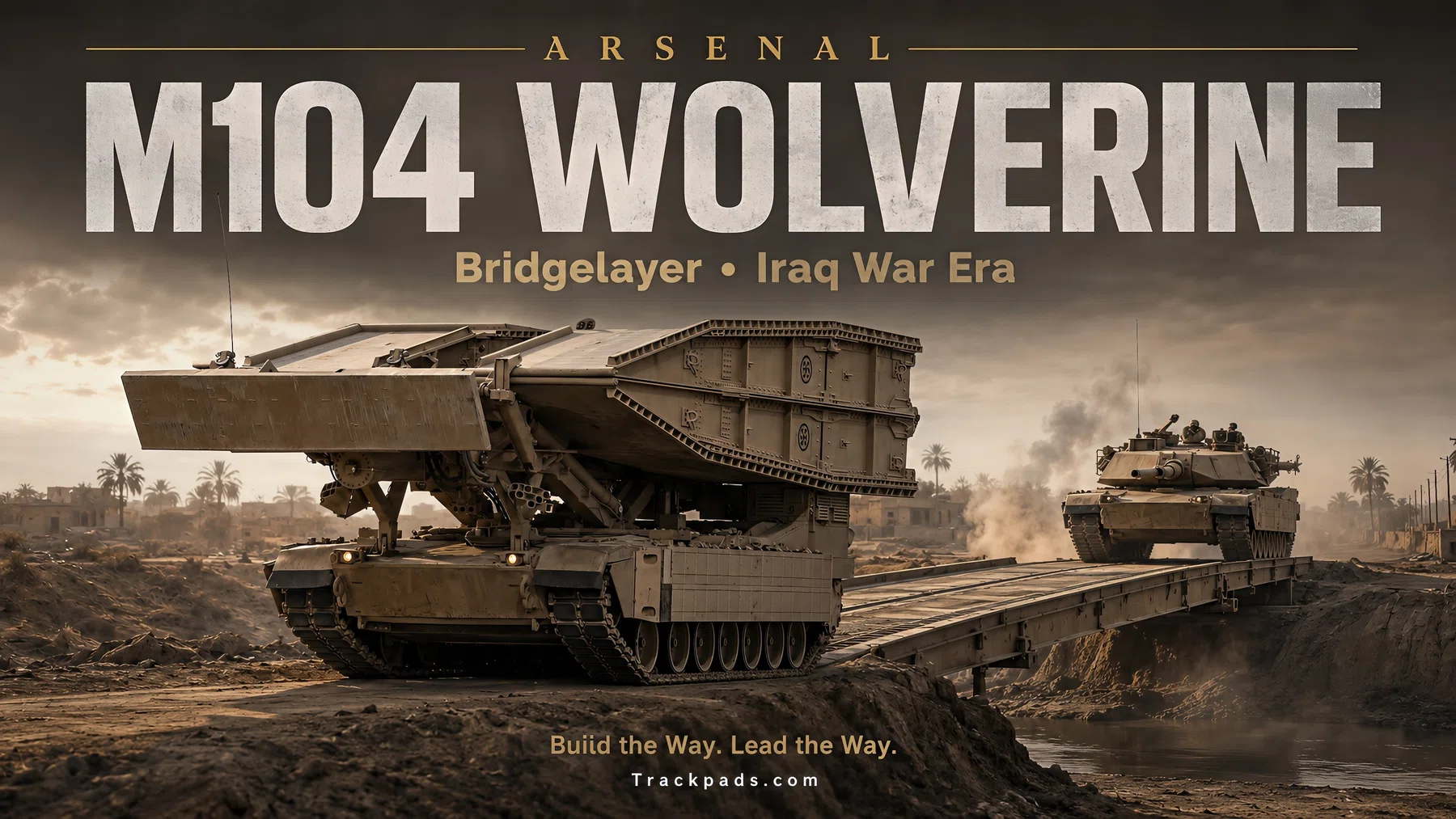
Four minutes later, the bridge settles onto the far lip with a dull metallic thump. The Wolverine retracts its launcher, throws itself into gear, and lurches across its own handiwork. The first Abrams follows at a controlled, combat-speed roll, then another, and another, the entire armored task force pouring over what had been a solid line on the map. For the crews, it feels routine in training. In a real war—whether across a German river line or an Iraqi canal—the ability to erase an obstacle this quickly could mean the difference between maintaining momentum and bleeding away the initiative.
The Problem It Was Built To Solve
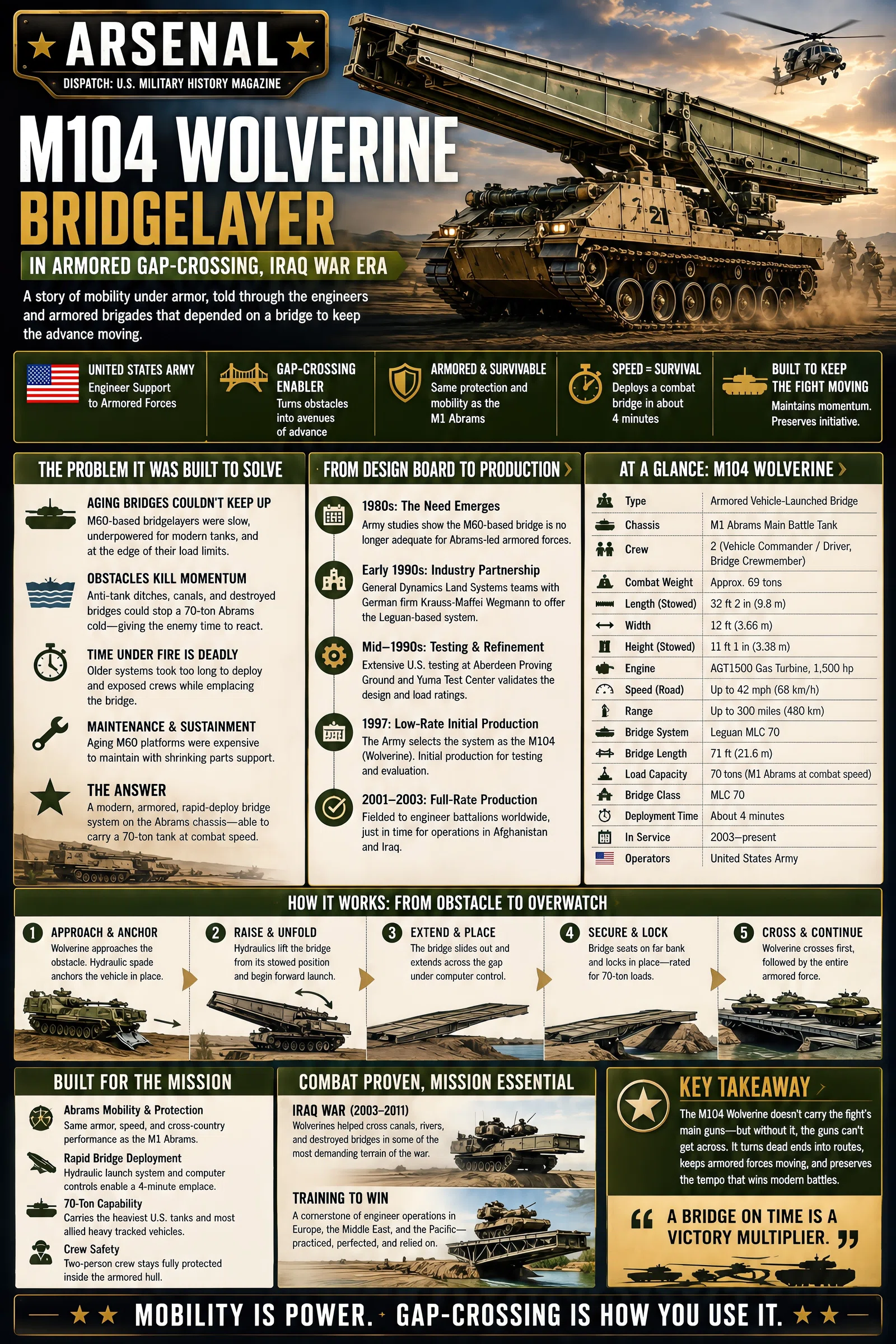
The Wolverine exists because of a very specific tactical frustration: by the end of the Cold War, American heavy armor could move faster and hit harder than ever before, but its bridging support was stuck in the 1960s. The Army’s existing armored vehicle-launched bridge was built on the M60 series tank chassis and carried a steel scissor bridge that had served faithfully for decades. It could still throw a crossing over a stream or anti-tank ditch, but the numbers no longer matched the reality of modern armored warfare.
The M1 Abrams and the Bradley fighting vehicle were heavier, faster, and more demanding than the older Patton tanks they replaced. In field exercises, planners kept discovering the same choke points: the bridging vehicles struggled to keep up with high-tempo maneuvers, and when they did arrive, the bridge itself was at the edge of what it could safely carry. Abrams crews could cross, but often only at a crawl, one at a time, with commanders quietly worrying about both the structural limits of the bridge and the clock ticking on enemy response.
Doctrinally, this was a serious problem. American heavy forces were built around the idea of rapid offensive maneuver—crossing rivers, canals, and demolition craters without pausing long enough for an enemy to reset defenses or mass fires. Gap-crossing operations were supposed to be violent, rehearsed bursts of movement that punched armored spearheads through natural and man-made obstacles. Instead, the bridging piece was becoming a brake on the system.
On top of that, sustainment realities bit hard. The M60-based bridgelayers were aging, maintenance-intensive machines with dwindling parts support. The Army could continue to patch them up, but every hour in the motor pool was an hour not training, and every breakdown on exercise was a reminder that the support gear no longer matched the main battle tank it was supposed to serve.
The answer, at least on paper, was obvious: put a modern bridge on the same chassis as the Abrams, give it comparable speed and protection, and design a launch system that could deploy a long, heavy bridge quickly enough to keep armored task forces moving. That decision would lead to a partnership between American and European firms, a new aluminum Leguan bridge able to carry a seventy-ton load at combat speed, and a vehicle the Army would eventually designate the M104 Wolverine Heavy Assault Bridge.
From Design Board To Production
Once the Army accepted that the old M60-based bridge vehicles could not keep up with Abrams-led armored formations, it began laying the groundwork for a modern replacement. Work on a new heavy assault bridge concept ran through the 1980s, but shifting budgets and the end of the Cold War kept pushing decisions to the right. The Gulf War was a turning point. Rapid armored thrusts across Iraqi terrain made it obvious that any future gap-crossing vehicle had to share the Abrams’ mobility and protection rather than trail behind it. A modern bridging system would have to match a seventy-ton tank in speed, keep its crew under armor throughout the launch, and deliver a span long enough to defeat man-made ditches and demolished bridges.
By the early 1990s the Army had turned to industry with a specific requirement. General Dynamics Land Systems partnered with the German firm that produced the Leguan family of armored bridges, offering a system that combined a modified M1 hull with a horizontally launched, single-piece aluminum bridge. After comparing options, the Army selected this layout in the mid-1990s and assigned it the experimental designation XM104 Wolverine. The chassis choice shifted to the M1A2 System Enhancement Program standard, giving the Wolverine the same digital backbone, power generation, and automotive performance as the front-line tank. Prototype trials demonstrated that the vehicle could emplace a full-length bridge in a few minutes, recover it in under ten, and keep the crew protected the entire time.
Production, however, never reached the scale first imagined on paper. The Army initially talked about several hundred vehicles, enough to support heavy divisions across multiple theaters. In the end, shifting doctrine toward lighter, more expeditionary forces and hard budget choices cut that ambition down to a small fleet. Only a few dozen Wolverines were built and sent to select engineer units, where they gave commanders a glimpse of what fully modern armored bridging could look like. At a glance, the M104 Wolverine is a United States armored vehicle-launched bridge based on the M1A2 tank chassis, operated by a two-person crew in the United States Army engineer community, carrying a twenty-six-meter Leguan bridge rated for roughly seventy-ton vehicles and able to lay or recover that span in minutes while matching Abrams road and cross-country speed.
Over time, the Wolverine’s strengths were weighed against its costs and complexity. Maintaining a highly specialized bridge launcher on an Abrams hull, complete with sophisticated hydraulics and electronics, proved expensive. As the Army looked for more affordable ways to refresh its bridging fleet, attention shifted to a newer, scissor-bridge system on an Abrams chassis that would become the Joint Assault Bridge, intended to replace both the aging M60 bridgelayers and the limited Wolverine fleet. The M104’s production run closed quietly, but its development work and field experience directly shaped the thinking that went into its successor.
Inside The Weapon
Walk up to a Wolverine in the motor pool and, from the glacis plate down, it looks like any other Abrams. The same broad hull, the same armored skirts, the same high, purposeful stance on six road wheels per side. Above the hull, though, everything changes. Where a tank would carry a turret and gun, the Wolverine mounts the Leguan bridge sections on a launch frame, nested like a folded ladder along the roofline. Behind the armor sit the same gas turbine engine and transmission used in the tank, giving the bridgelayer high acceleration on roads, solid cross-country performance, and the ability to keep up with the armored columns it supports. What it lacks in firepower it makes up for in mobility and protection, relying on other vehicles in the formation to provide direct security.
Inside, the crew space feels more like a hybrid between a tank and a specialized engineer vehicle. The driver occupies the familiar front-left position in the hull, hands on controls that behave much like those in an Abrams. Behind and above him, the vehicle commander doubles as the bridge operator, working at a console of displays and control panels tied into the hydraulic and electronic systems that move the bridge. Both crew members have access to the launch controls, which are heavily automated. In practice, they choose the site, confirm the geometry of the gap, anchor the vehicle, and then supervise the sequence while the computer executes the finely timed motions of lifting, extending, and placing the bridge. Throughout, they stay under armor, talking over the internal intercom and multiple radio nets that link them to supported tank and infantry units.
From the commander’s seat, launching a bridge is a choreographed procedure. The Wolverine drives up to the near bank and drops a rear spade to bite into the ground, locking the hull in place. With the push of a control input, hydraulic actuators raise the folded bridge stack and begin to slide it forward, the two halves locking together into a rigid span as they clear the hull. The bridge then creeps outward over the gap in a horizontal arc rather than swinging up like a scissor, keeping the vehicle’s silhouette lower and easier to mask behind terrain. As the far end finds the opposite bank, the commander can make fine adjustments to alignment based on what he sees through periscopes and cameras. When the bridge settles, they retract the launcher, pull the spade, and either cross first to lead the way or ease aside to let the tanks roll through at controlled combat speed.
The Wolverine’s subsystems are all tuned to that single mission of getting heavy forces over obstacles without pause. Its digital communications suite ties into the broader battle management network, allowing engineer commanders to coordinate gap crossings as carefully as any fire mission. The power-generation and hydraulic systems are sized to move the bridge smoothly and repeatedly in harsh conditions, from dust-choked desert to muddy canal banks. Habitability is similar to an Abrams: cramped, noisy with the turbine at full power, but climate-controlled and protected, a far cry from the days when engineers had to work exposed on top of unarmored bridging trucks. In training, Wolverine crews learn to work their sequence under time pressure and simulated enemy contact. In a real campaign, they would be the quiet pivot point in a much louder battle, erasing obstacles so that the rest of the brigade can keep moving forward.
Baptism Of Fire
For the Wolverine, the moment of truth came far from American training areas, on the broken road network of Iraq. In late 2006 the 20th Engineer Battalion, one of the first units to receive the new heavy assault bridge, deployed with an armored brigade into Baghdad’s dense sprawl, bringing the M104 into a real combat theater for the first time. Their job was simple to describe and hard to execute: keep armored and mechanized forces moving across canals, highway cuts, and demolition craters in a city where every choke point could hide an improvised explosive device or an ambush team. The old M60-based bridgelayers had already proven their worth in earlier operations, but here the heavier Abrams and Bradley fleets needed a bridge that matched their weight and tempo.
A typical Wolverine mission in that environment began in darkness. Route clearance teams swept ahead, watching for pressure plates and command wires near a suspected obstacle. Tank and Bradley crews took up overwatch positions covering the approaches, turrets trained on likely firing points. When the engineers called it clear enough to risk the bridging vehicle, the M104 rolled forward, its turbine whine familiar to every armored crewman on the net. The commander would nose the hull up to an irrigation canal or the gap in a blown overpass, drop the rear spade, and start the launch sequence from behind armor. In a few minutes, the Leguan bridge slid out over the water or broken concrete, joining its sections into a single twenty-six-meter span strong enough to carry a seventy-ton Abrams at combat speed rather than a cautious crawl.
These crossings rarely made headlines, but they shaped the rhythm of operations. In Baghdad and on other Iraqi routes, Wolverines helped turn canals and highway cuts from stop signs into brief pauses, shortening crossing times from the better part of an hour with improvised solutions down to a handful of minutes with a purpose-built bridge. Reports from the period describe Wolverines supporting route clearance and obstacle-breaching missions as armored battalions tried to avoid predictable routes and keep pressure on insurgent networks. At the tactical level, commanders learned to fold the Wolverine into their battle drills: secure the far bank with dismounts and overwatch, launch the bridge under armor, then push tanks and infantry fighting vehicles across before an enemy could adjust.
Even when not under direct fire, the stress was real. Every minute a Wolverine sat anchored on a skyline or by a canal was a minute exposed to mortar rounds or a buried charge that had been missed. Training rotations at the National Training Center and other ranges began to reflect that pressure, forcing crews to work through malfunctions and misalignments with the clock running and simulated enemy artillery tracking the obstacle. Photographs from Fort Irwin and later evaluations at Fort Johnson show Wolverines threading their bridges out over dusty ditches under the watchful eye of observer-controllers, rehearsing the same maneuvers that crews had used in Iraq. The Wolverine’s combat baptism, quiet as it was, confirmed that the concept worked: a fully armored, Abrams-speed bridge layer could erase heavy obstacles without handing the enemy a long window to react.
Strengths And Weaknesses
Ask the engineers who worked with it, and the Wolverine’s greatest strength is obvious: it finally put armored bridging on the same footing as the tanks it supported. Built on the M1A2 System Enhancement Program hull, the M104 shared the Abrams’ automotive performance, protection, and most of its logistics trail, which meant it could maneuver with heavy brigades instead of lagging behind. Its twenty-six-meter Leguan bridge was rated to carry a seventy-ton load at around sixteen kilometers per hour, giving Abrams crews the confidence to cross at a controlled roll instead of inching along an older span. The launch and recovery cycle, under five minutes to emplace and under ten to bring the bridge back, kept both the crew and the rest of the column under armor instead of working on unprotected bridging trucks.
Automation was another advantage. Both crew members could operate the bridge controls, but once they confirmed the site and anchored the hull, the computer handled most of the choreographed movements of raising, joining, and extending the bridge. That reduced the number of people exposed and cut down on the kind of manual handling that had once put engineers out in the open under fire. A modern communications suite tied the Wolverine into brigade and battalion nets, so that crossing plans could be coordinated in the same digital picture as tank and infantry movements. In theory, at least, the Wolverine made it possible to plan a gap crossing as a timed maneuver rather than a separate engineering project bolted onto the side of the fight.
The weaknesses lay less in battlefield performance than in cost and complexity. The Army originally envisioned hundreds of Wolverines replacing every aging M60 armored vehicle-launched bridge, but production stopped after about forty-four vehicles, all assigned to a handful of engineer units. Maintaining a highly specialized launcher on an Abrams hull proved expensive, with hydraulic and electronic systems that demanded skilled technicians and steady spares support. Budget cuts and a shift toward lighter, more expeditionary formations made it hard to justify a large fleet of heavy, fuel-hungry bridging vehicles, even if they solved a very real problem for armored brigades. In training, some commanders also worried about depending on a capability that existed in such small numbers, knowing that a single mechanical failure or combat loss could remove the only Wolverine in a task force.
From the enemy’s perspective, the Wolverine’s existence closed off one of the more reliable ways to slow a heavy American column. Blowing bridges, carving anti-tank ditches, or using canals as barriers had long been a standard response to armored maneuver. With an M104 in the formation, those obstacles became temporary inconveniences rather than fixed walls. Insurgents and conventional opponents alike shifted tactics toward attacking the approaches to crossing sites with improvised explosives and indirect fire, trying to hit the engineers and dismounted security rather than the bridge vehicle itself. In that sense, the Wolverine did its job so well that it forced enemies to change where and how they tried to interfere.
Compared to the M60 AVLB it was meant to replace, the Wolverine offered a longer, stronger bridge and far better crew protection, but it did so at a higher financial and logistical price. The Joint Assault Bridge that followed took a different path, using an Abrams hull but a shorter eighteen-point-three-meter scissor bridge that could deploy in about three minutes. While the JAB gives up some span length, it gains a simpler, more sustainable launcher and a program sized to replace both the old AVLBs and the small Wolverine fleet. The tradeoff says as much about budgets and maintenance as it does about tactics: the M104 showed what was possible, while the JAB reflects what the Army believed it could field across an entire force.
Variants And Evolution
Unlike some famous tanks or aircraft, the Wolverine never developed a long list of variants. The core idea—an Abrams-based chassis carrying a Leguan bridge on a horizontal launcher—remained consistent from prototype to production. Development work focused on refining the bridge sections, launch controls, and integration with the M1A2’s electronics rather than spawning whole new sub-types. There were incremental improvements as the program matured, but no distinct “A1” or export models that took on separate identities. The vehicle was always a niche tool for American heavy engineer units rather than a platform aimed at a broad global market.
The real evolution happened around it. The Leguan bridge system itself became a kind of family, mounted on different chassis in European service and continuing to evolve in materials and load ratings. The experience of blending that bridge with an Abrams hull taught designers hard lessons about weight distribution, hydraulic power, and the value of automation in reducing crew workload. Those lessons fed directly into the Joint Assault Bridge program, which kept the basic principle of an armored, tank-chassis bridgelayer but chose a scissor bridge with a shorter span and faster deployment, paired with a launcher designed from the outset for maintainability and commonality with existing depots.
At the doctrinal level, the Wolverine helped cement the idea that armored brigades needed organic, Abrams-speed bridging as part of their standard toolkit, not as an attached specialty asset that could be stripped away. Fielding tables in the early modular brigade era assumed that Mobility Augmentation Companies would have heavy assault bridges alongside breaching and obstacle-laying equipment, and planning tools began to treat gap crossings as deliberate, rehearsed actions woven into the brigade’s battle rhythm. Even as the M104 itself remained rare, its presence in those organizations shaped how American forces thought about keeping momentum across rivers, canals, and man-made gaps.
Legacy And Where To See It Today
Today, the Wolverine sits at an interesting point in United States Army history. It is modern enough that some examples still serve in training and evaluation roles yet rare enough that many soldiers and Marines have never seen one outside a photograph. Heavy brigade engineer battalions at places like the National Training Center and the Joint Readiness Training Center have used Wolverines in obstacle-breach scenarios, rehearsing the same under-armor bridge launches that helped armored units cross canals and broken roadways in Iraq. Maintenance and training pictures from Fort Irwin and Fort Johnson show these vehicles being kept in working order even as the Joint Assault Bridge gradually replaces them in frontline units.
In design terms, the M104’s legacy lives on in the JAB and in other Abrams-based engineering vehicles. The idea that a bridgelayer should share a chassis, protection package, and much of the automotive system with the main battle tank is now taken for granted, as is the expectation that bridge launches should be automated, repeatable, and possible without exposing engineers to direct fire. Modern bridging programs build on the Wolverine’s example, aiming to shorten crossing times even further and to reduce the maintenance burden that limited the M104’s fielding. For heavy forces, the lesson is clear: mobility is more than horsepower and armor; it is the ability to erase obstacles as fast as an enemy can create them.
As the Joint Assault Bridge fleet grows and Wolverines rotate into storage or retirement, it is likely that some will find their way into museum collections alongside the M60-based bridgelayers they were meant to replace. Visitors walking the lines at armor museums and base parks may soon see an Abrams hull without a turret, carrying a folded bridge instead of a gun, and trace a direct line from Cold War AVLBs through the Wolverine to the current generation of bridging systems. For readers of Dispatch and followers of Trackpads, the M104 also connects to other stories: Beyond the Call features where engineers fight for a crossing under fire, Living History interviews with soldiers who drove and maintained heavy bridging gear, and future Arsenal pieces on the Joint Assault Bridge and its cousins. Whatever replaces it in metal, the Wolverine’s core idea endures: in modern war, the units that can cross the gap first usually decide how the rest of the battle will be fought.