In Action
The convoy has stopped, which is the last thing anyone wants on that Iraqi highway before dawn. Ahead, an M1 Abrams sits angled off the broken pavement, nose down in a soft shoulder that turned out to be more swamp than desert. Its tracks have dug in deep. The tank’s turbine is silent now, but the crew can still feel the embarrassment and the rising tension on the platoon net. They are blocking the route, and the battalion’s timetable does not care about mud.
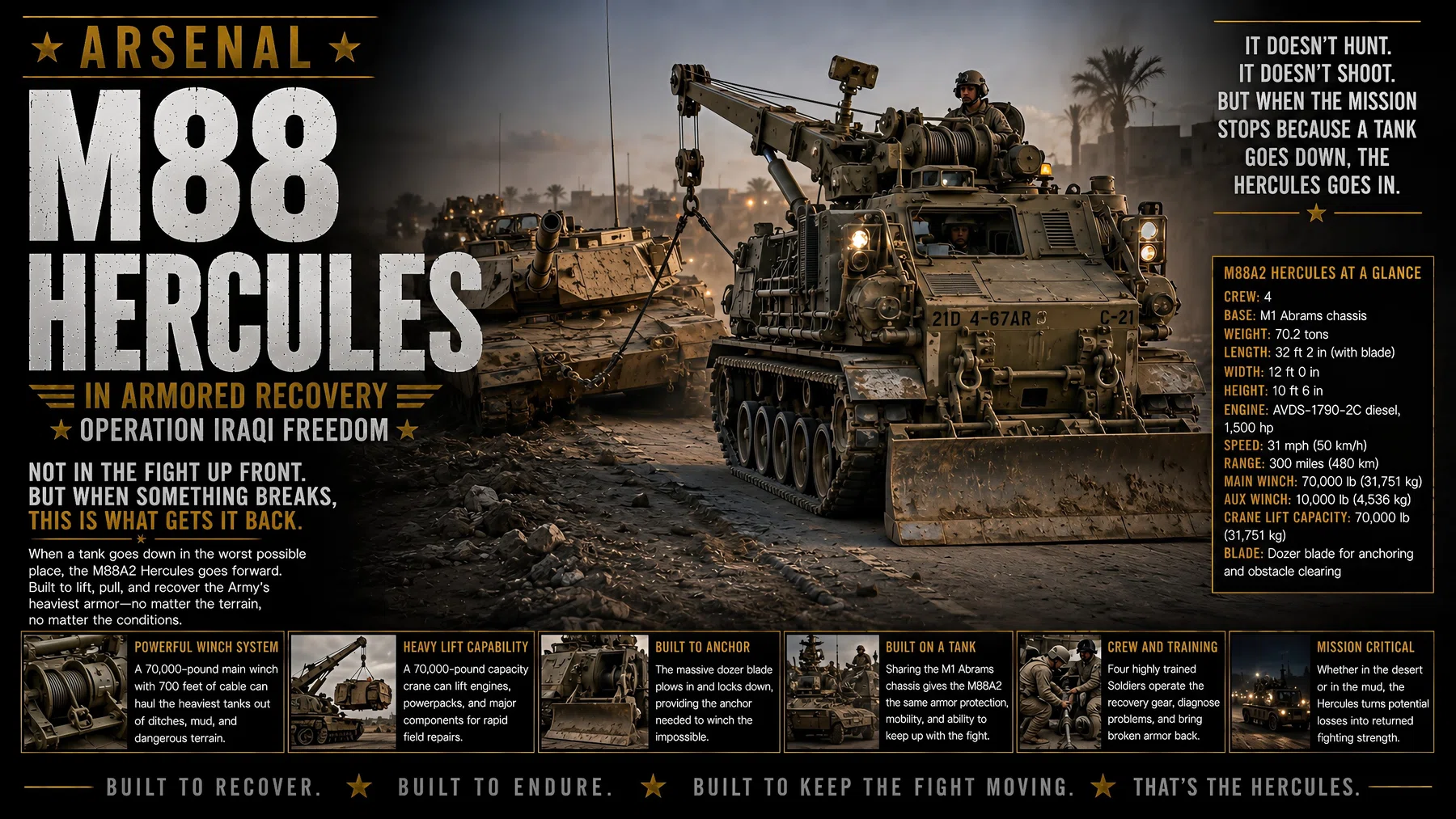
Headlights are kept low, red-lensed flashlights flicker, and out of the dark comes the squat shape of an M88A2 Hercules. It is not pretty. It looks like someone grafted a crane onto an old tank and dared it to go where the slick new Abrams cannot. The Hercules grinds forward, dozer blade biting in to anchor itself, tracks clattering over broken asphalt and debris. Its commander stands half-out of the hatch, guiding the driver and calling distances as if maneuvering a tugboat alongside a damaged ship.
The recovery crew moves fast, almost wordless. The big main winch cable snakes out, hooks are passed in quick hand-to-hand relays, and the Abrams driver stares at the Hercules as if willing it not to bog down too. There is the metallic snap of tension running down the line, the growl of the recovery vehicle’s engine straining, then a lurch as the stuck tank shudders and inches backward. Dust, exhaust, and shouted corrections fill the air as the pair of armored beasts claw their way back to the roadway.
Minutes later, the Abrams is back in column, its crew chastened but grateful. The Hercules rumbles off to its next call, a support vehicle by designation but a lifeline in practice. Scenes like this, repeated from Vietnam through the Gulf War and into Iraq and Afghanistan, are the reason the United States Army invested in a purpose-built machine that could drag its heaviest armor out of trouble and back into the fight.
The Problem It Was Built To Solve
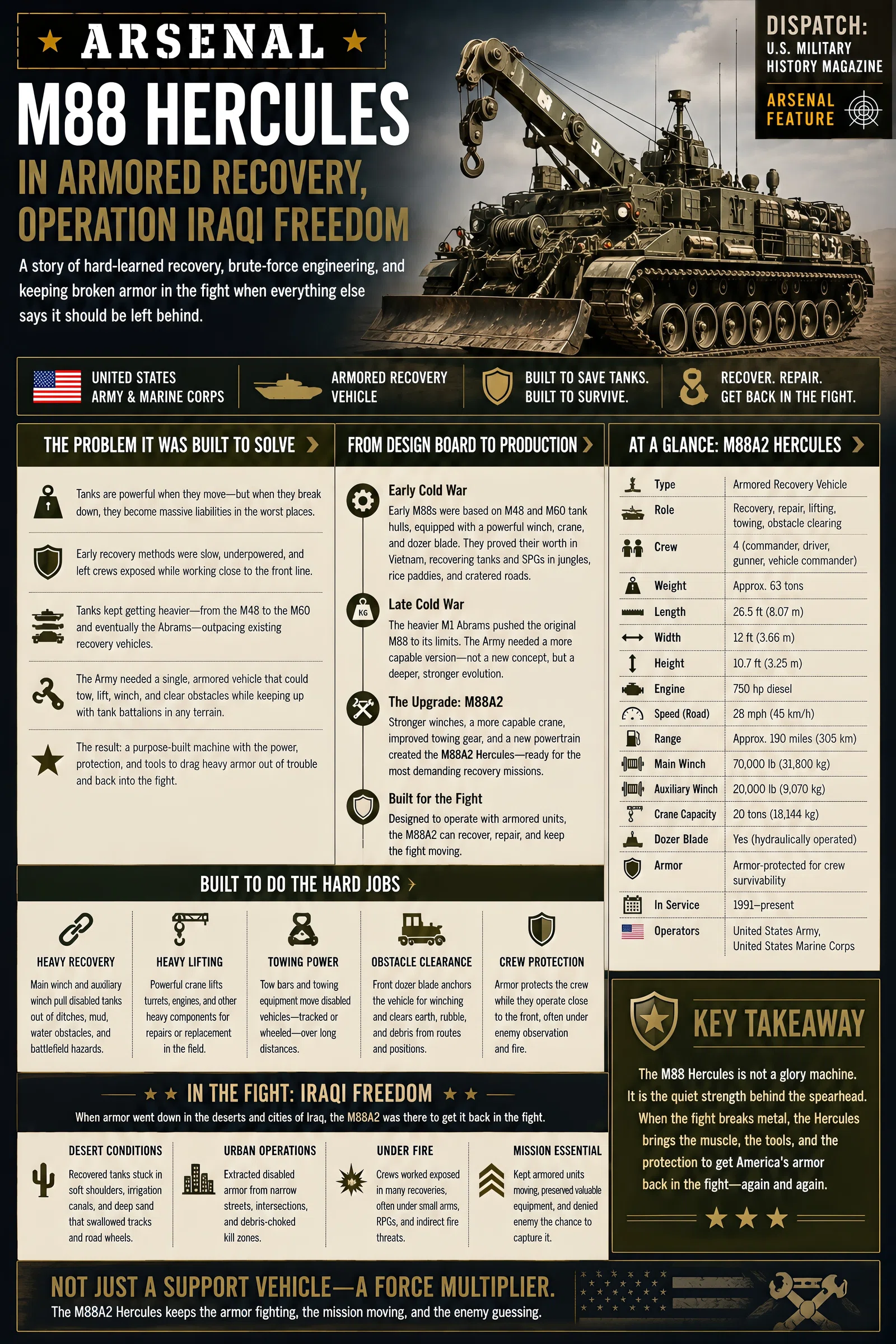
Tanks are unforgiving machines. When everything works, they can dominate ground combat. When something goes wrong, they become seventy-ton paperweights sitting in the worst possible places: bogged in mud, bellied on rubble, mechanically dead in the middle of a chokepoint, or knocked out under direct enemy observation. Early in the Cold War, the United States Army learned the hard way that improvising recovery for these monsters with standard trucks or lightly modified tanks was slow, dangerous, and often impossible under fire.
Experiences from the Second World War and Korea had already shown that armored forces needed their own dedicated recovery assets. As main battle tanks grew heavier from the M48 to the M60 and eventually to the Abrams, the gap widened between what existing recovery vehicles could handle on paper and what crews were being asked to do in real terrain. Winches lacked pulling power. Hulls struggled to anchor themselves securely in mud or on ice. Cranes were too small to lift powerpacks or turret components quickly in the field. Recovery teams were also exposed, working unarmored or lightly protected vehicles close to the front line.
The Army needed a single, armored, tracked recovery vehicle that could stay with tank battalions, maneuver in the same terrain, and haul or lift anything those battalions might break or lose. It had to tow disabled tanks, winch them out of ditches and canals, hoist heavy components, and clear obstacles, all while protecting its own crew. It also needed to be reliable enough to handle long road marches in Europe and the punishing conditions of places like Vietnam and, later, the Middle East.
That combination of demands drove engineers toward a solution based on a tank chassis, equipped with a powerful main winch, auxiliary winches, a serious crane, and a bulldozer blade to act as both earthmover and anchor. The result would become the M88 series, and eventually the M88A2 Hercules, a specialized machine built around a simple promise to armored commanders: if your tank goes down, we can go get it.
From Design Board To Production
The M88 story begins in the early Cold War, when the United States Army needed a dedicated recovery vehicle to keep up with its growing fleet of medium and main battle tanks. Early versions of the M88 were based on tank hulls from the M48 and M60 families, combining a low, armored profile with a powerful winch, crane, and dozer blade. These original machines proved their worth in Vietnam, dragging damaged tanks and self-propelled guns out of rice paddies, jungle tracks, and cratered roads. They were tough, but as the decades passed, the tanks they were supposed to rescue kept getting heavier.
The arrival of the M1 Abrams in the late Cold War pushed the old M88 design to its limits. The Abrams brought thicker armor, a more powerful gun, and a higher weight than its predecessors. On paper, the existing recovery vehicles could still tow or winch it, but in practice crews were operating on the edge of what their equipment could safely handle. The Army needed an update, not a completely new concept, but a deeper and more capable version of the same basic idea. Engineers focused on stronger winches, a more capable crane, better towing gear, and an upgraded powertrain to cope with modern armor.
At a glance, the M88A2 Hercules is a tracked armored recovery vehicle built in the United States for the United States Army and Marine Corps in the late Cold War and post–Cold War era. It typically carries a crew of three, with room for additional personnel, and its primary “armament” is mechanical: a heavy main winch, an auxiliary winch, a crane capable of lifting major tank components, and a dozer blade that acts as both earthmover and anchor. On the road it can travel fast enough to keep pace with armored columns, and its towing and winching power are matched to the weight class of the Abrams. Production upgrades flowed through American armored vehicle plants, turning older M88 hulls into Hercules-standard machines over time.
Inside The Weapon
Walk up to an M88A2 Hercules and it feels less like a tank and more like an armored tow truck built on a tank’s bones. The glacis plate at the front is dominated by the heavy dozer blade, which can be lowered to bite into the ground, stabilizing the vehicle during winching operations or pushing earth and debris aside. Along one side of the hull rises the crane, with its boom folded and secured when not in use. Stowage boxes, tow bars, chains, and rigging gear crowd the exterior, giving the sense that every bit of space has been claimed for some tool or spare part that might save a tank crew’s day.
Inside, the layout is familiar to anyone used to armored vehicles but tailored to the recovery mission. The driver sits low in the front, with limited visibility through periscopes and a hatch he can open when the situation allows. The commander has a better view, able to stand in his hatch to guide tight maneuvers, scan for threats, or direct recovery operations. A third crew member, often the mechanic or crane operator, works both inside and outside the hull, moving between control stations and the ground where chains, cables, and hooks are being rigged. Communication is constant, whether over intercom or shouted through open hatches when engines are roaring and winches screaming.
The heart of the Hercules is its main winch and crane system. The main winch lives deep in the hull, feeding a thick cable out through rollers and guides to the front where it can be routed to the casualty. An auxiliary winch helps handle the heavy main cable or reposition loads. The crane, mounted on the side, can pivot and extend to lift powerpacks, turrets, or other heavy components, allowing crews to perform major repairs in the field rather than waiting for depot-level support. The engine and transmission sit behind the crew compartment, separated by bulkheads but very present in sound and vibration; the whole vehicle hums and shakes when working at full strain.
Life inside an M88A2 blends the cramped, noisy environment of any armored vehicle with the particular hazards of heavy recovery work. Crews train to move methodically, checking chocks, anchors, and rigging under calm conditions so that the same motions become automatic at night or under fire. In training areas, recovery jobs might be carefully staged with plenty of time and clear fields of view. In combat, the same tasks happen in ditches, on embankments, or in urban clutter, with small arms fire or indirect fire close enough to make every minute feel longer. The Hercules is not glamorous, but for tank and mechanized infantry units, it represents the difference between abandoning a disabled vehicle and seeing it back in the line the next day.
Baptism Of Fire
The muddy Iraqi roadside where that Abrams went down was not the first time an M88 crew had been called to save the day, but it was the kind of moment that defined the Hercules in Operation Iraqi Freedom. In the opening weeks of the 2003 invasion, armored columns drove long distances on narrow roads, across canals, and through built-up areas, pushing at a pace that punished engines, suspensions, and human endurance. When tanks slid off causeways into irrigation ditches, or threw a track in the middle of a convoy, recovery teams had to get them moving again before the column stacked up into a tempting target.
In that context, the M88A2 was more than a support vehicle trailing behind the line of march. Recovery sections moved forward near the combat companies, ready to peel off when a call came over the net. In one engagement, a battalion push toward a key river crossing bogged down when multiple armored vehicles became stuck in soft ground near the approaches. Hercules crews drove their blunt-nosed machines into the same mud, dropped blades, rigged cables, and winched each casualty free while artillery thumped in the distance and small arms fire snapped uncomfortably close. Their work did not appear in headline battle maps, but it decided whether the battalion made its timetable.
Earlier M88 variants had already earned their combat stripes in Vietnam by dragging burned or broken tanks out of rice paddies and helping clear routes under fire. Those decades of experience shaped how crews in Iraq approached the job. They knew how to position the vehicle, how much strain the winch could tolerate, and when to back off rather than risk snapping a cable or burying the Hercules itself. In cities like Baghdad and Fallujah, recovery operations often took place in tight streets littered with debris or wrecks, under the threat of ambush or improvised explosive devices. The Hercules could not fire back like a tank, but its armor and presence reassured the crews of the vehicles it came to rescue.
What looked to outsiders like a tow operation was, in military terms, a way of preserving combat power. Each tank or armored vehicle hauled out of danger was one less loss on a readiness report and one more machine available for the next mission. The M88 series did not decide the outcome of battles on its own, but by quietly returning damaged equipment to service, it helped keep armored formations intact through the grind of long campaigns.
Strengths And Weaknesses
Ask crews and maintainers what they value most about the M88A2 Hercules and the answers usually begin with simple confidence. It is armored, tracked, and powered well enough to go where tanks go, which means recovery teams are not stuck waiting on the edge of bad terrain while casualties sit exposed. The combination of a powerful main winch, auxiliary winch, crane, and dozer blade gives the crew a toolkit that can be adapted to many problems, from a simple tow to a complex multi-point recovery or field lifting job. Being able to pull an Abrams out of a ditch and then, on another day, swap a powerpack in the field makes the Hercules a versatile companion to any armored unit.
There is also a morale factor. Tank crews know that if something breaks far forward, they are not automatically facing abandonment or demolition of their own vehicle. The presence of a dedicated recovery vehicle that shares their armor and mobility changes how commanders think about risk. They can push through rough ground or contested choke points with the understanding that, if the worst happens and a vehicle goes down, a Hercules team can at least attempt a save rather than leaving it for the enemy or for later.
That said, the M88A2 is not without limitations. It is itself a large, heavy vehicle, which can make transport and bridging more complicated and places demands on fuel and maintenance. Its protection is substantial but not equal to the latest tank armor, and in conflicts where roadside bombs or shaped-charge attacks became common, recovery crews sometimes found themselves operating in environments where they were as vulnerable as any other support vehicle. The crane and winch capacities are impressive but not infinite; there are still angles, soil conditions, and damage patterns that make a recovery unsafe or impossible.
From an enemy perspective, a recovery vehicle is a high-value target. Disable or destroy it and the opposing armored unit has a harder time salvaging its own losses. In some modern fights, adversaries learned to aim at the support tail as much as at the tanks themselves. Compared to allied recovery vehicles based on other tank chassis, the Hercules sits in a similar performance band, trading details of layout and powertrain but following the same basic logic: heavy, armored, and purpose-built for the most difficult jobs in the armored world.
Variants And Evolution
The Hercules of Operation Iraqi Freedom is the latest step in a long line of American armored recovery vehicles. The original M88 emerged in the early 1960s, built on the running gear of the then-standard tanks of the era and powered by a gasoline engine. It provided a much-needed tracked recovery platform for the armored units of the Cold War, but its fuel consumption and powerplant reflected an earlier generation of design. As the Army shifted toward diesel engines and heavier tanks, the M88A1 arrived with a diesel powertrain and improved systems, extending the life of the basic design.
The leap to the M88A2 Hercules was driven by the Abrams weight class and the desire for more margin in recovery operations. The “Hercules” upgrade brought a strengthened main winch with greater pulling capacity, a more capable crane able to handle heavier components, enhanced towing equipment, and improvements to the engine and transmission to move all that mass with authority. Additional armor and other survivability enhancements reflected the reality that recovery crews often worked within reach of enemy fire. Many Hercules vehicles were created by rebuilding older M88 hulls to the new standard, combining proven structures with modern equipment.
There have also been export and adaptation paths. Allied nations operating American-designed tanks or similar heavy vehicles have used M88 family recovery vehicles in their own formations, sometimes with local modifications or equipment fits. Over time, incremental upgrades have continued in the form of improved communications, navigation gear, and protection kits tuned to specific theaters. Discussions about further improving the M88 line or eventually replacing it reflect both the continued relevance of heavy tracked recovery and the ever-increasing weight and complexity of the vehicles it must support.
Legacy And Where To See It Today
The legacy of the M88 family and the Hercules in particular is measured less in public recognition and more in the quiet continuity of armored operations. Modern doctrine assumes that heavy combat vehicles can be recovered, repaired, and returned to service rather than written off at the first serious breakdown or battlefield hit. That assumption rests on specialized support machines like the Hercules. Its very existence shapes how planners think about offensive tempo, how training centers teach armored units to handle casualties, and how long commanders are willing to operate in difficult terrain before pausing to consolidate.
Even as newer designs and technologies emerge, the basic idea of a tracked, armored recovery vehicle with winch, crane, and blade remains central to mechanized forces. The M88 line helped set that template, showing that recovery cannot be an afterthought handled by whatever trucks are handy. Instead, it is a deliberate capability built into battalion organizations, with crews who take pride in solving some of the nastiest mechanical and terrain problems their comrades can find. In that sense, the Hercules has influenced how armies around the world think about sustaining armor under combat conditions.
For those who want to see an M88 up close, examples can be found at armor museums, on training ranges, and as static displays at posts where armored units have long histories. Museum exhibits often place the recovery vehicle near the tanks it supports, emphasizing the relationship between the two. Photographs and video of the Hercules at work in exercises and conflicts appear in coverage produced by organizations like Dispatch and Trackpads, providing a visual sense of how it moves, anchors, and hauls under stress. In the wider Dispatch ecosystem, the Hercules sits alongside tank stories in Arsenal, Medal of Honor narratives in Beyond the Call, and interviews with recovery veterans and maintainers in Living History.