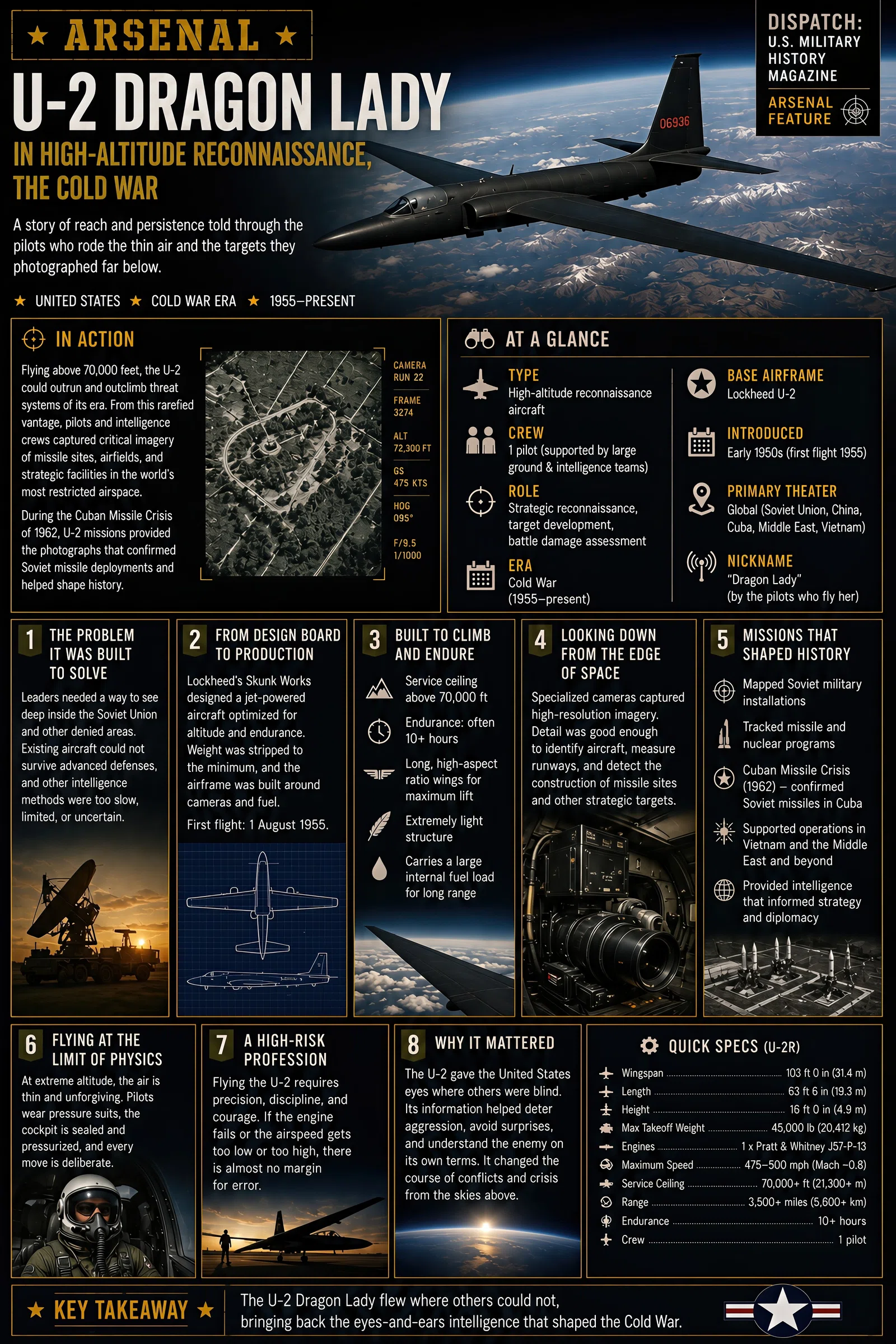
In Action
Dawn over Cuba, October 1962. At a tiny Florida airfield, a pilot in a bulky pressure suit shuffles across the tarmac, more astronaut than airman. Ahead of him, balanced on spindly bicycle landing gear and outrigger pods, the U-2 Dragon Lady already seems to float above the concrete. Ground crew move carefully around the fragile, long-winged aircraft, checking fuel, oxygen, and cameras one last time. This flight will help decide how close the world is to nuclear war.
Climbing out over the sea, the U-2 feels less like a jet and more like a glider that happens to roar. The pilot watches the altimeter unwind upward past sixty thousand feet, then seventy, until the sky deepens toward indigo and the horizon curves. The cockpit is cramped, his suit stiff, and every movement is deliberate. Outside, the air is so thin that a small change in speed could mean a stall on one side or overspeed on the other.
Far below, Cuba slides beneath the nose: roads, fields, rail lines, and then the sharp-edged geometry of missile sites under construction. Inside the fuselage, cameras quietly click and whir, capturing frame after frame on long reels of film. The pilot knows enemy radars are probing for him and that surface-to-air missiles now have the reach to threaten even this rarefied altitude. He follows his precise track line anyway. When he turns for home, he carries evidence that will shape diplomacy, strategy, and the U-2’s reputation as the airplane that looked straight into the heart of the Cold War.
The Problem It Was Built To Solve
The U-2 was born from a simple, dangerous question: what is happening deep inside the Soviet Union and other closed societies, and how can the United States know in time to act? In the first decade of the nuclear age, strategic planners worried about bomber bases, missile fields, and nuclear storage sites that existing intelligence methods could not reliably find or track. Maps were outdated, human agents could see only a few streets or a single factory, and traditional reconnaissance aircraft could rarely survive long enough inside hostile airspace to bring back useful photographs.
By the early 1950s, radar-directed fighters and anti-aircraft guns made low and medium altitude penetration increasingly suicidal. Yet satellites were still on the drawing board, and political leaders needed hard evidence, not guesswork, to make choices about deterrence, arms production, and crisis management. The result was a demand for an aircraft that could fly far higher than any interceptor, stay there long enough to survey wide swaths of territory, and bring home film with the resolution to count aircraft, measure runways, and spot the shadow of a missile.
Engineers and intelligence officers converged on the same answer: go above the reach of most defenses, strip weight to the minimum, and use the thinnest possible wings to ride a part of the atmosphere no one had exploited before. The United States intelligence community, working closely with the United States, set out to build a jet-powered camera platform that was essentially a powered sailplane, optimized not for speed or maneuverability but for ceiling and endurance. That decision would lead directly to the U-2: a frail-looking but formidable tool designed to solve the most pressing strategic reconnaissance problem of the Cold War.
From Design Board To Production
The U-2 began as a sketch on a Lockheed designer’s drawing board, an idea that looked almost too simple: a jet engine grafted to a soaring sailplane wing. In the early 1950s, the Central Intelligence Agency and the United States turned to Lockheed’s Skunk Works team to make that sketch real under intense secrecy and even more intense time pressure. Engineer Clarence “Kelly” Johnson and his small group of specialists traded almost everything in a conventional fighter for altitude and endurance. Armor, heavy structure, even landing gear strength gave way to lightness and lift. The result was an aircraft that looked fragile on the ground but unmatched at seventy thousand feet.
Development moved at a pace that would be unthinkable for a modern program. From contract to first flight took only months, with prototypes assembled in a remote Nevada test site carved out of the desert for the purpose. The team accepted a series of deliberate compromises: a single engine with no backup, a spindly bicycle landing gear that demanded perfect handling, wings so long they flexed visibly under load. The airplane was built around its cameras and fuel tanks, everything else subordinated to keeping it high and on station as long as possible.
At a glance, the U-2 was a single-seat, high-altitude reconnaissance aircraft of the United States, operated first by the Central Intelligence Agency and the United States during the Cold War. One pilot sat alone in a pressurized cockpit while a large ground and intelligence team supported each mission. Its primary capability was long-range photographic reconnaissance, with cameras capable of resolving small objects from extreme altitude. Typical performance included cruising altitudes above seventy thousand feet, speeds in the high subsonic range, and mission lengths measured in many hours rather than minutes. Built in relatively small numbers, it was never meant to be common. Instead, it was meant to be irreplaceable wherever the United States needed to see deep into denied airspace.
Inside The Weapon
Seen up close on the ramp, the U-2 does not look like a Cold War titan. The fuselage is narrow, the nose long and pointed, and the wings stretch so far that ground crew fit temporary “pogo” wheels near the tips just to keep them off the concrete. Under the belly, camera bays and sensor housings dominate the shape, while the tall, single fin at the tail keeps the whole machine in line through the thin air where it lives. The bicycle landing gear, with one wheel ahead of the other instead of a wide pair under the wings, makes the Dragon Lady wobble and sway as she taxis, more like a tightrope walker than a modern jet.
Inside, the cockpit feels more like a capsule than a comfortable flight deck. Early-model U-2 pilots climbed in wearing full-pressure suits similar to those used by astronauts, complete with gloves, helmet, and their own life-support system. Instrument panels were packed but straightforward, with altimeter, airspeed, attitude indicators, and engine gauges sharing space with navigation and camera controls. Once strapped in, the pilot’s movement was limited. Every switch throw and dial adjustment required deliberate, often awkward motions in bulky gloves. Communication with the ground and tanker aircraft flowed through radios mounted above and around him, with mission control and intelligence staff following every stage of the flight from far below.
The main camera bay sat behind the cockpit, housing large-format optical cameras pointed through carefully designed windows in the fuselage. Technicians loaded long rolls of high-resolution film before each mission, sealing panels and checking heaters and stabilizers that kept the cameras aligned and the film from cracking in the cold. Over time, new sensors joined the cameras: side-looking radar for all-weather imaging, electronic intelligence receivers to map enemy radar networks, and other classified packages. The engine, buried in the fuselage with intakes along the sides, pushed the aircraft to altitude and then loafed there, sipping fuel to keep the Dragon Lady aloft hour after hour.
Living with the U-2 meant accepting that flying it was a team effort even if only one person rode inside. Ground crews fueled, armed with film, and inspected the delicate airframe, then chased the aircraft down the runway in trucks when it landed, ready to catch a wingtip before it struck the ground. Intelligence officers and photo interpreters waited for the film, eager to turn the ghostly images into briefings and maps. For the pilot, long missions brought physical strain and mental isolation: managing the “coffin corner” where stall and overspeed lived uncomfortably close together, coping with pressure suit fatigue, and knowing that a single mistake or unseen missile could end both mission and life. Yet many described the view as unforgettable, with entire countries spread beneath a dark sky, and the knowledge that the pictures they brought home could help prevent a war.
Baptism Of Fire
From the beginning, the U-2’s “combat” was fought with lenses and film instead of guns and missiles. Its baptism of fire came in the late 1950s, when the first operational sorties crossed deep into Soviet airspace from airfields on the edges of Europe and Asia. Pilots flew alone over factory towns, bomber bases, naval yards, and missile test ranges that Western planners had only seen as vague patches on old maps. On those early missions, enemy fighters clawed upwards but rarely got close. Radar plots showed desperate interceptions stalling out miles below the Dragon Lady’s thin contrail, and for a time it seemed altitude alone might be enough to guarantee safety.
That illusion ended on a May morning in 1960, when Francis Gary Powers took off from Pakistan on a long track planned to cross some of the most sensitive territory in the Soviet Union. High overhead, the U-2 still seemed untouchable, but surface-to-air missile batteries had evolved. Near Sverdlovsk, a salvo of missiles rose to meet the intruder. On the ground, witnesses saw white streaks slash the sky; in the cockpit, Powers felt the aircraft shudder and break apart as a warhead detonated nearby. He survived, but the U-2’s cloak of invisibility did not. The resulting diplomatic crisis exposed the program to the world, humiliated political leaders, and forced a pause while strategy and tactics were reconsidered.
Yet the Dragon Lady’s story did not end there. Two years later, the aircraft’s cameras revealed Soviet missile sites under construction in Cuba, providing the hard proof that framed the Cuban Missile Crisis. Daily flights tracked new launchers, support equipment, and camouflaged bunkers as the standoff sharpened. Commanders used that information to calibrate pressure and avoid miscalculation, while Soviet crews did their best to conceal, move, and harden their assets. The U-2’s baptism of fire thus stretched from the invisible battles over the Soviet Union to the razor’s edge confrontation over Cuba, proving that photographs could be as decisive as bombs in shaping the course of the Cold War.
Strengths And Weaknesses
Crews and commanders valued the U-2 for one overwhelming strength: the ability to see what no one else could. Its high altitude and long endurance made it possible to map vast complexes, track construction over time, and monitor troop movements and missile deployments with a clarity that reshaped intelligence estimates. For pilots, there was pride in mastering an aircraft that demanded finesse. When everything went right, a U-2 mission felt like riding the border between sky and space, bringing home pictures that would brief presidents and prime ministers instead of a single squadron commander.
Those same qualities came with heavy costs. The Dragon Lady was notoriously unforgiving to fly, especially near its operational ceiling, where the margin between stall and overspeed was razor-thin. Landings could be treacherous, with gusts, crosswinds, and the bicycle landing gear conspiring to punish small errors. Ground crews wrestled with the aircraft’s delicate structure, long wings, and complex sensor packages, all of which required careful handling and meticulous maintenance. A single mishandled panel or loose connector could ruin an entire mission’s worth of film or cripple a delicate sensor.
Enemy forces learned to exploit the U-2’s weaknesses. Surface-to-air missiles grew more capable, radar networks more dense, and political tolerance for manned overflights more limited. The aircraft had no real ability to defend itself beyond staying high and on track. Compared with faster reconnaissance aircraft that followed, such as high-speed strategic jets, the U-2 relied on altitude rather than speed to stay alive. Satellites eventually took over some of its missions, offering global coverage without risking a pilot or causing an international incident when detected. Yet even as those rivals matured, the Dragon Lady remained valuable for its flexibility, ability to be retasked quickly, and the simple fact that it could loiter for hours over an area of interest, building a deep picture rather than a single snapshot.
Variants And Evolution
Over the decades, the U-2 evolved from a single-purpose film camera platform into a family of reconnaissance aircraft adapted to changing technologies and missions. Early versions focused on high-resolution photography, carrying large cameras that exposed long rolls of film to capture industrial complexes, airfields, and missile sites. As adversary defenses improved and political sensitivities grew, engineers worked to increase range, payload, and survivability without sacrificing altitude. New models featured stretched fuselages, stronger structures, and more powerful engines to lift heavier sensor suites and more fuel.
Sensor technology transformed the Dragon Lady even more than airframe changes. Film cameras were joined, and eventually supplemented, by electro-optical systems that could transmit imagery in near real time, synthetic aperture radar that could see through clouds and darkness, and electronic intelligence receivers that mapped radar and communication networks. Modular bays under the fuselage and along the sides allowed different payloads to be swapped in depending on the mission: strategic survey, battlefield awareness, or specialized collection. Pilots still flew alone, but the aircraft became the visible tip of a much larger intelligence system spread across ground stations, analysts, and data archives.
The U-2’s evolution also extended beyond traditional military reconnaissance. Some airframes were adapted for atmospheric research, sampling high-altitude winds and particles, while others tested new sensors or communication systems that later migrated to satellites and unmanned platforms. Throughout these changes, one thread remained constant: the basic airframe continued to do what it was designed to do in the 1950s, climb higher than almost anything else with wings and stay there long enough to bring back information no one could get any other way.
Legacy And Where To See It Today
The U-2 Dragon Lady’s legacy reaches far beyond its spindly landing gear and long black wings. Strategically, it helped bridge the dangerous gap between ignorance and overreaction in the early nuclear age, replacing rumor and worst-case assumptions with detailed photographs and measured assessments. Its flights informed decisions about bomber production, missile deployment, arms control negotiations, and crisis management from the Cold War through later regional confrontations. Doctrine for strategic reconnaissance, both manned and unmanned, owes much to lessons learned about planning, risk, and the value of persistence that came from U-2 operations.
In technological terms, the Dragon Lady helped pave the way for modern satellites and high-altitude unmanned aircraft by demonstrating what long-endurance, high-altitude platforms could achieve. Concepts such as modular sensor payloads, global basing, and rapid retasking across theaters carried forward into newer systems. Even as other aircraft and space-based systems took over many missions, the U-2 remained stubbornly current, upgraded with new sensors and avionics instead of being retired quietly. Its continued service well into the twenty-first century stands as a testament to the soundness of its original concept and the willingness of engineers and crews to adapt it to new demands.
For those who want to see a Dragon Lady in person, preserved airframes rest in air and space museums across the United States and abroad. Visitors can stand beneath those long wings at national aviation museums, Cold War galleries, and base heritage parks, imagining what it was like to strap into a pressure suit and ride the edge of space. Photographs and video, including material from Trackpads and related Dispatch features, show the aircraft in flight and on the ground, connecting static displays to living memories. The U-2’s story also intersects with other Dispatch strands, from Beyond the Call narratives about Cold War reconnaissance to Living History interviews with pilots, maintainers, and intelligence analysts who worked with its imagery. Behind every Dragon Lady were crews, opponents, and decision makers whose lives and choices were shaped by what its cameras saw when nothing else could look that far.